IAO 2004, Всички кръгове — Задача 4. α4. Moon
IX International Astronomy Olympiad · 1 октомври 2004 г.
Внимание: Бележка към темата
Old photocopy scan. Two short passages of the official solutions are lost where the photocopied pages join (problem 4 between pages 4 and 5, the Sunrise solution between pages 13 and 14). The sky maps of the observational round are not in the archive file.
Условие
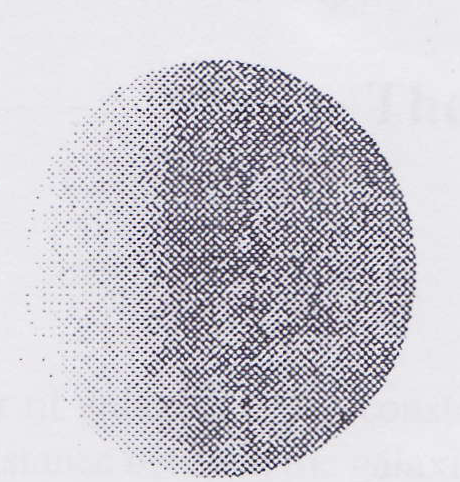
Yesterday during the observation round you saw the moon. Sometimes there were no clouds. Imagine that at the same time the moon was observed by school children on mountain Koshka (which means “cat” in Russian) (branch of the Crimean Astrophysical Observatory). The objective diameter of the telescope-refractor used is cm and its focal length is cm. There was a photographic plate in the focal plane of the objective. Draw in actual size the image (with the main details), which appeared on the photographic plate after it had been developed. The direction “top” in your picture should coincide with the direction “top” on the photographic plate. All calculations necessary for the correct solution should be shown.
Отговори
27.5 mm
Diameter of the Moon's image on the plate; the image is a reversed negative of the waning Moon aged about 19 days.
Решение
A reversed image of the waning moon in the age of approximately 19 days will be on the photographic plate after the development. Just this image should be in the solution (with the main parts of the surface of the moon). There is a negative image on the photographic plate. so the light parts of the surface of the moon have to be drawn dark. As it is required to draw [illegible: the rest of this sentence is missing where pages 4 and 5 of the photocopy join] focal plane at the distance of 3048 mm from the lens and the distance between the points is the diameter of the image in the focal plane of the objective. So from the drawn triangle we have:
but β should be in radians (that is, non-dimensional values):
The figure should be approximately such as:
Group α, theoretical round
Data from the “Table of planetary data” may be used for the solving of every problem.
And the White Bear and Penguin are waiting for you on the practical round.
Group β, theoretical round
Data from the “Table of planetary data” may be used for the solving of every problem.
And the White Bear and Penguin are waiting for you in the practical round.
Parameters of orbits. Physical characteristics of some planets, Moon and Sun
Элементы орбит. Физические характеристики некоторых планет, Луны и Солнца
| Body, planet | Average distance to central body, in astr. units | Average distance to central body, in mln. km | Sidereal (or analogous) period, in trop. years | Sidereal (or analogous) period, in days | Eccentricity e | Equat. diameter, km | Mass, kg | Av. density, g/cm | Grav. acceler. at surf., m/s | Max. magn. from Earth **) | Albedo |
|---|---|---|---|---|---|---|---|---|---|---|---|
| Солнце Sun | 1392000 | 1989000 | 1,409 | ||||||||
| Меркурий Mercury | 0,387 | 57,9 | 0,241 | 87,97 | 0,206 | 4 879 | 0,3302 | 5,43 | 3,70 | 0,06 | |
| Венера Venus | 0,723 | 108,2 | 0,615 | 224,70 | 0,007 | 12 104 | 4,8690 | 5,24 | 8,87 | 0,78 | |
| Земля Earth | 1,000 | 149,6 | 1,000 | 365,26 | 0,017 | 12 756 | 5,9742 | 5,515 | 9,81 | 0,36 | |
| Луна Moon | 0,00257 | 0,38440 | 0,0748 | 27,3217 | 0,055 | 3 475 | 0,0735 | 3,34 | 1,62 | 0,07 |
**) Для внешних планет и Луны – в среднем противостоянии.
**) For outer planets and Moon – in mean opposition.
Оригинал в Архива: iao2004.pdf