IAO 2004, Всички кръгове — Задача 5. α5. Cats in space
IX International Astronomy Olympiad · 1 октомври 2004 г.
Внимание: Бележка към темата
Old photocopy scan. Two short passages of the official solutions are lost where the photocopied pages join (problem 4 between pages 4 and 5, the Sunrise solution between pages 13 and 14). The sky maps of the observational round are not in the archive file.
Условие
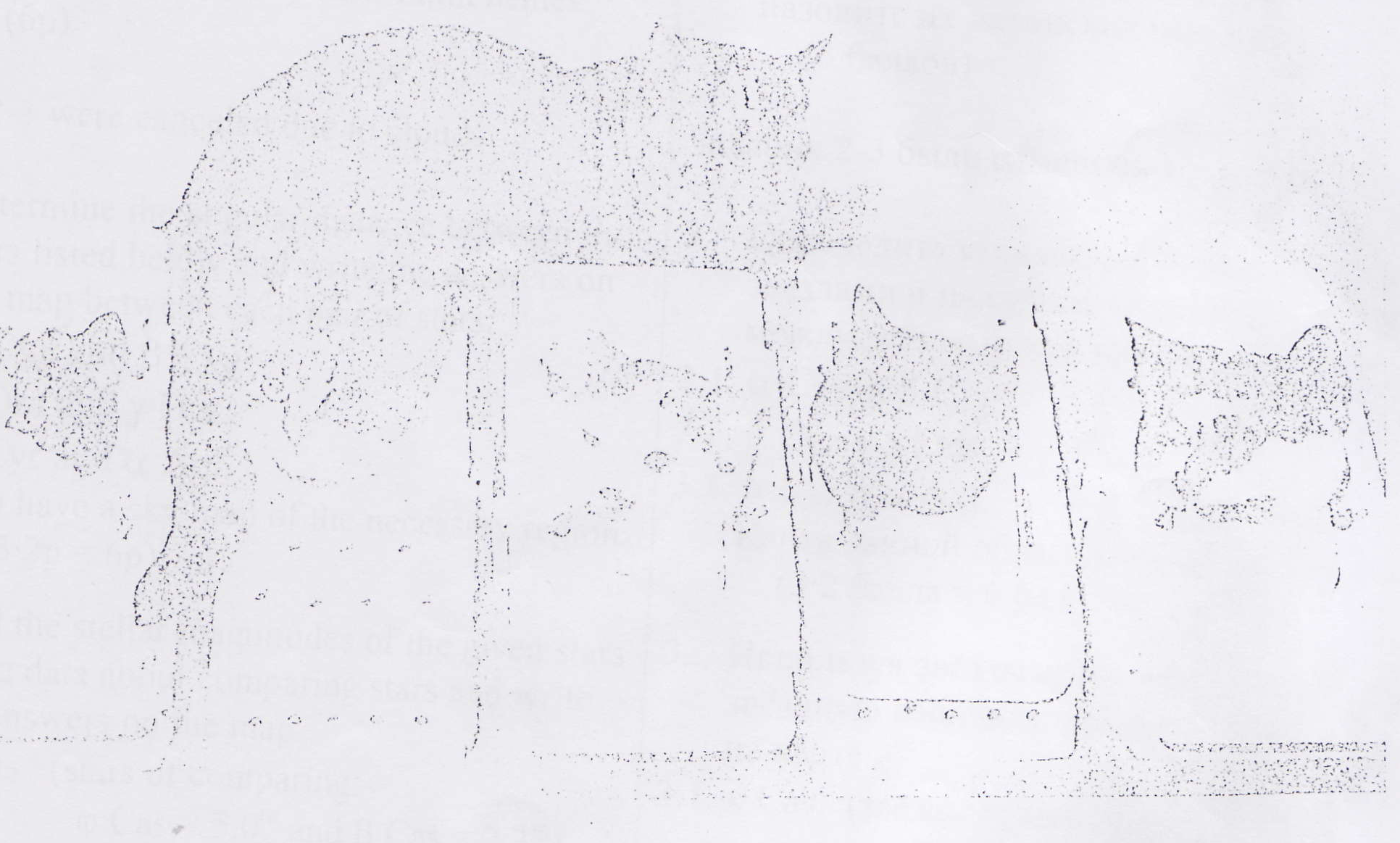
Exactly 47 years ago, on October 4, 1957, the first artificial satellite of the Earth, "Sputnik I", was launched. Soon after animals went to space. At first there were Russian dogs, then American monkeys... And the French government planned to send cats into space, and not simply one or two cats, but a whole crew of 5 cats! You can see the squad of French cat astronauts (five members of the main crew and one doubler (reserved astronaut)) on the photo. In one of the experiments the cats were illuminated by a strong floodlight located on the Eiffel tower and the data were analyzed. The experiments with the doubler located 10 km from Eiffel tower, have shown, that each of its eyes when hit by this floodlight sparkles as a star of (while observed from Eiffel tower).
Calculate approximately the visible stellar magnitude of the total constellation of the eyes of the crew, if the satellite flies above Paris at an altitude of 250 km.
Estimate roughly from what maximum distance the members of the main crew could determine that the light of the eyes of the cat-doubler is not simply a single star but a binary star?
Consider all the crew members and doubler to be identical to each another. The height of the Eiffel tower is m.
Отговори
- About 18m.5; the binary star of the doubler's eyes is resolved from about 200 to 500 meters (≈ 350 m).
Решение
The light from the floodlight reflected from the cat's eyes reaches an observer. The flow of light from the floodlight falling in the cat's eye is inversely proportional to the square of the distance from the floodlight to the cat (), the flow of light from the cat's eye to the observer is also inversely proportional to the square of the distance to it (). Thus, the flow of light returning to the observer after reflection at the cat's eyes, is proportional to . Taking into account that the constellation "the crew of the cats" consists of 10 eyes, and the "laboratory experiment" is conducted with one eye, we receive a difference in flows:
In stellar magnitudes it is
Thus, visible from the Eiffel tower the total stellar magnitude of the crew eyes is
Roughly the distance between the cats' eyes is equal to 5 cm, and resolving power of the eyes maybe twice better than human one, 30 ". The distance from which 5 cm are visible as 30" is equal to
The cats-astronauts quite can see a binary star of eyes of the doubler from such a distance. The right answer for the estimation is: from 200 to 500 meters.
Group α, theoretical round
Data from the “Table of planetary data” may be used for the solving of every problem.
And the White Bear and Penguin are waiting for you on the practical round.
Group β, theoretical round
Data from the “Table of planetary data” may be used for the solving of every problem.
And the White Bear and Penguin are waiting for you in the practical round.
Parameters of orbits. Physical characteristics of some planets, Moon and Sun
Элементы орбит. Физические характеристики некоторых планет, Луны и Солнца
| Body, planet | Average distance to central body, in astr. units | Average distance to central body, in mln. km | Sidereal (or analogous) period, in trop. years | Sidereal (or analogous) period, in days | Eccentricity e | Equat. diameter, km | Mass, kg | Av. density, g/cm | Grav. acceler. at surf., m/s | Max. magn. from Earth **) | Albedo |
|---|---|---|---|---|---|---|---|---|---|---|---|
| Солнце Sun | 1392000 | 1989000 | 1,409 | ||||||||
| Меркурий Mercury | 0,387 | 57,9 | 0,241 | 87,97 | 0,206 | 4 879 | 0,3302 | 5,43 | 3,70 | 0,06 | |
| Венера Venus | 0,723 | 108,2 | 0,615 | 224,70 | 0,007 | 12 104 | 4,8690 | 5,24 | 8,87 | 0,78 | |
| Земля Earth | 1,000 | 149,6 | 1,000 | 365,26 | 0,017 | 12 756 | 5,9742 | 5,515 | 9,81 | 0,36 | |
| Луна Moon | 0,00257 | 0,38440 | 0,0748 | 27,3217 | 0,055 | 3 475 | 0,0735 | 3,34 | 1,62 | 0,07 |
**) Для внешних планет и Луны – в среднем противостоянии.
**) For outer planets and Moon – in mean opposition.
Оригинал в Архива: iao2004.pdf