IAO 2005, Теория, практически тур и наблюдения — Задача 9. β6. Earth transit.
X Международная астрономическая олимпиада · X International Astronomy Olympiad · 25.X. – 2.XI.2005 · Beijing, China · Китай, Пекин · 25 октомври 2005 г. · 8 т.
Внимание: Бележка към темата
This photographed English/Russian mixed-round booklet includes nine distinct theory tasks with native solution sketches, practical αβ7 and β8 without keys, and three bilingual observational tasks without keys. The α practical task 8, planetary data table, observational sky map and refraction drawing grid referenced in the source are absent. The Sun sketch provides only methods and no calculated distance or magnitude. Jury-result companions print 8 points per theory task, 10 per practical task and 20 for the observational round together, with 88 per cohort; those two cohort totals are not a total for this combined 14-task edition. The 12-minute allowance applies only to all observational jobs. Printed source errors are preserved: the Andromeda sketch uses exp(17.1/5)=2630; the α5 magnitude-difference sign is positive; β4 switches to Δα in one sentence; β5 refers to α2; the refraction formula prints 273°; the planetary-nebula question describes an explosion. Native diagram lines and spectrum peaks are faint in the original photograph.
Theoretical round. Problems to solve · General note
Groups α β
General note. Maybe not all problems have correct questions. Some questions (maybe the main question of the problem, maybe one of the subquestions) may have no real sense. In this case you have to write in your answer (in English or Russian): «situation is impossible - ситуация невозможна». Of course, this answer has to be explained numerically or logically.
При решении каждой задачи можно использовать данные прилагаемой “Таблицы данных о планетах”
Data from the “Table of planetary data” may be used for solving every problem.
Theoretical round. Sketches for solutions · Тезисы решений задач теоретического тура
Русский · English
Условие
At November 7, 2005, the Mars opposition will occur. During this event Mars will be situated at from the Earth, being quite close to the ecliptic line ( south of it) as observed from the Earth. For this event the Martian Space Agency is planning the near-Mars space mission with astronauts onboard purposed to observe the Earth transit on the solar disk (at least transit through the edge of the Sun) and to investigate the Earth's atmosphere. What minimum orbital period of motion around Mars must this space station have?
Отговори
- about 13.5 days
Решение
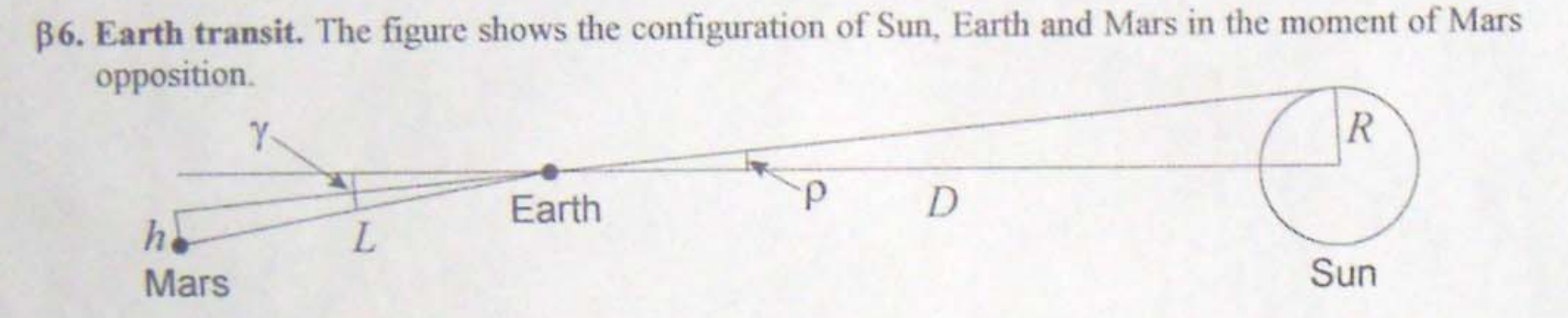
The angular radius of the Sun visible from the Earth is equal to
Here is the radius of the Sun, is the distance between Sun and Earth. Let will be the distance between Earth and Mars. Being observed from the Earth, the angular distance between the Mars and ecliptic line is larger than angular radius of the Sun, thus as can be seen in the figure, there will be no Earth transit on the solar disk observable from Mars, it will be a pity for Martians. To observe it anyway, they have to go by the distance towards the ecliptic plane (northwards). Taking into account that all angles are small and the Earth is many times smaller than the Sun, we will calculate this distance:
To reach the distance required having the minimal orbital period, the Earth transit observation point must be the apocenter of the orbit. The pericenter distance cannot be less than the radius of Mars (about 3400 km). The minimal large semi-axis of the station orbit will be about
This value is 0.296 of the large semi-axis of the Moon orbit around the Earth. Calculating the period, we have to take into account that the mass of the Mars is 0.107 of the mass of the Earth. Using General III Kepler law:
we find that the station orbital period is about 0.49 of the lunar period or 13.5 days. For the mission to be successful, the station must be launched at October, 31, in three days after the theoretical round of X IAO.
Observational round. Problems · Задачи наблюдательного тура · Groups α, β
English
Maximum total time for all jobs is 12 minutes.
Русский
Максимальное время выполнения задания – 12 минут.
Теми и трудност
Оценена трудност: 4/5.
Небесна механика · Светлина и астрономически измервания · Закони на Кеплер · Орбитални елементи · Ъглов размер
Предпоставки: Гимназиална подготовка, Разширена олимпиадна подготовка
Оригинал в Архива: iao2005.pdf · официални решения: iao2005.pdf