IAO 2007, Практически тур, Група α — Задача 7. Лучевая скорость.
Задачи практического тура · 29 септември 2007 г.
Note for jury and team leaders
Note for jury and team leaders. The proposed sketches are not full; the team leaders have to give more detailed explanations for students. But the correct solutions in the students’ papers (enough for 10pts) may be shorter.
Source annotations
The official O−C answer table prints calculated dates47685 and47383 for observations12 and13 respectively; these do not agree with the surrounding cycle sequence or the printed O−C values. The first interval in its final table is printed0–45878.2. All these printed entries are retained without correction.
Язык решений
В архиве предоставлены английские официальные эскизы решений; они сохранены на языке оригинала.
Условие
Вообразите цефеиду, среднее значение видимой звёздной величины которой равно . Спектроскопические наблюдения этой цефеиды были проведены в течение 16 последовательных ночей. Журнал наблюдений приведен в Таблице, где лучевая скорость дана в гелиоцентрической системе координат. Постройте такой график, основываясь на данных приведенных в Таблице, который бы позволил вам определить некоторые важные характеристики этой цефеиды и ответить на вопрос: могла ли эта цефеида наблюдаться на небе первыми людьми на Земле (около 2 миллионов лет назад)? (Ответ нужно написать по-английски: Yes или No.) Какой была ее видимая звездная величина в то время?
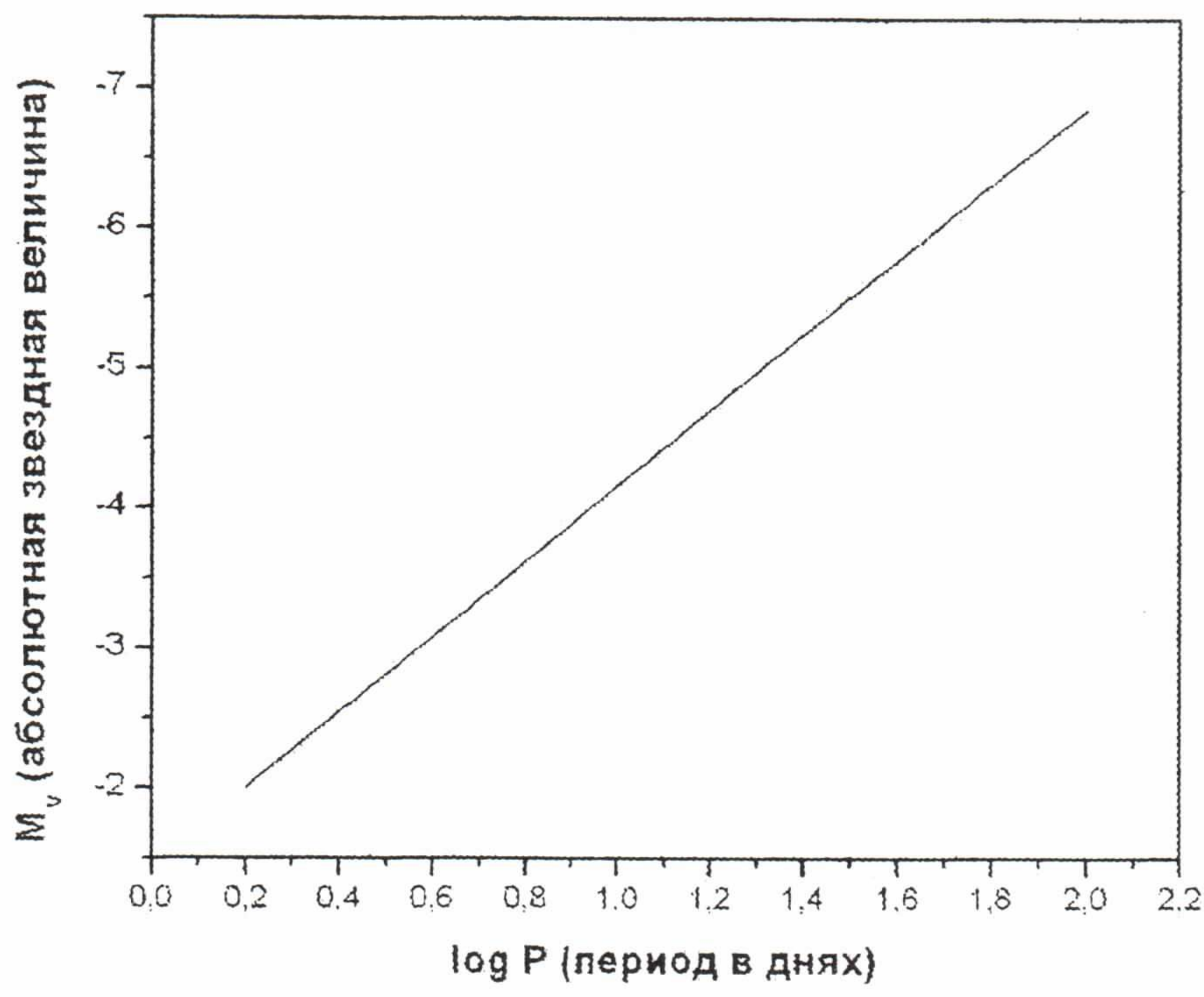
Дополнительная информация. Используйте зависимость, показанную на приложенном графике (эта зависимость применяется для цефеид – пульсирующих звезд).
Рекомендации: межзвездным поглощением и возможным изменением среднего значения светимости цефеиды за 2 млн. лет можно пренебречь.
| Момент наблюдений (в долях суток) | Наблюдаемая лучевая скорость, км/с |
|---|---|
| 0.9 | 75 |
| 1.8 | 74 |
| 2.9 | 51 |
| 3.9 | 45 |
| 4.9 | 67 |
| 5.8 | 75 |
| 6.8 | 63 |
| 7.8 | 46 |
| 8.8 | 47 |
| 8.9 | 50 |
| 9.8 | 70 |
| 10.8 | 70 |
| 11.9 | 53 |
| 12.8 | 42 |
| 13.8 | 42 |
| 14.8 | 58 |
| 15.9 | 75 |
Решение
- Use the data from table to plot heliocentric radial velocity versus time.
- Determine approximately pulsational period of cepheid from the plot ( d).
- Use the given plot to determine the mean absolute magnitude of cepheid ().
- Determine the heliocentric distance of cepheid using the known formula:
(interstellar absorption is ignored). With a given mean apparent magnitude one gets pc.
- Use the plot versus time to find approximate radial velocity of the center of mass of pulsating star (i. e. velocity of its space motion relatively to the Sun).
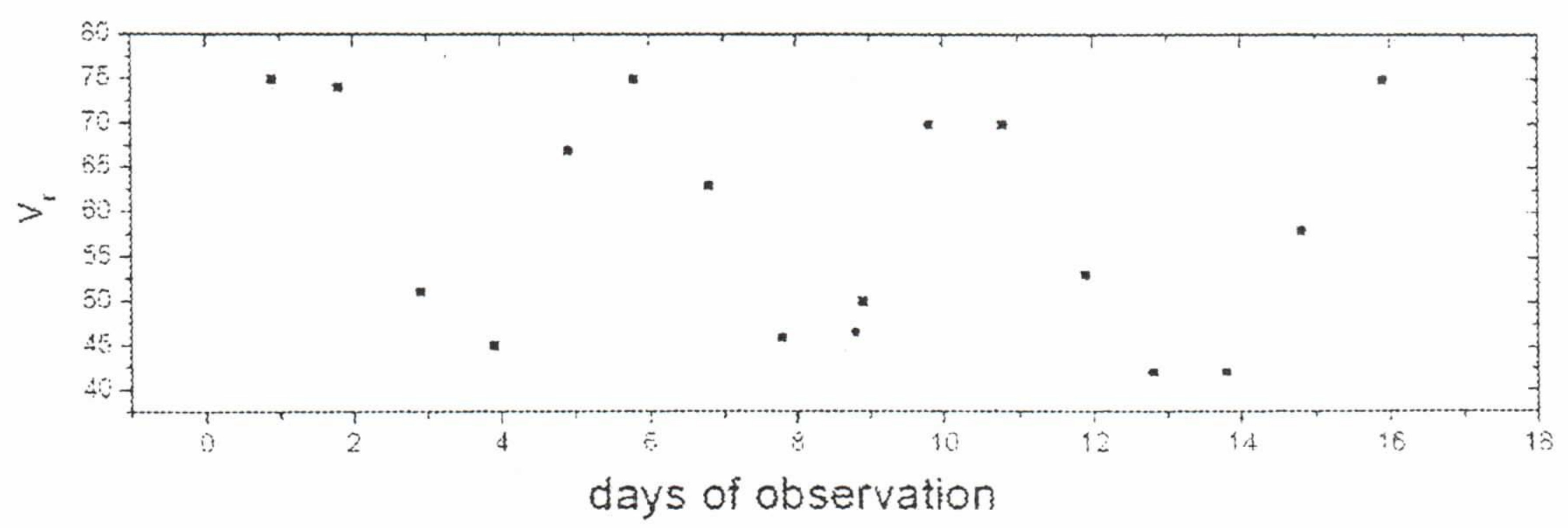
Thus, roughly we can estimate km/s and conclude that our Cepheids recedes from the Sun.
- During 2 million years ( y) the star passed with such a velocity the distance:
Here is the number of second in one years.
2 million years ago our star was 100 pc closer to the Sun than now, thus, its distance was at that time 700 pc. With such a distance its apparent magnitude was:
Here we neglected again the interstellar absorption and possible variations of the absolute magnitude of our cepheid during considered time interval. Thus, we conclude that 2 million year ago the star could be seen.
Оригинал в Архива: alphapract1.jpg · официални решения: practsol1.jpg · допълнителни данни: alphapract2.jpg · допълнителни данни: alphapractdata.jpg · допълнителни данни: practsol2.jpg