IAO 2007, Теория, Група α, английски — Задача 1. Earth and Moon.
Theoretical round. Problems to solve · 29 септември 2007 г.
Бележка
Maybe not all problems have correct questions. Some questions (maybe the main question of the problem, maybe one of the subquestions) may have no real sense. In this case you have to write in your answer (in English or Russian): «situation is impossible – ситуация невозможна». Of course, this answer has to be explained numerically or logically.
Source availability
The numerical table of planetary data is not present in the32-file2007 archive inventory. The file bgtheo6.jpg contains only a translation of column headings, without numerical planetary rows. No table from another year has been substituted. The separately archived airplane/Moon photograph is included in full with question4.
Note for jury and team leaders
The proposed sketches are not full; the team leaders have to give more detailed explanations for students. But the correct solutions in the students’ papers (enough for8pts) may be shorter.
Source photograph damage
The second and fourth official solution photographs lose some initial letters or words at the left edge. Ellipses inside the affected solution text mark those source losses. Legible formulas, results and grading remarks are retained; missing letters have not been silently supplied. The solution for question4 contains no explanatory drawing, although the question requests one.
Printed source annotations
The supplied key’s Moon magnitude calculations and approximate values are retained. The source results and formulas are reproduced without scientific correction; punctuation and multiplication spacing are normalized only for mathematical rendering.
Условие
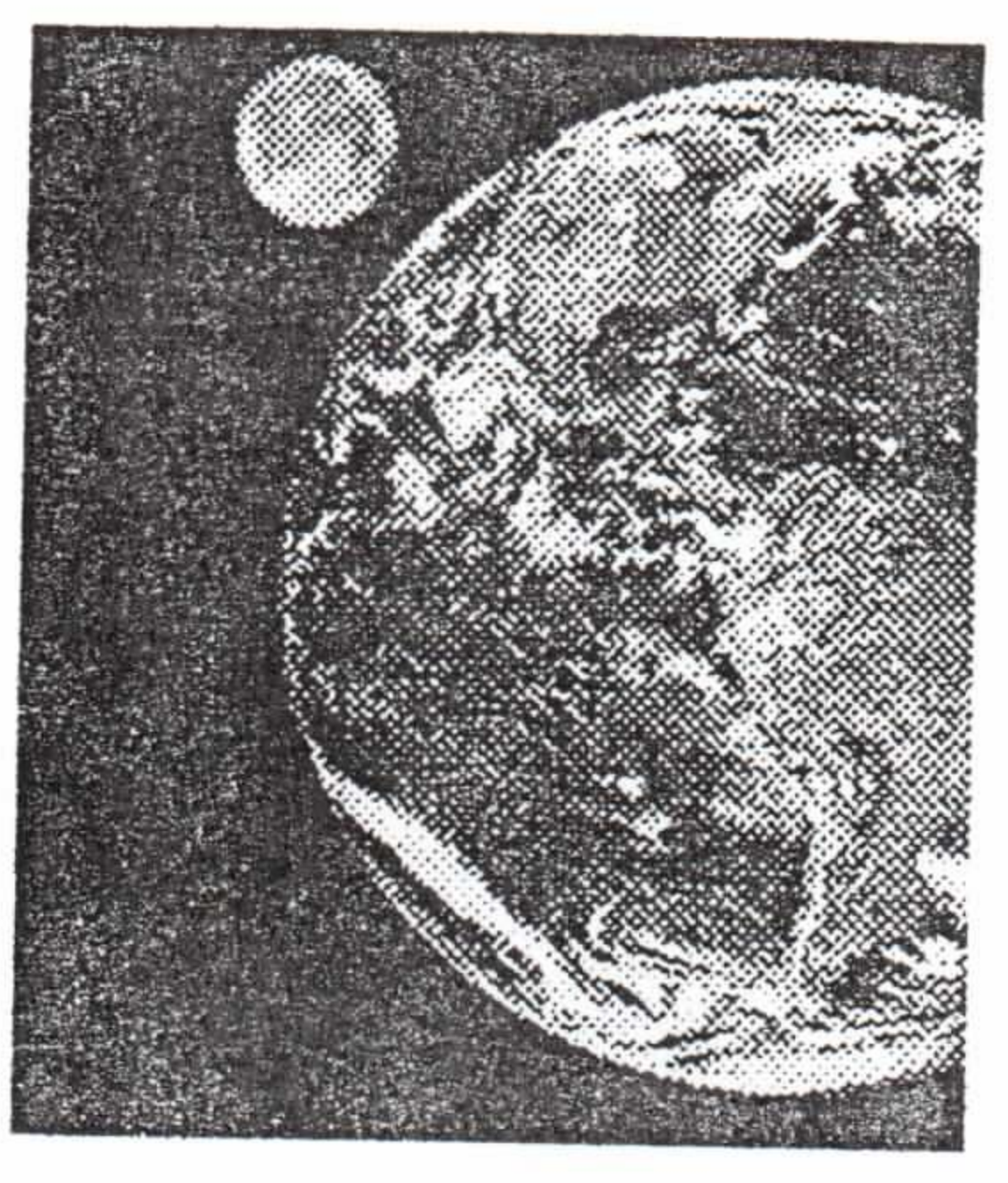
The photo of the Earth and the Moon is taken from an artificial satellite of the Earth. Estimate the stellar magnitude of the Moon for an observer on this satellite.
Решение
Let us find the distance from the satellite to the Moon.
Let , and are angular radii as seen from the satellite, (radii and distances to the Earth (E) and Moon (M)). From the equations
one can find
or
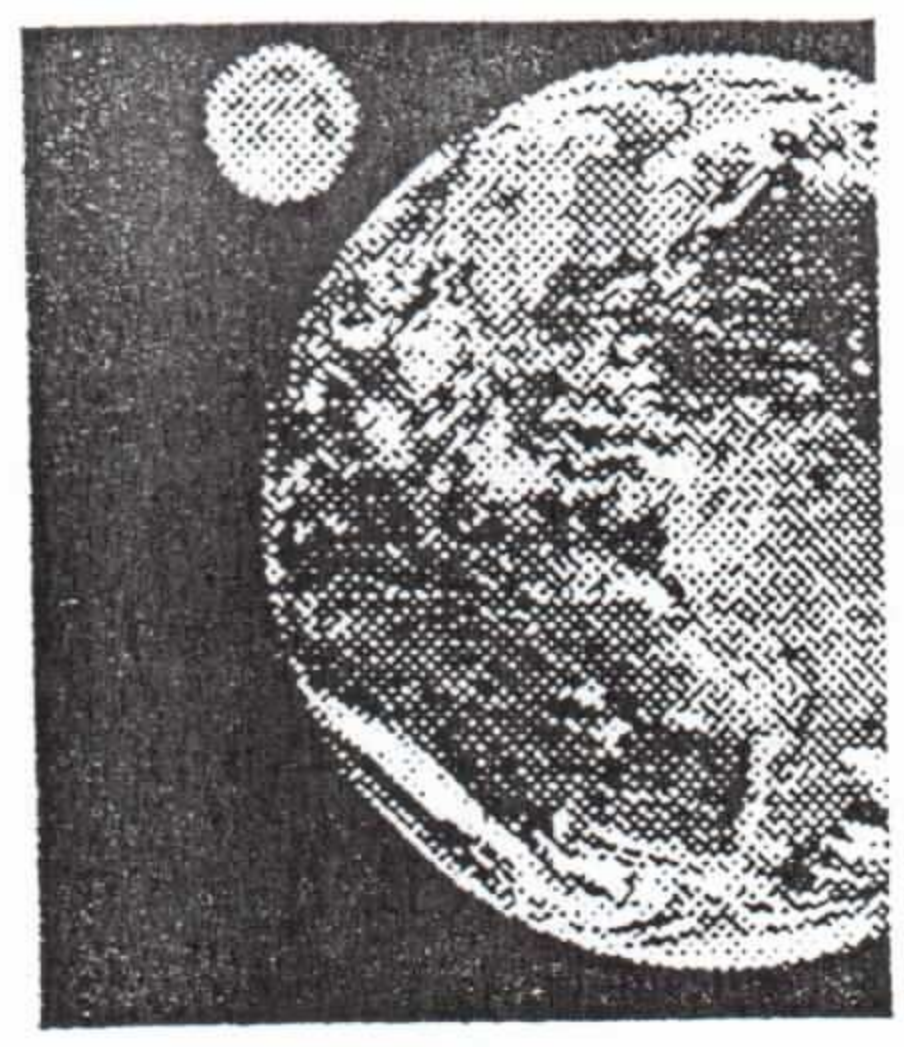
The close positions of the Earth and the Moon on the picture shows us that the satellite, the Earth and the Moon are approximately on one line and therefore we can approximately say
or
where is the distance from the Earth to the Moon.
From the picture we see that for the observer on the satellite the phase of the Moon is full moon. If is the magnitude of the full moon for the observer on the Earth (the distance to the Moon is ), the magnitude for the observer on the satellite is
We may measure values and on the picture and take values , and (and, by the way, ) from the table of the Solar System,
Note 1 for Jury members. Due to difference in printers the scales of the pictures were different in different copies of the pictures. Therefore the values of the lengths may be different from those written here. But the ratios, which are necessary for the solutions, of the lengths should be about the same. Nevertheless the problem is estimational. Measuring of and correct calculations have to result to answers from to .
Note 2 for Jury members. By the way, the short approximate solution that also should be regarded as a full solution (the so called solution in integer values):
After using the formula (or an analogous formula) and calculations we may find that , enlarging distance every 2.5 times (more exactly 2.512) enlarges the magnitude on , so
Data
Data from the table of planetary data may be used for solving every problem.
Оригинал в Архива: alphatheo.jpg · официални решения: theosol1.jpg · допълнителни данни: theosol2.jpg · допълнителни данни: theosol3.jpg · допълнителни данни: theosol4.jpg · допълнителни данни: photo.JPG