IAO 2008, Теория, Група β — Задача 4. Мечешки скок. Началото на XXI век.
XIII Международная астрономическая олимпиада · XIII International Astronomy Olympiad · XIII Olimpiade Internazionale di Astronomia — Италия, Триест, 13 – 21. X. 2008, Trieste, Italia — Round Th, Group α. β. · 13 октомври 2008 г. · 8 т.
Бележка
Maybe not all problems have correct questions. Some questions (maybe the main question of the problem, maybe one of the subquestions) may have no real sense. In this case you have to write in your answer (in English or Russian): «situation is impossible – ситуация невозможна». Of course, this answer has to be explained numerically or logically.
Data from the table of planetary data may be used for solving every problem.
Note for jury and team leaders.
The proposed sketches are not full; the team leaders have to give more detailed explanations for students. But the correct solutions in the students’ papers (enough for 8 pts) may be shorter.
Элементы орбит. Физические характеристики некоторых планет, Луны и Солнца
Parameters of orbits.
Physical characteristics of some planets, Moon and Sun
| Небесное тело, планета / Body, planet | Среднее расстояние от центрального тела / Average distance to central body, астр. ед. / astr. units | Среднее расстояние от центрального тела / Average distance to central body, млн. км / mln. km | Сидерический (или аналогичный) период обращения / Sidereal (or analogous) period, тропич. годах / troph. years | Сидерический (или аналогичный) период обращения / Sidereal (or analogous) period, средних сутках / days | Эксцентриситет / Eccentricity, e | Экваториальн. диаметр / Equat. diameter, km | Масса / Mass, kg | Средняя плотность / Av. density, g/cm³ | Ускор. своб. пад. у пов. / Grav. acceler. at surf., m/s² | Макс. блеск, вид. с Земли / Max. magn. from Earth **) | Альбедо / Albedo |
|---|---|---|---|---|---|---|---|---|---|---|---|
| Солнце / Sun | 1,6·10⁹ | 2,5·10¹¹ | 2,2·10⁸ | 8·10¹⁰ | 1392000 | 1989000 | 1,409 | −26,8ᵐ | |||
| Меркурий / Mercury | 0,387 | 57,9 | 0,241 | 87,97 | 0,206 | 4 879 | 0,3302 | 5,43 | 3,70 | 0,06 | |
| Венера / Venus | 0,723 | 108,2 | 0,615 | 224,70 | 0,007 | 12 104 | 4,8690 | 5,24 | 8,87 | 0,78 | |
| Земля / Earth | 1,000 | 149,6 | 1,000 | 365,26 | 0,017 | 12 756 | 5,9742 | 5,515 | 9,81 | 0,36 | |
| Луна / Moon | 0,00257 | 0,38440 | 0,0748 | 27,3217 | 0,055 | 3 475 | 0,0735 | 3,34 | 1,62 | −12,7ᵐ | 0,07 |
| Марс / Mars | 1,524 | 227,9 | 1,880 | 686,98 | 0,093 | 6 794 | 0,6419 | 3,94 | 3,71 | 0,15 | |
| Юпитер / Jupiter | 5,204 | 778,6 | 11,862 | 4 332,59 | 0,048 | 142 984 | 1899,8 | 1,33 | 24,86 | 0,66 | |
| Сатурн / Saturn | 9,584 | 1433,7 | 29,458 | 10 759,20 | 0,054 | 120 536 | 568,50 | 0,70 | 10,41 | 0,68 |
**) Для Луны – в среднем противостоянии.
**) For Moon – in mean opposition.
Координаты на эпоху 2000
Epoch 2000 coordinates
| α | δ | |
|---|---|---|
| Полярная звезда / Polar star | 2ʰ 31ᵐ 48ˢ.7 | 89° 15′ 51″ |
Условие
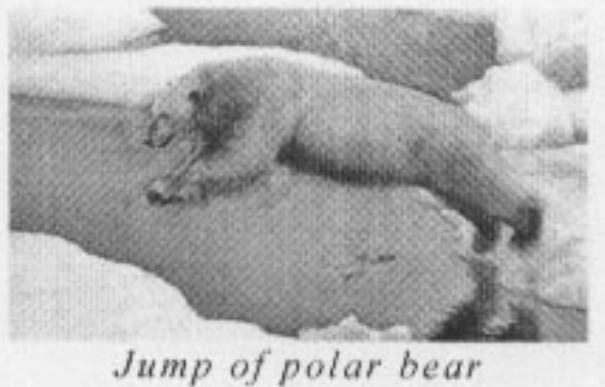
В пътеводителите на остров Шпицберген може да се намери следната фраза: „бялата мечка скача на 8 метра без предупреждение“. Средата на XXVI век. С цел да населят Слънчевата система с фауна, биолозите планират да закарат бели мечки от Шпицберген на ледените астероиди от пояса на Куйпър. Но физиците предупреждават, че някои скокливи мечки могат да станат независими обекти от пояса на Куйпър.
Оценете на астероиди с какви размери (диаметър) могат да се настаняват бели мечки безопасно от гледна точка на физиците. Отговорът трябва да се представи във вид на формула-неравенство.
Отговори
- Official key: D > √(3Lg/(πGρ)) ≈ 35 km, using the first cosmic speed and ice density 900 kg/m³.
Решение
Официална скица на решението, на оригиналния английски език.
Initial jump speed
So, the bear makes a start and flies... On Spitsbergen (that is, on the Earth) the length of jump is equal to
so
here is the initial speed of jump of the bear from the surface, – acceleration of gravity at the Earth. If we consider that this speed is not depend on the angle (in general it is not absolutely true, but we shall use this assumption in our model), the maximum length of jump is reached when ,
So, if m, we may obtain, that speed with which the bear makes a start from the Earth is approximately equal to
Safe asteroid diameter
If this speed will be larger than the second cosmic speed for the asteroid, the bear will depart and surely become an independent object of the Kuiper belt. The second cosmic speed may be used for the solution. Nevertheless, the first cosmic speed is better in the situation. Even, if this speed will be less the second cosmic speed, but larger than the first cosmic speed, it would be quite uncomfortable for the bear after it has jumped of the surface: it will follow an orbit of suborbital flight during many hours.
The relationship between the first cosmic speed and the size and density of the asteroid is
The first cosmic speed for an asteroid of the Kuiper belt is equal
So
Taking into account that the planned for settling by bears objects of the Kuiper belt consist basically of ice, their characteristic density is about . So we have that the first cosmic speed is equal to for the asteroids with diameter of order
Thus, from the physicists’ point of view it is possible to place polar bears comfortably on ice asteroids with diameters more than about 35 km.
Answer: km.
Бележка върху българския ръкопис
В долната част на листа има отделна ръкописна формула-неравенство за радиуса и бележката „въртене на астероида, възд. съпр.“. Запазена е като източникова бележка, отделно от английското официално решение за диаметъра.

Бележка от източника
No separate detailed rubric or Bulgarian official solution is present in the full year inventory. The English source explicitly supplies sketches, with a general reference to 8 points; all applicable supplied reasoning and jury notes are retained.
Бележка от източника
The Bulgarian sheet includes an additional handwritten radius inequality and rotation/air-resistance note; this is preserved as an annotation, distinct from the official English diameter calculation. The English task includes a bear illustration absent from the Bulgarian manuscript; it is supplied with explicit attribution.
Оригинал в Архива: betatheobg4.pdf · официални решения: theosol.pdf · допълнителни данни: betatheo.pdf · допълнителни данни: IAO2008-data.pdf