IAO 2009, Практически тур, Група α — Задача 6. Motion of a planet
Practical round. Problems to solve · 8 ноември 2009 г.
Условие
Most of the time, planets move from west to east relative to the background stars. Occasionally, however, they change direction and temporarily undergo retrograde motion. After a few weeks, the direction is changed again. The apparent motion of a planet was observed in Hangzhou this year. Table 1 lists the values of the 24 hour angular displacement of the planet relative to the background stars (simplified as ADRS) on the day that the observation was made. Modified Julian Day (MJD = JD − 2400000.5) are used for the dates. Minus means the direction is from east to west.
6.1.
Find the date (MJD) when the planet is at stationary point (simplified as STP) and at opposition (simplified as OPP) graphically, respectively. Accurate to one day. Write your answer in table 2.
6.2.
What's the value of 24 hour angular displacement of the planet per day when it is at opposition? Write your answer in table 2.
6.3.
On the basis of the result of question 2, estimate the radius of the planet's orbit in astronomical units. Suppose the orbit of Earth and the planet are both circular and the planet is in ecliptic plane.
Table 1
| Modified Julian Day | ADRS (degrees/day) |
|---|---|
| 54944 | 0.15 |
| 54965 | 0.1 |
| 54975 | 0.07 |
| 54989 | 0.03 |
| 55001 | -0.01 |
| 55014 | -0.05 |
| 55020 | -0.07 |
| 55032 | -0.1 |
| 55043 | -0.12 |
| 55055 | -0.13 |
| 55062 | -0.13 |
| 55074 | -0.12 |
| 55084 | -0.1 |
| 55092 | -0.08 |
| 55099 | -0.06 |
| 55109 | -0.03 |
| 55121 | 0.01 |
| 55133 | 0.05 |
Table 2
| MJD of STP | MJD of OPP | ADRS on the day of OPP |
|---|---|---|
Решение
1)
The plotted figure is shown as below.
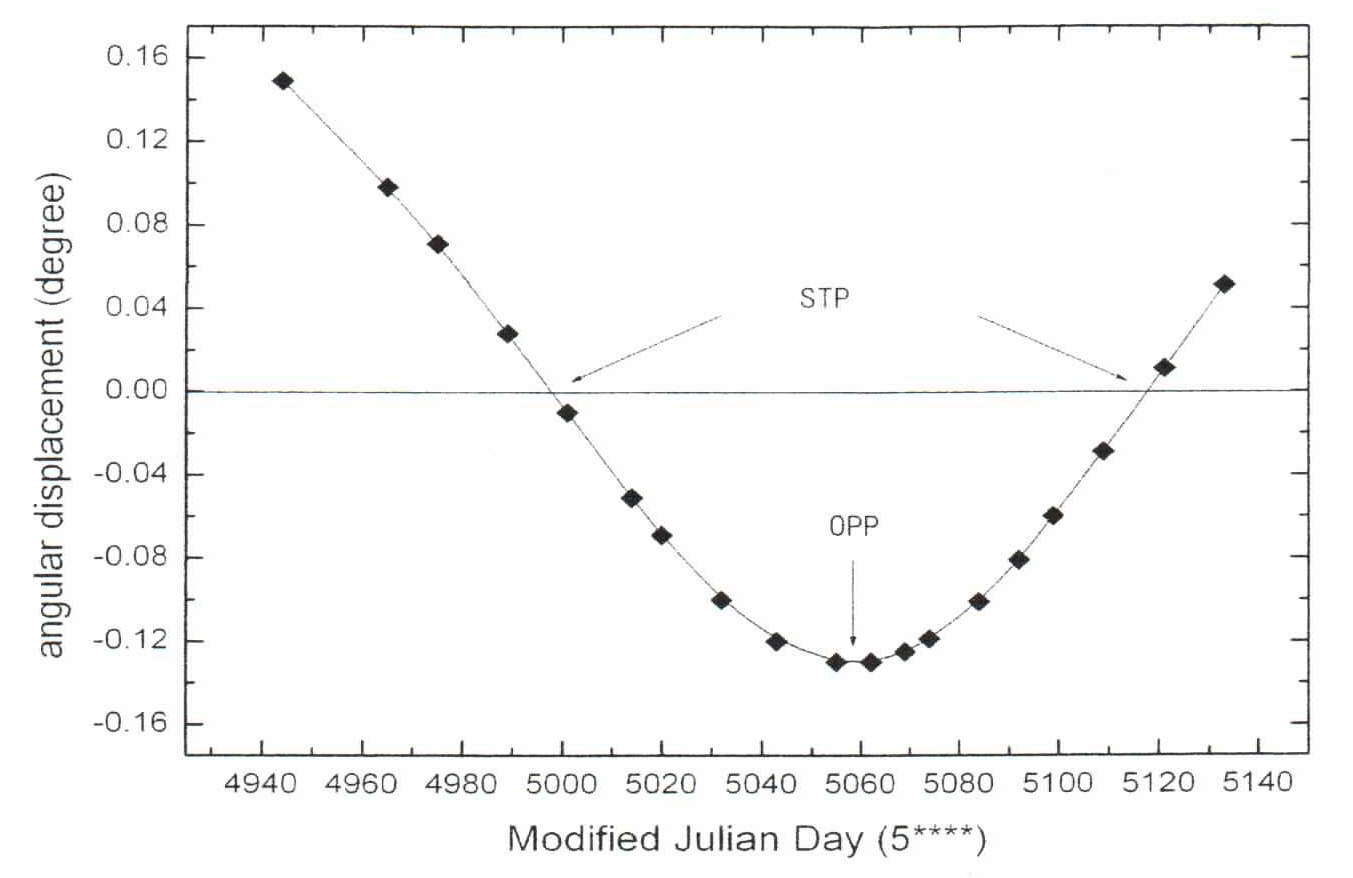
At stationary points, the planet's angular displacement is zero. It's easy to find the two days of stationary points: MJD 54998 and MJD 55118.
From one stationary point to another, the opposition of the planet happens when the angular displacement of the planet relative to the background stars peaks. The date can be read out through figure 1: MJD 55058, i.e. the lowest point of figure 1.
2)
The angular displacement on MJD 55058 is about .
| MJD of STP | MJD of OPP | ADRS on the day of OPP |
|---|---|---|
| & |
3)
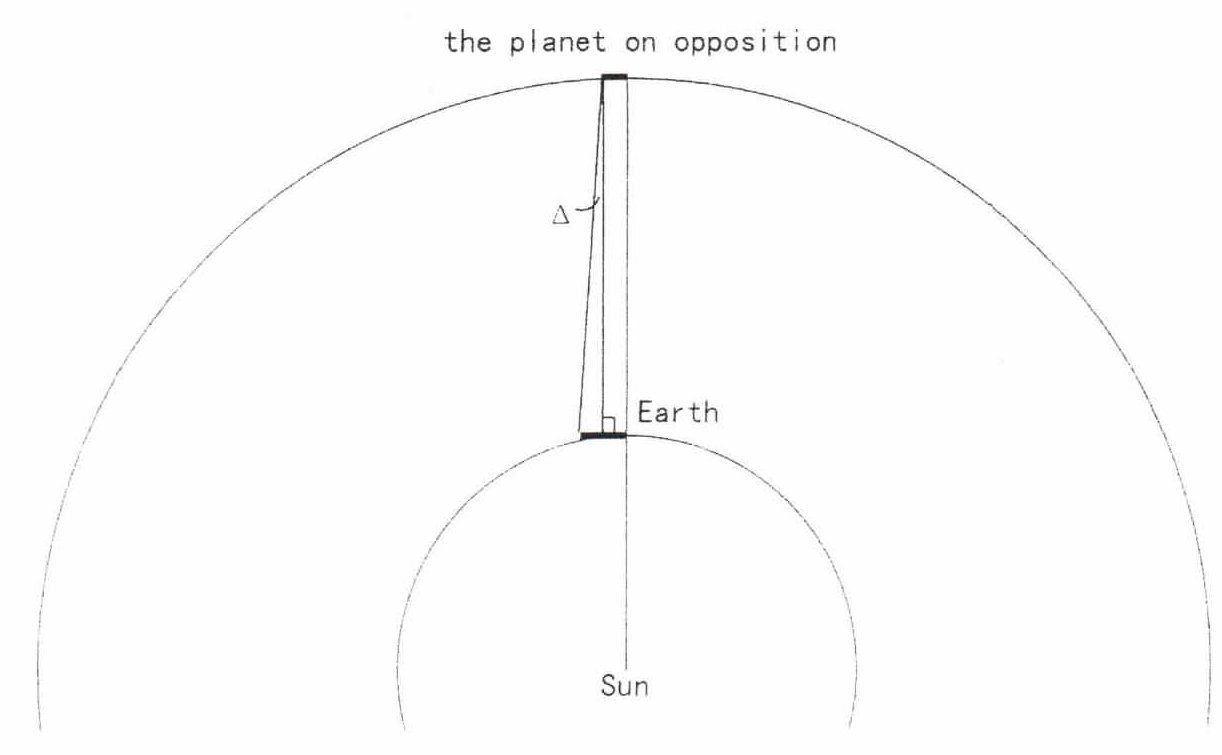
As shown in the figure above, when the planet is on opposition:
where and are the orbital speed and radius, is a short time interval from the moment of opposition. If we set the value of to one day, since (the value of is found from figure 1), (1) can be rewritten as:
According to Kepler's Law:
and
Substitute the value of into (2) and (3), we can find that:
where , . Thus, , .
Оригинал в Архива: 6alphapract.jpg · официални решения: practsol1.jpg · допълнителни данни: practsol2.jpg