IAO 2013, Практически тур, Група α — Задача 7. Asteroid
XVIII International Astronomy Olympiad — Vilnius, Lithuania, 6–14.IX.2013 — Practical round. Problems to solve · 6 септември 2013 г.
Условие
Analysis of observations of a near earth asteroid.
Astronomers of two observatories, which are located at a distance of 3172 km from each other, took CCD images of a certain region of the sky for the search of a near earth asteroid. Two images were obtained by Observatory 1 during the same night at UT and at UT. These images (negatives) are shown in Figs. 7.1 and 7.2, respectively. The next two images obtained on the same night were made at Observatory 1 .and Observatory 2 simultaneously. These images (negatives) are shown in Figs. 7.3 and 7.4. The scale of all the images is the same as shown in Fig. 7.1.
Note: You are provided a transparency for measurements of angular displacements of the asteroid.
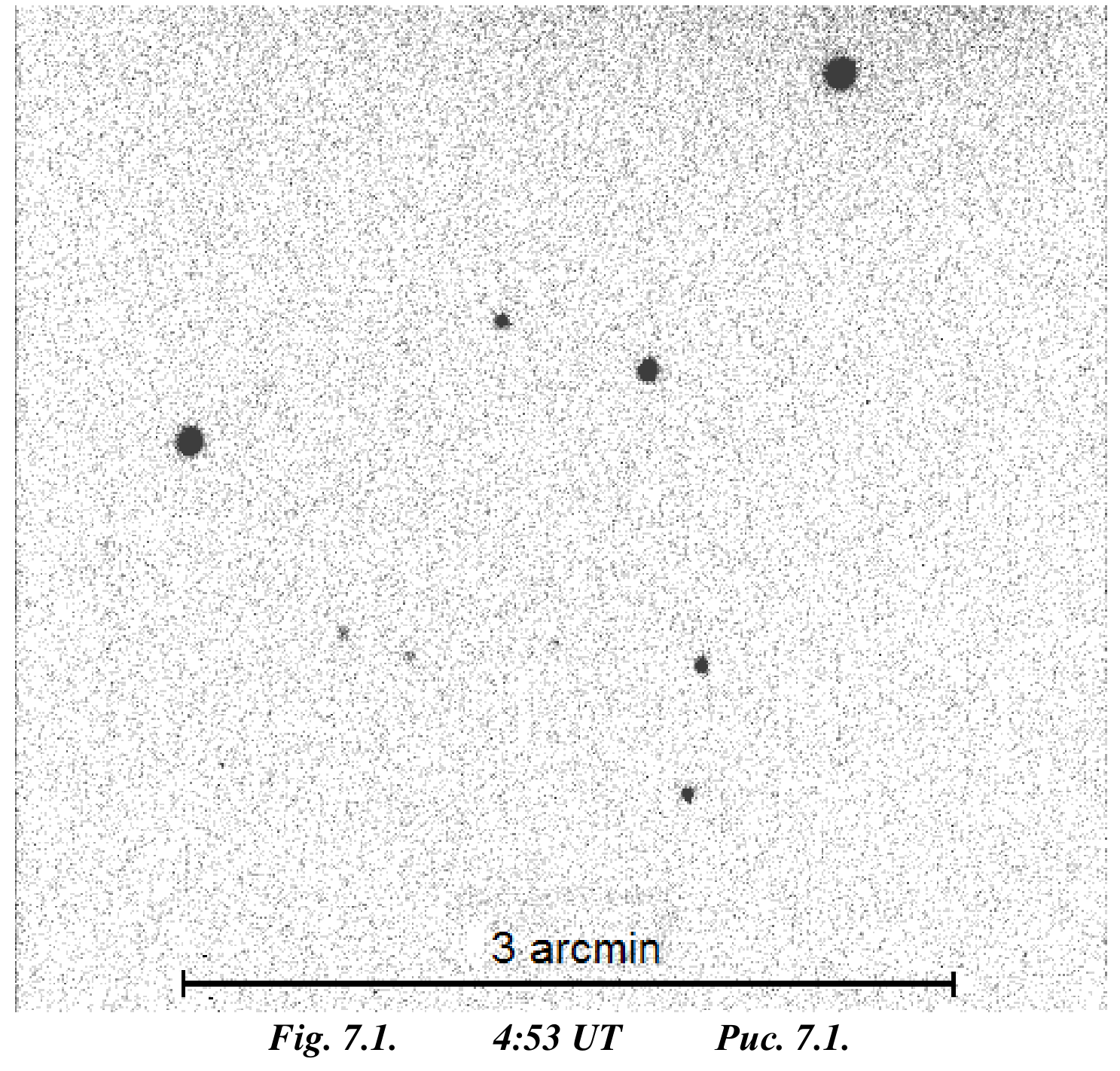
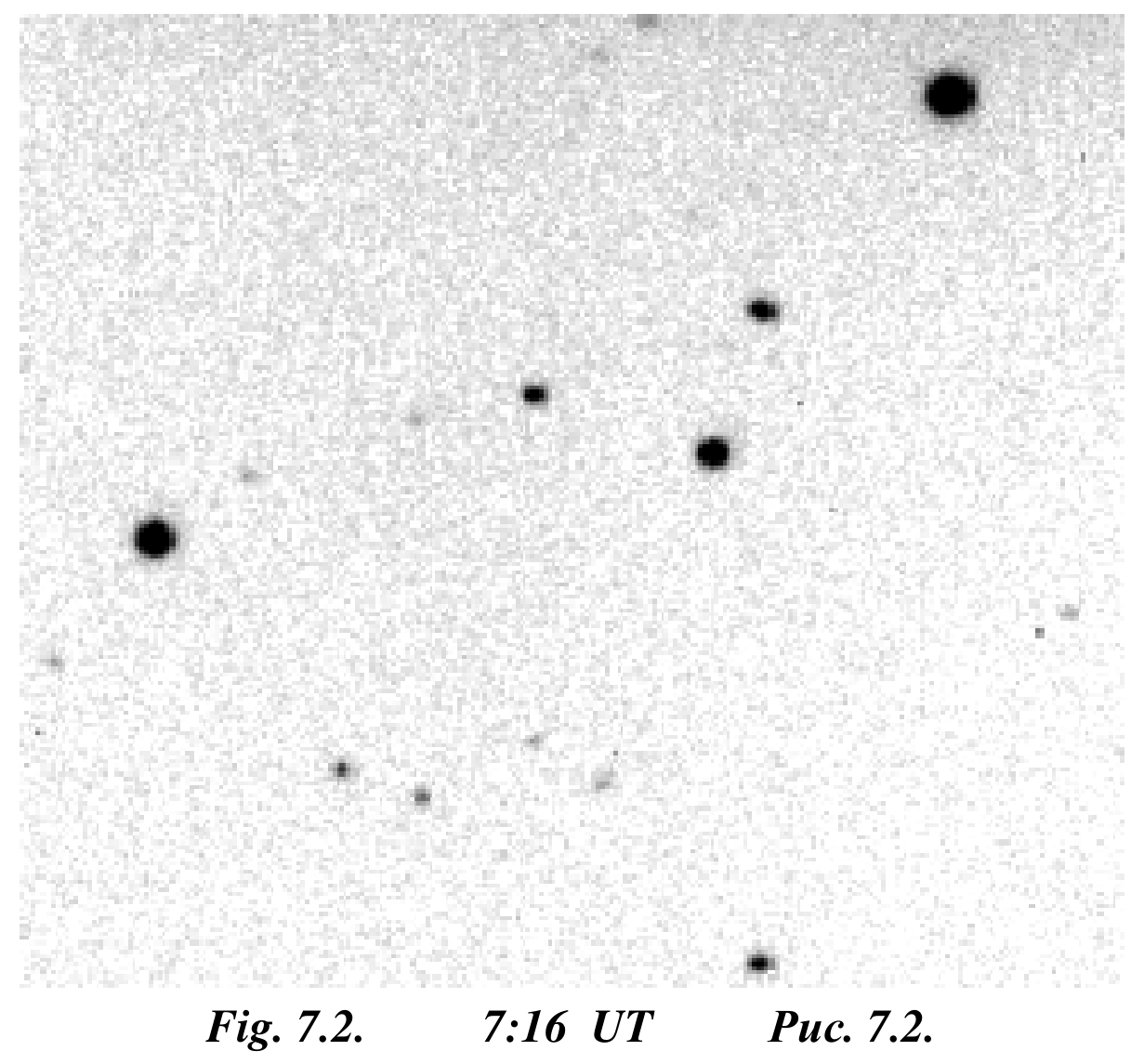
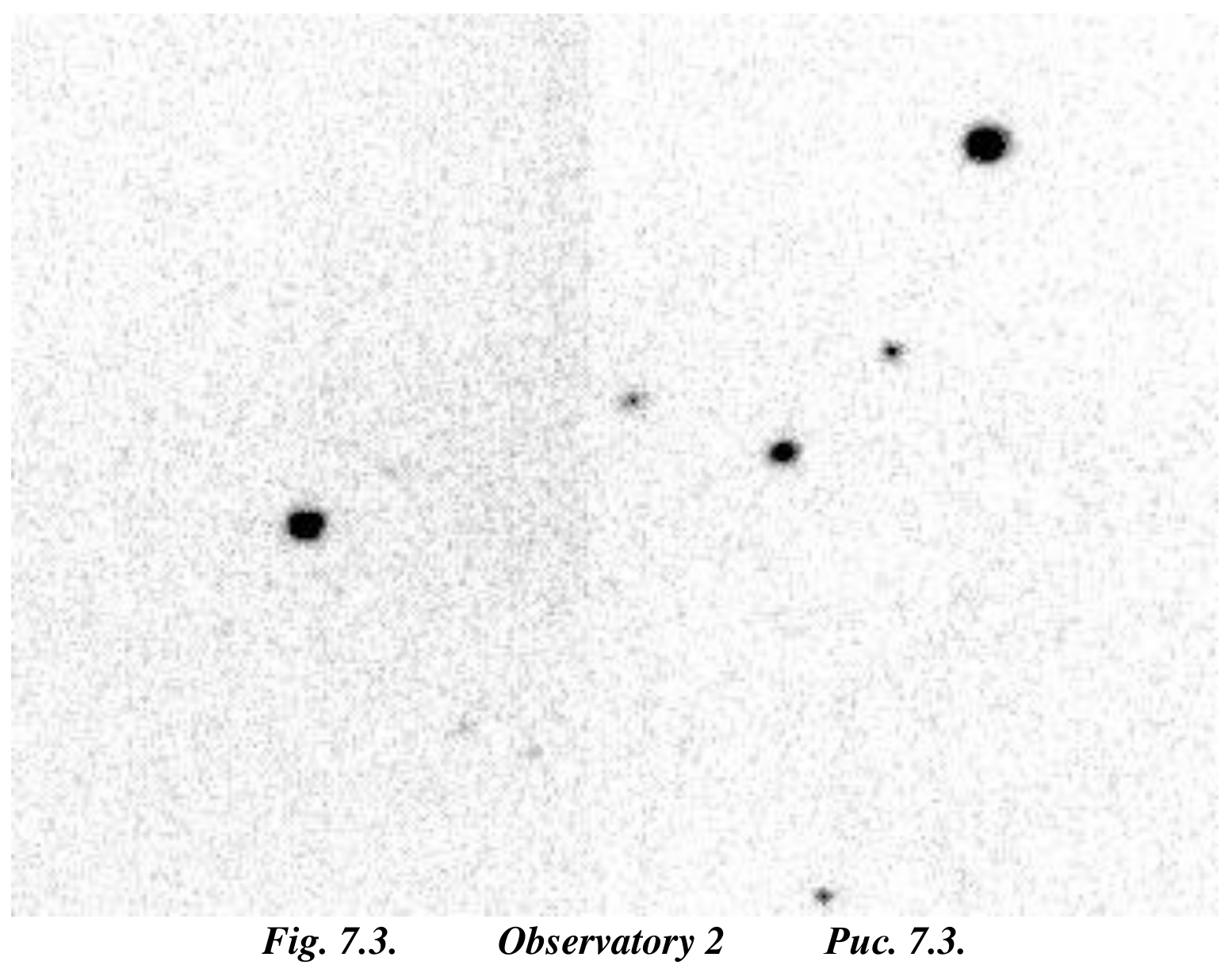
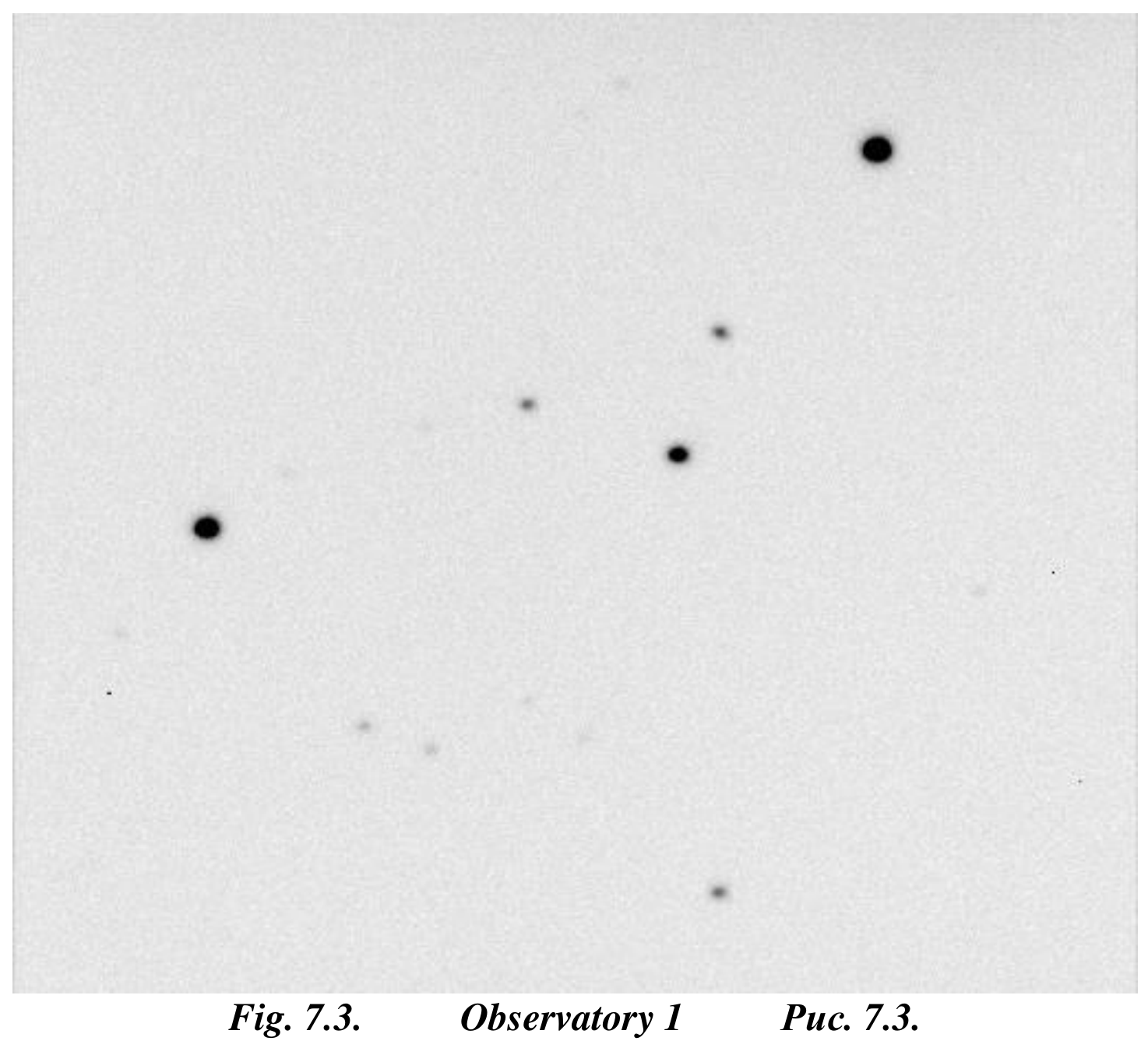
Source note: the fourth image is labelled “Fig. 7.3” again, although the question and solution refer to it as Fig. 7.4. The observatory labels on the images are retained.
7.1. Identify and mark the asteroid in the given Figs.
7.2. Measure the angular displacement (in arcsec) of the asteroid as seen from Observatory 1 and calculate its angular velocity in arcsec/s.
7.3. Measure the parallax of the asteroid (in arcsec) and calculate its distance from the earth.
7.4. Calculate the tangential linear velocity (velocity perpendicular to the line of sight) of the asteroid.
Решение
Official solution. The millimetre measurements refer to the original printed sheets; use the scale bar when viewing resized images.
7.1. Identification
Comparison of Figs. 7.1 and 7.2 allow us to identify the asteroid and evaluate its angular displacement due to its motion. We put the transparency on Fig. 7.1 and mark positions of several bright objects with a pencil. Then we put the transparency on Fig. 7.2 and move it until the markings of objects on the transparency will coincide with positions of corresponding objects in Fig. 7.2. We notice that one object changed its position considerably in Fig. 7.2. This is the asteroid.
7.2. Angular displacement and velocity
We mark the position of the asteroid on the transparency. Then we measure the displacement of the asteroid on the transparency and get mm. Using the scale of Fig. 7.1 we calculate the angular displacement of the asteroid.
The time interval between images of Figs. 7.1 and 7.2 is
The angular velocity of the asteroid
7.3. Parallax and distance
The parallax of the asteroid is evaluated by comparison of Figs. 7.3 and 7.4. These two images were taken from two different locations at the same time. We mark the positions of the asteroid overlaying the same transparency on Figs. 7.3 and 7.4 and measure the displacement of the asteroid on the same transparency, mm.
Angular displacement of the asteroid is arcsec. Then the parallax arcsec.
The distance of the asteroid is , where B is the baseline, i.e. the distance between observatories. Then since p is a small angle and measured in arcsec.
7.4. Tangential velocity
The tangential linear velocity of the asteroid is or .
Оригинал в Архива: alphapract7.pdf · официални решения: a7sol.png · допълнителни данни: alphapract7data.pdf