IAO 2014, Теория, Група α — Задача 6. Най-ярките звезди
Задачи за теоретичния тур · 12 октомври 2014 г. · 8 т.
Обща забележка
Обща забележка. Възможно е не във всички задачи въпросите да са поставени коректно. Някои въпроси (възможно е да е главният въпрос на задачата или да е някой подвъпрос) може да нямат смисъл. В такъв случай в решението трябва да се напише на руски или на английски – „ситуация невозможна“ или „impossible situation“. Разбира се, решението трябва да се подкрепи с пресмятания или логически разсъждения.
Данните от таблиците (Слънчева система, звезди, константи) могат да се използват във всяка задача.
Отговорите „Да – Yes“ или „Нет – No“ трябва да се напишат на руски или на английски.
Условие
Кои четири звезди ще бъдат най-ярките в нощното небе на Чолпон-Ата в CL (150-тия) век от новата ера? Считайте, че до височина над хоризонта небето е закрито от планини. Обяснете вашия отговор, като направите необходимите чертежи и пресмятания. Имената на звездите напишете с латински букви
Решение
Theoretical round. Sketches for solutions
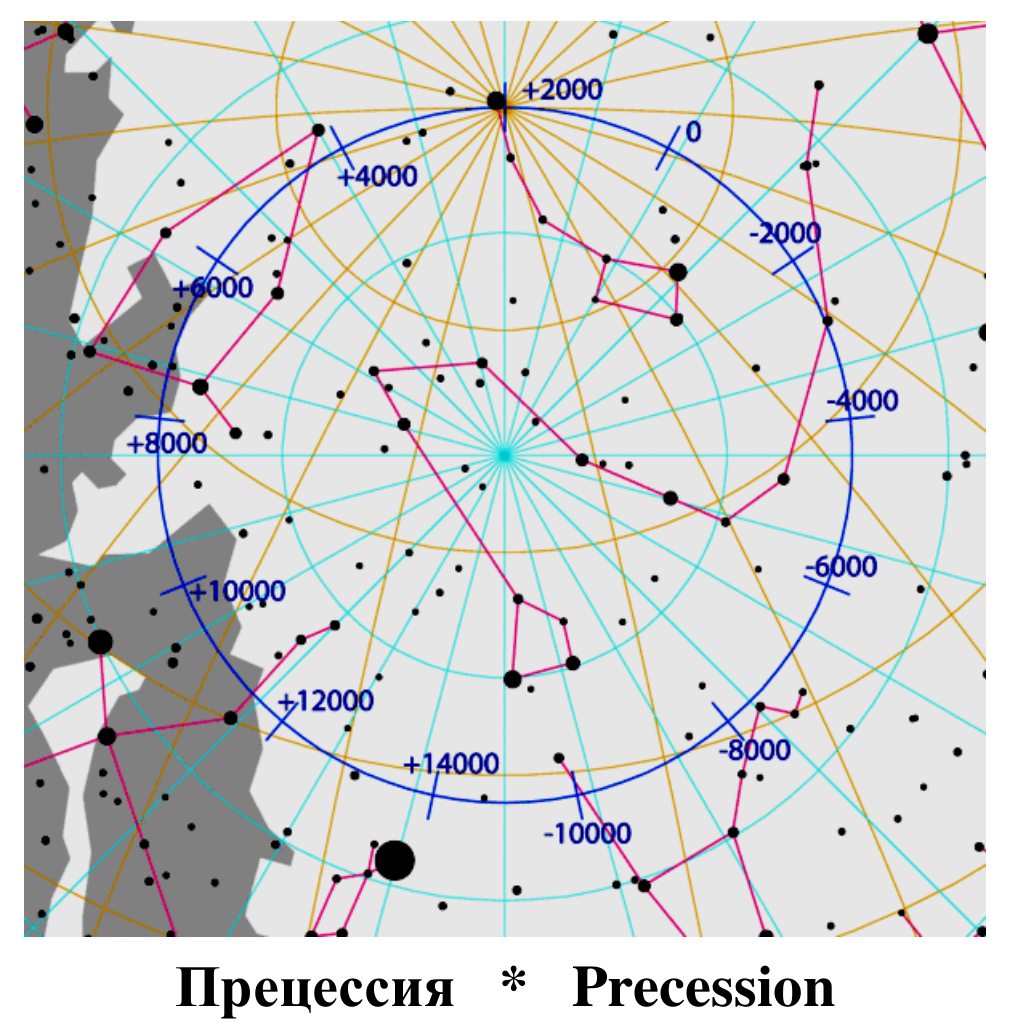
Due to precession of the Earth’s axis, the North celestial pole moves in a circle around the North ecliptic pole, making one circle approximately every ~26000 years (the value can be clearly seen in the sky map of precession). The time till the CL century AD is approximately half of this period, and the North pole will change its position by approximately in the direction of the brightest star in Draco constellation, γ Dra or Eltamin (in Draco the order of α-β-γ… is not the traditional one that starts from the brightest star, this fact is also clearly seen from the supplement materials). That is, in the CL century the visible part of the celestial sphere will be shifted about 47° in the direction to about the current 18h RA.
Let us list the brightest stars (for example, twice more of them than the required four) and see whether they may be seen in Cholpon-Ata in the CL century. Now we can see stars with for any RA. After 13000 years the limit will move, for RA6h and for RA18h (according to current coordinates). The situation is more complicated for other right ascensions. Anyway, the center of invisible area of the sky will be at the point (6h,−43°) and its radius will be . By easy drawing we can find that
| Звезда | Star | Designation | RA | Dec | Magnitude | Vis XXI | Vis CL |
|---|---|---|---|---|---|---|---|
| Сириус | Sirius | α CMa | 06h 45m 09s | −16°42′58″ | −1.46 | + | − |
| Канопус | Canopus | α Car | 06h 23m 57s | −52°41′45″ | −0.72 | − | − |
| Толиман | Toliman | α Cen | 14h 39m 36s | −60°50′07″ | −0.29 | − | + |
| Арктур | Arcturus | α Boo | 14h 15m 38s | 19°10′57″ | −0.04ᵛ | + | + |
| Вега | Vega | α Lyr | 18h 36m 56s | 38°47′01″ | 0.03 | + | + |
| Капелла | Capella | α Aur | 05h 16m 41s | 45°59′53″ | 0.08 | + | + |
| Ригель | Rigel | β Ori | 05h 14m 32s | −08°12′06″ | 0.12 | + | − |
| Процион | Procyon | α CMi | 07h 39m 18s | 05°13′30″ | 0.38 | + | − |
That is, we will lose from the visible stars Sirius, Procyon and Rigel, and get α Centauri. The four brightest stars in the night sky of Cholpon-Ata in the CL century AD are: α Centauri, Arcturus, Vega and Capella.
Theoretical round. Basic criteria
- Understanding nature, precession — 1.5 pt.
- Position of North celestial pole after 13000 years — 1 pt.
- Region of sky never rising above mountains — 1.5 pt.
- Speculation about Sirius, Canopus, Toliman, Arcturus, Vega, Capella — 3 pt.
- Final correct answer — 1 pt.
Официални решения и оценяване
Официалните скици на решенията и критериите са запазени на оригиналния английски език.
Note for jury and team leaders
The proposed sketches are not full; the team leaders have to give more detailed explanations for students. But the correct solutions in the students’ papers (enough for 8 pts) may be shorter.
Бележка
Jury members should evaluate the student’s solutions in essence, and not by looking on formal existence the mentioned sentences or formulae. The formal presence of the mentioned positions in the text is not necessary to give the respective points. Points should be done if the following steps de facto using these positions.
Parameters of orbits. Physical characteristics of some planets, Moon, Sun and Eris
| Body | Distance (AU) | Distance (10⁶ km) | Period (tropical years) | Period (days) | Inclination i (°) | Eccentricity | Equatorial diameter (km) | Mass (10²⁴ kg) | Density (g/cm³) | Gravity (m/s²) | Axial tilt (°) | Max. magnitude | Albedo |
|---|---|---|---|---|---|---|---|---|---|---|---|---|---|
| Sun | 1392000 | 1989000 | 1.409 | −26.74 | |||||||||
| Mercury | 0.387 | 57.9 | 0.241 | 87.969 | 7.00 | 0.206 | 4879 | 0.3302 | 5.43 | 3.70 | 0.01 | 0.06 | |
| Venus | 0.723 | 108.2 | 0.615 | 224.7007 | 3.40 | 0.007 | 12104 | 4.8690 | 5.24 | 8.87 | 177.36 | 0.78 | |
| Earth | 1.000 | 149.6 | 1.000 | 365.2564 | 0.00 | 0.017 | 12756 | 5.9742 | 5.515 | 9.81 | 23.44 | 0.36 | |
| Moon | 0.00257 | 0.38440 | 0.0748 | 27.3217 | 5.15 | 0.055 | 3475 | 0.07348 | 3.34 | 1.62 | 6.7 | −12.7 | 0.07 |
| Mars | 1.524 | 227.9 | 1.880 | 686.98 | 1.85 | 0.093 | 6794 | 0.6419 | 3.94 | 3.71 | 25.19 | −2.0 | 0.15 |
| Jupiter | 5.204 | 778.6 | 11.862 | 4332.59 | 1.30 | 0.048 | 142984 | 1899.8 | 1.33 | 24.86 | 3.13 | −2.7 | 0.66 |
| Saturn | 9.584 | 1433.7 | 29.458 | 10759.20 | 2.48 | 0.054 | 120536 | 568.50 | 0.70 | 10.41 | 26.73 | 0.7 | 0.68 |
| Eris | 68.05 | 205029 | 43.82 | 0.435 | 2326 | 0.0167 | 2.52 | 0.7 | 0.96 |
Source footnote: for outer planets and Moon — in mean opposition.
Some constants and formulae
| Constant or formula | Value |
|---|---|
| Speed of light in vacuum c (m/s) | 299792458 |
| Constant of gravitation G (N·m²/kg²) | |
| Solar constant A (W/m²) | 1367 |
| Hubble parameter H₀ (km/s/Mpc), mean | 71 |
| Hubble parameter, range | 50–100 |
| Planck constant h (J·s) | |
| Charge of electron e (C) | |
| Mass of electron mₑ (kg) | |
| Proton-to-electron ratio | 1836.15 |
| Faraday constant F (C/mol) | 96485 |
| Magnetic constant μ₀ (H/m) | |
| Universal gas constant R (J/mol/K) | 8.314 |
| Boltzmann constant k (J/K) | |
| Stefan–Boltzmann constant σ (W/m²/K⁴) | |
| Wien displacement constant b (m·K) | 0.002897 |
| Laboratory wavelength Hα (Å) | 6562.81 |
| Tropical year length T (days) | 365.242199 |
| Standard atmosphere (Pa) | 101325 |
| Visible light extinction by terrestrial atmosphere in zenith (minimum) | 19%, 0.23 magnitudes |
| Height of homogeneous atmosphere (m) | 7991 |
| Refractive index of water for 20°C n | 1.334 |
| Moment of inertia of a solid ball | |
| Volume of a ball | |
| Area of sphere | |
| π | 3.14159265 |
| e | 2.71828183 |
| Golden ratio φ | 1.61803399 |
| Coordinates | Bishkek | Cholpon-Ata |
|---|---|---|
| Longitude E | 74°34′ | 77°05′ |
| Latitude N | 42°52′ | 42°39′ |
| Timezone | UT+6 | UT+6 |
28 brightest stars in the sky. Some other stars
| Name | Designation | RA | Dec | Parallax (arcsec) | Magnitude | Spectral class |
|---|---|---|---|---|---|---|
| Altair | α Aql | 19h50m47s | 08°52′06″ | 0.195 | 0.77 | A7 |
| Capella | α Aur | 05h16m41s | 45°59′53″ | 0.073 | 0.08 | G5+G0 |
| Arcturus | α Boo | 14h15m38s | 19°10′57″ | 0.089 | −0.04ᵛ | K1 |
| Canopus | α Car | 06h23m57s | −52°41′45″ | 0.028 | −0.72 | F0 |
| Miaplacidus | β Car | 09h13m12s | −69°43′02″ | 0.029 | 1.68 | A2 |
| Toliman (Rigel Kent) | α Cen | 14h39m36s | −60°50′07″ | 0.747 | −0.01; 1.33 | G2; K1 |
| Hadar | β Cen | 14h03m49s | −60°22′23″ | 0.009 | 0.61 | B1 |
| Sirius | α CMa | 06h45m09s | −16°42′58″ | 0.375 | −1.46 | A1 |
| Adara | ε CMa | 06h58m38s | −28°58′19″ | 0.008 | 1.50 | B2 |
| Procyon | α CMi | 07h39m18s | 05°13′30″ | 0.288 | 0.38 | F5 |
| Acrux | α Cru | 12h26m36s | −63°05′57″ | 0.010 | 0.77 | B0 |
| Becrux | β Cru | 12h47m43s | −59°41′20″ | 0.009 | 1.30 | B0 |
| Gacrux | γ Cru | 12h31m10s | −57°06′48″ | 0.037 | 1.60 | M4 |
| Deneb | α Cyg | 20h41m26s | 45°16′49″ | 0.002 | 1.25 | A2 |
| Achernar | α Eri | 01h37m43s | −57°14′12″ | 0.026 | 0.46 | B3 |
| Castor | α Gem | 07h34m36s | 31°53′18″ | 0.065 | 1.58 | A1+A2 |
| Pollux | β Gem | 07h45m19s | 28°01′35″ | 0.097 | 1.14 | K0 |
| Regulus | α Leo | 10h08m22s | 11°58′02″ | 0.041 | 1.35 | B7 |
| Vega | α Lyr | 18h36m56s | 38°47′01″ | 0.123 | 0.03 | A0 |
| Betelgeuse | α Ori | 05h55m10s | 07°24′25″ | 0.005 | 0.5ᵛ | M2 |
| Rigel | β Ori | 05h14m32s | −08°12′06″ | 0.013 | 0.12 | B8 |
| Bellatrix | γ Ori | 05h25m08s | 06°20′59″ | 0.013 | 1.64 | B2 |
| Fomalhaut | α PsA | 22h57m39s | −29°37′20″ | 0.130 | 1.16 | A3 |
| Antares | α Sco | 16h29m24s | −26°25′55″ | 0.024 | 0.96 | M1+B4 |
| Shaula | λ Sco | 17h33m37s | −37°06′14″ | 0.005 | 1.62 | B2 |
| Aldebaran | α Tau | 04h35m55s | 16°30′33″ | 0.048 | 0.85ᵛ | K5 |
| Elnath | β Tau | 05h26m18s | 28°36′27″ | 0.025 | 1.66 | B7 |
| Spica | α Vir | 13h25m12s | −11°09′41″ | 0.023 | 0.98 | B1 |
Some other stars
| Name | Designation | RA | Dec | Parallax (arcsec) | Magnitude | Spectral class |
|---|---|---|---|---|---|---|
| Hamal | α Ari | 02h07m10s | 23°27′45″ | 0.050 | 2.01 | K2 |
| Sheratan | β Ari | 01h54m39s | 20°48′30″ | 0.055 | 2.64 | A5 |
| Thuban | α Dra | 14h04m23s | 64°22′33″ | 0.011 | 3.65 | A0 |
| Rastaban | β Dra | 17h30m26s | 52°18′05″ | 0.009 | 2.79 | G2 |
| Eltamin | γ Dra | 17h56m36s | 51°29′20″ | 0.021 | 2.24 | K5 |
| Polaris | α UMi | 02h31m49s | 89°15′51″ | 0.007 | 1.97ᵛ | F7 |
| Kochab | β UMi | 14h50m42s | 74°09′20″ | 0.025 | 2.07 | K4 |
| Pherkad | γ UMi | 15h20m44s | 71°50′02″ | 0.007 | 3.06ᵛ | A3 |
| Yildun | δ UMi | 17h32m19s | 86°35′11″ | 0.019 | 4.35 | A1 |
| Proxima Centauri | V645 Cen, α Cen C | 14h29m43s | −62°40′46″ | 0.769 | 11.05 | M5.5 |
Source discrepancy
the key prints 262.12° in 4.2; its printed β=48°33′ gives 262°54′ for 360°−2β. The printed angle and time are retained.
Source discrepancy
the lower-culmination line prints the same symbolic expression as the upper line, but substitutes −90°+φ+δ. The original mismatch is retained.
Source discrepancy
The printed individual grading allocations for Proxima Centauri sum to 9 points, although the general instructions describe each whole solution as sufficient for 8 points. Both the printed allocations and the 8-point whole-problem scale are retained.
Оригинал в Архива: bgtheo1.jpg · официални решения: theosol.pdf · допълнителни данни: bgtheo2.jpg · допълнителни данни: bgtheo3.jpg · допълнителни данни: bgtheo4.jpg · допълнителни данни: bgtheo5.jpg · допълнителни данни: bgtheo6.jpg · допълнителни данни: theocriteria.pdf · допълнителни данни: sombrero.pdf · допълнителни данни: constants.pdf · допълнителни данни: hrd.pdf