IAO 2014, Теория, Група β — Задача 5. Климат
Задачи за теоретичния тур · 12 октомври 2014 г. · 8 т.
Обща забележка
Обща забележка. Възможно е не във всички задачи въпросите да са поставени коректно. Някои въпроси (възможно е да е главният въпрос на задачата или да е някой подвъпрос) може да нямат смисъл. В такъв случай в решението трябва да се напише на руски или на английски – „ситуация невозможна“ или „impossible situation“. Разбира се, решението трябва да се подкрепи с пресмятания или логически разсъждения.
Данните от таблиците (Слънчева система, звезди, константи) могат да се използват във всяка задача.
Отговорите „Да – Yes“ или „Нет – No“ трябва да се напишат на руски или на английски.
Условие
XXXII век от новата ера. По неизвестни причини Слънцето е започнало да изстива, а ъгълът на наклона на еклиптиката към равнината на небесния екватор е намалял до нула. Учените са пресметнали, че проблемът със запазването на климата на Земята и ежегодната смяна на сезоните може да се реши чрез създаване на изкуствена звезда с пренебрежимо малка маса, но аналогична по светимост на звезда от главната последователност, която да се пусне в кръгова орбита около Слънцето. Звездата ще се движи около Слънцето като вътрешна планета, в резултат на което на Земята ще се установи температурен режим, аналогичен на сегашния на Иссик-Кул: средна зимна температура −3°, средна лятна +17°.
5.1.
Оценете до каква температура е изстинало Слънцето.
5.2.
Оценете на какъв спектрален клас ще съответства звездата, която трябва да се постави на нужната орбита.
Решение
Theoretical round. Sketches for solutions
In order to get an inner orbit of the star that would provide a seasonal cycle with a periodicity of 1 year, it is necessary that its close position with the Earth would take place once a year. That is, the synodic period of its revolution should be one year. It is not difficult to find that the sidereal period of revolution of the celestial body must be equal to
and the radius of its orbit, from the III Kepler’s law:
Thus, the new celestial body will once a year become close to the Earth at a distance of au, providing summer on the planet, and once a year move away to a distance of au, leaving the Earth in winter.
The ratio of energies received by the Earth from the new star in summer and winter will be
The ratio of these energies to the energy , received from the new star at a distance of 1 au is
At the same time, the Earth will always receive additional energy from the cooler Sun, that is, in the summer, and . To keep the heat balance, all the incoming energy should be radiated.
The ratio of the energy radiated by the Earth in summer and winter will be
Neglecting the effects of delays of the seasons compared to the maxima and minima of the energy income, let us assume that , . Then we can write:
The sum of and the average for the period must be the same as the Earth receives nowadays, . To estimate the average value of , let us take , and so
5.1. Thus, the Sun in new conditions will emit 4.6% less energy, and so its temperature will be lower and equal to
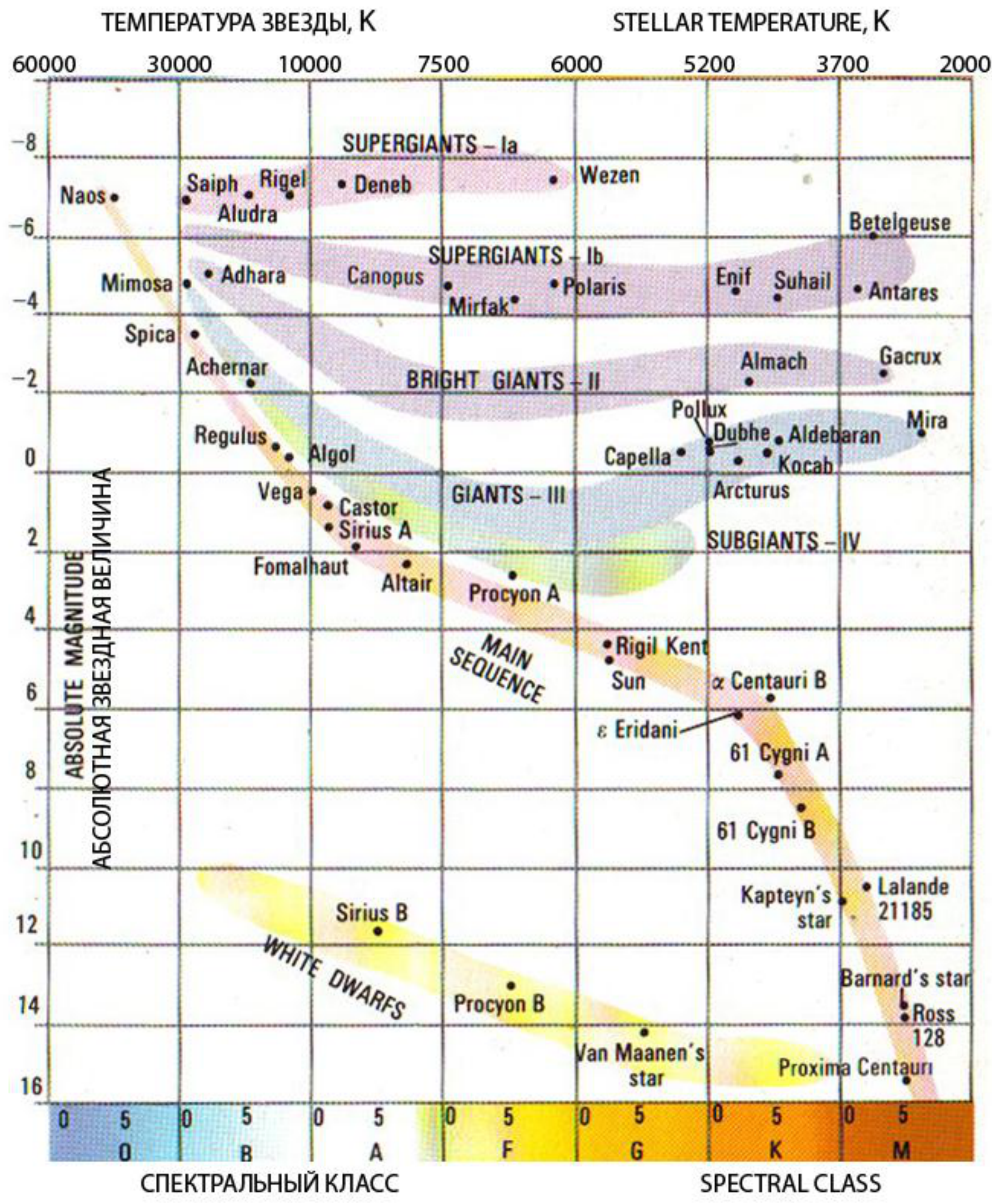
5.2. To understand what spectral type will correspond to the star, we calculate by how many magnitudes it is fainter than the Sun:
From the HR diagram, we find that it is about the spectral type K 3.
Theoretical round. Basic criteria
- Understanding nature of effect and conclusion synodic period 1 year — 1 pt.
- Sidereal period 0.5 years — 1 pt.
- Orbital radius from Kepler’s III law — 1 pt.
- Energy balances — 2 pt.
- 5.1. Temperature of Sun — 1 pt.
- 5.2. ΔM=−(5/2)lg(0.0464)≈3.3 and from HR diagram spectral type K 3 — 2 pt.
Официални решения и оценяване
Официалните скици на решенията и критериите са запазени на оригиналния английски език.
Note for jury and team leaders
The proposed sketches are not full; the team leaders have to give more detailed explanations for students. But the correct solutions in the students’ papers (enough for 8 pts) may be shorter.
Бележка
Jury members should evaluate the student’s solutions in essence, and not by looking on formal existence the mentioned sentences or formulae. The formal presence of the mentioned positions in the text is not necessary to give the respective points. Points should be done if the following steps de facto using these positions.
Parameters of orbits. Physical characteristics of some planets, Moon, Sun and Eris
| Body | Distance (AU) | Distance (10⁶ km) | Period (tropical years) | Period (days) | Inclination i (°) | Eccentricity | Equatorial diameter (km) | Mass (10²⁴ kg) | Density (g/cm³) | Gravity (m/s²) | Axial tilt (°) | Max. magnitude | Albedo |
|---|---|---|---|---|---|---|---|---|---|---|---|---|---|
| Sun | 1392000 | 1989000 | 1.409 | −26.74 | |||||||||
| Mercury | 0.387 | 57.9 | 0.241 | 87.969 | 7.00 | 0.206 | 4879 | 0.3302 | 5.43 | 3.70 | 0.01 | 0.06 | |
| Venus | 0.723 | 108.2 | 0.615 | 224.7007 | 3.40 | 0.007 | 12104 | 4.8690 | 5.24 | 8.87 | 177.36 | 0.78 | |
| Earth | 1.000 | 149.6 | 1.000 | 365.2564 | 0.00 | 0.017 | 12756 | 5.9742 | 5.515 | 9.81 | 23.44 | 0.36 | |
| Moon | 0.00257 | 0.38440 | 0.0748 | 27.3217 | 5.15 | 0.055 | 3475 | 0.07348 | 3.34 | 1.62 | 6.7 | −12.7 | 0.07 |
| Mars | 1.524 | 227.9 | 1.880 | 686.98 | 1.85 | 0.093 | 6794 | 0.6419 | 3.94 | 3.71 | 25.19 | −2.0 | 0.15 |
| Jupiter | 5.204 | 778.6 | 11.862 | 4332.59 | 1.30 | 0.048 | 142984 | 1899.8 | 1.33 | 24.86 | 3.13 | −2.7 | 0.66 |
| Saturn | 9.584 | 1433.7 | 29.458 | 10759.20 | 2.48 | 0.054 | 120536 | 568.50 | 0.70 | 10.41 | 26.73 | 0.7 | 0.68 |
| Eris | 68.05 | 205029 | 43.82 | 0.435 | 2326 | 0.0167 | 2.52 | 0.7 | 0.96 |
Source footnote: for outer planets and Moon — in mean opposition.
Some constants and formulae
| Constant or formula | Value |
|---|---|
| Speed of light in vacuum c (m/s) | 299792458 |
| Constant of gravitation G (N·m²/kg²) | |
| Solar constant A (W/m²) | 1367 |
| Hubble parameter H₀ (km/s/Mpc), mean | 71 |
| Hubble parameter, range | 50–100 |
| Planck constant h (J·s) | |
| Charge of electron e (C) | |
| Mass of electron mₑ (kg) | |
| Proton-to-electron ratio | 1836.15 |
| Faraday constant F (C/mol) | 96485 |
| Magnetic constant μ₀ (H/m) | |
| Universal gas constant R (J/mol/K) | 8.314 |
| Boltzmann constant k (J/K) | |
| Stefan–Boltzmann constant σ (W/m²/K⁴) | |
| Wien displacement constant b (m·K) | 0.002897 |
| Laboratory wavelength Hα (Å) | 6562.81 |
| Tropical year length T (days) | 365.242199 |
| Standard atmosphere (Pa) | 101325 |
| Visible light extinction by terrestrial atmosphere in zenith (minimum) | 19%, 0.23 magnitudes |
| Height of homogeneous atmosphere (m) | 7991 |
| Refractive index of water for 20°C n | 1.334 |
| Moment of inertia of a solid ball | |
| Volume of a ball | |
| Area of sphere | |
| π | 3.14159265 |
| e | 2.71828183 |
| Golden ratio φ | 1.61803399 |
| Coordinates | Bishkek | Cholpon-Ata |
|---|---|---|
| Longitude E | 74°34′ | 77°05′ |
| Latitude N | 42°52′ | 42°39′ |
| Timezone | UT+6 | UT+6 |
28 brightest stars in the sky. Some other stars
| Name | Designation | RA | Dec | Parallax (arcsec) | Magnitude | Spectral class |
|---|---|---|---|---|---|---|
| Altair | α Aql | 19h50m47s | 08°52′06″ | 0.195 | 0.77 | A7 |
| Capella | α Aur | 05h16m41s | 45°59′53″ | 0.073 | 0.08 | G5+G0 |
| Arcturus | α Boo | 14h15m38s | 19°10′57″ | 0.089 | −0.04ᵛ | K1 |
| Canopus | α Car | 06h23m57s | −52°41′45″ | 0.028 | −0.72 | F0 |
| Miaplacidus | β Car | 09h13m12s | −69°43′02″ | 0.029 | 1.68 | A2 |
| Toliman (Rigel Kent) | α Cen | 14h39m36s | −60°50′07″ | 0.747 | −0.01; 1.33 | G2; K1 |
| Hadar | β Cen | 14h03m49s | −60°22′23″ | 0.009 | 0.61 | B1 |
| Sirius | α CMa | 06h45m09s | −16°42′58″ | 0.375 | −1.46 | A1 |
| Adara | ε CMa | 06h58m38s | −28°58′19″ | 0.008 | 1.50 | B2 |
| Procyon | α CMi | 07h39m18s | 05°13′30″ | 0.288 | 0.38 | F5 |
| Acrux | α Cru | 12h26m36s | −63°05′57″ | 0.010 | 0.77 | B0 |
| Becrux | β Cru | 12h47m43s | −59°41′20″ | 0.009 | 1.30 | B0 |
| Gacrux | γ Cru | 12h31m10s | −57°06′48″ | 0.037 | 1.60 | M4 |
| Deneb | α Cyg | 20h41m26s | 45°16′49″ | 0.002 | 1.25 | A2 |
| Achernar | α Eri | 01h37m43s | −57°14′12″ | 0.026 | 0.46 | B3 |
| Castor | α Gem | 07h34m36s | 31°53′18″ | 0.065 | 1.58 | A1+A2 |
| Pollux | β Gem | 07h45m19s | 28°01′35″ | 0.097 | 1.14 | K0 |
| Regulus | α Leo | 10h08m22s | 11°58′02″ | 0.041 | 1.35 | B7 |
| Vega | α Lyr | 18h36m56s | 38°47′01″ | 0.123 | 0.03 | A0 |
| Betelgeuse | α Ori | 05h55m10s | 07°24′25″ | 0.005 | 0.5ᵛ | M2 |
| Rigel | β Ori | 05h14m32s | −08°12′06″ | 0.013 | 0.12 | B8 |
| Bellatrix | γ Ori | 05h25m08s | 06°20′59″ | 0.013 | 1.64 | B2 |
| Fomalhaut | α PsA | 22h57m39s | −29°37′20″ | 0.130 | 1.16 | A3 |
| Antares | α Sco | 16h29m24s | −26°25′55″ | 0.024 | 0.96 | M1+B4 |
| Shaula | λ Sco | 17h33m37s | −37°06′14″ | 0.005 | 1.62 | B2 |
| Aldebaran | α Tau | 04h35m55s | 16°30′33″ | 0.048 | 0.85ᵛ | K5 |
| Elnath | β Tau | 05h26m18s | 28°36′27″ | 0.025 | 1.66 | B7 |
| Spica | α Vir | 13h25m12s | −11°09′41″ | 0.023 | 0.98 | B1 |
Some other stars
| Name | Designation | RA | Dec | Parallax (arcsec) | Magnitude | Spectral class |
|---|---|---|---|---|---|---|
| Hamal | α Ari | 02h07m10s | 23°27′45″ | 0.050 | 2.01 | K2 |
| Sheratan | β Ari | 01h54m39s | 20°48′30″ | 0.055 | 2.64 | A5 |
| Thuban | α Dra | 14h04m23s | 64°22′33″ | 0.011 | 3.65 | A0 |
| Rastaban | β Dra | 17h30m26s | 52°18′05″ | 0.009 | 2.79 | G2 |
| Eltamin | γ Dra | 17h56m36s | 51°29′20″ | 0.021 | 2.24 | K5 |
| Polaris | α UMi | 02h31m49s | 89°15′51″ | 0.007 | 1.97ᵛ | F7 |
| Kochab | β UMi | 14h50m42s | 74°09′20″ | 0.025 | 2.07 | K4 |
| Pherkad | γ UMi | 15h20m44s | 71°50′02″ | 0.007 | 3.06ᵛ | A3 |
| Yildun | δ UMi | 17h32m19s | 86°35′11″ | 0.019 | 4.35 | A1 |
| Proxima Centauri | V645 Cen, α Cen C | 14h29m43s | −62°40′46″ | 0.769 | 11.05 | M5.5 |
Source discrepancy
the key prints 262.12° in 4.2; its printed β=48°33′ gives 262°54′ for 360°−2β. The printed angle and time are retained.
Source discrepancy
the winter ratio is printed with (R₀−R)² in its denominator although the preceding winter distance is R₀+R and the numerical0.38 corresponds to the latter. The printed formula is retained. Calligraphic ℰ here represents the separate radiated-energy symbol used in the key.
Source discrepancy
the key switches from z=0.0035 to0.0036 while retaining1050 km/s; the latter multiplication would give1080. It also changes the moving gas from the first spectrum to the third in its prose. Both inconsistencies are retained. The “in reality” values above are statements of the2014 source.
Оценяване: Proxima Centauri
The printed Proxima Centauri allocations are 1 + 3×1 + 1 + 1.5 + 1.5 = 8 points, matching the whole-problem scale.
Оригинал в Архива: bgtheo5.jpg · официални решения: theosol.pdf · допълнителни данни: bgtheo2.jpg · допълнителни данни: bgtheo3.jpg · допълнителни данни: bgtheo4.jpg · допълнителни данни: bgtheo5.jpg · допълнителни данни: bgtheo6.jpg · допълнителни данни: theocriteria.pdf · допълнителни данни: sombrero.pdf · допълнителни данни: constants.pdf · допълнителни данни: hrd.pdf