IAO 2014, Теория, Група β — Задача 6. Галактиката Сомбреро
Задачи за теоретичния тур · 12 октомври 2014 г. · 8 т.
Обща забележка
Обща забележка. Възможно е не във всички задачи въпросите да са поставени коректно. Някои въпроси (възможно е да е главният въпрос на задачата или да е някой подвъпрос) може да нямат смисъл. В такъв случай в решението трябва да се напише на руски или на английски – „ситуация невозможна“ или „impossible situation“. Разбира се, решението трябва да се подкрепи с пресмятания или логически разсъждения.
Данните от таблиците (Слънчева система, звезди, константи) могат да се използват във всяка задача.
Отговорите „Да – Yes“ или „Нет – No“ трябва да се напишат на руски или на английски.
Условие
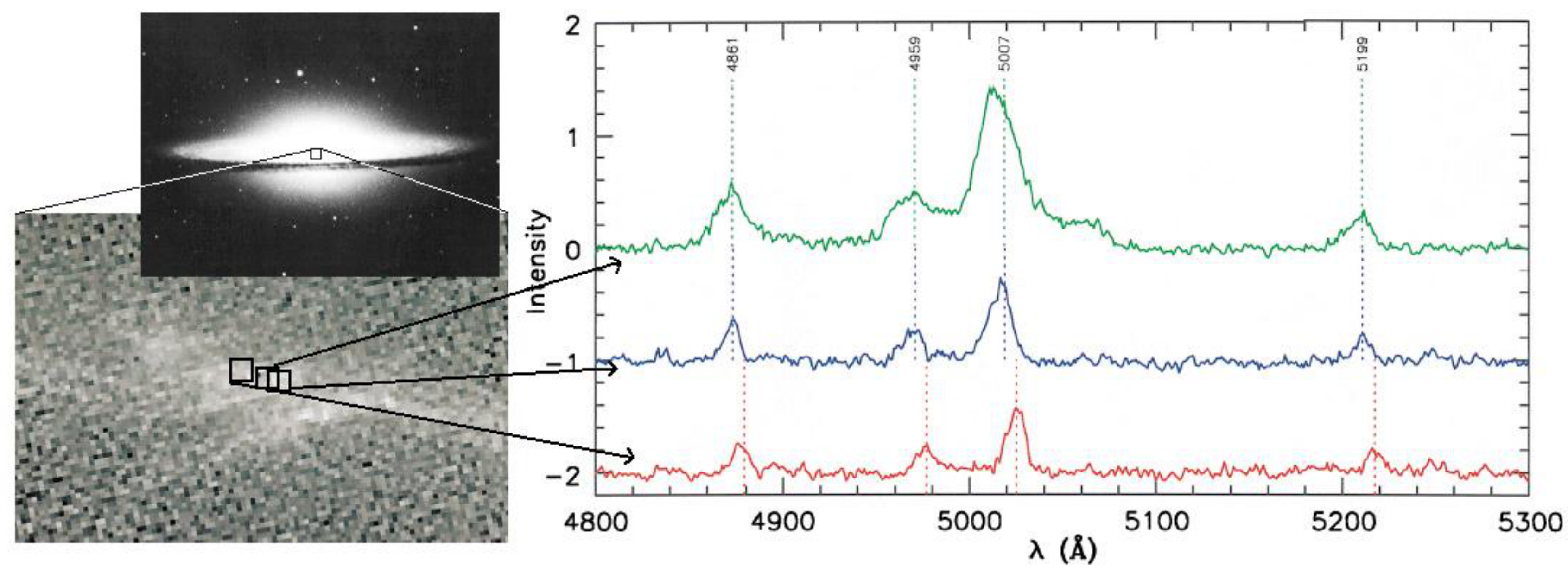
Галактиката Сомбреро, M104, е известна с това, че притежава една от свръхмасивните черни дупки. Вляво са дадени снимки на галактиката и нейния център. Размерите на снимките са и съответно. Вдясно са дадени три спектъра (с емисионни линии на йонизирания кислород и азот) на области около центъра на галактиката, получени с космическия телескоп Хъбъл. Долният спектър е на област около самия център, двата други спектъра са на съседни области. Отгоре около пунктираните линии са дадени стойности в ангстрьоми на съответните лабораторни дължини на вълните.
6.1.
Приближава ли се към нас или се отдалечава M104? (Отговорете на въпроса като нарисувате схема).
6.2.
Оценете скоростта на M104 към нас или от нас.
6.3.
Грубо оценете масата на свръхмасивната черна дупка в центъра на M104 (отговора дайте в слънчеви маси ).
Решение
Theoretical round. Sketches for solutions
6.1. All the lines in the spectra are shifted somewhat to longer wavelengths (redshifted). Obviously, M 104 is receding from us due to the expansion of the Universe.
6.2. The overall receding velocity of M 104 may be found from the redshift of the spectrum of the central region. Taking the average redshift of the four emission lines, we find that
and since , the overall receding velocity of M 104 is given by:
6.3. According to the Hubble law the distance to Sombrero Galaxy is
Note: In reality the distance to Sombrero Galaxy is 9 Mpc. But we continue solution according to the calculated value,15 Mpc.
The first and second spectra have different shifts than the third one. It indicates that the gas which is generating the emission lines has a motion relative to the center of M 104. The amounts of these redshifts are not too clear but evidently less than the third one. To find the mass of the smaller region near the center, we will use the first spectrum as obtained closer to the center region. The distance from the center of the galaxy to this near-center region can be found by measuring sizes at the lower picture. The angular distance is approximately 0.05 of the width of the lower image, . To get the actual distance in a.u., it is easy to use the formula
Note: In reality .
The average difference in redshifts of the first and third spectra may be estimated as about . Thus the velocity of the gas relative to the galactic center is about
Then, let us assume that the gas in the region of the third spectrum revolves around the galactic center in a circular orbit with the period T. Its revolving velocity is
By comparing with the average velocity of the Earth revolving around the Sun (A=1 au, P=1 year),
we find that
Assuming that the mass of the gas is much less than that of the galactic center and applying the Kepler’s III law (in units solar mass–au–year), we obtain the mass of the galactic center
Note: In reality, we should write .
It is an approximation for the mass of the supermassive black hole in the center of M 104.
Theoretical round. Basic criteria
- 6.1. Spectra redshifted, receding from us — 1 pt.
- 6.2. z_av=(Δλ/λ)_average≈0.0035 — 1 pt; V=cz=0.0036×300000 km/s=1050 km/s — 1 pt.
- 6.3. L=V/H=1050 km/s /71 km/s/Mpc≈15 Mpc — 1 pt; R(au)=0.54×15·10⁶≈8·10⁶ — 1 pt; other correct calculations and obtaining mass of galactic center — 3 pt.
Официални решения и оценяване
Официалните скици на решенията и критериите са запазени на оригиналния английски език.
Note for jury and team leaders
The proposed sketches are not full; the team leaders have to give more detailed explanations for students. But the correct solutions in the students’ papers (enough for 8 pts) may be shorter.
Бележка
Jury members should evaluate the student’s solutions in essence, and not by looking on formal existence the mentioned sentences or formulae. The formal presence of the mentioned positions in the text is not necessary to give the respective points. Points should be done if the following steps de facto using these positions.
Parameters of orbits. Physical characteristics of some planets, Moon, Sun and Eris
| Body | Distance (AU) | Distance (10⁶ km) | Period (tropical years) | Period (days) | Inclination i (°) | Eccentricity | Equatorial diameter (km) | Mass (10²⁴ kg) | Density (g/cm³) | Gravity (m/s²) | Axial tilt (°) | Max. magnitude | Albedo |
|---|---|---|---|---|---|---|---|---|---|---|---|---|---|
| Sun | 1392000 | 1989000 | 1.409 | −26.74 | |||||||||
| Mercury | 0.387 | 57.9 | 0.241 | 87.969 | 7.00 | 0.206 | 4879 | 0.3302 | 5.43 | 3.70 | 0.01 | 0.06 | |
| Venus | 0.723 | 108.2 | 0.615 | 224.7007 | 3.40 | 0.007 | 12104 | 4.8690 | 5.24 | 8.87 | 177.36 | 0.78 | |
| Earth | 1.000 | 149.6 | 1.000 | 365.2564 | 0.00 | 0.017 | 12756 | 5.9742 | 5.515 | 9.81 | 23.44 | 0.36 | |
| Moon | 0.00257 | 0.38440 | 0.0748 | 27.3217 | 5.15 | 0.055 | 3475 | 0.07348 | 3.34 | 1.62 | 6.7 | −12.7 | 0.07 |
| Mars | 1.524 | 227.9 | 1.880 | 686.98 | 1.85 | 0.093 | 6794 | 0.6419 | 3.94 | 3.71 | 25.19 | −2.0 | 0.15 |
| Jupiter | 5.204 | 778.6 | 11.862 | 4332.59 | 1.30 | 0.048 | 142984 | 1899.8 | 1.33 | 24.86 | 3.13 | −2.7 | 0.66 |
| Saturn | 9.584 | 1433.7 | 29.458 | 10759.20 | 2.48 | 0.054 | 120536 | 568.50 | 0.70 | 10.41 | 26.73 | 0.7 | 0.68 |
| Eris | 68.05 | 205029 | 43.82 | 0.435 | 2326 | 0.0167 | 2.52 | 0.7 | 0.96 |
Source footnote: for outer planets and Moon — in mean opposition.
Some constants and formulae
| Constant or formula | Value |
|---|---|
| Speed of light in vacuum c (m/s) | 299792458 |
| Constant of gravitation G (N·m²/kg²) | |
| Solar constant A (W/m²) | 1367 |
| Hubble parameter H₀ (km/s/Mpc), mean | 71 |
| Hubble parameter, range | 50–100 |
| Planck constant h (J·s) | |
| Charge of electron e (C) | |
| Mass of electron mₑ (kg) | |
| Proton-to-electron ratio | 1836.15 |
| Faraday constant F (C/mol) | 96485 |
| Magnetic constant μ₀ (H/m) | |
| Universal gas constant R (J/mol/K) | 8.314 |
| Boltzmann constant k (J/K) | |
| Stefan–Boltzmann constant σ (W/m²/K⁴) | |
| Wien displacement constant b (m·K) | 0.002897 |
| Laboratory wavelength Hα (Å) | 6562.81 |
| Tropical year length T (days) | 365.242199 |
| Standard atmosphere (Pa) | 101325 |
| Visible light extinction by terrestrial atmosphere in zenith (minimum) | 19%, 0.23 magnitudes |
| Height of homogeneous atmosphere (m) | 7991 |
| Refractive index of water for 20°C n | 1.334 |
| Moment of inertia of a solid ball | |
| Volume of a ball | |
| Area of sphere | |
| π | 3.14159265 |
| e | 2.71828183 |
| Golden ratio φ | 1.61803399 |
| Coordinates | Bishkek | Cholpon-Ata |
|---|---|---|
| Longitude E | 74°34′ | 77°05′ |
| Latitude N | 42°52′ | 42°39′ |
| Timezone | UT+6 | UT+6 |
28 brightest stars in the sky. Some other stars
| Name | Designation | RA | Dec | Parallax (arcsec) | Magnitude | Spectral class |
|---|---|---|---|---|---|---|
| Altair | α Aql | 19h50m47s | 08°52′06″ | 0.195 | 0.77 | A7 |
| Capella | α Aur | 05h16m41s | 45°59′53″ | 0.073 | 0.08 | G5+G0 |
| Arcturus | α Boo | 14h15m38s | 19°10′57″ | 0.089 | −0.04ᵛ | K1 |
| Canopus | α Car | 06h23m57s | −52°41′45″ | 0.028 | −0.72 | F0 |
| Miaplacidus | β Car | 09h13m12s | −69°43′02″ | 0.029 | 1.68 | A2 |
| Toliman (Rigel Kent) | α Cen | 14h39m36s | −60°50′07″ | 0.747 | −0.01; 1.33 | G2; K1 |
| Hadar | β Cen | 14h03m49s | −60°22′23″ | 0.009 | 0.61 | B1 |
| Sirius | α CMa | 06h45m09s | −16°42′58″ | 0.375 | −1.46 | A1 |
| Adara | ε CMa | 06h58m38s | −28°58′19″ | 0.008 | 1.50 | B2 |
| Procyon | α CMi | 07h39m18s | 05°13′30″ | 0.288 | 0.38 | F5 |
| Acrux | α Cru | 12h26m36s | −63°05′57″ | 0.010 | 0.77 | B0 |
| Becrux | β Cru | 12h47m43s | −59°41′20″ | 0.009 | 1.30 | B0 |
| Gacrux | γ Cru | 12h31m10s | −57°06′48″ | 0.037 | 1.60 | M4 |
| Deneb | α Cyg | 20h41m26s | 45°16′49″ | 0.002 | 1.25 | A2 |
| Achernar | α Eri | 01h37m43s | −57°14′12″ | 0.026 | 0.46 | B3 |
| Castor | α Gem | 07h34m36s | 31°53′18″ | 0.065 | 1.58 | A1+A2 |
| Pollux | β Gem | 07h45m19s | 28°01′35″ | 0.097 | 1.14 | K0 |
| Regulus | α Leo | 10h08m22s | 11°58′02″ | 0.041 | 1.35 | B7 |
| Vega | α Lyr | 18h36m56s | 38°47′01″ | 0.123 | 0.03 | A0 |
| Betelgeuse | α Ori | 05h55m10s | 07°24′25″ | 0.005 | 0.5ᵛ | M2 |
| Rigel | β Ori | 05h14m32s | −08°12′06″ | 0.013 | 0.12 | B8 |
| Bellatrix | γ Ori | 05h25m08s | 06°20′59″ | 0.013 | 1.64 | B2 |
| Fomalhaut | α PsA | 22h57m39s | −29°37′20″ | 0.130 | 1.16 | A3 |
| Antares | α Sco | 16h29m24s | −26°25′55″ | 0.024 | 0.96 | M1+B4 |
| Shaula | λ Sco | 17h33m37s | −37°06′14″ | 0.005 | 1.62 | B2 |
| Aldebaran | α Tau | 04h35m55s | 16°30′33″ | 0.048 | 0.85ᵛ | K5 |
| Elnath | β Tau | 05h26m18s | 28°36′27″ | 0.025 | 1.66 | B7 |
| Spica | α Vir | 13h25m12s | −11°09′41″ | 0.023 | 0.98 | B1 |
Some other stars
| Name | Designation | RA | Dec | Parallax (arcsec) | Magnitude | Spectral class |
|---|---|---|---|---|---|---|
| Hamal | α Ari | 02h07m10s | 23°27′45″ | 0.050 | 2.01 | K2 |
| Sheratan | β Ari | 01h54m39s | 20°48′30″ | 0.055 | 2.64 | A5 |
| Thuban | α Dra | 14h04m23s | 64°22′33″ | 0.011 | 3.65 | A0 |
| Rastaban | β Dra | 17h30m26s | 52°18′05″ | 0.009 | 2.79 | G2 |
| Eltamin | γ Dra | 17h56m36s | 51°29′20″ | 0.021 | 2.24 | K5 |
| Polaris | α UMi | 02h31m49s | 89°15′51″ | 0.007 | 1.97ᵛ | F7 |
| Kochab | β UMi | 14h50m42s | 74°09′20″ | 0.025 | 2.07 | K4 |
| Pherkad | γ UMi | 15h20m44s | 71°50′02″ | 0.007 | 3.06ᵛ | A3 |
| Yildun | δ UMi | 17h32m19s | 86°35′11″ | 0.019 | 4.35 | A1 |
| Proxima Centauri | V645 Cen, α Cen C | 14h29m43s | −62°40′46″ | 0.769 | 11.05 | M5.5 |
Source discrepancy
the key prints 262.12° in 4.2; its printed β=48°33′ gives 262°54′ for 360°−2β. The printed angle and time are retained.
Source discrepancy
the winter ratio is printed with (R₀−R)² in its denominator although the preceding winter distance is R₀+R and the numerical0.38 corresponds to the latter. The printed formula is retained. Calligraphic ℰ here represents the separate radiated-energy symbol used in the key.
Source discrepancy
the key switches from z=0.0035 to0.0036 while retaining1050 km/s; the latter multiplication would give1080. It also changes the moving gas from the first spectrum to the third in its prose. Both inconsistencies are retained. The “in reality” values above are statements of the2014 source.
Оценяване: Proxima Centauri
The printed Proxima Centauri allocations are 1 + 3×1 + 1 + 1.5 + 1.5 = 8 points, matching the whole-problem scale.
Оригинал в Архива: bgtheo6.jpg · официални решения: theosol.pdf · допълнителни данни: bgtheo2.jpg · допълнителни данни: bgtheo3.jpg · допълнителни данни: bgtheo4.jpg · допълнителни данни: bgtheo5.jpg · допълнителни данни: bgtheo6.jpg · допълнителни данни: theocriteria.pdf · допълнителни данни: sombrero.pdf · допълнителни данни: constants.pdf · допълнителни данни: hrd.pdf