IAO 2014, Теория, Група β — Задача 6. Sombrero Galaxy
XIX International Astronomy Olympiad. Theoretical round. Group β · 12 октомври 2014 г. · 8 т.
Бележка
General note. Maybe not all problems have correct questions. Some questions (maybe the main question of the problem, maybe one of the subquestions) may make no real sense. In this case you have to write in your answer (in English or Russian): «impossible situation – ситуация невозможна». Of course, this answer has to be explained numerically or logically.
Data from the tables (Planetary data, stars, constants, etc.) may be used for solving every problem.
The answers «Да-Yes» or «Нет-No» have to be written in English or Russian.
Условие
The Sombrero Galaxy, M104, is known as a holder of one of supermassive black holes. Images of the galaxy and its center (left side) have angular sizes 10'×7' and 10.8"×7.2" respectively. To the right, three spectra from the Hubble space telescope (in the region containing the emission lines from ionized oxygen and nitrogen) are shown for regions around the center of the galaxy. The bottom spectrum is from a region around the very center, while other two spectra are from flanking region. The values on top of the dotted lines indicate the rest (laboratory) wavelength in Ångströms.
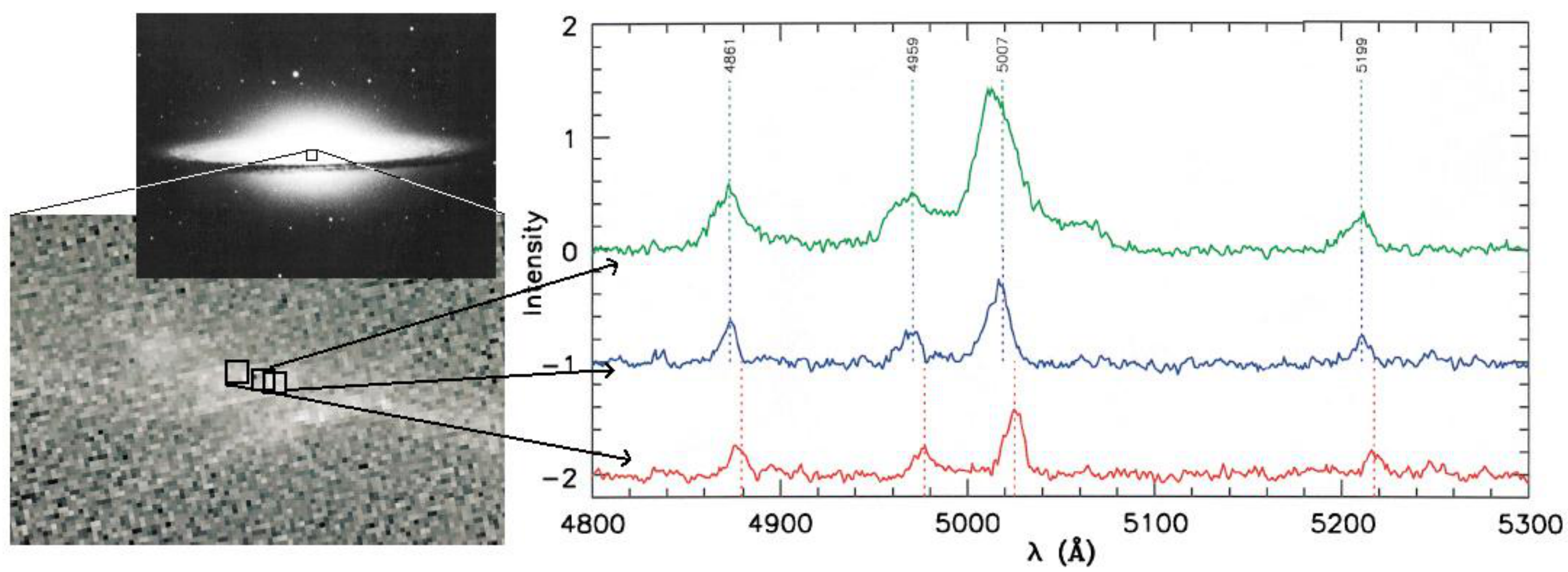
6.1. Is M104 approaching us or receding from us? (Answer this question by sketch drawing.)
6.2. Estimate the velocity of M104 towards us or away from us.
6.3. Roughly estimate the approximate mass of the supermassive black hole in the center of M104 (answer in solar masses m).
Решение
Official sketches for solutions. The source notes that these sketches are not full; team leaders should give more detailed explanations, while correct student solutions sufficient for 8 points may be shorter.
Solution
6.1. All the lines in the spectra are shifted somewhat to longer wavelengths (redshifted). Obviously, M104 is receding from us due to the expansion of the Universe.
6.2. The overall receding velocity of M104 may be found from the redshift of the spectrum of the central region. Taking the average redshift of the four emission lines, we find that
and since , the overall receding velocity of M104 is given by:
6.3. According to the Hubble law the distance to Sombrero Galaxy is
Note: In reality the distance to Sombrero Galaxy is 9 Mpc. But we continue solution according to the calculated value, 15 Mpc.
The first and second spectra have different shifts than the third one. It indicates that the gas which is generating the emission lines has a motion relative to the center of M104. The amounts of these redshifts are not too clear but evidently less than the third one. To find the mass of the smaller region near the center, we will use the first spectrum as obtained closer to the center region. The distance from the center of the galaxy to this near-center region can be found by measuring sizes at the lower picture. The angular distance is approximately 0.05 of the width of the lower image, . To get the actual distance in a.u., it is easy to use the formula
Note: In reality .
The average difference in redshifts of the first and third spectra may be estimated as about . Thus the velocity of the gas relative to the galactic center is about
Then, let us assume that the gas in the region of the third spectrum revolves around the galactic center in a circular orbit with the period T. Its revolving velocity is
By comparing with the average velocity of the Earth revolving around the Sun (A=1 au, P=1 year),
we find that
Assuming that the mass of the gas is much less than that of the galactic center and applying the Kepler’s III law (in units solar mass–au–year), we obtain the mass of the galactic center
Note: In reality, we should write .
It is an approximation for the mass of the supermassive black hole in the center of M104.
Source note: the key switches from z=0.0035 to 0.0036 while retaining 1050 km/s; the latter multiplication would give 1080. It also changes the moving gas from the first spectrum to the third in its prose. Both inconsistencies are retained. The “in reality” values above are statements of the 2014 source.
Official grading criteria
- 6.1. Spectra redshifted, receding from us — 1 pt.
- 6.2. z_av=(Δλ/λ)_average≈0.0035 — 1 pt; V=cz=0.0036×300000 km/s=1050 km/s — 1 pt.
- 6.3. L=V/H=1050 km/s /71 km/s/Mpc≈15 Mpc — 1 pt; R(au)=0.54×15·10⁶≈8·10⁶ — 1 pt; other correct calculations and obtaining mass of galactic center — 3 pt.
Jury note: evaluate the solution in essence rather than formal presence of sentences/formulae; award points when subsequent steps de facto use the required positions.
Parameters of orbits and physical characteristics
| Body | Distance (AU) | Distance (10⁶ km) | Period (tropical years) | Period (days) | Inclination i (°) | Eccentricity | Equatorial diameter (km) | Mass (10²⁴ kg) | Density (g/cm³) | Gravity (m/s²) | Axial tilt (°) | Max. magnitude | Albedo |
|---|---|---|---|---|---|---|---|---|---|---|---|---|---|
| Sun | 1392000 | 1989000 | 1.409 | −26.74 | |||||||||
| Mercury | 0.387 | 57.9 | 0.241 | 87.969 | 7.00 | 0.206 | 4879 | 0.3302 | 5.43 | 3.70 | 0.01 | 0.06 | |
| Venus | 0.723 | 108.2 | 0.615 | 224.7007 | 3.40 | 0.007 | 12104 | 4.8690 | 5.24 | 8.87 | 177.36 | 0.78 | |
| Earth | 1.000 | 149.6 | 1.000 | 365.2564 | 0.00 | 0.017 | 12756 | 5.9742 | 5.515 | 9.81 | 23.44 | 0.36 | |
| Moon | 0.00257 | 0.38440 | 0.0748 | 27.3217 | 5.15 | 0.055 | 3475 | 0.07348 | 3.34 | 1.62 | 6.7 | −12.7 | 0.07 |
| Mars | 1.524 | 227.9 | 1.880 | 686.98 | 1.85 | 0.093 | 6794 | 0.6419 | 3.94 | 3.71 | 25.19 | −2.0 | 0.15 |
| Jupiter | 5.204 | 778.6 | 11.862 | 4332.59 | 1.30 | 0.048 | 142984 | 1899.8 | 1.33 | 24.86 | 3.13 | −2.7 | 0.66 |
| Saturn | 9.584 | 1433.7 | 29.458 | 10759.20 | 2.48 | 0.054 | 120536 | 568.50 | 0.70 | 10.41 | 26.73 | 0.7 | 0.68 |
| Eris | 68.05 | 205029 | 43.82 | 0.435 | 2326 | 0.0167 | 2.52 | 0.7 | 0.96 |
Source footnote: for outer planets and Moon — in mean opposition. Blank cells are blank in the source.
Some constants and formulae
| Constant or formula | Value |
|---|---|
| Speed of light in vacuum c (m/s) | 299792458 |
| Constant of gravitation G (N·m²/kg²) | |
| Solar constant A (W/m²) | 1367 |
| Hubble parameter H₀ (km/s/Mpc), mean | 71 |
| Hubble parameter, range | 50–100 |
| Planck constant h (J·s) | |
| Charge of electron e (C) | |
| Mass of electron mₑ (kg) | |
| Proton-to-electron ratio | 1836.15 |
| Faraday constant F (C/mol) | 96485 |
| Magnetic constant μ₀ (H/m) | |
| Universal gas constant R (J/mol/K) | 8.314 |
| Boltzmann constant k (J/K) | |
| Stefan–Boltzmann constant σ (W/m²/K⁴) | |
| Wien displacement constant b (m·K) | 0.002897 |
| Laboratory wavelength Hα (Å) | 6562.81 |
| Tropical year length T (days) | 365.242199 |
| Standard atmosphere (Pa) | 101325 |
| Visible light extinction by terrestrial atmosphere in zenith (minimum) | 19%, 0.23 magnitudes |
| Height of homogeneous atmosphere (m) | 7991 |
| Refractive index of water for 20°C n | 1.334 |
| Moment of inertia of a solid ball | |
| Volume of a ball | |
| Area of sphere | |
| π | 3.14159265 |
| e | 2.71828183 |
| Golden ratio φ | 1.61803399 |
| Coordinates | Bishkek | Cholpon-Ata |
|---|---|---|
| Longitude E | 74°34′ | 77°05′ |
| Latitude N | 42°52′ | 42°39′ |
| Timezone | UT+6 | UT+6 |
28 brightest stars and some other stars
| Name | Designation | RA | Dec | Parallax (arcsec) | Magnitude | Spectral class |
|---|---|---|---|---|---|---|
| Altair | α Aql | 19h50m47s | 08°52′06″ | 0.195 | 0.77 | A7 |
| Capella | α Aur | 05h16m41s | 45°59′53″ | 0.073 | 0.08 | G5+G0 |
| Arcturus | α Boo | 14h15m38s | 19°10′57″ | 0.089 | −0.04ᵛ | K1 |
| Canopus | α Car | 06h23m57s | −52°41′45″ | 0.028 | −0.72 | F0 |
| Miaplacidus | β Car | 09h13m12s | −69°43′02″ | 0.029 | 1.68 | A2 |
| Toliman (Rigel Kent) | α Cen | 14h39m36s | −60°50′07″ | 0.747 | −0.01; 1.33 | G2; K1 |
| Hadar | β Cen | 14h03m49s | −60°22′23″ | 0.009 | 0.61 | B1 |
| Sirius | α CMa | 06h45m09s | −16°42′58″ | 0.375 | −1.46 | A1 |
| Adara | ε CMa | 06h58m38s | −28°58′19″ | 0.008 | 1.50 | B2 |
| Procyon | α CMi | 07h39m18s | 05°13′30″ | 0.288 | 0.38 | F5 |
| Acrux | α Cru | 12h26m36s | −63°05′57″ | 0.010 | 0.77 | B0 |
| Becrux | β Cru | 12h47m43s | −59°41′20″ | 0.009 | 1.30 | B0 |
| Gacrux | γ Cru | 12h31m10s | −57°06′48″ | 0.037 | 1.60 | M4 |
| Deneb | α Cyg | 20h41m26s | 45°16′49″ | 0.002 | 1.25 | A2 |
| Achernar | α Eri | 01h37m43s | −57°14′12″ | 0.026 | 0.46 | B3 |
| Castor | α Gem | 07h34m36s | 31°53′18″ | 0.065 | 1.58 | A1+A2 |
| Pollux | β Gem | 07h45m19s | 28°01′35″ | 0.097 | 1.14 | K0 |
| Regulus | α Leo | 10h08m22s | 11°58′02″ | 0.041 | 1.35 | B7 |
| Vega | α Lyr | 18h36m56s | 38°47′01″ | 0.123 | 0.03 | A0 |
| Betelgeuse | α Ori | 05h55m10s | 07°24′25″ | 0.005 | 0.5ᵛ | M2 |
| Rigel | β Ori | 05h14m32s | −08°12′06″ | 0.013 | 0.12 | B8 |
| Bellatrix | γ Ori | 05h25m08s | 06°20′59″ | 0.013 | 1.64 | B2 |
| Fomalhaut | α PsA | 22h57m39s | −29°37′20″ | 0.130 | 1.16 | A3 |
| Antares | α Sco | 16h29m24s | −26°25′55″ | 0.024 | 0.96 | M1+B4 |
| Shaula | λ Sco | 17h33m37s | −37°06′14″ | 0.005 | 1.62 | B2 |
| Aldebaran | α Tau | 04h35m55s | 16°30′33″ | 0.048 | 0.85ᵛ | K5 |
| Elnath | β Tau | 05h26m18s | 28°36′27″ | 0.025 | 1.66 | B7 |
| Spica | α Vir | 13h25m12s | −11°09′41″ | 0.023 | 0.98 | B1 |
Some other stars
| Name | Designation | RA | Dec | Parallax (arcsec) | Magnitude | Spectral class |
|---|---|---|---|---|---|---|
| Hamal | α Ari | 02h07m10s | 23°27′45″ | 0.050 | 2.01 | K2 |
| Sheratan | β Ari | 01h54m39s | 20°48′30″ | 0.055 | 2.64 | A5 |
| Thuban | α Dra | 14h04m23s | 64°22′33″ | 0.011 | 3.65 | A0 |
| Rastaban | β Dra | 17h30m26s | 52°18′05″ | 0.009 | 2.79 | G2 |
| Eltamin | γ Dra | 17h56m36s | 51°29′20″ | 0.021 | 2.24 | K5 |
| Polaris | α UMi | 02h31m49s | 89°15′51″ | 0.007 | 1.97ᵛ | F7 |
| Kochab | β UMi | 14h50m42s | 74°09′20″ | 0.025 | 2.07 | K4 |
| Pherkad | γ UMi | 15h20m44s | 71°50′02″ | 0.007 | 3.06ᵛ | A3 |
| Yildun | δ UMi | 17h32m19s | 86°35′11″ | 0.019 | 4.35 | A1 |
| Proxima Centauri | V645 Cen, α Cen C | 14h29m43s | −62°40′46″ | 0.769 | 11.05 | M5.5 |
Оригинал в Архива: betatheo.pdf · официални решения: theosol.pdf · допълнителни данни: theocriteria.pdf · допълнителни данни: sombrero.pdf · допълнителни данни: constants.pdf · допълнителни данни: hrd.pdf