IAO 2014, Теория, Група β — Задача 4. Hydroplanet
XIX International Astronomy Olympiad. Theoretical round. Group β · 12 октомври 2014 г. · 8 т.
Бележка
General note. Maybe not all problems have correct questions. Some questions (maybe the main question of the problem, maybe one of the subquestions) may make no real sense. In this case you have to write in your answer (in English or Russian): «impossible situation – ситуация невозможна». Of course, this answer has to be explained numerically or logically.
Data from the tables (Planetary data, stars, constants, etc.) may be used for solving every problem.
The answers «Да-Yes» or «Нет-No» have to be written in English or Russian.
Условие
Hydroplanet consists of a rocky “core” of radius and a thick layer of water surrounding it from all sides. Local humans live at the bottom of this world’s ocean (i.e., on the surface of the “core”), and hydrosphere is an analogue of our atmosphere for them. Local scientists observe astronomical objects from the bottom of the ocean. Like on our Earth, the duration of day-night period on Hydroplanet is T = 24 hours.
4.1. Find the minimum depth of the ocean, for which celestial bodies will be visible at the horizon.
4.2. What will be the duration of the day for inhabitants of the planet’s equator? The disk of the central star can be considered as a point source of light.
4.3. Calculate the value of “atmoshperical” refraction at the horizon on such a planet.
Points of your solution have to include drawings with all necessary sizes or angular sizes. The outer surface of the ocean is smooth, no waves or ripples.
Решение
Official sketches for solutions. The source notes that these sketches are not full; team leaders should give more detailed explanations, while correct student solutions sufficient for 8 points may be shorter.
Solution
When passing the border between the airless space and water, rays are reflected:
As a result the rays go steeper after refraction. Due to the total reflection effect, only those rays reach observers at the outer surface of the ocean, which are directed, in the water medium, so that their angle with respect to the normal to the water surface is below the critical value that occurs for , i.e. for .
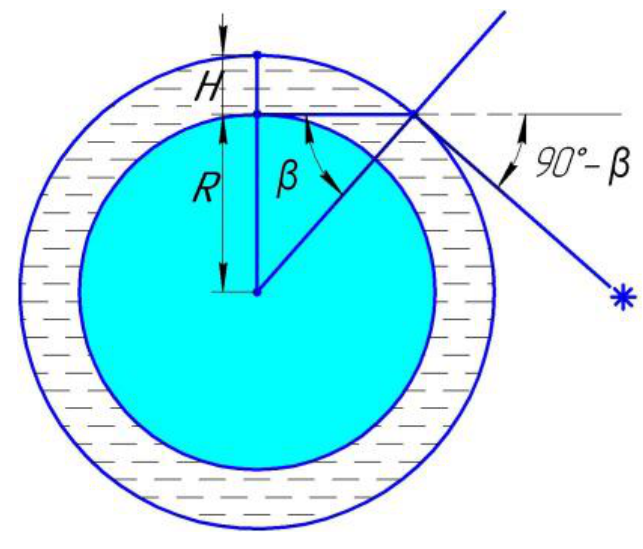
For low depth of the ocean, this is the largest zenith distance from which rays reach observers. When increasing the ocean’s depth, this critical zenith angle increases because of the surface curvature. Drawing a plot, it is easy to find that light from the horizon line begins to come in the case of the minimal ocean depth that satisfies the condition:
4.1. Answer: .
4.2. It appears from the same plot that the central star on the sky of the Hydroplanet passes, from its rise to its set, the angle
In hour units, this is .
4.3. It appears from the same plot that it is the angle that is analogous to the refraction angle at the horizon for such a planet.
Source note: the key prints 262.12° in 4.2; its printed β=48°33′ gives 262°54′ for 360°−2β. The printed angle and time are retained.
Official grading criteria
Common part
- Understanding nature of effect, total reflection effect — 2 pt.
- Correct drawing (also showing total reflection effect) — 1 pt.
- Using refractive index of water n=1.334, calculation sinβ and β — 1.5 pt.
4.1. Answer H=0.334R — 1.5 pt.
4.2. Calculation and correct answer — 1 pt.
4.3. Picture, calculation and correct answer — 1 pt.
Jury note: evaluate the solution in essence rather than formal presence of sentences/formulae; award points when subsequent steps de facto use the required positions.
Parameters of orbits and physical characteristics
| Body | Distance (AU) | Distance (10⁶ km) | Period (tropical years) | Period (days) | Inclination i (°) | Eccentricity | Equatorial diameter (km) | Mass (10²⁴ kg) | Density (g/cm³) | Gravity (m/s²) | Axial tilt (°) | Max. magnitude | Albedo |
|---|---|---|---|---|---|---|---|---|---|---|---|---|---|
| Sun | 1392000 | 1989000 | 1.409 | −26.74 | |||||||||
| Mercury | 0.387 | 57.9 | 0.241 | 87.969 | 7.00 | 0.206 | 4879 | 0.3302 | 5.43 | 3.70 | 0.01 | 0.06 | |
| Venus | 0.723 | 108.2 | 0.615 | 224.7007 | 3.40 | 0.007 | 12104 | 4.8690 | 5.24 | 8.87 | 177.36 | 0.78 | |
| Earth | 1.000 | 149.6 | 1.000 | 365.2564 | 0.00 | 0.017 | 12756 | 5.9742 | 5.515 | 9.81 | 23.44 | 0.36 | |
| Moon | 0.00257 | 0.38440 | 0.0748 | 27.3217 | 5.15 | 0.055 | 3475 | 0.07348 | 3.34 | 1.62 | 6.7 | −12.7 | 0.07 |
| Mars | 1.524 | 227.9 | 1.880 | 686.98 | 1.85 | 0.093 | 6794 | 0.6419 | 3.94 | 3.71 | 25.19 | −2.0 | 0.15 |
| Jupiter | 5.204 | 778.6 | 11.862 | 4332.59 | 1.30 | 0.048 | 142984 | 1899.8 | 1.33 | 24.86 | 3.13 | −2.7 | 0.66 |
| Saturn | 9.584 | 1433.7 | 29.458 | 10759.20 | 2.48 | 0.054 | 120536 | 568.50 | 0.70 | 10.41 | 26.73 | 0.7 | 0.68 |
| Eris | 68.05 | 205029 | 43.82 | 0.435 | 2326 | 0.0167 | 2.52 | 0.7 | 0.96 |
Source footnote: for outer planets and Moon — in mean opposition. Blank cells are blank in the source.
Some constants and formulae
| Constant or formula | Value |
|---|---|
| Speed of light in vacuum c (m/s) | 299792458 |
| Constant of gravitation G (N·m²/kg²) | |
| Solar constant A (W/m²) | 1367 |
| Hubble parameter H₀ (km/s/Mpc), mean | 71 |
| Hubble parameter, range | 50–100 |
| Planck constant h (J·s) | |
| Charge of electron e (C) | |
| Mass of electron mₑ (kg) | |
| Proton-to-electron ratio | 1836.15 |
| Faraday constant F (C/mol) | 96485 |
| Magnetic constant μ₀ (H/m) | |
| Universal gas constant R (J/mol/K) | 8.314 |
| Boltzmann constant k (J/K) | |
| Stefan–Boltzmann constant σ (W/m²/K⁴) | |
| Wien displacement constant b (m·K) | 0.002897 |
| Laboratory wavelength Hα (Å) | 6562.81 |
| Tropical year length T (days) | 365.242199 |
| Standard atmosphere (Pa) | 101325 |
| Visible light extinction by terrestrial atmosphere in zenith (minimum) | 19%, 0.23 magnitudes |
| Height of homogeneous atmosphere (m) | 7991 |
| Refractive index of water for 20°C n | 1.334 |
| Moment of inertia of a solid ball | |
| Volume of a ball | |
| Area of sphere | |
| π | 3.14159265 |
| e | 2.71828183 |
| Golden ratio φ | 1.61803399 |
| Coordinates | Bishkek | Cholpon-Ata |
|---|---|---|
| Longitude E | 74°34′ | 77°05′ |
| Latitude N | 42°52′ | 42°39′ |
| Timezone | UT+6 | UT+6 |
28 brightest stars and some other stars
| Name | Designation | RA | Dec | Parallax (arcsec) | Magnitude | Spectral class |
|---|---|---|---|---|---|---|
| Altair | α Aql | 19h50m47s | 08°52′06″ | 0.195 | 0.77 | A7 |
| Capella | α Aur | 05h16m41s | 45°59′53″ | 0.073 | 0.08 | G5+G0 |
| Arcturus | α Boo | 14h15m38s | 19°10′57″ | 0.089 | −0.04ᵛ | K1 |
| Canopus | α Car | 06h23m57s | −52°41′45″ | 0.028 | −0.72 | F0 |
| Miaplacidus | β Car | 09h13m12s | −69°43′02″ | 0.029 | 1.68 | A2 |
| Toliman (Rigel Kent) | α Cen | 14h39m36s | −60°50′07″ | 0.747 | −0.01; 1.33 | G2; K1 |
| Hadar | β Cen | 14h03m49s | −60°22′23″ | 0.009 | 0.61 | B1 |
| Sirius | α CMa | 06h45m09s | −16°42′58″ | 0.375 | −1.46 | A1 |
| Adara | ε CMa | 06h58m38s | −28°58′19″ | 0.008 | 1.50 | B2 |
| Procyon | α CMi | 07h39m18s | 05°13′30″ | 0.288 | 0.38 | F5 |
| Acrux | α Cru | 12h26m36s | −63°05′57″ | 0.010 | 0.77 | B0 |
| Becrux | β Cru | 12h47m43s | −59°41′20″ | 0.009 | 1.30 | B0 |
| Gacrux | γ Cru | 12h31m10s | −57°06′48″ | 0.037 | 1.60 | M4 |
| Deneb | α Cyg | 20h41m26s | 45°16′49″ | 0.002 | 1.25 | A2 |
| Achernar | α Eri | 01h37m43s | −57°14′12″ | 0.026 | 0.46 | B3 |
| Castor | α Gem | 07h34m36s | 31°53′18″ | 0.065 | 1.58 | A1+A2 |
| Pollux | β Gem | 07h45m19s | 28°01′35″ | 0.097 | 1.14 | K0 |
| Regulus | α Leo | 10h08m22s | 11°58′02″ | 0.041 | 1.35 | B7 |
| Vega | α Lyr | 18h36m56s | 38°47′01″ | 0.123 | 0.03 | A0 |
| Betelgeuse | α Ori | 05h55m10s | 07°24′25″ | 0.005 | 0.5ᵛ | M2 |
| Rigel | β Ori | 05h14m32s | −08°12′06″ | 0.013 | 0.12 | B8 |
| Bellatrix | γ Ori | 05h25m08s | 06°20′59″ | 0.013 | 1.64 | B2 |
| Fomalhaut | α PsA | 22h57m39s | −29°37′20″ | 0.130 | 1.16 | A3 |
| Antares | α Sco | 16h29m24s | −26°25′55″ | 0.024 | 0.96 | M1+B4 |
| Shaula | λ Sco | 17h33m37s | −37°06′14″ | 0.005 | 1.62 | B2 |
| Aldebaran | α Tau | 04h35m55s | 16°30′33″ | 0.048 | 0.85ᵛ | K5 |
| Elnath | β Tau | 05h26m18s | 28°36′27″ | 0.025 | 1.66 | B7 |
| Spica | α Vir | 13h25m12s | −11°09′41″ | 0.023 | 0.98 | B1 |
Some other stars
| Name | Designation | RA | Dec | Parallax (arcsec) | Magnitude | Spectral class |
|---|---|---|---|---|---|---|
| Hamal | α Ari | 02h07m10s | 23°27′45″ | 0.050 | 2.01 | K2 |
| Sheratan | β Ari | 01h54m39s | 20°48′30″ | 0.055 | 2.64 | A5 |
| Thuban | α Dra | 14h04m23s | 64°22′33″ | 0.011 | 3.65 | A0 |
| Rastaban | β Dra | 17h30m26s | 52°18′05″ | 0.009 | 2.79 | G2 |
| Eltamin | γ Dra | 17h56m36s | 51°29′20″ | 0.021 | 2.24 | K5 |
| Polaris | α UMi | 02h31m49s | 89°15′51″ | 0.007 | 1.97ᵛ | F7 |
| Kochab | β UMi | 14h50m42s | 74°09′20″ | 0.025 | 2.07 | K4 |
| Pherkad | γ UMi | 15h20m44s | 71°50′02″ | 0.007 | 3.06ᵛ | A3 |
| Yildun | δ UMi | 17h32m19s | 86°35′11″ | 0.019 | 4.35 | A1 |
| Proxima Centauri | V645 Cen, α Cen C | 14h29m43s | −62°40′46″ | 0.769 | 11.05 | M5.5 |
Оригинал в Архива: betatheo.pdf · официални решения: theosol.pdf · допълнителни данни: theocriteria.pdf · допълнителни данни: sombrero.pdf · допълнителни данни: constants.pdf · допълнителни данни: hrd.pdf