IAO 2016, Практически тур, Група α — Задача 6. Наблюдатель кометы
XXI Международная астрономическая олимпиада. Задачи практического тура. Группа α · 5 октомври 2016 г. · 12 т.
Об источниках
Русское условие напечатано с пометкой «Только для перевода». Отсутствующие в нём рисунки и таблица восстановлены из соответствующей английской версии того же задания. Официальное решение приведено на исходном английском языке; отдельного русского ключа в архиве нет. Английская языковая версия задачи сохраняется отдельно. Баллы для пунктов взяты из официального ключа.
Условие
В таблице 1 представлены эфемериды 20 наблюдений кометы P/2007 R2 (Гиббса), полученные через равные промежутки времени в 121 дней 18 часов (3 наблюдения в год). Угол наклона орбиты кометы составляет и им можно пренебречь. Использованы следующие обозначения:
- N – порядковый номер наблюдения.
- Date (UT) – дата, а HR и MN – это время наблюдения (час, минуты) по всемирному времени.
- R. A. (измеряется в часах, минутах и секундах) и DEC (градусах, минутах и секундах) – прямое восхождение и склонение центра кометы соответствено.
- T-mag – примерная полная видимая звёздная величина кометы.
- Delta – расстояние от наблюдателя до центра кометы в момент наблюдения в астрономических единицах (а.е.).
- S-O-C (Sun-Observer-Comet) – угол Солнце-Наблюдатель-Комета в градусах, (видимая солнечная элонгация кометы, измеряемая с места наблюдения в диапазоне 0º – 180º).
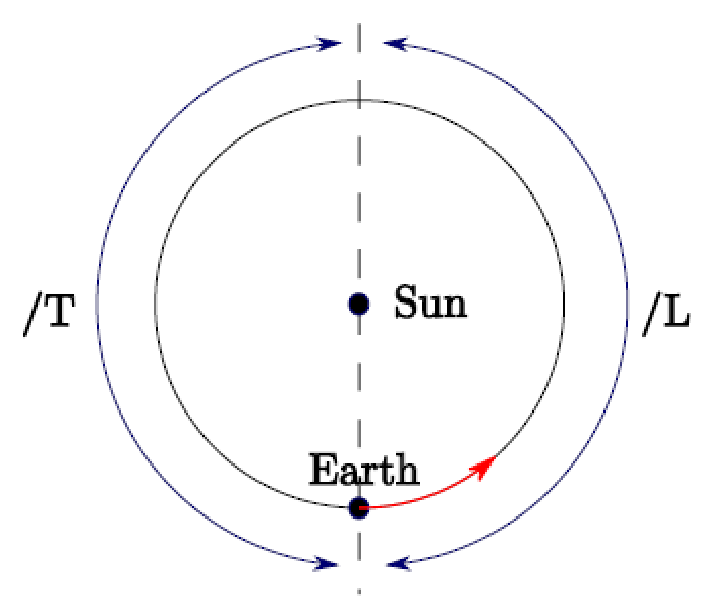
- Столбец «r'» – видимое положение кометы относительно Солнца на небе;
/T означает что комета следует за Солнцем (восходит и заходит позже Солнца)
/L означает что комета находится впереди Солнца (восходит и заходит раньше Солнца), как показано на Рис.1.
На рисунке 1 изображена орбита Земли вокруг Солнца, как она видна с северного полюса эклиптики. Направление орбитального движения Земли показано стрелкой.
С помощью этих данных:
6.1. Нарисуйте на мллиметровой бумаге орбиту кометы как её видно с северного полюса эклиптики. Обозначите точки (положения кометы) соответствующими номерами . Считайте, что Земля движется с постоянной орбитальной скоростью. [2 т.]
6.2. Вычислите величину большой полуоси её орбиты и эксцентриситета . [3 т.]
6.3. Оцените орбитальный период кометы , не исспользуя при этом никаких других данных (как, например, массу Солнца или III закон Кеплера). [1 т.]
6.4. Вычислите скорость кометы в перигелии и афелии , не используя при этом никаких других данных (например, массу Солнца). [2 т.]
6.5. Вычислите массу Солнца . Гравитационной постоянная равна . [2 т.]
6.6. Вычислите скорость кометы и скорость убегания (вторую космическую скорость) для положения . [2 т.]
Таблица 1. Эфемериды кометы
Таблица и рисунок восстановлены из второй страницы английского оригинала practical_6a.pdf. Заголовки таблицы двуязычны в источнике.
| N | Date (UT) | HR:MN | R. A. | DEC | T-mag | Delta | S-O-C | /r |
|---|---|---|---|---|---|---|---|---|
| 1 | 2004-09-30 | 00:00 | 12 26 37.40 | -02 35 00.4 | 33.12 | 6.485 | 0.271 | /T |
| 2 | 2005-01-29 | 18:00 | 13 28 32.58 | -09 15 06.5 | 32.32 | 4.967 | 105.966 | /L |
| 3 | 2005-05-31 | 12:00 | 12 38 34.29 | -04 26 57.7 | 31.77 | 4.493 | 120.555 | /T |
| 4 | 2005-09-30 | 06:00 | 13 29 55.02 | -09 49 15.1 | 31.82 | 5.715 | 17.327 | /T |
| 5 | 2006-01-30 | 00:00 | 15 07 52.88 | -18 16 04.6 | 30.60 | 4.419 | 80.257 | /L |
| 6 | 2006-05-31 | 18:00 | 14 28 41.00 | -15 54 56.7 | 28.80 | 2.940 | 149.891 | /T |
| 7 | 2006-09-30 | 12:00 | 15 08 57.98 | -18 38 54.3 | 28.09 | 3.884 | 42.866 | /T |
| 8 | 2007-01-30 | 06:00 | 18 31 38.72 | -24 18 09.1 | 25.77 | 3.252 | 32.669 | /L |
| 9 | 2007-06-01 | 00:00 | 23 02 49.26 | -07 42 38.0 | 21.35 | 1.464 | 86.189 | /L |
| 10 | 2007-09-30 | 18:00 | 03 31 15.59 | +20 03 36.3 | 18.62 | 0.649 | 131.671 | /L |
| 11 | 2008-01-30 | 12:00 | 03 43 46.19 | +21 38 57.9 | 23.18 | 1.616 | 108.756 | /T |
| 12 | 2008-05-31 | 06:00 | 06 55 11.41 | +23 55 34.8 | 27.27 | 3.724 | 32.564 | /T |
| 13 | 2008-09-30 | 00:00 | 09 38 45.54 | +15 09 48.2 | 29.09 | 4.234 | 45.116 | /L |
| 14 | 2009-01-29 | 18:00 | 09 57 24.96 | +13 53 18.2 | 29.55 | 3.204 | 163.127 | /L |
| 15 | 2009-05-31 | 12:00 | 09 31 40.74 | +15 30 19.4 | 31.20 | 4.845 | 70.213 | /T |
| 16 | 2009-09-30 | 06:00 | 11 04 18.66 | +06 35 02.1 | 32.13 | 5.854 | 22.454 | /L |
| 17 | 2010-01-30 | 00:00 | 11 42 42.32 | +02 32 28.1 | 31.90 | 4.447 | 134.801 | /L |
| 18 | 2010-05-31 | 18:00 | 10 57 35.25 | +07 03 49.9 | 32.45 | 5.196 | 92.885 | /T |
| 19 | 2010-09-30 | 12:00 | 12 04 42.28 | -00 18 36.2 | 33.00 | 6.407 | 5.875 | /L |
| 20 | 2011-01-30 | 06:00 | 12 58 53.76 | -06 12 50.7 | 32.40 | 4.920 | 113.868 | /L |
Отговори
6.2. a ≈ 3.45 AU, e ≈ 0.58
From the official solution (measured on the drawing); the solution adds that the real values are a ≈ 3.44 AU and e ≈ 0.57.
6.3. 6.33 years
The solution adds that the real value is T ≈ 6.38 years.
6.4. va ≈ 31.5 km/s, vp ≈ 8.4 km/s (as printed)
As printed in the official solution. The printed labels appear swapped: the comet is faster at perihelion, so physically the perihelion speed is ≈ 31.5 km/s and the aphelion speed ≈ 8.4 km/s.
6.5. kg
6.6. v ≈ 17.2 km/s, ve ≈ 23.7 km/s
From the official solution, with the measured r = 3.25 AU.
Решение
Официальное решение на английском языке / Official solution in English.
The gravitational constant is or .
6.1
We start off by drawing the Earth’s orbit. Using the tabular data we find that the suitable value for the radius is 2 cm. Because there are 3 observations per year, as noted in the text, there are just 3 positions of the Earth, where the observations take place: one for 30 September, one for 29-30 January and one for 31 May-1 June. We mark these positions on the graph paper. Because 30 Sep 2004 is when Delta takes the largest tabular value (6.485 AU), it is convenient to place 30 Sep on the x-axis. The other two observational points are separated by an angle of and are easily marked using simple geometry.
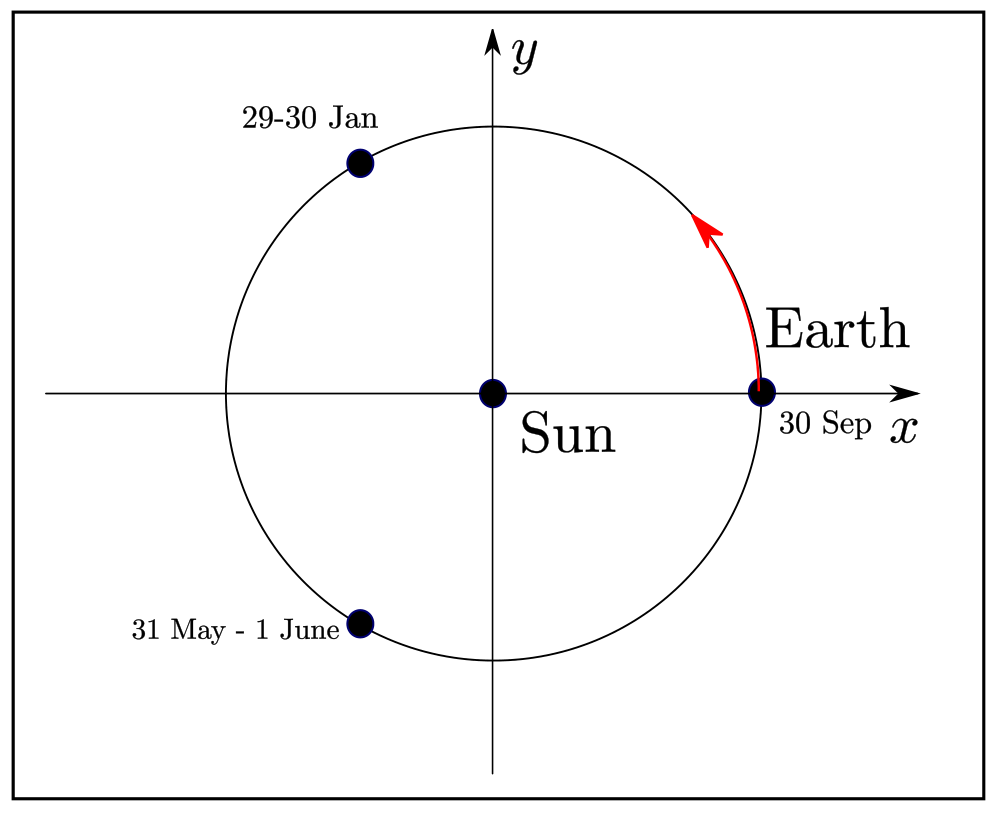
Next we draw all 20 points from the table on the graphing paper, where each point represents the comet’s position for a particular observation with given . To this end, we use only columns Date(UT), Delta and S-O-T and disregard the rest. Note that Delta is the distance between the comet and the Earth. Therefore some care must be exercised to measure Delta from the correct position of the Earth defined by Date(UT).
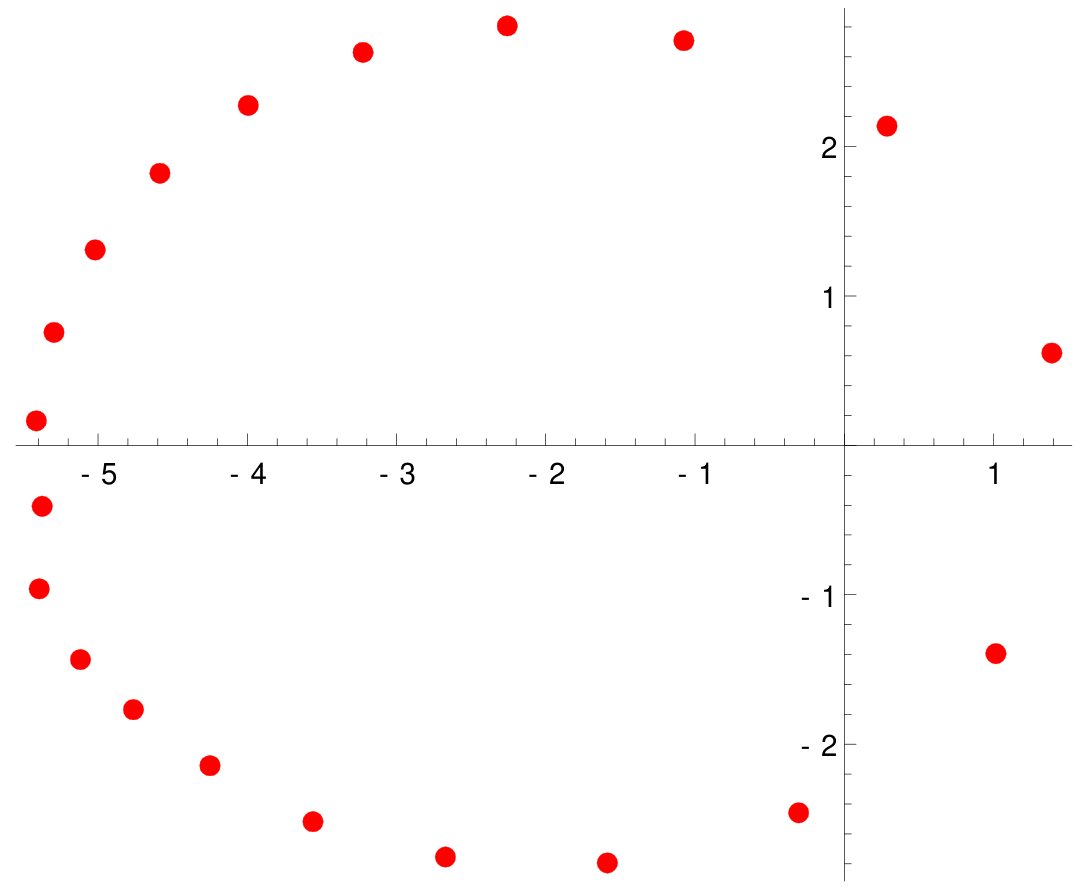
Next we draw a smooth closed curve around the points, which resembles an ellipse.
Source note: the solution names the column S-O-T, while the supplied table labels it S-O-C.
6.2
First by observing the curve we identify the direction of the semi-major axis. Then we draw a line along this direction, which approximately halves the ellipse. Next we mark the so-obtained perihelion and aphelion and measure the distance between them, which yields . We also measure the perihelion distance, which yields . Bearing in mind that 2 cm = 1 AU, we find that
In fact, the real values are AU and .
6.3
The first point () and the last point () almost lie on the x-axis meaning that for the time interval separating these observations, the comet has done a full cycle. Therefore we obtain
while the real value is years.
6.4
From Kepler’s second law we know that a line segment joining an orbiting body and the Sun sweeps out equal areas during equal intervals of time . This means that , where is the area inside the ellipse, and is the comet’s orbital period. Note that at the perihelion and at the aphelion the following identities hold for very small :
For the derivation consider the area of an isosceles triangle of height and base .
Thus we find
We can express the speeds directly by and if we use the formula :
Source discrepancy: the first numerical line swaps the perihelion/aphelion labels; the next line changes the square-root factors but retains the same numerical values. These expressions are reproduced as printed. The following 6.6 derivation uses the perihelion expression with .
6.5
The solar mass can be obtained directly from the identity (neglecting the comet’s mass): . Thus we have
6.6
From conservation of energy we have , which gives
In solution 6.4. we found . From we obtain .
Thus we arrive at
For the observation with we measure that AU, so we get km/s.
The escape velocity at this point is obtained by taking the limit as approaches :
Справочный лист 2016: параметры орбит, тел и звёзд
Дополнительный справочный лист из архива того же года; в шапке напечатано «Theo». Ограничения на использование дополнительных данных в отдельных пунктах условия сохраняются.
| Body | Distance (AU) | Distance (10⁶ km) | Period (tropical years) | Period (days) | Eccentricity | Equatorial diameter (km) | Mass (10²⁴ kg) | Density (g/cm³) | Gravity (m/s²) | Maximum magnitude | Albedo |
|---|---|---|---|---|---|---|---|---|---|---|---|
| Sun | 1392000 | 1989000 | 1.409 | −26.8 | |||||||
| Mercury | 0.387 | 57.9 | 0.241 | 87.969 | 0.206 | 4879 | 0.3302 | 5.43 | 3.70 | −2.2 | 0.06 |
| Venus | 0.723 | 108.2 | 0.615 | 224.701 | 0.007 | 12104 | 4.8690 | 5.24 | 8.87 | −4.7 | 0.78 |
| Earth | 1.000 | 149.6 | 1.000 | 365.256 | 0.017 | 12756 | 5.9742 | 5.515 | 9.81 | 0.36 | |
| Moon | 0.00257 | 0.38440 | 0.0748 | 27.3217 | 0.055 | 3475 | 0.0735 | 3.34 | 1.62 | −12.7 | 0.07 |
| Mars | 1.524 | 227.9 | 1.880 | 686.980 | 0.093 | 6794 | 0.6419 | 3.94 | 3.71 | −2.0 | 0.15 |
| Ceres | 2.77 | 414 | 4.60 | 1681 | 0.077 | 963 | 0.0009 | 2.16 | 0.27 | 6.7 | 0.09 |
| Jupiter | 5.204 | 778.6 | 11.862 | 4332.59 | 0.048 | 142984 | 1899.8 | 1.33 | 24.86 | −2.7 | 0.66 |
| Saturn | 9.584 | 1433.7 | 29.458 | 10759.20 | 0.054 | 120536 | 568.50 | 0.70 | 10.41 | 0.7 | 0.68 |
| Uranus | 19.191 | 2871.0 | 84.015 | 30685.93 | 0.046 | 51118 | 86.625 | 1.30 | 8.44 | 5.5 | 0.74 |
| Neptune | 30.071 | 4498.6 | 164.778 | 60187.64 | 0.008 | 49532 | 102.78 | 1.76 | 11.20 | 7.8 | 0.58 |
| Pluto | 39.482 | 5906.4 | 248.09 | 90613 | 0.249 | 2374 | 0.0130 | 1.86 | 0.61 | 15.1 | 0.6 |
| Makemake | 45.436 | 5906.4 | 306.28 | 111867 | 0.163 | 1502 | 0.003 | 1.70 | 0.40 | 0.77 | |
| Eris | 67.668 | 10210 | 557 | 203500 | 0.441 | 2326 | 0.0167 | 2.52 | 0.68 | 0.90 |
For outer planets and Moon — in mean opposition. Blank cells are blank in the source.
Данные о некоторых звёздах / Data of some stars
| Name | Designation | RA | DEC | Distance | Magnitude | Temperature | Mass |
|---|---|---|---|---|---|---|---|
| Солнце / Sun | ☉ | 0h–24h | −23°26′ to +23°26′ | 1 au | −26.74 | 5777 K | 1 M☉ |
| Бетельгейзе / Betelgeuse | α Ori | 05h55m10s | 07°24′25″ | 197 pc | 0.5 | 3590 K | 11.6 M☉ |
| Альфа Центавра / Alpha Centauri A; B | α Cen | 14h39m36s | −60°50′07″ | 1.33 pc | −0.01; 1.33 | 5810 K; 5260 K | 1.11 M☉; 0.93 M☉ |
В таблице Makemake напечатано 45.436 au и 5906.4 млн км; оба исходных значения сохранены. Звёздная величина Солнца напечатана −26.8 в планетной таблице и −26.74 в таблице звёзд.
Справочный лист 2016: константы и формулы
Дополнительный справочный лист из архива того же года; в шапке напечатано «Theo». Ограничения на использование дополнительных данных в отдельных пунктах условия сохраняются.
| Constant or formula | Value |
|---|---|
| Speed of light in vacuum c (m/s) | 299792458 |
| Constant of gravitation G (N·m²/kg²) | |
| Solar constant A (W/m²) | 1367 |
| Hubble parameter H₀ (km/s/Mpc), mean | 68 |
| Hubble parameter, range | 50–100 |
| Planck constant h (J·s) | |
| Charge of electron e (C) | |
| Mass of electron mₑ (kg) | |
| Proton-to-electron ratio | 1836.15 |
| Faraday constant F (C/mol) | 96485 |
| Magnetic constant μ₀ (H/m) | |
| Universal gas constant R (J/mol/K) | 8.314 |
| Boltzmann constant k (J/K) | |
| Stefan–Boltzmann constant σ (W/m²/K⁴) | |
| Wien displacement constant b (m·K) | 0.002897 |
| Laboratory wavelength Hα (Å) | 6562.81 |
| Tropical year length T (days) | 365.242199 |
| Sidereal year length T (days) | 365.25636 |
| Anomalistic year length T (days) | 365.259636 |
| Nodal period of lunar orbit (years) | −18.6 |
| Standard atmosphere (Pa) | 101325 |
| Visible light extinction by terrestrial atmosphere in zenith (minimum) | 19%, 0.23 magnitudes |
| Height of homogeneous atmosphere (m) | 7991 |
| Refractive index of water for 20°C n | 1.334 |
| Moment of inertia of a solid ball | |
| Moment of inertia of sphere | |
| Volume of a ball | |
| Area of sphere | |
| π | 3.14159265 |
| e | 2.71828183 |
| Golden ratio φ | 1.61803399 |
Оригинал в Архива: 6a_ru.pdf · официални решения: practical_6a-solution.pdf · допълнителни данни: practical_6a.pdf · допълнителни данни: data_1.png · допълнителни данни: data_2.png