IAO 2016, Практически тур — αβ-7. Начална функция на масите и свръхновите
XXI Международная астрономическая олимпиада · XXI International Astronomy Olympiad · Болгария, Пампорово-Смолян 5 – 13. X. 2016 · Round: Prac · 5 октомври 2016 г. · 8 т.
Source recovery / Източници
The original Russian/Bulgarian questions are retained as a distinct language edition. Missing figures and data are supplied from the matching English originals. Official solutions remain in their original English; no Russian or Bulgarian official key occurs in the complete year inventory. Part points come from the official keys.
Условие
Еволюцията на единична звезда зависи преди всичко от нейната маса, затова масата е най-важният параметър на звездите. Смята се, че разпределението на звездите по маси в момента на тяхното раждане (известно също като начална функция на масите, Initial Mass Function – IMF), има универсален характер.
На Фиг. 2 е дадена началната функция на масите в логаритмична скала в съответствие с два различни модела. Данните от наблюденията са представени в равни интервали, заедно с грешките. По оста Y е нанесено относителното количество звезди () с дадена маса.
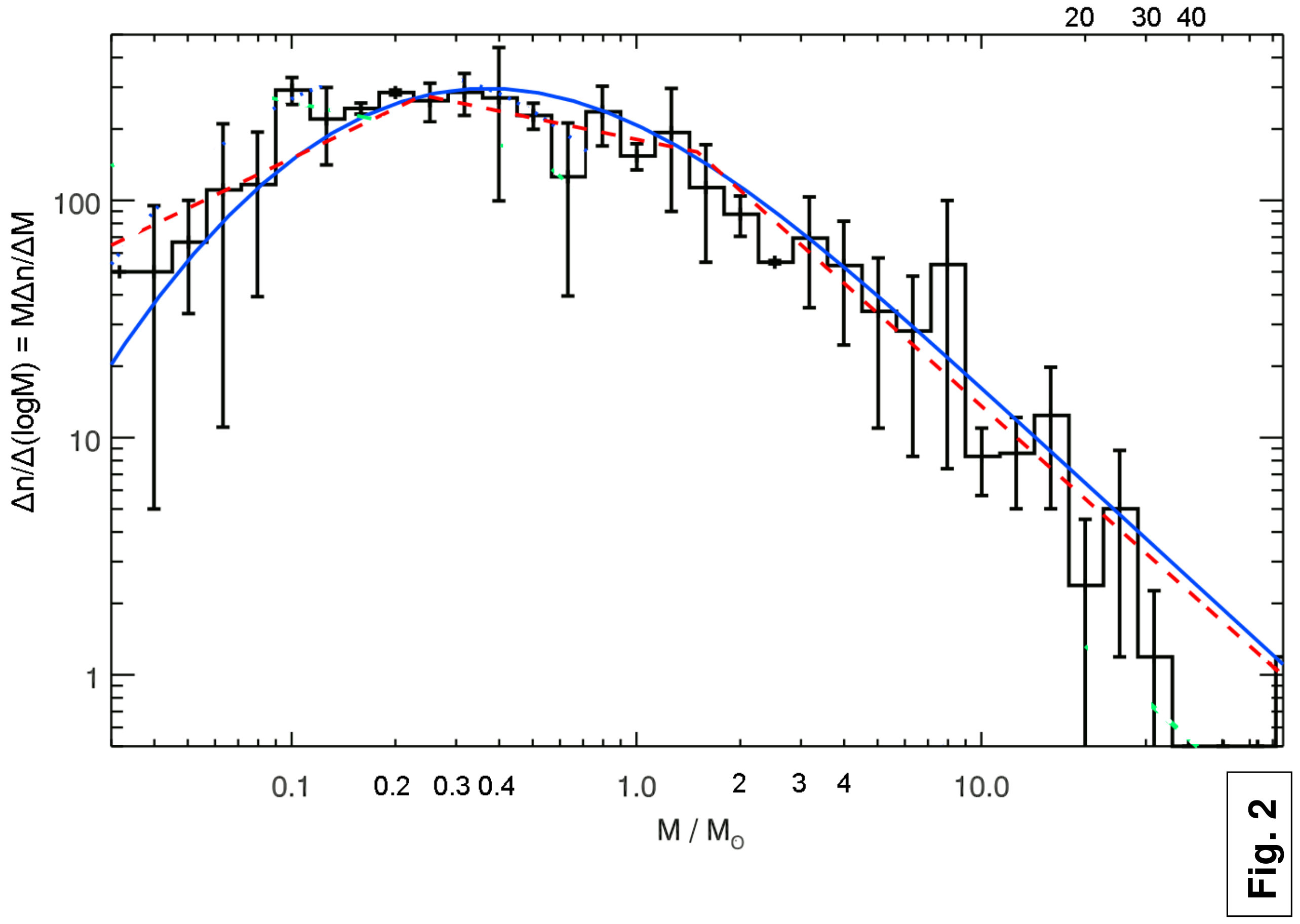
7.1. Скоростта на звездообразуване в нашата Галактика е примерно равна на за година. Звездите с маси по-големи от се взривяват като свръхнови с гравитационен колапс на ядрото. Оценете честотата на поява на свръхнови с гравитационен колапс на ядрото в нашата Галактика (с други думи – колко често избухват свръхнови от дадения тип в нашата Галактика).
Подсказване: Каква е средната начална маса на една свръхнова? Каква част от общата маса на образуващите се звезди участва във формирането на свръхновите ()? Намерете отговорите на тези въпроси като направите измервания по графиката на IMF на Фиг. 2. [6 т.]
7.2. Каква е честотата (в единици година) на поява на непосредствено наблюдаеми свръхнови в Млечния път? Ако тази честота е съществено различна от получения от вас резултат в 7.1., дайте обяснение за това чрез изобразяване на същността на явлението върху схема, а при необходимост също и с много кратък текст (не повече от 20 думи). [2 т.]
Отговори
7.1. 0.12 yr⁻¹
Official solution: MSN ~ 20 M☉, q ~ 30%, f = q(ΔM/Δt)/MSN ~ 0.12 yr⁻¹ (a supernova each 8 years); values within an order of magnitude are accepted. The actual values quoted are MSN ~ 12 M☉, q ~ 8%, f = 1/20 yr⁻¹.
7.2. 0.0025 yr⁻¹
Official solution: f ~ 1/400 yr⁻¹; many explosions are obscured by dust in the galactic disk.
Решение
Official solution in English.
The gravitational constant is or .
7.1 — 6pts (3pts for reasonably accurate measurements + 3pts for further considerations)
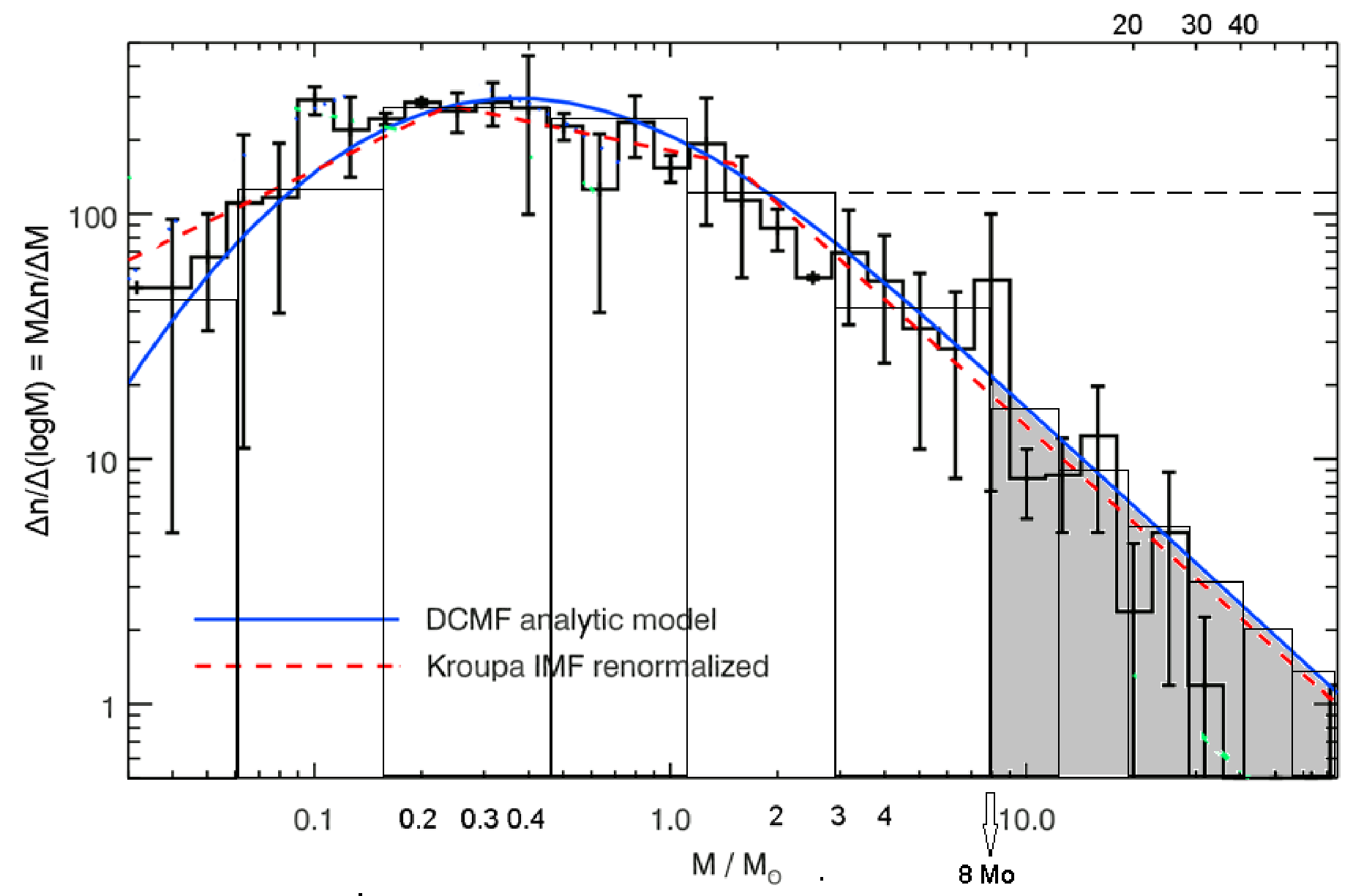
Stars with an initial mass > explode as core-collapse supernovae. Let us mark on the IMF figure the space where these stars reside with grey. Then we divide both the left and the right part of the graph with bins. We calculate the scales on both axes:
X:
Y: (defining )
The base of the Y-axis logarithm is irrelevant – if it is changed, the function is multiplied by a constant and the final results should be the same.
For each bin we calculate the width and the height . We make the rough approximation that so the process is analogous to numerical integration and can be expressed with integrals as well. For further accuracy the function can be extrapolated linearly until it crosses the X-axis at ~ .
For each bin we then calculate the X-axis center M and the value of that corresponds to the bin width. If the values to the left of the vertical line are , and to the right are , , we can obtain
A reasonable result would be , .
Other mathematical methods and bin distributions may be used so these values are correct within an order of magnitude. Participants from group α can avoid the usage of logarithms by considering the Y-axis in the form and by doing linear approximations between the X-axis ticks (or by choosing bins using the ticks).
As the galactic star formation rate is said to be , and the timescale of the evolution of massive stars is much lower than the change of this rate, the mass rate of supernova explosions is
This mass is distributed among objects with an average mass therefore the expected frequency is
or the derived expectations are that there should be a supernova each 8 years on average. Please note that the mass loss of massive stars is not taken into account which leads to significant systematic errors. The mass of supernova progenitors right before the explosion is significantly lower than their initial mass. The actual values are , , and .
7.2 — 2pts
The last directly observed galactic supernovae exploded in 1006, 1054, 1572 and 1604 and some of them were type Ia, which are less massive systems with a different mechanism of explosion. So the approximate value of the observed frequency is
This value is significantly lower than the one derived in 7.1. A possible explanation is that many explosions are obscured by dust as massive stars are situated in the galactic disk. As we lie inside it, the galactic disk covers a large angular area on the sky which is not easy to monitor. Furthermore, most of the observations historically were conducted from the Northern Hemisphere.
Справочный лист 2016: параметры орбит, тел и звёзд
Дополнительный справочный лист из архива того же года; в шапке напечатано «Theo». Ограничения на использование дополнительных данных в отдельных пунктах условия сохраняются.
| Body | Distance (AU) | Distance (10⁶ km) | Period (tropical years) | Period (days) | Eccentricity | Equatorial diameter (km) | Mass (10²⁴ kg) | Density (g/cm³) | Gravity (m/s²) | Maximum magnitude | Albedo |
|---|---|---|---|---|---|---|---|---|---|---|---|
| Sun | 1392000 | 1989000 | 1.409 | −26.8 | |||||||
| Mercury | 0.387 | 57.9 | 0.241 | 87.969 | 0.206 | 4879 | 0.3302 | 5.43 | 3.70 | −2.2 | 0.06 |
| Venus | 0.723 | 108.2 | 0.615 | 224.701 | 0.007 | 12104 | 4.8690 | 5.24 | 8.87 | −4.7 | 0.78 |
| Earth | 1.000 | 149.6 | 1.000 | 365.256 | 0.017 | 12756 | 5.9742 | 5.515 | 9.81 | 0.36 | |
| Moon | 0.00257 | 0.38440 | 0.0748 | 27.3217 | 0.055 | 3475 | 0.0735 | 3.34 | 1.62 | −12.7 | 0.07 |
| Mars | 1.524 | 227.9 | 1.880 | 686.980 | 0.093 | 6794 | 0.6419 | 3.94 | 3.71 | −2.0 | 0.15 |
| Ceres | 2.77 | 414 | 4.60 | 1681 | 0.077 | 963 | 0.0009 | 2.16 | 0.27 | 6.7 | 0.09 |
| Jupiter | 5.204 | 778.6 | 11.862 | 4332.59 | 0.048 | 142984 | 1899.8 | 1.33 | 24.86 | −2.7 | 0.66 |
| Saturn | 9.584 | 1433.7 | 29.458 | 10759.20 | 0.054 | 120536 | 568.50 | 0.70 | 10.41 | 0.7 | 0.68 |
| Uranus | 19.191 | 2871.0 | 84.015 | 30685.93 | 0.046 | 51118 | 86.625 | 1.30 | 8.44 | 5.5 | 0.74 |
| Neptune | 30.071 | 4498.6 | 164.778 | 60187.64 | 0.008 | 49532 | 102.78 | 1.76 | 11.20 | 7.8 | 0.58 |
| Pluto | 39.482 | 5906.4 | 248.09 | 90613 | 0.249 | 2374 | 0.0130 | 1.86 | 0.61 | 15.1 | 0.6 |
| Makemake | 45.436 | 5906.4 | 306.28 | 111867 | 0.163 | 1502 | 0.003 | 1.70 | 0.40 | 0.77 | |
| Eris | 67.668 | 10210 | 557 | 203500 | 0.441 | 2326 | 0.0167 | 2.52 | 0.68 | 0.90 |
For outer planets and Moon — in mean opposition. Blank cells are blank in the source.
Данные о некоторых звёздах / Data of some stars
| Name | Designation | RA | DEC | Distance | Magnitude | Temperature | Mass |
|---|---|---|---|---|---|---|---|
| Солнце / Sun | ☉ | 0h–24h | −23°26′ to +23°26′ | 1 au | −26.74 | 5777 K | 1 M☉ |
| Бетельгейзе / Betelgeuse | α Ori | 05h55m10s | 07°24′25″ | 197 pc | 0.5 | 3590 K | 11.6 M☉ |
| Альфа Центавра / Alpha Centauri A; B | α Cen | 14h39m36s | −60°50′07″ | 1.33 pc | −0.01; 1.33 | 5810 K; 5260 K | 1.11 M☉; 0.93 M☉ |
В таблице Makemake напечатано 45.436 au и 5906.4 млн км; оба исходных значения сохранены. Звёздная величина Солнца напечатана −26.8 в планетной таблице и −26.74 в таблице звёзд.
Справочный лист 2016: константы и формулы
Дополнительный справочный лист из архива того же года; в шапке напечатано «Theo». Ограничения на использование дополнительных данных в отдельных пунктах условия сохраняются.
| Constant or formula | Value |
|---|---|
| Speed of light in vacuum c (m/s) | 299792458 |
| Constant of gravitation G (N·m²/kg²) | |
| Solar constant A (W/m²) | 1367 |
| Hubble parameter H₀ (km/s/Mpc), mean | 68 |
| Hubble parameter, range | 50–100 |
| Planck constant h (J·s) | |
| Charge of electron e (C) | |
| Mass of electron mₑ (kg) | |
| Proton-to-electron ratio | 1836.15 |
| Faraday constant F (C/mol) | 96485 |
| Magnetic constant μ₀ (H/m) | |
| Universal gas constant R (J/mol/K) | 8.314 |
| Boltzmann constant k (J/K) | |
| Stefan–Boltzmann constant σ (W/m²/K⁴) | |
| Wien displacement constant b (m·K) | 0.002897 |
| Laboratory wavelength Hα (Å) | 6562.81 |
| Tropical year length T (days) | 365.242199 |
| Sidereal year length T (days) | 365.25636 |
| Anomalistic year length T (days) | 365.259636 |
| Nodal period of lunar orbit (years) | −18.6 |
| Standard atmosphere (Pa) | 101325 |
| Visible light extinction by terrestrial atmosphere in zenith (minimum) | 19%, 0.23 magnitudes |
| Height of homogeneous atmosphere (m) | 7991 |
| Refractive index of water for 20°C n | 1.334 |
| Moment of inertia of a solid ball | |
| Moment of inertia of sphere | |
| Volume of a ball | |
| Area of sphere | |
| π | 3.14159265 |
| e | 2.71828183 |
| Golden ratio φ | 1.61803399 |
Оригинал в Архива: bgpract.pdf · официални решения: practical_7ab-solution.pdf · допълнителни данни: practical_7ab.pdf · допълнителни данни: data_1.png · допълнителни данни: data_2.png · допълнителни данни: practical_6a-solution.pdf · допълнителни данни: practical_6b-solution.pdf · допълнителни данни: practical_6a.pdf · допълнителни данни: practical_6b.pdf