IAO 2016, Практически тур, Група α — Задача 6. Comet observer
XXI International Astronomy Olympiad — Practical round, Group α · 5 октомври 2016 г.
Условие
6. Comet observer. Table 1 shows 20 observations (ephemerides) of the comet P/2007 R2 (Gibbs), taken in equal time intervals of 121 days and 18 hours, so that there are 3 measurements per year. The orbit's inclination angle is and can be neglected. The following notations are used:
N – number of observation.
Date (UT) – date of observation, HR and MN are hour and minutes
R. A. (hh:mm:ss) and DEC (deg:mm:ss) – right ascension and declination of comet’s centre, respectively.
T-mag – the comet's approximate apparent total magnitude.
Delta – the distance of comet’s centre with respect to the observer at the observation moment, measured in au (astronomical units)
S-O-C (Sun-Observer-Comet) – Sun-Observer-Comet angle in degrees (the comet's apparent solar elongation, in the range 0º – 180º).
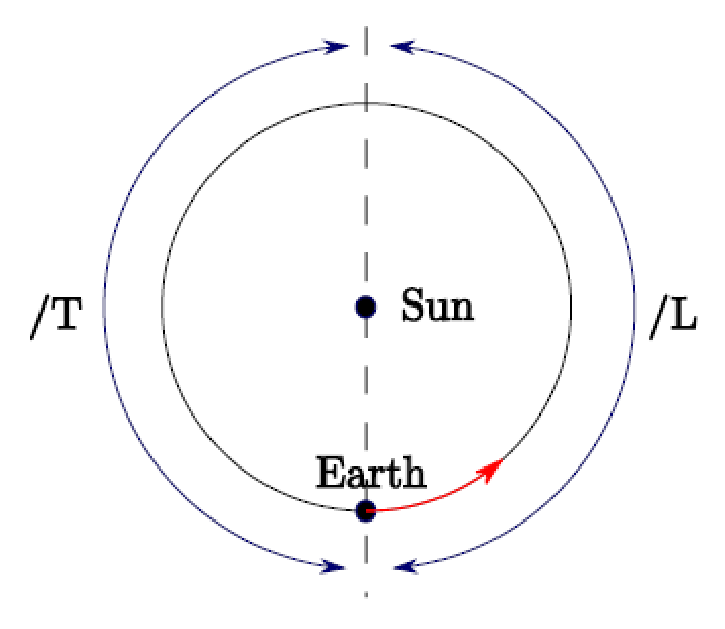
Column /r – the comet's apparent position relative to the Sun in the observer's sky.
/T indicates that the comet trails the Sun (the comet rises and sets after the Sun),
/L indicates that the comet leads the Sun (the comet rises and sets before the Sun), as shown on Figure 1.
Fig. 1: The Earth’s orbit around the Sun, as seen from the north ecliptic pole. The direction of Earth’s orbital motion is shown with an arrow.
| N | Date (UT) | HR:MN | R. A. | DEC | T-mag | Delta | S-O-C | /r |
|---|---|---|---|---|---|---|---|---|
| 1 | 2004-09-30 | 00:00 | 12 26 37.40 | -02 35 00.4 | 33.12 | 6.485 | 0.271 | /T |
| 2 | 2005-01-29 | 18:00 | 13 28 32.58 | -09 15 06.5 | 32.32 | 4.967 | 105.966 | /L |
| 3 | 2005-05-31 | 12:00 | 12 38 34.29 | -04 26 57.7 | 31.77 | 4.493 | 120.555 | /T |
| 4 | 2005-09-30 | 06:00 | 13 29 55.02 | -09 49 15.1 | 31.82 | 5.715 | 17.327 | /T |
| 5 | 2006-01-30 | 00:00 | 15 07 52.88 | -18 16 04.6 | 30.60 | 4.419 | 80.257 | /L |
| 6 | 2006-05-31 | 18:00 | 14 28 41.00 | -15 54 56.7 | 28.80 | 2.940 | 149.891 | /T |
| 7 | 2006-09-30 | 12:00 | 15 08 57.98 | -18 38 54.3 | 28.09 | 3.884 | 42.866 | /T |
| 8 | 2007-01-30 | 06:00 | 18 31 38.72 | -24 18 09.1 | 25.77 | 3.252 | 32.669 | /L |
| 9 | 2007-06-01 | 00:00 | 23 02 49.26 | -07 42 38.0 | 21.35 | 1.464 | 86.189 | /L |
| 10 | 2007-09-30 | 18:00 | 03 31 15.59 | +20 03 36.3 | 18.62 | 0.649 | 131.671 | /L |
| 11 | 2008-01-30 | 12:00 | 03 43 46.19 | +21 38 57.9 | 23.18 | 1.616 | 108.756 | /T |
| 12 | 2008-05-31 | 06:00 | 06 55 11.41 | +23 55 34.8 | 27.27 | 3.724 | 32.564 | /T |
| 13 | 2008-09-30 | 00:00 | 09 38 45.54 | +15 09 48.2 | 29.09 | 4.234 | 45.116 | /L |
| 14 | 2009-01-29 | 18:00 | 09 57 24.96 | +13 53 18.2 | 29.55 | 3.204 | 163.127 | /L |
| 15 | 2009-05-31 | 12:00 | 09 31 40.74 | +15 30 19.4 | 31.20 | 4.845 | 70.213 | /T |
| 16 | 2009-09-30 | 06:00 | 11 04 18.66 | +06 35 02.1 | 32.13 | 5.854 | 22.454 | /L |
| 17 | 2010-01-30 | 00:00 | 11 42 42.32 | +02 32 28.1 | 31.90 | 4.447 | 134.801 | /L |
| 18 | 2010-05-31 | 18:00 | 10 57 35.25 | +07 03 49.9 | 32.45 | 5.196 | 92.885 | /T |
| 19 | 2010-09-30 | 12:00 | 12 04 42.28 | -00 18 36.2 | 33.00 | 6.407 | 5.875 | /L |
| 20 | 2011-01-30 | 06:00 | 12 58 53.76 | -06 12 50.7 | 32.40 | 4.920 | 113.868 | /L |
Table 1.
Use the data from the table to:
6.1. Draw the comet's orbit on the provided graph paper as seen from the north ecliptic pole. Denote the points (comet's positions) with their relevant numbers . Assume that the Earth moves with constant orbital speed. [2 т.]
6.2. Calculate the values of the orbit's semi-major axis and eccentricity . [3 т.]
6.3. Without using any additional data (such as the mass of the Sun or Kepler’s Third Law), estimate the comet's orbital period . [1 т.]
6.4. Without using any additional data (such as the mass of the Sun), calculate the orbital speed of the comet in perihelion and aphelion . [2 т.]
6.5. Calculate the solar mass . The gravitational constant is . [2 т.]
6.6. Calculate the orbital velocity and the escape velocity at the position with . [2 т.]
Отговори
6.2. a ≈ 3.45 AU, e ≈ 0.58
From the official solution (measured on the drawing); the solution adds that the real values are a ≈ 3.44 AU and e ≈ 0.57.
6.3. 6.33 years
The solution adds that the real value is T ≈ 6.38 years.
6.4. va ≈ 31.5 km/s, vp ≈ 8.4 km/s (as printed)
As printed in the official solution. The printed labels appear swapped: the comet is faster at perihelion, so physically the perihelion speed is ≈ 31.5 km/s and the aphelion speed ≈ 8.4 km/s.
6.5. kg
6.6. v ≈ 17.2 km/s, ve ≈ 23.7 km/s
From the official solution, with the measured r = 3.25 AU.
Решение
The gravitational constant is γ or
Problem α-6. Comet observer.
6.1. 2pts
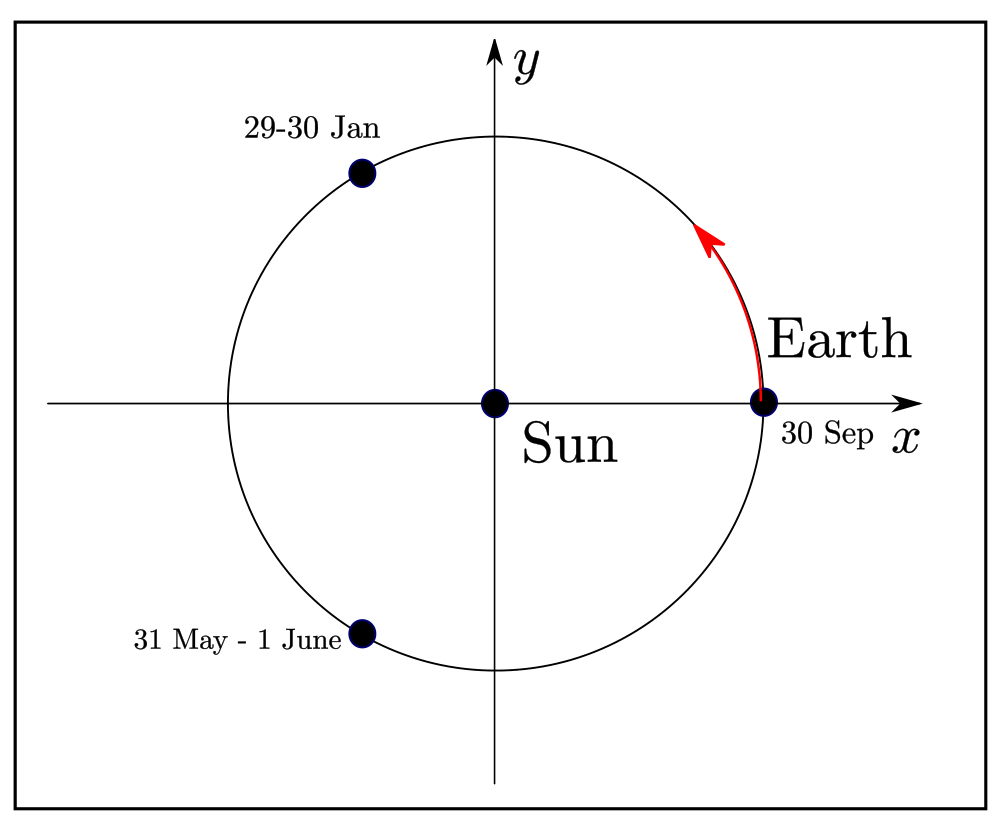
We start off by drawing the Earth’s orbit. Using the tabular data we find that the suitable value for the radius is 2 cm. Because there are 3 observations per year, as noted in the text, there are just 3 positions of the Earth, where the observations take place: one for 30 September, one for 29-30 January and one for 31 May-1 June. We mark these positions on the graph paper. Because 30 Sep 2004 is when Delta takes the largest tabular value (6.485 AU), it is convenient to place 30 Sep on the x-axis. The other two observational points are separated by an angle of and are easily marked using simple geometry.
Next we draw all 20 points from the table on the graphing paper, where each point represents the comet’s position for a particular observation with given . To this end, we use only columns Date(UT), Delta and S-O-T and disregard the rest. Note that Delta is the distance between the comet and the Earth. Therefore some care must be exercised to measure Delta from the correct position of the Earth defined by Date(UT).
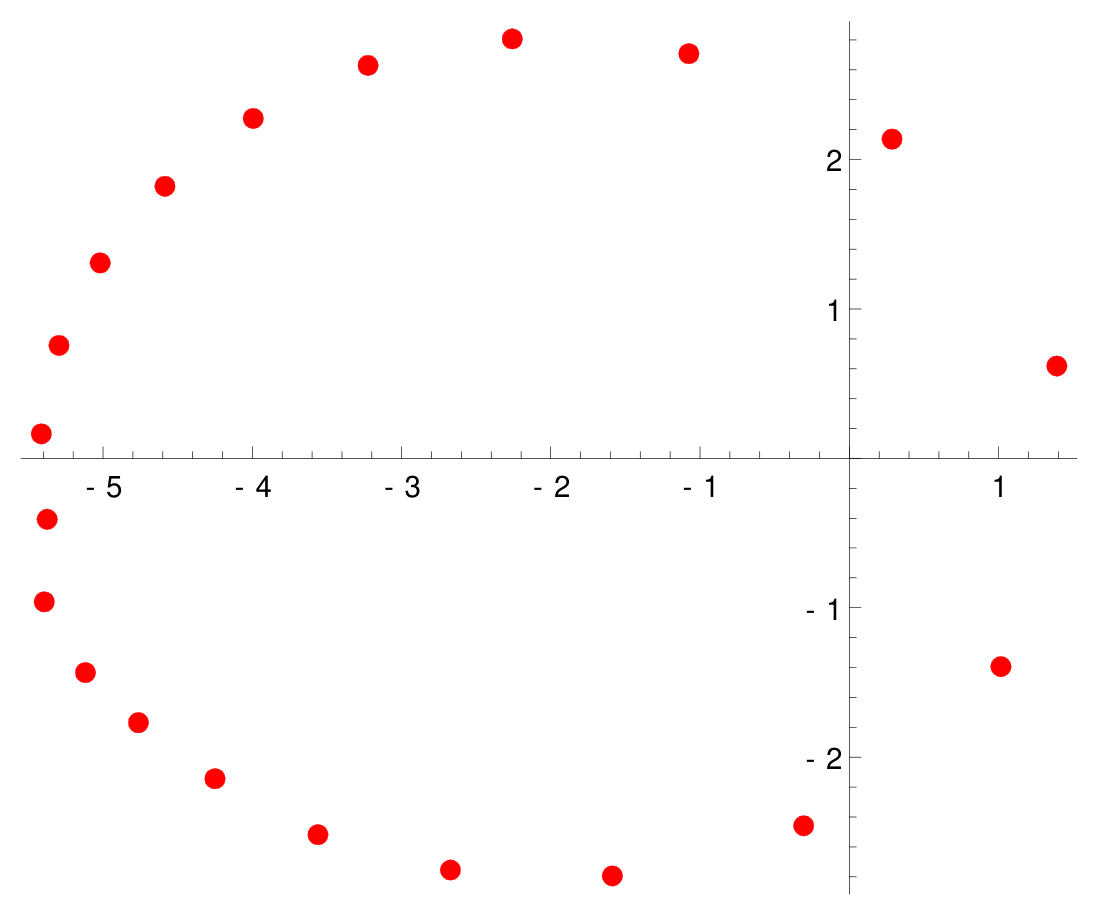
Next we draw a smooth closed curve around the points, which resembles an ellipse.
6.2. 3pts
First by observing the curve we identify the direction of the semi-major axis. Then we draw a line along this direction, which approximately halves the ellipse. Next we mark the so-obtained perihelion and aphelion and measure the distance between them, which yields . We also measure the perihelion distance, which yields . Bearing in mind that 2 cm = 1 AU, we find that
In fact, the real values are AU and .
6.3. 1pt
The first point ()and the last point () almost lie on the x-axis meaning that for the time interval separating these observations, the comet has done a full cycle. Therefore we obtain
while the real value is years.
6.4. 2pts
From Kepler’s second law we know that a line segment joining an orbiting body and the Sun sweeps out equal areas during equal intervals of time . This means that , where is the area inside the ellipse, and is the comet’s orbital period. Note that at the perihelion and at the aphelion the following identities hold for very small :
For the derivation consider the area of an isosceles triangle of height and base .
Thus we find
We can express the speeds directly by and if we use the formula :
6.5. 2pts
The solar mass can be obtained directly from the identity (neglecting the comet’s mass): . Thus we have
6.6. 2pts
From conservation of energy we have , which gives
In solution 6.4. we found . From we obtain .
Thus we arrive at
For the observation with we measure that AU, so we get km/s.
The escape velocity at this point is obtained by taking the limit as approaches :
Оригинал в Архива: practical_6a.pdf · официални решения: practical_6a-solution.pdf