IAO 2016, Практически тур — α-6. Кометен наблюдател
XXI Международная астрономическая олимпиада · XXI International Astronomy Olympiad · Болгария, Пампорово-Смолян 5 – 13. X. 2016 · Round: Prac · 5 октомври 2016 г. · 12 т.
Source recovery / Източници
The original Russian/Bulgarian questions are retained as a distinct language edition. Missing figures and data are supplied from the matching English originals. Official solutions remain in their original English; no Russian or Bulgarian official key occurs in the complete year inventory. Part points come from the official keys.
Условие
В таблица 1 са дадени ефемеридите на 20 наблюдения на кометата P/2007 R2 (Гибс), получени през равни интервали от време – 121 дни и 18 часа (3 наблюдения в година). Ъгълът на наклона на орбитата на кометата е и може да се пренебрегне. Използвани са следните обозначения:
- N – номер на наблюдението
- Date (UT) – дата, а HR и MN – това е момент на наблюдението (часове, минути) по универсално време.
- R.A. (в часове, минути и секунди) и DEC (градуси, минути и секунди) – съответно ректасцензията и деклинацията на центъра на кометата.
- T-mag – примерната пълна видима звездна величина на кометата.
- Delta – разстояние от наблюдателя до центъра на кометата в момента на наблюдението в астрономически единици
- S-O-C (Sun-Observer-Comet) – ъгълът Слънце-Наблюдател-Комета (видимата елонгация на кометата, измервана от мястото на наблюдение в интервала –).
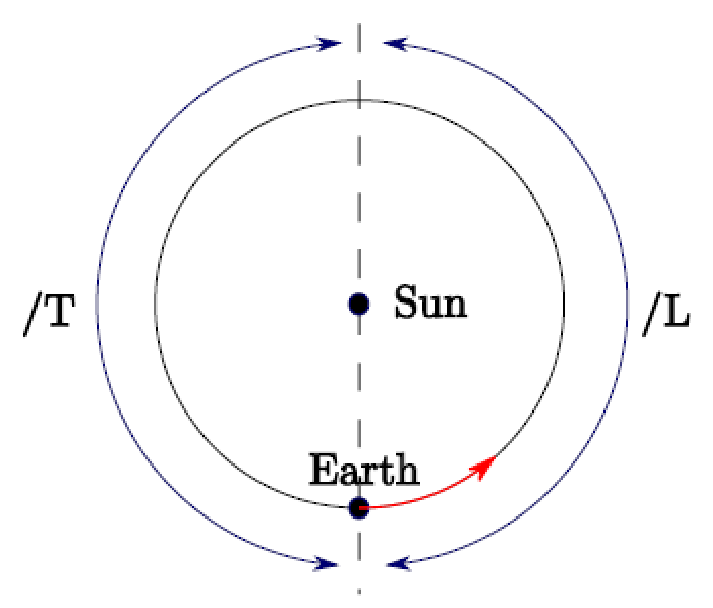
- Колонката „r'“ – видимото положение на кометата относно Слънцето на небето (T означава, че кометата следва Слънцето (изгрява и залязва по-късно от Слънцето); L означава, че кометата се намира пред Слънцето (изгрява и залязва по-рано от Слънцето), както е показано на Фиг. 1.)
На Фиг. 1 е дадена орбитата на Земята около Слънцето, както се вижда от северния еклиптичен полюс. Посоката на орбитално движение на Земята е означена със стрелка.
С помощта на тези данни:
6.1. Нарисувайте на милиметровата хартия орбитата на кометата, както се вижда от северния еклиптичен полюс. Означете точките (положенията на кометата), съответстващи на номерата на наблюденията N. Считайте, че Земята се движи с постоянна орбитална скорост. [2 т.]
6.2. Пресметнете голямата полуос и ексцентрицитета на кометната орбита. [3 т.]
6.3. Оценете орбиталния период на кометата, без да използвате каквито и да са други данни (като например масата на Слънцето или III закон на Кеплер). [1 т.]
6.4. Пресметнете скоростите на кометата в перихелий и в афелий , без да използвате други данни (например масата на Слънцето). [2 т.]
6.5. Пресметнете масата на Слънцето . Гравитационната константа е . [2 т.]
6.6. Изчислете скоростта на кометата в положението . Изчислете скоростта на избягване (втора космическа скорост) в същата точка. [2 т.]
Таблица 1. Ефемериди на кометата
Таблицата и фигурата са възстановени от втората страница на английския оригинал practical_6a.pdf; запазени са двуезичните заглавия на колоните.
| N | Date (UT) | HR:MN | R. A. | DEC | T-mag | Delta | S-O-C | /r |
|---|---|---|---|---|---|---|---|---|
| 1 | 2004-09-30 | 00:00 | 12 26 37.40 | -02 35 00.4 | 33.12 | 6.485 | 0.271 | /T |
| 2 | 2005-01-29 | 18:00 | 13 28 32.58 | -09 15 06.5 | 32.32 | 4.967 | 105.966 | /L |
| 3 | 2005-05-31 | 12:00 | 12 38 34.29 | -04 26 57.7 | 31.77 | 4.493 | 120.555 | /T |
| 4 | 2005-09-30 | 06:00 | 13 29 55.02 | -09 49 15.1 | 31.82 | 5.715 | 17.327 | /T |
| 5 | 2006-01-30 | 00:00 | 15 07 52.88 | -18 16 04.6 | 30.60 | 4.419 | 80.257 | /L |
| 6 | 2006-05-31 | 18:00 | 14 28 41.00 | -15 54 56.7 | 28.80 | 2.940 | 149.891 | /T |
| 7 | 2006-09-30 | 12:00 | 15 08 57.98 | -18 38 54.3 | 28.09 | 3.884 | 42.866 | /T |
| 8 | 2007-01-30 | 06:00 | 18 31 38.72 | -24 18 09.1 | 25.77 | 3.252 | 32.669 | /L |
| 9 | 2007-06-01 | 00:00 | 23 02 49.26 | -07 42 38.0 | 21.35 | 1.464 | 86.189 | /L |
| 10 | 2007-09-30 | 18:00 | 03 31 15.59 | +20 03 36.3 | 18.62 | 0.649 | 131.671 | /L |
| 11 | 2008-01-30 | 12:00 | 03 43 46.19 | +21 38 57.9 | 23.18 | 1.616 | 108.756 | /T |
| 12 | 2008-05-31 | 06:00 | 06 55 11.41 | +23 55 34.8 | 27.27 | 3.724 | 32.564 | /T |
| 13 | 2008-09-30 | 00:00 | 09 38 45.54 | +15 09 48.2 | 29.09 | 4.234 | 45.116 | /L |
| 14 | 2009-01-29 | 18:00 | 09 57 24.96 | +13 53 18.2 | 29.55 | 3.204 | 163.127 | /L |
| 15 | 2009-05-31 | 12:00 | 09 31 40.74 | +15 30 19.4 | 31.20 | 4.845 | 70.213 | /T |
| 16 | 2009-09-30 | 06:00 | 11 04 18.66 | +06 35 02.1 | 32.13 | 5.854 | 22.454 | /L |
| 17 | 2010-01-30 | 00:00 | 11 42 42.32 | +02 32 28.1 | 31.90 | 4.447 | 134.801 | /L |
| 18 | 2010-05-31 | 18:00 | 10 57 35.25 | +07 03 49.9 | 32.45 | 5.196 | 92.885 | /T |
| 19 | 2010-09-30 | 12:00 | 12 04 42.28 | -00 18 36.2 | 33.00 | 6.407 | 5.875 | /L |
| 20 | 2011-01-30 | 06:00 | 12 58 53.76 | -06 12 50.7 | 32.40 | 4.920 | 113.868 | /L |
Отговори
6.2. a ≈ 3.45 AU, e ≈ 0.58
From the official solution (measured on the drawing); the solution adds that the real values are a ≈ 3.44 AU and e ≈ 0.57.
6.3. 6.33 years
The solution adds that the real value is T ≈ 6.38 years.
6.4. va ≈ 31.5 km/s, vp ≈ 8.4 km/s (as printed)
As printed in the official solution. The printed labels appear swapped: the comet is faster at perihelion, so physically the perihelion speed is ≈ 31.5 km/s and the aphelion speed ≈ 8.4 km/s.
6.5. kg
6.6. v ≈ 17.2 km/s, ve ≈ 23.7 km/s
From the official solution, with the measured r = 3.25 AU.
Решение
Official solution in English.
The gravitational constant is or .
6.1
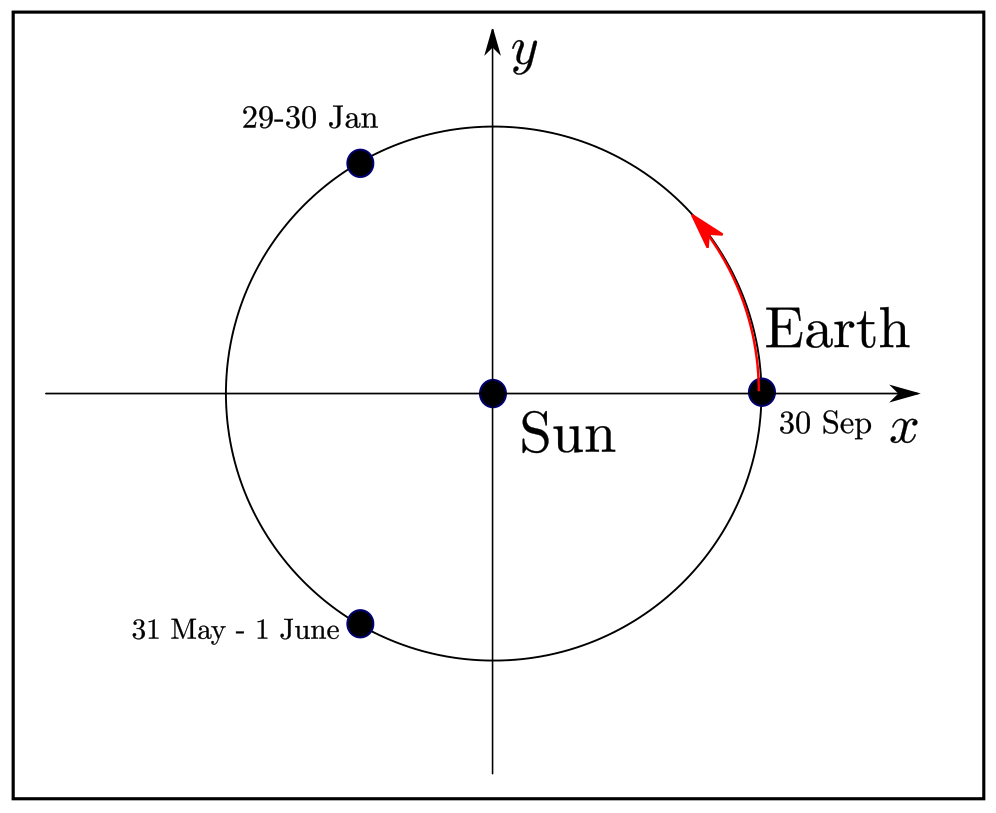
We start off by drawing the Earth’s orbit. Using the tabular data we find that the suitable value for the radius is 2 cm. Because there are 3 observations per year, as noted in the text, there are just 3 positions of the Earth, where the observations take place: one for 30 September, one for 29-30 January and one for 31 May-1 June. We mark these positions on the graph paper. Because 30 Sep 2004 is when Delta takes the largest tabular value (6.485 AU), it is convenient to place 30 Sep on the x-axis. The other two observational points are separated by an angle of and are easily marked using simple geometry.
Next we draw all 20 points from the table on the graphing paper, where each point represents the comet’s position for a particular observation with given . To this end, we use only columns Date(UT), Delta and S-O-T and disregard the rest. Note that Delta is the distance between the comet and the Earth. Therefore some care must be exercised to measure Delta from the correct position of the Earth defined by Date(UT).
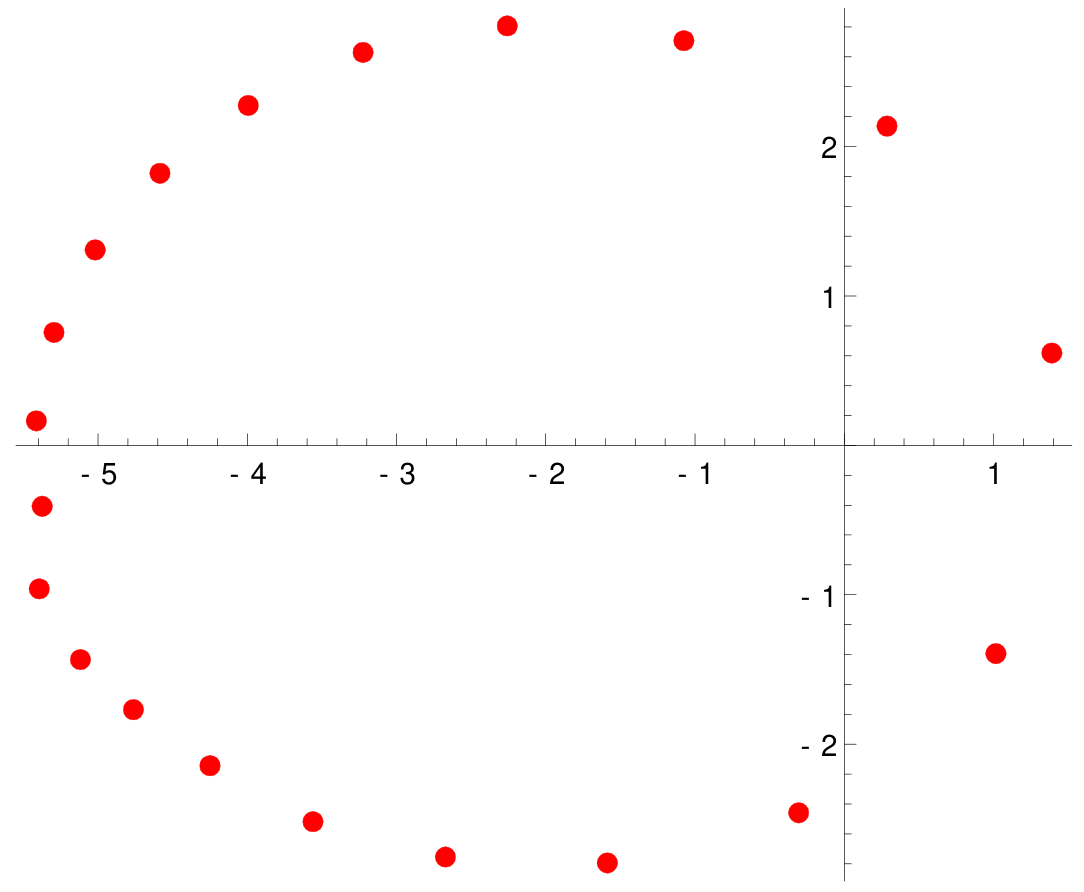
Next we draw a smooth closed curve around the points, which resembles an ellipse.
Source note: the solution names the column S-O-T, while the supplied table labels it S-O-C.
6.2
First by observing the curve we identify the direction of the semi-major axis. Then we draw a line along this direction, which approximately halves the ellipse. Next we mark the so-obtained perihelion and aphelion and measure the distance between them, which yields . We also measure the perihelion distance, which yields . Bearing in mind that 2 cm = 1 AU, we find that
In fact, the real values are AU and .
6.3
The first point () and the last point () almost lie on the x-axis meaning that for the time interval separating these observations, the comet has done a full cycle. Therefore we obtain
while the real value is years.
6.4
From Kepler’s second law we know that a line segment joining an orbiting body and the Sun sweeps out equal areas during equal intervals of time . This means that , where is the area inside the ellipse, and is the comet’s orbital period. Note that at the perihelion and at the aphelion the following identities hold for very small :
For the derivation consider the area of an isosceles triangle of height and base .
Thus we find
We can express the speeds directly by and if we use the formula :
Source discrepancy: the first numerical line swaps the perihelion/aphelion labels; the next line changes the square-root factors but retains the same numerical values. These expressions are reproduced as printed. The following 6.6 derivation uses the perihelion expression with .
6.5
The solar mass can be obtained directly from the identity (neglecting the comet’s mass): . Thus we have
6.6
From conservation of energy we have , which gives
In solution 6.4. we found . From we obtain .
Thus we arrive at
For the observation with we measure that AU, so we get km/s.
The escape velocity at this point is obtained by taking the limit as approaches :
Справочный лист 2016: параметры орбит, тел и звёзд
Дополнительный справочный лист из архива того же года; в шапке напечатано «Theo». Ограничения на использование дополнительных данных в отдельных пунктах условия сохраняются.
| Body | Distance (AU) | Distance (10⁶ km) | Period (tropical years) | Period (days) | Eccentricity | Equatorial diameter (km) | Mass (10²⁴ kg) | Density (g/cm³) | Gravity (m/s²) | Maximum magnitude | Albedo |
|---|---|---|---|---|---|---|---|---|---|---|---|
| Sun | 1392000 | 1989000 | 1.409 | −26.8 | |||||||
| Mercury | 0.387 | 57.9 | 0.241 | 87.969 | 0.206 | 4879 | 0.3302 | 5.43 | 3.70 | −2.2 | 0.06 |
| Venus | 0.723 | 108.2 | 0.615 | 224.701 | 0.007 | 12104 | 4.8690 | 5.24 | 8.87 | −4.7 | 0.78 |
| Earth | 1.000 | 149.6 | 1.000 | 365.256 | 0.017 | 12756 | 5.9742 | 5.515 | 9.81 | 0.36 | |
| Moon | 0.00257 | 0.38440 | 0.0748 | 27.3217 | 0.055 | 3475 | 0.0735 | 3.34 | 1.62 | −12.7 | 0.07 |
| Mars | 1.524 | 227.9 | 1.880 | 686.980 | 0.093 | 6794 | 0.6419 | 3.94 | 3.71 | −2.0 | 0.15 |
| Ceres | 2.77 | 414 | 4.60 | 1681 | 0.077 | 963 | 0.0009 | 2.16 | 0.27 | 6.7 | 0.09 |
| Jupiter | 5.204 | 778.6 | 11.862 | 4332.59 | 0.048 | 142984 | 1899.8 | 1.33 | 24.86 | −2.7 | 0.66 |
| Saturn | 9.584 | 1433.7 | 29.458 | 10759.20 | 0.054 | 120536 | 568.50 | 0.70 | 10.41 | 0.7 | 0.68 |
| Uranus | 19.191 | 2871.0 | 84.015 | 30685.93 | 0.046 | 51118 | 86.625 | 1.30 | 8.44 | 5.5 | 0.74 |
| Neptune | 30.071 | 4498.6 | 164.778 | 60187.64 | 0.008 | 49532 | 102.78 | 1.76 | 11.20 | 7.8 | 0.58 |
| Pluto | 39.482 | 5906.4 | 248.09 | 90613 | 0.249 | 2374 | 0.0130 | 1.86 | 0.61 | 15.1 | 0.6 |
| Makemake | 45.436 | 5906.4 | 306.28 | 111867 | 0.163 | 1502 | 0.003 | 1.70 | 0.40 | 0.77 | |
| Eris | 67.668 | 10210 | 557 | 203500 | 0.441 | 2326 | 0.0167 | 2.52 | 0.68 | 0.90 |
For outer planets and Moon — in mean opposition. Blank cells are blank in the source.
Данные о некоторых звёздах / Data of some stars
| Name | Designation | RA | DEC | Distance | Magnitude | Temperature | Mass |
|---|---|---|---|---|---|---|---|
| Солнце / Sun | ☉ | 0h–24h | −23°26′ to +23°26′ | 1 au | −26.74 | 5777 K | 1 M☉ |
| Бетельгейзе / Betelgeuse | α Ori | 05h55m10s | 07°24′25″ | 197 pc | 0.5 | 3590 K | 11.6 M☉ |
| Альфа Центавра / Alpha Centauri A; B | α Cen | 14h39m36s | −60°50′07″ | 1.33 pc | −0.01; 1.33 | 5810 K; 5260 K | 1.11 M☉; 0.93 M☉ |
В таблице Makemake напечатано 45.436 au и 5906.4 млн км; оба исходных значения сохранены. Звёздная величина Солнца напечатана −26.8 в планетной таблице и −26.74 в таблице звёзд.
Справочный лист 2016: константы и формулы
Дополнительный справочный лист из архива того же года; в шапке напечатано «Theo». Ограничения на использование дополнительных данных в отдельных пунктах условия сохраняются.
| Constant or formula | Value |
|---|---|
| Speed of light in vacuum c (m/s) | 299792458 |
| Constant of gravitation G (N·m²/kg²) | |
| Solar constant A (W/m²) | 1367 |
| Hubble parameter H₀ (km/s/Mpc), mean | 68 |
| Hubble parameter, range | 50–100 |
| Planck constant h (J·s) | |
| Charge of electron e (C) | |
| Mass of electron mₑ (kg) | |
| Proton-to-electron ratio | 1836.15 |
| Faraday constant F (C/mol) | 96485 |
| Magnetic constant μ₀ (H/m) | |
| Universal gas constant R (J/mol/K) | 8.314 |
| Boltzmann constant k (J/K) | |
| Stefan–Boltzmann constant σ (W/m²/K⁴) | |
| Wien displacement constant b (m·K) | 0.002897 |
| Laboratory wavelength Hα (Å) | 6562.81 |
| Tropical year length T (days) | 365.242199 |
| Sidereal year length T (days) | 365.25636 |
| Anomalistic year length T (days) | 365.259636 |
| Nodal period of lunar orbit (years) | −18.6 |
| Standard atmosphere (Pa) | 101325 |
| Visible light extinction by terrestrial atmosphere in zenith (minimum) | 19%, 0.23 magnitudes |
| Height of homogeneous atmosphere (m) | 7991 |
| Refractive index of water for 20°C n | 1.334 |
| Moment of inertia of a solid ball | |
| Moment of inertia of sphere | |
| Volume of a ball | |
| Area of sphere | |
| π | 3.14159265 |
| e | 2.71828183 |
| Golden ratio φ | 1.61803399 |
Оригинал в Архива: bgpract.pdf · официални решения: practical_7ab-solution.pdf · допълнителни данни: practical_7ab.pdf · допълнителни данни: data_1.png · допълнителни данни: data_2.png · допълнителни данни: practical_6a-solution.pdf · допълнителни данни: practical_6b-solution.pdf · допълнителни данни: practical_6a.pdf · допълнителни данни: practical_6b.pdf