IAO 2018, Теория, α+β — αβ-3. Sunset at Colombo
XXIII International Astronomy Olympiad — Theoretical round, α and β · 6 октомври 2018 г. · 8 т.
Read once more before you start your work
General note. Maybe not all problems have correct questions. Some questions (maybe the main question of the problem, maybe one of the subquestions) may make no real sense. In this case you have to write in your answer (in English): «impossible situation». Of course, this answer has to be explained numerically or logically.
Data from the tables (Planetary data, stars, constants, etc.) may be used for solving every problem.
The answers «Yes» or «No» have to be written in English.
Do not forget that in clean copy you should write solutions only on even (left) pages. The odd (right) pages will be used by your team leader to translate solutions into English and also to emphasize your thoughts in solutions.
Parameters of orbits and physical characteristics of Sun, planets, some dwarf planets and Moon
| Body, planet | Average distance to central body (astr. units) | Distance (mln. km) | Sidereal period (tropical years) | Period (days) | Eccentricity e | Equatorial diameter (km) | Mass (10²⁴ kg) | Average density (g/cm³) | Gravity at surface (m/s²) | Max. magnitude from Earth | Albedo |
|---|---|---|---|---|---|---|---|---|---|---|---|
| Sun | 1.6·10⁹ | 2.5·10¹¹ | 2.2·10⁸ | 8·10¹⁰ | 1392000 | 1989000 | 1.409 | −26.8ᵐ | |||
| Mercury | 0.387 | 57.9 | 0.241 | 87.969 | 0.206 | 4879 | 0.3302 | 5.43 | 3.70 | −2.2ᵐ | 0.06 |
| Venus | 0.723 | 108.2 | 0.615 | 224.701 | 0.007 | 12104 | 4.8690 | 5.24 | 8.87 | −4.7ᵐ | 0.78 |
| Earth | 1.000 | 149.6 | 1.000 | 365.256 | 0.017 | 12756 | 5.9742 | 5.515 | 9.81 | 0.36 | |
| Moon | 0.00257 | 0.38440 | 0.0748 | 27.3217 | 0.055 | 3475 | 0.0735 | 3.34 | 1.62 | −12.7ᵐ | 0.07 |
| Mars | 1.524 | 227.9 | 1.880 | 686.980 | 0.093 | 6794 | 0.6419 | 3.94 | 3.71 | −2.0ᵐ | 0.15 |
| Ceres | 2.77 | 414 | 4.60 | 1681 | 0.077 | 963 | 0.0009 | 2.16 | 0.27 | 6.7ᵐ | 0.09 |
| Jupiter | 5.204 | 778.6 | 11.862 | 4332.59 | 0.048 | 142984 | 1899.8 | 1.33 | 24.86 | −2.7ᵐ | 0.66 |
| Saturn | 9.584 | 1433.7 | 29.458 | 10759.20 | 0.054 | 120536 | 568.50 | 0.70 | 10.41 | 0.7ᵐ | 0.68 |
| Uranus | 19.191 | 2871.0 | 84.015 | 30685.93 | 0.046 | 51118 | 86.625 | 1.30 | 8.44 | 5.5ᵐ | 0.74 |
| Neptune | 30.071 | 4498.6 | 164.778 | 60187.64 | 0.008 | 49532 | 102.78 | 1.76 | 11.20 | 7.8ᵐ | 0.58 |
| Pluto | 39.482 | 5906.4 | 248.09 | 90613 | 0.249 | 2374 | 0.0130 | 1.86 | 0.61 | 15.1ᵐ | 0.6 |
For outer planets and Moon — in mean opposition.
| Coordinates | Hotel | Seafront in the center |
|---|---|---|
| λ (E) | 79°52′ | 79°51′ |
| φ (N) | 07°00′ | 06°54′ |
| Timezone | UT+05:30 | UT+05:30 |
Some constants and formulae
| Quantity | Value |
|---|---|
| Speed of light in vacuum, c (m/s) | 299792458 |
| Constant of gravitation, G (N·m²/kg²) | 6.674·10⁻¹¹ |
| Solar constant, A (W/m²) | 1367 |
| Hubble parameter, H₀ (km/s/Mpc): mean value | 68 |
| Hubble parameter: diapason of values | 50–100 |
| Planck constant, h (J·s) | 6.626·10⁻³⁴ |
| Charge of electron, e (C) | 1.602·10⁻¹⁹ |
| Mass of electron, mₑ (kg) | 9.109·10⁻³¹ |
| Proton-to-electron mass ratio | 1836.15 |
| Faraday constant, F (C/mol) | 96485 |
| Magnetic constant, μ₀ (H/m) | 1.257·10⁻⁶ |
| Universal gas constant, R (J/mol/K) | 8.314 |
| Boltzmann constant, k (J/K) | 1.381·10⁻²³ |
| Stefan-Boltzmann constant, σ (W/m²/K⁴) | 5.670·10⁻⁸ |
| Wien’s displacement constant, b (m·K) | 0.002897 |
| Laboratory wavelength of Hα (Å) | 6563 |
| Laboratory wavelength of Hβ (Å) | 4861 |
| Tropical year length, T (days) | 365.242199 |
| Sidereal year length, T (days) | 365.25636 |
| Anomalistic year length, T (days) | 365.259636 |
| Nodal period of lunar orbit (years) | −18.6 |
| Standard pressure (Pa) | 101325 |
| Visible light extinction by the terrestrial atmosphere in zenith (minimum) | 19%, 0.23ᵐ |
| Height of homogeneous atmosphere (m) | 7991 |
| Refractive index of water for 20°C, n | 1.334 |
| Moment of inertia of solid ball | |
| Moment of inertia of sphere | |
| Volume of a ball | |
| Area of sphere | |
| π | 3.14159265 |
| e | 2.71828183 |
| Golden ratio, φ | 1.61803399 |
Theoretical round. Basic criteria. For work of Jury
Note. The given sketches of solutions are not full; the team leaders have to give more detailed explanations to students. The correct solutions in the students’ papers (enough for 8 pts) may be shorter.
Note. Jury members should evaluate the student’s solutions in essence, and not by looking on formal existence the mentioned sentences or formulae. The formal presence of the mentioned positions in the text is not necessary to give the respective points. Points should be done if the following steps de facto using these positions.
Note. Jury members should elaborate more detailed criteria, and also create criteria for other correct ways of the student’s solutions.
Printed source discrepancies
The galaxy key prints nm for the wavelengths 6563 and 4861, while the constants sheet gives Å. The Martian key reverses the question’s subpart order, prints a lunar-radius term 0.17·10⁵ km, and reuses L₂ for the semimajor axis. The satellite key calls R a diameter and prints 10h20m after subtracting 62 minutes from 11h12m. Printed formulas and labels are retained rather than silently corrected. The satellite key refers to a drawing absent from the supplied solution packet.
Условие
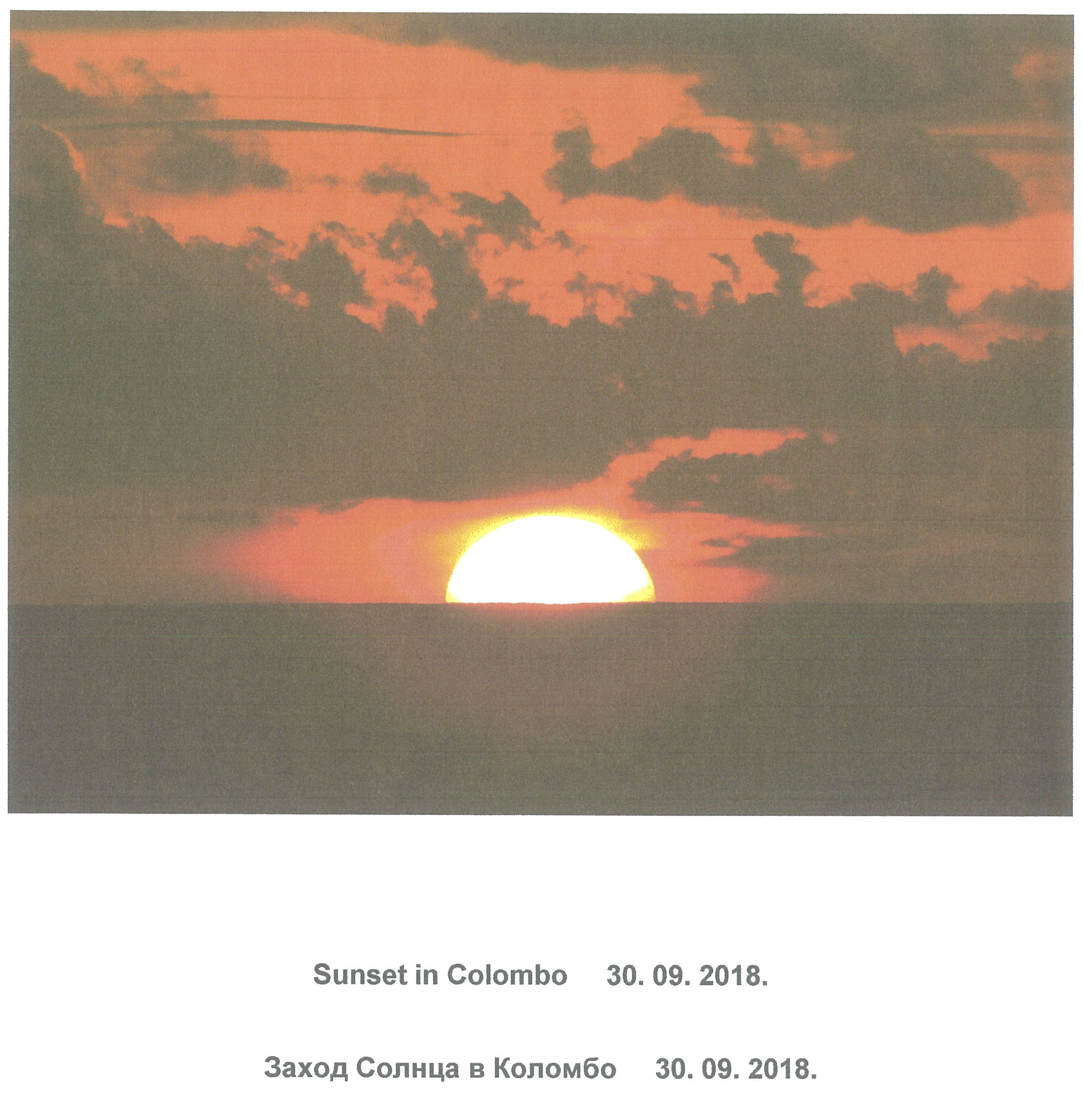
The sunset picture was taken on September 30, 2018, from the seafront in the center of Colombo. The height of the camera above sea level was approximately 6.5 m. Calculate with the highest possible reasonable accuracy:
3.1.
at what time (use Sri Lanka time) the picture was taken.
3.2.
after what time after the moment of this picture will civil twilight end?
3.3.
Draw the position of the Sun seen at this moment from Adams Pk. (see the map) located to the East of Colombo (if clouds do not obstruct the observation).
Решение
3.1.
We see in the picture that half of the solar disk disappeared over the horizon. This is exactly half of the disk with great accuracy, since we see its vertical edges strictly on the horizon. In zero approximation, this occurs at 18:00 local time. The accuracy of the fact, that the center of the Sun is on the horizon at the photo, can be estimated at or ±8 seconds in units of time.
Let us consider what corrections to this time need to be taken into account and what is the accuracy of each the correction.
1. Longitudinal correction. The local time of Sri Lanka is UT+05:30, and it corresponds to the longitude East, the photographer was at the longitude , i.e. to the west. This means that for him the sunset occurs later. The accuracy of this correction corresponds to in longitude or 2 seconds in time.
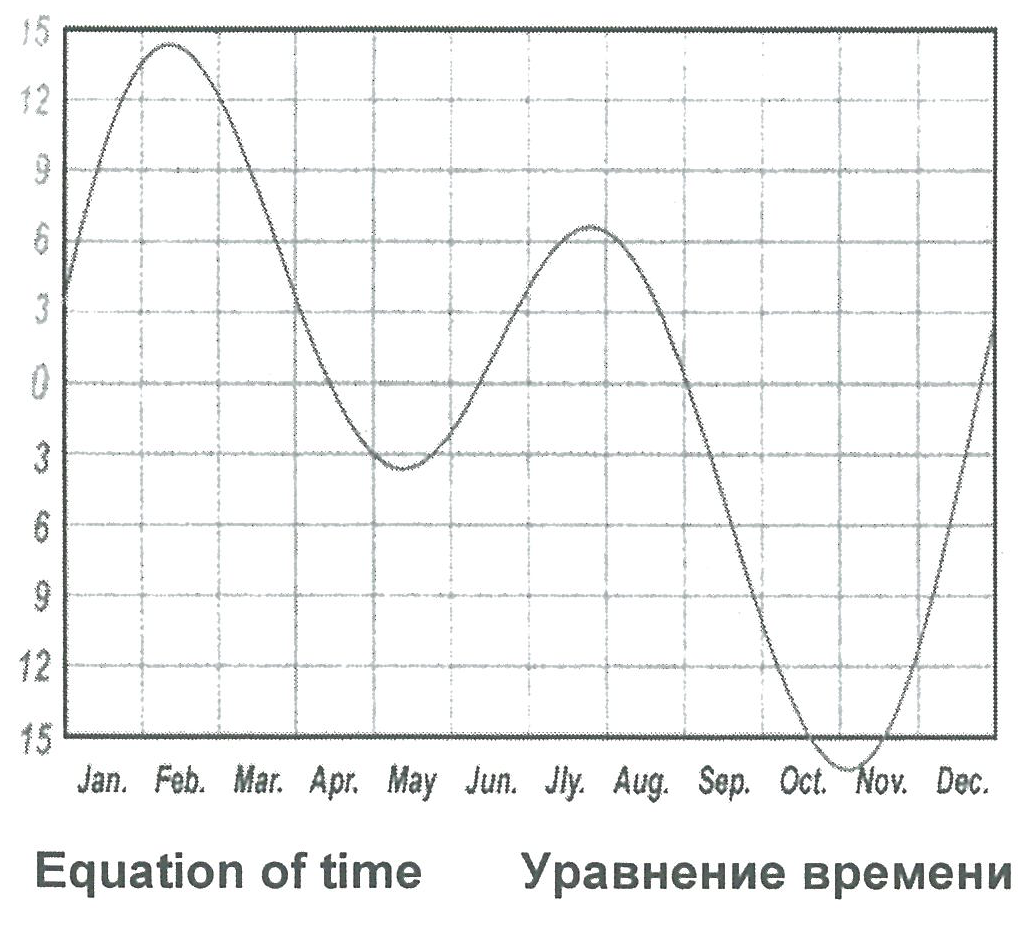
2. Correction of the equation of time. According to the schedule, we find that on September 30 all events related to the Sun occur 10 minutes earlier. The accuracy of the correction is determined by the graph and is approximately half a minute.
3. The center of the Sun crosses the mathematical horizon strictly in the west and at 18:00 of true solar time only at the moments of equinoxes. The evening of September 30 in Colombo is 7 days and 11 hours later than the autumnal equinox. During this time, the Sun has moved along the ecliptic by about . The declination of the Sun is approximately equal to . Given the latitude of the place , we obtain that the Sun is lower than at the same time during the autumnal equinox. The rate of lowering the Sun is ( arises due to the fact that the Sun moves not along a large circle, but along a small circle, and is due to the inclination of the trajectory). In our case these coefficients are very close to 1, so the Sun goes down in 1 minute 28 seconds. That is, this correction is minus 1 minute 28 seconds. The correction accuracy is 4 seconds.
4. Refraction. The refraction near the horizon is . The Sun passes down this angle in 2 minutes and 20 seconds. This is a correction with a plus sign. Correction accuracy is 4 seconds.
5. Lowering of the horizon. It is said that the height of the camera above sea level was approximately , with the radius of Earth , this gives lowering of the horizon for . This correction is plus more 20 seconds. The accuracy of the correction corresponds to 2 seconds in time.
In total, the sum all corrections is:
The largest error is given by the inaccuracy in determining the correction due to the equation of time on graph. That is, the event occurred at 18:01:48 with an accuracy of half a minute. Or at 18:02 if to write with a reasonable accuracy.
3.2.
Civil twilight ends when the center of the Sun appears below the mathematical horizon. As we calculated above, at the time of the shooting, the center of the Sun was at and was moving downward with speed
The remaining before reaching the Sun will pass in 21.5 minutes. That is, the answer to the second question of the problem is 21.5 minutes.
3.3.
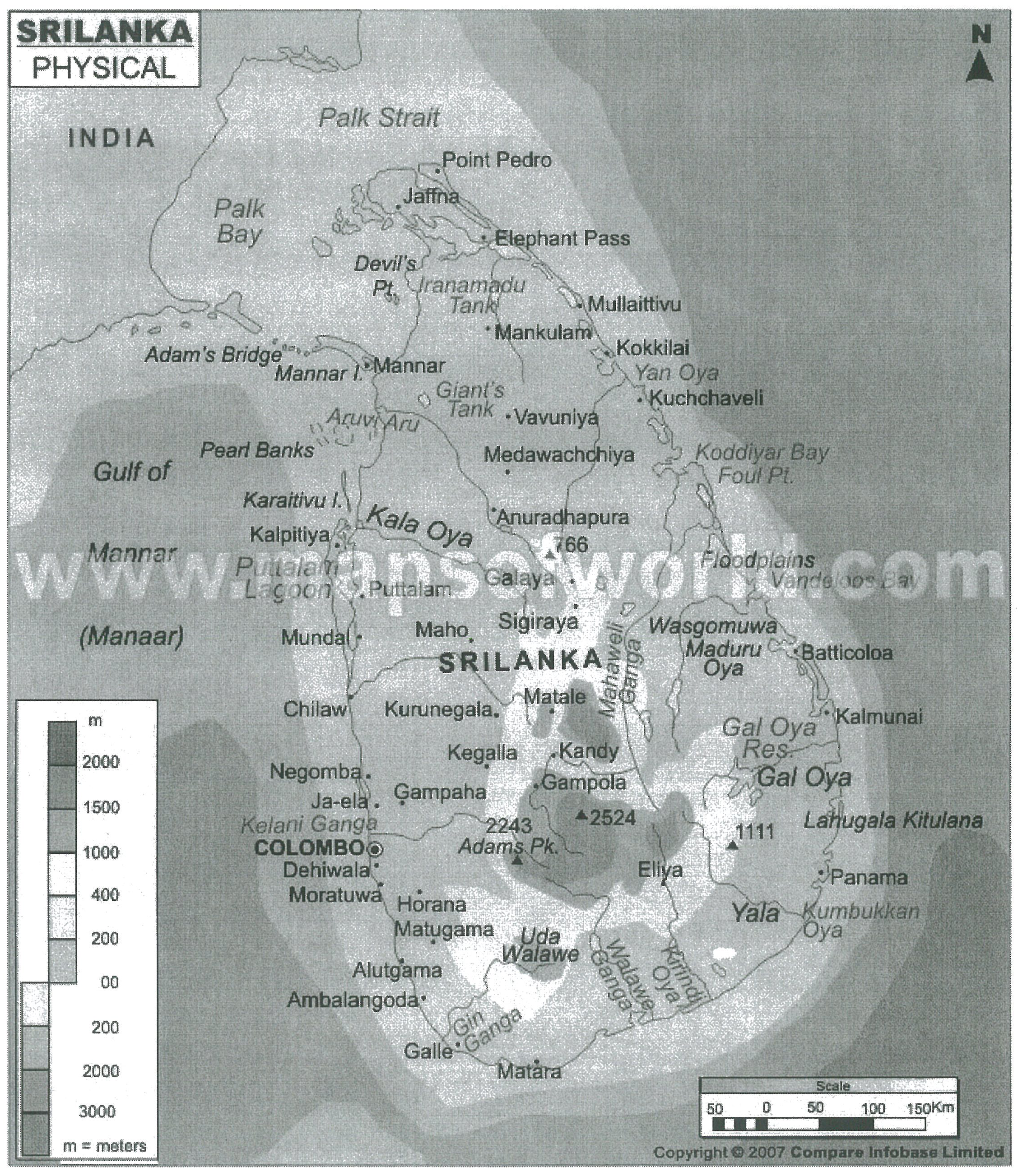
The height of Adams Pk, as we see on the map, is equal to 2243 m. Lowering the horizon from this peak will be . This is more than when photographing from the seafront. This effect raises the apparent position of the solar disk above the visible horizon (by compared to the camera on the seafront). On the other hand, measurements on the map (28 mm from the coast to the peak with a scale of 200 km to 40 mm) show that Adams Pk is 140 km East of Colombo, which corresponds to enlarging longitude by . The apparent position of the solar disk is lowered due to this effect. The difference of the effects is or one third of the angular diameter of the Sun. Thus, from Adams Pk at this time the position of the Sun will be visible, at which 1/6 of its diameter is below the horizon, and 5/6 above the horizon. This picture should be drawn.
Basic criteria
| Item | Points |
|---|---|
| 3.1. Zero approximation that it is occurs at 18:00 | 0.5 |
| Calculation of the effects (corrections) | 5 × 0.5 (2.5 in total) |
| Correct final answer | 0.5 |
| Correct issue about the accuracy of the answer | 0.5 |
| 3.2. | 1.5 |
| 3.3. Measurements on the map | 0.5 |
| Calculation of lowering the horizon from peak | 1 |
| The picture itself | 1 |
Оригинал в Архива: theo.pdf · официални решения: theosol.pdf · допълнителни данни: iao2018_alpha.pdf