IAO 2019, Теория, α+β — αβ-1. Culmination of the Moon.
XXIV International Astronomy Olympiad — Theoretical round, α and β · 19 октомври 2019 г. · 8 т.
For translation only.
Note for translators: in texts for Group β by the red color marked the text identical to that used for Group α.
Source availability
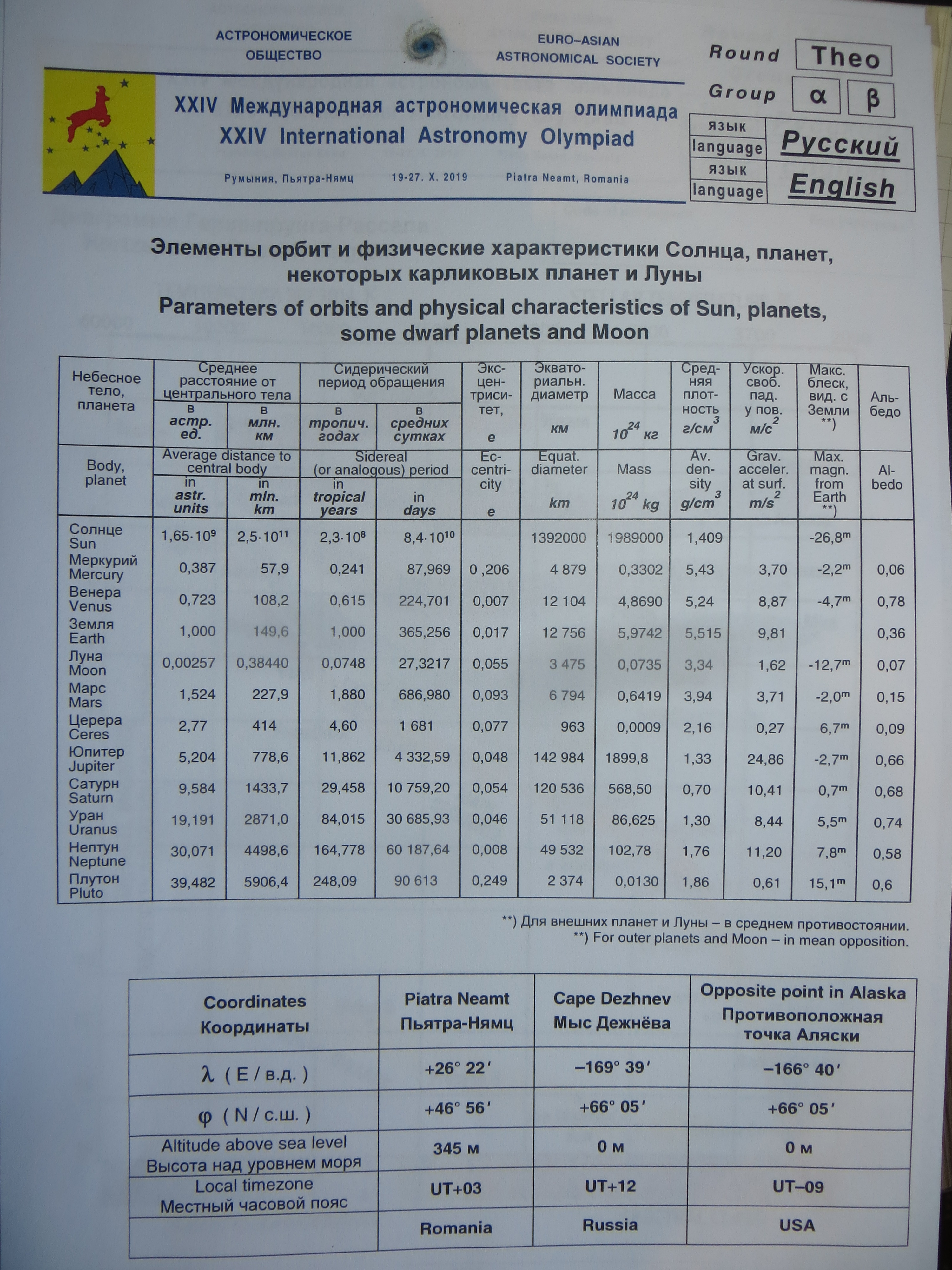
The three photographed sheets contain the combined English translator edition and the bilingual diagram for β-5. The archived data sheets contain Solar-System parameters, geographical coordinates, constants and the Hertzsprung–Russell diagram. The star-data table referred to in the key (including Ruchbah, Vega, Altair and UY Scuti) and the additional mid-round formula promised to Group α are not included in these archived theory/data sources. The surviving key supplies its own working values; no missing handout has been reconstructed.
Условие
To prepare for observing the annular solar eclipse, which will take place on December 26, 2019 (early in the morning Romanian time), the Polar Bear-astronomer decided to observe the culmination of the Moon and came to Piatra Neamt for this.
1.1.
At what day of October 2019 will the Moon culminate at the highest position?
1.2.
At what time (with the accuracy of an hour) will this happen?
1.3.
Estimate, at what heigh this culmination will take place?
1.4.
Include an artistic picture with an image of the Bear-astronomer observing the culmination of the Moon.
The inclination angle of the lunar orbit should not be taken into account.
Решение
The difference in the height of the culmination of the Moon appears from the fact that the Moon in its monthly movement moves approximately along the ecliptic (neglecting inclination angle of the orbit ), and different points of the ecliptic culminate at different heights (the same as the Sun culminates at different heights during the year). The highest culmination occurs when the Moon is at the highest point of the ecliptic (at the point where the Sun is on June 22).
The December's annular eclipse will occur 4 days after the day of the winter solstice. On the day of the winter solstice, the Sun is at the lowest point of the ecliptic, and 4 days later – about 4° east. This means that the last time at the highest point of the ecliptic, the Moon was 184° back, and in previous times it was more earlier. The moon moves along the ecliptic with a speed 360°/27.32 days. It is easy to understand without even calculating that in October at the highest point the Moon was before the solar eclipse. In days:
68.6 days before the morning of December 26 is October 18–19. Thus, the approximate answer to question 1.1 is “on October 18–19”, but what date exactly, we can find out by answering the question 1.2.
The phases of the Moon change every 29.53 days. Thus, the second new moon before the eclipse occurs on December 26 − 59 days = October 28. So on October 18–19 we have 9–10 days before the new Moon. Culmination of the new Moon occurs at 12 o'clock local solar time, and culmination 9–10 days before the new Moon occurs about 7.3–8.1 hours earlier. Thus, the culmination will occur at 3.9–4.7 o'clock in the morning of local solar time or at the sixth hour in the morning according to the current UT+03 timezone in Romania. With this in mind, we get that the exact date of the highest culmination of the Moon is October 19, although on October 18, it culminated at almost the same height.
1.1. 1.2.
Answers: October 19, in the 6th hour in the morning.
1.3.
.
1.4.
Picture.
Basic criteria
1.1.
- Using idea about declination of the Moon during month – 1 pt.
- Correct using reference point (like solstice for lowest point of the ecliptic) – 1 pt.
- Using the necessary period and phases of the Moon, calculations – 1 pt.
- Correct final answer – 1 pt.
1.2. Conclusions and result – 2 pt.
1.3. Formula – 0.5 pt. Result – 0.5 pt.
1.4. Artistic picture of the Bear-astronomer – 1 pt.
Theoretical round. Sketches for solutions. For jury job ONLY
Note. The given sketches are not full; the team leaders have to give more detailed explanations to students. But the correct solutions in the students’ papers (enough for 8 pts) may be shorter.
Note. Jury members should evaluate the student’s solutions in essence, and not by looking on formal existence the mentioned sentences or formulae. The formal presence of the mentioned positions in the text is not necessary to give the respective points. Points should be done if the following steps de facto using these positions.
Theoretical round. Basic criteria. For work of Jury
Note. The given sketches of solutions are not full; the team leaders have to give more detailed explanations to students. The correct solutions in the students’ papers (enough for 8 pts) may be shorter.
Note. Jury members should evaluate the student’s solutions in essence, and not by looking on formal existence the mentioned sentences or formulae. The formal presence of the mentioned positions in the text is not necessary to give the respective points. Points should be done if the following steps de facto using these positions.
Note. Jury members should elaborate more detailed criteria, and also create criteria for other correct ways of the student’s solutions.
Crossed-out source passage
A red handwritten cross on solution page 2 deletes the following duplicated block between the first estimate and “The physical diameter of the central part of the cluster is”. It is recorded here rather than treated as an active step of the α solution:
“The physical diameter of the cluster is:
By comparing the cluster size in the image with the total image size of , we can find that the angular diameter of the central region of the ‘sphere’ is approximately –. We may take the value for the solution.”
Printed-source discrepancies
The original key is retained literally, including its inconsistent numerical steps: the comet-radiation derivation prints ; the interstellar-comet key repeats pc/year for different speeds and ends with “only stars and brighter” followed by “No”. The sunset key calls the Chukchi correction “sunrise” and the Eskimo correction “sunset”. The satellite question uses , while the key uses , and its Fig. 3 is also called Figure 5.3. These are source discrepancies, not silently corrected calculations. The NGC rubric prints “The answer using the both criteria – pt.” without a numerical score; no value is invented.
Оригинал в Архива: theo1.JPG · официални решения: theosol.pdf · допълнителни данни: theo3.JPG · допълнителни данни: hrd.JPG · допълнителни данни: data_2.JPG · допълнителни данни: data_1.JPG · допълнителни данни: theo2.JPG