IChO 2009, Теория — Задача 1. Theoretical problem1 — Estimating the Avogadro constant
41st International Chemistry Olympiad — Cambridge2009 — Theoretical problems (Volume3 collection edition2014)
Внимание: Бележка към темата
Source edition: The Competition Problems from the International Chemistry Olympiads, Volume 3, edited by Anton Sirota, IUVENTA / IChO International Information Centre, Bratislava, 2014. The collection normalizes task numbering and omits some original grading points, practical instructions and data-dependent key material. Every item actually printed in this Cambridge 2009 section is retained. The referenced practical answer booklet, TLC template and Practical 1 carbon NMR spectrum were not obtained. Reproduced for teaching purposes with the printed Volume 3 attribution and rights notice; commercial publication/distribution requires permission from the copyright holder.
Collection edition and native section
The Competition Problems from the International Chemistry Olympiads, Volume3,41st–45th IChO2009–2013. Edited by Anton Sirota. IUVENTA–Slovak Youth Institute, Bratislava2014. This scoped paper preserves only the41st International Chemistry Olympiad,18–27July2009, Cambridge, United Kingdom.
Native rights statement and archive qualification
You are free to copy, distribute, transmit or adapt this publication or its parts for unlimited teaching purposes, you are obliged, however, to attribute your copies, transmissions or adaptations with a reference to "The Competition Problems from the International Chemistry Olympiads, Volume 3" as it is commonly required in the chemical literature. The problems copied cannot be published and distributed for commercial proposes. The above conditions can only be waived if you get permission from the copyright holder.
Copyright2014IUVENTA–IChO International Information Centre; ISBN978-80-8072-154-1. Attribution: The Competition Problems from the International Chemistry Olympiads, Volume3, edited by Anton Sirota, Bratislava2014.
Source note: This wording permits copying, distribution, transmission and adaptation for unlimited teaching purposes with the required Volume3 reference. It forbids commercial publication/distribution unless the copyright holder waives the conditions. This free educational archive retains the required Volume 3 attribution and this rights notice. Reproduction is presented for teaching purposes under the printed grant; no commercially unrestricted permission is claimed. The publisher must assess this obtained statement before adoption.
Issued by IUVENTA – Slovak Youth Institute in 2014 with the financial support of the Ministry of Education of the Slovak Republic. Number of copies: 250. Not for sale.
International Chemistry Olympiad, International Information Centre, IUVENTA – Slovak Youth Institute, Búdková 2, SK 811 04 Bratislava 1, Slovakia. E-mail: anton.sirota@stuba.sk. Web: www.icho.sk.
Full native editorial preface
Preface This publication contains 39 theoretical and 14 practical competition problems from the 41st – 45th International Chemistry Olympiads (IChO) organized in the years 2009 – 2013. It has been published by the IChO International Information Centre in Bratislava (Slovakia) as a continuation of the preceding Volumes 1 and 2 published on the occasion of the 40th anniversary of the IChO with the titles: • The competition problems from the International Chemistry Olympiads, Volume 1, 1st – 20th IChO, 1968 – 1988 (IUVENTA, Bratislava, 2008). • The competition problems from the International Chemistry Olympiads, Volume 2, 21st – 40th IChO, 1989 – 2008 (IUVENTA, Bratislava, 2009). Not less than 318 theoretical and 110 practical problems were set in the IChO during the forty-five years of its existence. In the elaboration of this collection the editor had to face certain difficulties because the aim was not only to make use of past recordings but also to give them such a form that they may be used in practice and further chemical education. Consequently, it was necessary to make some corrections in order to unify the form of the problems (numbering the tasks of the particular problems, solution inserted immediately after the text of the problem, solutions without grading points and special graphs used for grading of practical problems). Nevertheless, the mentioned corrections and changes do not concern the contents and language of the competition problems. The practical problems set in the IChO competitions, contain as a rule some instructions, list of apparatuses available, chemicals on each desk and those available in the laboratory, and the risk and safety phrases with regard to the chemicals used. All of these items are important for the competitors during the competition but less important for those who are going to read the competition tasks of this collection and thus, they are omitted. Some parts of the solutions of practical problems are also left out since they require the experimental data which could be obtained by experiments during the practical part of the IChO competition. In this publication SI quantities and units are preferred. Only some exceptions have been made when, in an effort to preserve the original text, the quantities and units have been used that are not SI. Although the numbers of significant figures in the results of some solutions do not obey the criteria generally accepted, they were left without change.
Unfortunately, the authors of the particular competition problems are not known and due to the procedure of creation of the IChO competition problems, it is impossible to assign any author's name to a particular problem. Nevertheless, responsibility for the scientific content and language of the problems lies exclusively with the organizers of the particular International Chemistry Olympiads. This review of the competition problems from the 41st – 45th IChO should serve to both competitors and their teachers as a source of further ideas in their preparation for this difficult competition. For those who have taken part in some of these International Chemistry Olympiads the collection of the problems could be of help as archival and documentary material. In the previous forty-five years many known and unknown people - teachers, authors, pupils, and organizers proved their abilities and knowledge and contributed to the success of this already well known and world-wide competition. We wish to all who will organize and attend the future International Chemistry Olympiads, success and happiness. Bratislava, July 2014 Anton Sirota, editor
Source note: The preface describes general editorial omissions. This Cambridge section nevertheless prints practical chemical lists, procedures and selected grading graphs, all retained. Missing original answer-booklet/NMR material is not invented.
Условие
Many different methods have been used to determine the Avogadro constant. Three different methods are given below.
Method A – from X-ray diffraction data (modern)
The unit cell is the smallest repeating unit in a crystal structure. The unit cell of a gold crystal is found by X-ray diffraction to have the face-centred cubic unit structure (i.e. where the centre of an atom is located at each corner of a cube and in the middle of each face). The side of the unit cell is found to be 0.408 nm.
1.1 Sketch the unit cell and calculate how many Au atoms the cell contains.
1.2 The density of Au is . Calculate the volume and mass of the cubic unit cell.
1.3 Hence calculate the mass of a gold atom and the Avogadro constant, given that the relative atomic mass of Au is 196.97.
Method B – from radioactive decay (Rutherford,1911)
The radioactive decay series of ²²⁶Ra is as follows:

The times indicated are half-lives, the units are y = years, d = days, m = minutes. The first decay, marked t above, has a much longer half-life than the others.
1.4 In the table below, identify which transformations are α-decays and which are β-decays.
| Transformation | α-decay | β-decay |
|---|---|---|
| ²²⁶Ra → ²²²Rn | □ | □ |
| ²²²Rn → ²¹⁸Po | □ | □ |
| ²¹⁸Po → ²¹⁴Pb | □ | □ |
| ²¹⁴Pb → ²¹⁴Bi | □ | □ |
| ²¹⁴Bi → ²¹⁴Po | □ | □ |
| ²¹⁴Po → ²¹⁰Pb | □ | □ |
| ²¹⁰Pb → ²¹⁰Bi | □ | □ |
| ²¹⁰Bi → ²¹⁰Po | □ | □ |
| ²¹⁰Po → ²⁰⁶Pb | □ | □ |
1.5 A sample containing 192 mg of ²²⁶Ra was purified and allowed to stand for 40 days. Identify the first isotope in the series (excluding Ra) that has not reached a steady state.
1.6 The total rate of α-decay from the sample was then determined by scintillation to be 27.7GBq (where1Bq=1count s⁻¹). The sample was then sealed for 163 days. Calculate the number of α particles produced.
1.7 At the end of the 163 days the sample was found to contain 10.4mm³ of He, measured at 101325 Pa and 273 K. Calculate the Avogadro constant from these data.
1.8 Given that thee relative isotopic mass of ²²⁶Ra measured by mass spectrometry is 226.25, use the textbook value of the Avogadro constant () to calculate the number of ²²⁶Ra atoms in the original sample, nRa, the decay rate constant, λ, and the half-life, t, of ²²⁶Ra (in years). You need only consider the decays up to but not including the isotope identified in 1.5.
Method C – dispersion of particles (Perrin,1909)
One of the first accurate determinations of the Avogadro constant was carried out by studying the vertical distribution under gravity of colloidal particles suspended in water. In one such experiment, particles with radius and density were suspended in a tube of water at15°C. After allowing sufficient time to equilibrate, the mean numbers of particles per unit volume observed at four heights from the bottom of the tube were:
| height / 10⁻⁶m | 5 | 35 | 65 | 95 |
|---|---|---|---|---|
| mean number per unit volume | 4.00 | 1.88 | 0.90 | 0.48 |
1.9 Assuming the particles to be spherical, calculate:
i) the mass, m, of a particle;
ii) the mass, mH₂O, of the water it displaces;
iii) the effective mass, m*, of the particle in water accounting for buoyancy (i.e. taking account of the upthrust due to the displaced volume of water).
Take the density of water to be999kg m⁻³.
At equilibrium, the number of particles per unit volume at different heights may be modelled according to a Boltzmann distribution:
where nₕ is the number of particles per unit volume at height h; nₕ₀ is the number of particles per unit volume at the reference height h₀; Eₕ is the gravitational potential energy per mole of particles at height h relative to the particles at the bottom of the tube; R is the gas constant,8.3145J K⁻¹ mol⁻¹.
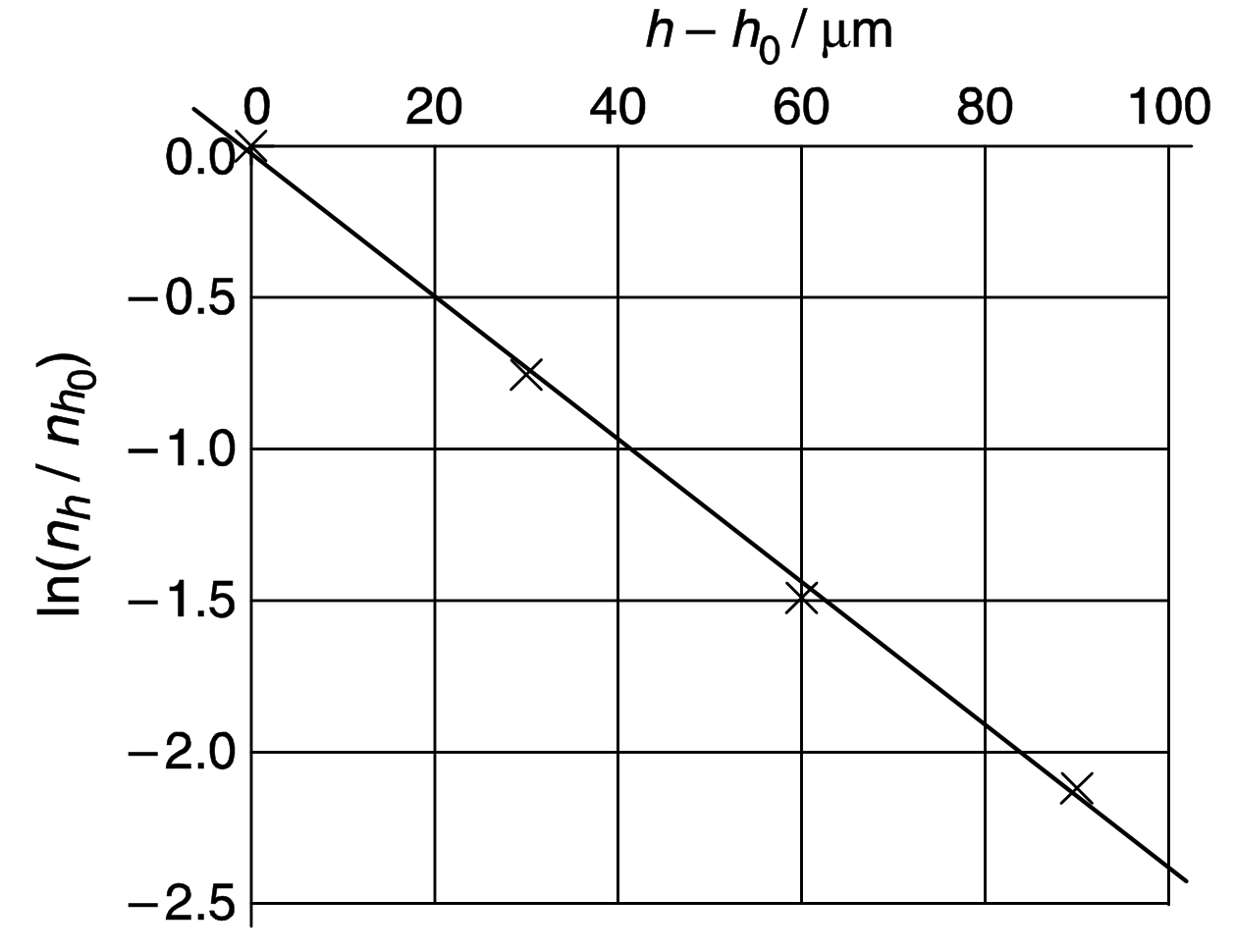
A graph of ln(nₕ/nₕ₀) against(h−h₀), based on the data in the table above, is shown below. The reference height is taken to be5μm from the bottom of the tube.
1.10 Derive an expression for the gradient (slope) of the graph.
1.11 Determine the Avogadro constant from these data.
Решение
1.1 Unit cell
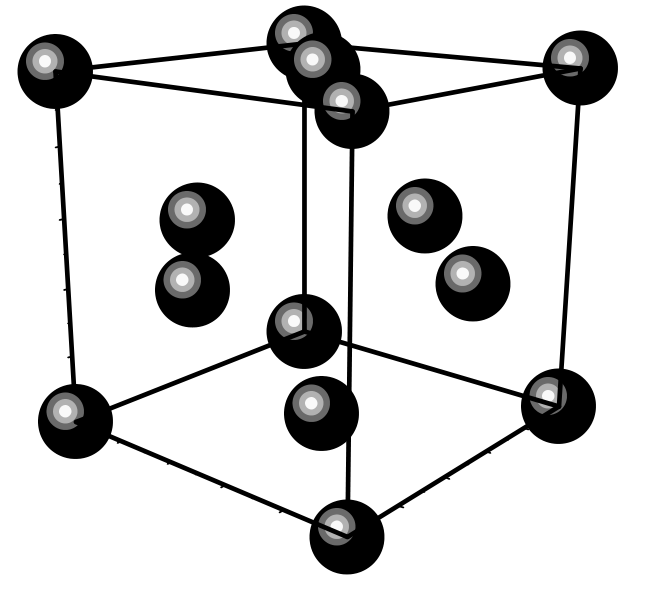
Number of Au atoms in the unit cell:8×1/8 from each corner=1;6×½ from each face=3. Total=4atoms.
1.2 Volume and mass
1.3 Mass of Au atom; Avogadro constant
1.4
| Transformation | α-decay | β-decay |
|---|---|---|
| ²²⁶Ra→²²²Rn | ✓ | |
| ²²²Rn→²¹⁸Po | ✓ | |
| ²¹⁸Po→²¹⁴Pb | ✓ | |
| ²¹⁴Pb→²¹⁴Bi | ✓ | |
| ²¹⁴Bi→²¹⁴Po | ✓ | |
| ²¹⁴Po→²¹⁰Pb | ✓ | |
| ²¹⁰Pb→²¹⁰Bi | ✓ | |
| ²¹⁰Bi→²¹⁰Po | ✓ | |
| ²¹⁰Po→²⁰⁶Pb | ✓ |
1.5 Answer:²¹⁰Pb.
1.6 .
1.7 Answer:
1.8
(only¼of the decays are from²²⁶Ra)
1.9 ; ; ; .
1.10 .
1.11 Acceptable range of slopes is0.0235±0.002μm. Hence (error range needs widening here).
Source note: The last slope is printed positive with unitμm on native page13; that sign/unit is retained rather than silently changed to the negative reciprocal-length slope suggested by the graph.
Оригинал в Архива: IChO 41st-45th.pdf · решение от архива: IChO 41st-45th.pdf · допълнителни данни: IChO 41st-45th.pdf