IChO 2009, Теория — Задача 2. Theoretical problem2 — Interstellar production of H₂
41st International Chemistry Olympiad — Cambridge2009 — Theoretical problems (Volume3 collection edition2014)
Внимание: Бележка към темата
Source edition: The Competition Problems from the International Chemistry Olympiads, Volume 3, edited by Anton Sirota, IUVENTA / IChO International Information Centre, Bratislava, 2014. The collection normalizes task numbering and omits some original grading points, practical instructions and data-dependent key material. Every item actually printed in this Cambridge 2009 section is retained. The referenced practical answer booklet, TLC template and Practical 1 carbon NMR spectrum were not obtained. Reproduced for teaching purposes with the printed Volume 3 attribution and rights notice; commercial publication/distribution requires permission from the copyright holder.
Collection edition and native section
The Competition Problems from the International Chemistry Olympiads, Volume3,41st–45th IChO2009–2013. Edited by Anton Sirota. IUVENTA–Slovak Youth Institute, Bratislava2014. This scoped paper preserves only the41st International Chemistry Olympiad,18–27July2009, Cambridge, United Kingdom.
Native rights statement and archive qualification
You are free to copy, distribute, transmit or adapt this publication or its parts for unlimited teaching purposes, you are obliged, however, to attribute your copies, transmissions or adaptations with a reference to "The Competition Problems from the International Chemistry Olympiads, Volume 3" as it is commonly required in the chemical literature. The problems copied cannot be published and distributed for commercial proposes. The above conditions can only be waived if you get permission from the copyright holder.
Copyright2014IUVENTA–IChO International Information Centre; ISBN978-80-8072-154-1. Attribution: The Competition Problems from the International Chemistry Olympiads, Volume3, edited by Anton Sirota, Bratislava2014.
Source note: This wording permits copying, distribution, transmission and adaptation for unlimited teaching purposes with the required Volume3 reference. It forbids commercial publication/distribution unless the copyright holder waives the conditions. This free educational archive retains the required Volume 3 attribution and this rights notice. Reproduction is presented for teaching purposes under the printed grant; no commercially unrestricted permission is claimed. The publisher must assess this obtained statement before adoption.
Issued by IUVENTA – Slovak Youth Institute in 2014 with the financial support of the Ministry of Education of the Slovak Republic. Number of copies: 250. Not for sale.
International Chemistry Olympiad, International Information Centre, IUVENTA – Slovak Youth Institute, Búdková 2, SK 811 04 Bratislava 1, Slovakia. E-mail: anton.sirota@stuba.sk. Web: www.icho.sk.
Full native editorial preface
Preface This publication contains 39 theoretical and 14 practical competition problems from the 41st – 45th International Chemistry Olympiads (IChO) organized in the years 2009 – 2013. It has been published by the IChO International Information Centre in Bratislava (Slovakia) as a continuation of the preceding Volumes 1 and 2 published on the occasion of the 40th anniversary of the IChO with the titles: • The competition problems from the International Chemistry Olympiads, Volume 1, 1st – 20th IChO, 1968 – 1988 (IUVENTA, Bratislava, 2008). • The competition problems from the International Chemistry Olympiads, Volume 2, 21st – 40th IChO, 1989 – 2008 (IUVENTA, Bratislava, 2009). Not less than 318 theoretical and 110 practical problems were set in the IChO during the forty-five years of its existence. In the elaboration of this collection the editor had to face certain difficulties because the aim was not only to make use of past recordings but also to give them such a form that they may be used in practice and further chemical education. Consequently, it was necessary to make some corrections in order to unify the form of the problems (numbering the tasks of the particular problems, solution inserted immediately after the text of the problem, solutions without grading points and special graphs used for grading of practical problems). Nevertheless, the mentioned corrections and changes do not concern the contents and language of the competition problems. The practical problems set in the IChO competitions, contain as a rule some instructions, list of apparatuses available, chemicals on each desk and those available in the laboratory, and the risk and safety phrases with regard to the chemicals used. All of these items are important for the competitors during the competition but less important for those who are going to read the competition tasks of this collection and thus, they are omitted. Some parts of the solutions of practical problems are also left out since they require the experimental data which could be obtained by experiments during the practical part of the IChO competition. In this publication SI quantities and units are preferred. Only some exceptions have been made when, in an effort to preserve the original text, the quantities and units have been used that are not SI. Although the numbers of significant figures in the results of some solutions do not obey the criteria generally accepted, they were left without change.
Unfortunately, the authors of the particular competition problems are not known and due to the procedure of creation of the IChO competition problems, it is impossible to assign any author's name to a particular problem. Nevertheless, responsibility for the scientific content and language of the problems lies exclusively with the organizers of the particular International Chemistry Olympiads. This review of the competition problems from the 41st – 45th IChO should serve to both competitors and their teachers as a source of further ideas in their preparation for this difficult competition. For those who have taken part in some of these International Chemistry Olympiads the collection of the problems could be of help as archival and documentary material. In the previous forty-five years many known and unknown people - teachers, authors, pupils, and organizers proved their abilities and knowledge and contributed to the success of this already well known and world-wide competition. We wish to all who will organize and attend the future International Chemistry Olympiads, success and happiness. Bratislava, July 2014 Anton Sirota, editor
Source note: The preface describes general editorial omissions. This Cambridge section nevertheless prints practical chemical lists, procedures and selected grading graphs, all retained. Missing original answer-booklet/NMR material is not invented.
Условие
If two atoms collide in interstellar space the energy of the resulting molecule is so great that it rapidly dissociates. Hydrogen atoms only react to give stable H2 molecules on the surface of dust particles. The dust particles absorb most of the excess energy and the newly formed H2 rapidly desorbs. This question examines two kinetic models for H2 formation on the surface of a dust particle. In both models, the rate constant for adsorption of H atoms onto the surface of dust particles is . The typical number density of H atoms (number of H atoms per unit volume) in interstellar space is [H]=10cm⁻³. [Note: In the following, you may treat numbers of surface-adsorbed atoms and number densities of gas-phase atoms in the same way as you would normally use concentrations in the rate equations. As a result, the units of the rate constants may be unfamiliar to you. Reaction rates have units of numbers of atoms or molecules per unit time.]
2.1 Calculate the rate at which H atoms adsorb onto a dust particle. You may assume that this rate is constant throughout.
Desorption of H atoms is first order with respect to the number of adsorbed atoms. The rate constant for the desorption step is .
2.2 Assuming that only adsorption and desorption take place, calculate the steady-state number, N, of H atoms on the surface of a dust particle.
The H atoms are mobile on the surface. When they meet they react to form H2, which then desorbs. The two kinetic models under consideration differ in the way the reaction is modelled, but share the same rate constants ka, kd, and kr, for adsorption, desorption, and bimolecular reaction, as given below. , ,
Model A
Reaction to form H2 is assumed to be second order. On a dust particle the rate of removal of H atoms by reaction is .
2.3 Write down an equation for the rate of change of N, including adsorption, desorption and reaction. Assuming steady state conditions, determine the value of N.
2.4 Calculate the rate of production of H2 per dust particle in this model.
Model B
Model B attempts to analyse the probability that the dust particles carry0,1or2H atoms. The three states are linked by the following reaction scheme. The assumption is made that no more than2atoms may be adsorbed simultaneously.
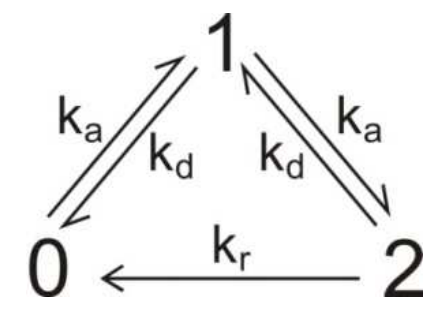
x₀,x₁ andx₂ are the fractions of dust particles existing in state0,1or2,respectively. These fractions may be treated in the same way as concentrations in the following kinetic analysis. For a system in state m with fraction xₘ,the rates of the three possible processes are:
| Process | Rate |
|---|---|
| Adsorption(m→m+1) | |
| Desorption(m→m−1) | |
| Reaction(m→m−2) |
2.5 Write down equations for the rates of change, dxm / dt, of the fractions x0, x1 and x2.
2.6 Assuming steady-state conditions, use the above rate equations to find expressions for the ratios x2/x1 and x1/x0 , and evaluate these ratios.
2.7 Evaluate the steady state fractions x0, x1 and x2. [If you were unable to determine the ratios in 2.6, use x2/x1 = a and x1/x0 = b and give the result algebraically.]
2.8 Evaluate the rate of production of H2 per dust particle in this model.
2.9 It is currently not possible to measure the rate of this reaction experimentally, but the most recent computer simulations of the rate give a value of . Which of the following statements apply to each model under these conditions? Mark any box you consider to be appropriate.
| Statement | Model A | Model B | Neither model |
|---|---|---|---|
| The rate determining step is adsorption of H atoms. | □ | □ | □ |
| The rate-determining step is desorption of H₂ molecules. | □ | □ | □ |
| The rate determining step is the bimolecular reaction of H atoms on the surface. | □ | □ | □ |
| The rate determining step is adsorption of the second H atom. | □ | □ | □ |
| The implicit assumption that reaction can take place regardless of the number of atoms adsorbed leads to substantial error(at least a factor of two). | □ | □ | □ |
| Limiting the number of atoms adsorbed on the particle to2leads to substantial error(at least a factor of two). | □ | □ | □ |
Решение
2.1 Answer:.
2.2 Answer:.
2.3
2.4 Answer:.
2.5
(remember P is changed to x)
2.6
2.7 , , .
2.8 .
2.9
| Statement | Model A | Model B | Neither model |
|---|---|---|---|
| The rate determining step is adsorption of H atoms. | ✓ | (✓) | |
| The rate-determining step is desorption of H₂ molecules. | ✓ | ||
| The rate determining step is the bimolecular reaction of H atoms on the surface. | ✓ | ||
| The rate determining step is adsorption of the second H atom. | ✓ | ||
| The implicit assumption that reaction can take place regardless of the number of atoms adsorbed leads to substantial error(at least a factor of two). | ✓ | ||
| Limiting the number of atoms adsorbed on the particle to2leads to substantial error(at least a factor of two). | ✓ |
Source note: The printed key uses Pₘ and includes the parenthesized Model B tick in the first row; the question uses xₘ. Both native details are retained.
Оригинал в Архива: IChO 41st-45th.pdf · решение от архива: IChO 41st-45th.pdf · допълнителни данни: IChO 41st-45th.pdf