IChO 2009, Теория — Задача 5. Theoretical problem5 — Epoxy resins
41st International Chemistry Olympiad — Cambridge2009 — Theoretical problems (Volume3 collection edition2014)
Внимание: Бележка към темата
Source edition: The Competition Problems from the International Chemistry Olympiads, Volume 3, edited by Anton Sirota, IUVENTA / IChO International Information Centre, Bratislava, 2014. The collection normalizes task numbering and omits some original grading points, practical instructions and data-dependent key material. Every item actually printed in this Cambridge 2009 section is retained. The referenced practical answer booklet, TLC template and Practical 1 carbon NMR spectrum were not obtained. Reproduced for teaching purposes with the printed Volume 3 attribution and rights notice; commercial publication/distribution requires permission from the copyright holder.
Collection edition and native section
The Competition Problems from the International Chemistry Olympiads, Volume3,41st–45th IChO2009–2013. Edited by Anton Sirota. IUVENTA–Slovak Youth Institute, Bratislava2014. This scoped paper preserves only the41st International Chemistry Olympiad,18–27July2009, Cambridge, United Kingdom.
Native rights statement and archive qualification
You are free to copy, distribute, transmit or adapt this publication or its parts for unlimited teaching purposes, you are obliged, however, to attribute your copies, transmissions or adaptations with a reference to "The Competition Problems from the International Chemistry Olympiads, Volume 3" as it is commonly required in the chemical literature. The problems copied cannot be published and distributed for commercial proposes. The above conditions can only be waived if you get permission from the copyright holder.
Copyright2014IUVENTA–IChO International Information Centre; ISBN978-80-8072-154-1. Attribution: The Competition Problems from the International Chemistry Olympiads, Volume3, edited by Anton Sirota, Bratislava2014.
Source note: This wording permits copying, distribution, transmission and adaptation for unlimited teaching purposes with the required Volume3 reference. It forbids commercial publication/distribution unless the copyright holder waives the conditions. This free educational archive retains the required Volume 3 attribution and this rights notice. Reproduction is presented for teaching purposes under the printed grant; no commercially unrestricted permission is claimed. The publisher must assess this obtained statement before adoption.
Issued by IUVENTA – Slovak Youth Institute in 2014 with the financial support of the Ministry of Education of the Slovak Republic. Number of copies: 250. Not for sale.
International Chemistry Olympiad, International Information Centre, IUVENTA – Slovak Youth Institute, Búdková 2, SK 811 04 Bratislava 1, Slovakia. E-mail: anton.sirota@stuba.sk. Web: www.icho.sk.
Full native editorial preface
Preface This publication contains 39 theoretical and 14 practical competition problems from the 41st – 45th International Chemistry Olympiads (IChO) organized in the years 2009 – 2013. It has been published by the IChO International Information Centre in Bratislava (Slovakia) as a continuation of the preceding Volumes 1 and 2 published on the occasion of the 40th anniversary of the IChO with the titles: • The competition problems from the International Chemistry Olympiads, Volume 1, 1st – 20th IChO, 1968 – 1988 (IUVENTA, Bratislava, 2008). • The competition problems from the International Chemistry Olympiads, Volume 2, 21st – 40th IChO, 1989 – 2008 (IUVENTA, Bratislava, 2009). Not less than 318 theoretical and 110 practical problems were set in the IChO during the forty-five years of its existence. In the elaboration of this collection the editor had to face certain difficulties because the aim was not only to make use of past recordings but also to give them such a form that they may be used in practice and further chemical education. Consequently, it was necessary to make some corrections in order to unify the form of the problems (numbering the tasks of the particular problems, solution inserted immediately after the text of the problem, solutions without grading points and special graphs used for grading of practical problems). Nevertheless, the mentioned corrections and changes do not concern the contents and language of the competition problems. The practical problems set in the IChO competitions, contain as a rule some instructions, list of apparatuses available, chemicals on each desk and those available in the laboratory, and the risk and safety phrases with regard to the chemicals used. All of these items are important for the competitors during the competition but less important for those who are going to read the competition tasks of this collection and thus, they are omitted. Some parts of the solutions of practical problems are also left out since they require the experimental data which could be obtained by experiments during the practical part of the IChO competition. In this publication SI quantities and units are preferred. Only some exceptions have been made when, in an effort to preserve the original text, the quantities and units have been used that are not SI. Although the numbers of significant figures in the results of some solutions do not obey the criteria generally accepted, they were left without change.
Unfortunately, the authors of the particular competition problems are not known and due to the procedure of creation of the IChO competition problems, it is impossible to assign any author's name to a particular problem. Nevertheless, responsibility for the scientific content and language of the problems lies exclusively with the organizers of the particular International Chemistry Olympiads. This review of the competition problems from the 41st – 45th IChO should serve to both competitors and their teachers as a source of further ideas in their preparation for this difficult competition. For those who have taken part in some of these International Chemistry Olympiads the collection of the problems could be of help as archival and documentary material. In the previous forty-five years many known and unknown people - teachers, authors, pupils, and organizers proved their abilities and knowledge and contributed to the success of this already well known and world-wide competition. We wish to all who will organize and attend the future International Chemistry Olympiads, success and happiness. Bratislava, July 2014 Anton Sirota, editor
Source note: The preface describes general editorial omissions. This Cambridge section nevertheless prints practical chemical lists, procedures and selected grading graphs, all retained. Missing original answer-booklet/NMR material is not invented.
Условие
The synthesis of epoxy resins is a multi-billion dollar industry worldwide. Epoxy resins are high performance adhesives synthesised from the reaction of a bis-epoxide with a diamine. The bis-epoxide is made from H and epichlorohydrin, C. Compounds C and H can be synthesised according to the schemes below.
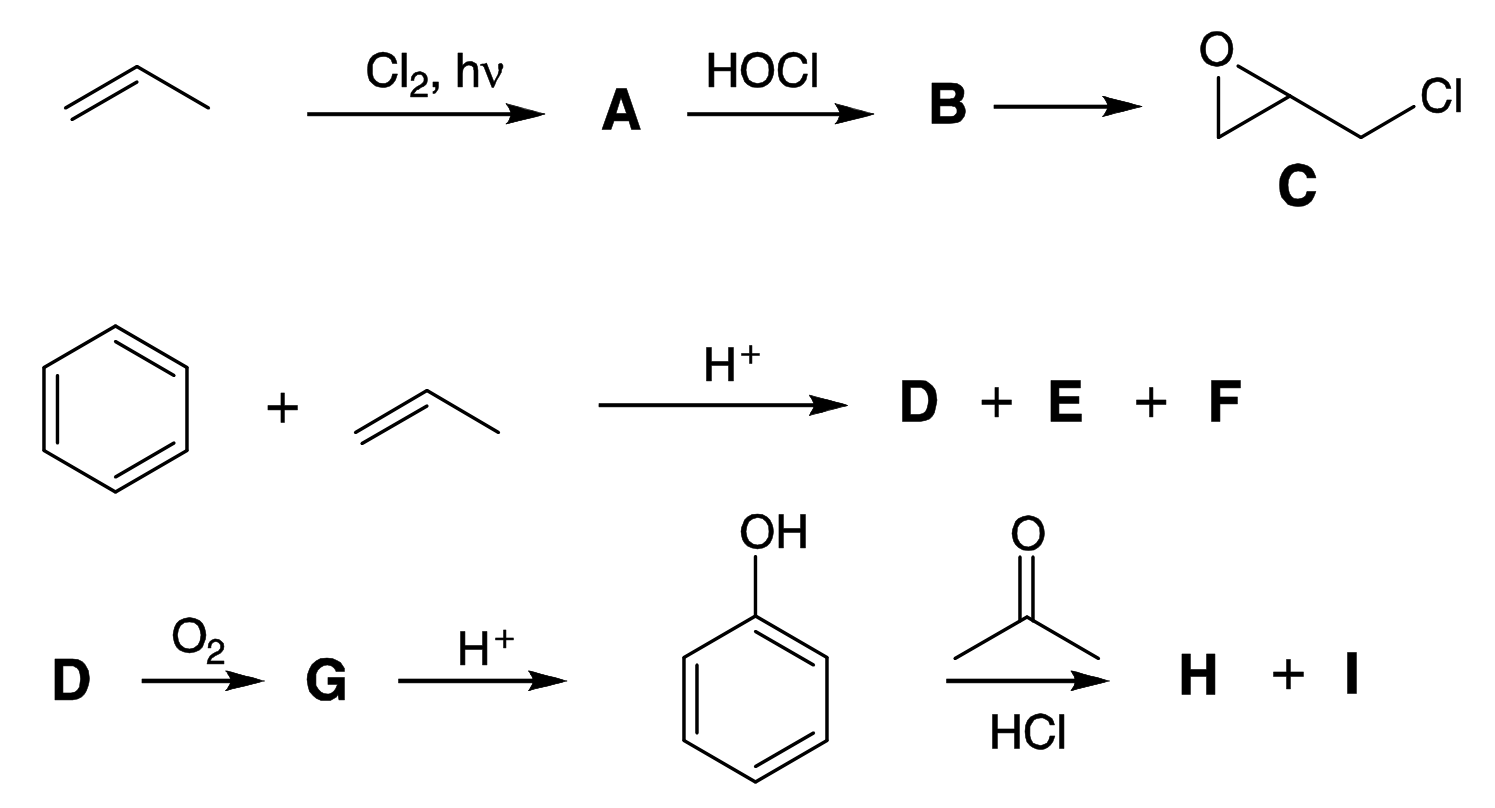
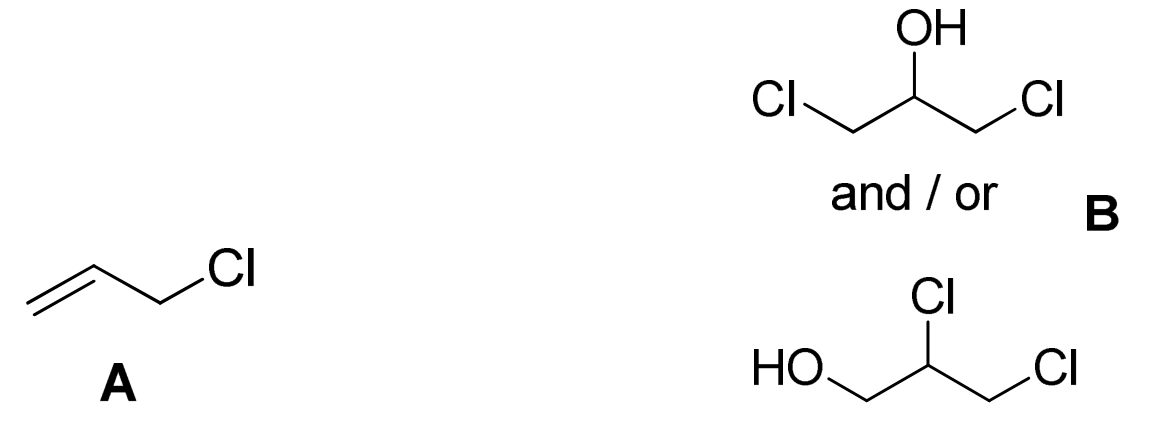
The synthesis of epichlorohydrin C begins with the reaction of propene with chlorine in the presence of light.
5.1 Draw the structures of A and B.
5.2 Give the formula of a suitable reagent for the conversion of B into epichlorohydrin C.
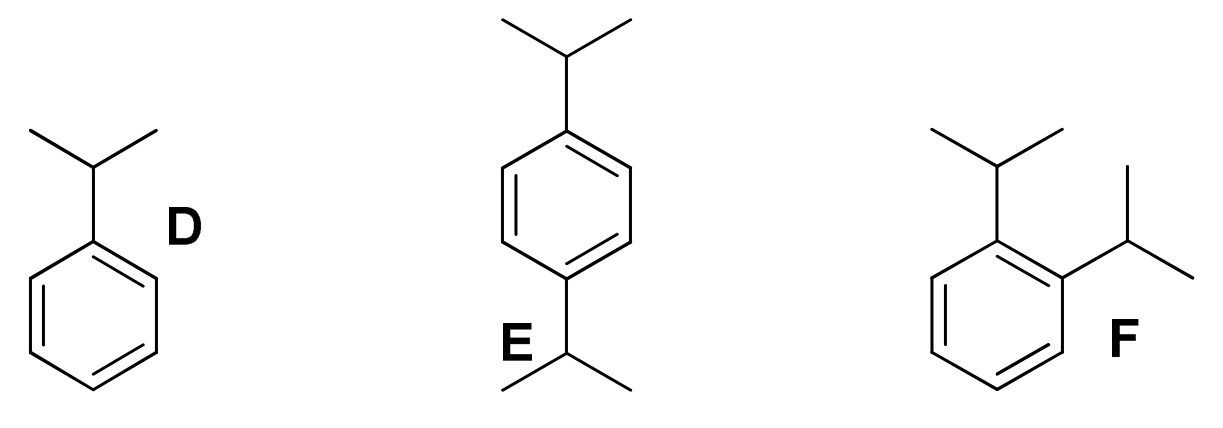
The synthesis of H commences with the reaction of benzene with propene in the presence of an acid catalyst which gives D as the major product and E and F as minor products.
5.3 Draw the structures of D, E, and F from the following data:
D: Elemental composition: C 89.94 %, H 10.06 %; 6 signals in the ¹³C NMR spectrum.
E: Elemental composition: C 88.82 %, H 11.18 %; 4 signals in the ¹³C NMR spectrum.
F: Elemental composition: C 88.82 %, H 11.18 %; 5 signals in the ¹³C NMR spectrum.
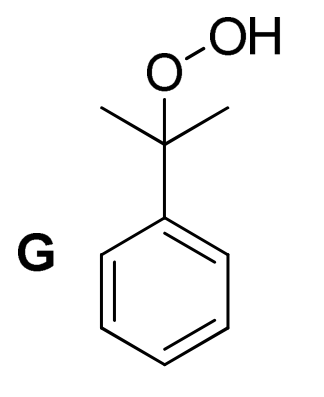
Bubbling oxygen through a hot solution of D gives G which on exposure to acid gives phenol (hydroxybenzene) and acetone (propanone). G turns starch iodide paper from white to dark blue. G has 6 signals in the ¹³C NMR spectrum and the following signals in the ¹H NMR spectrum: δ7.78 (1H, s), 7.45 – 7.22 (5H, m), 1.56 (6H, s); addition of D₂O results in the disappearance of the signal at δ= 7.78.
5.4 Draw the structure of G.
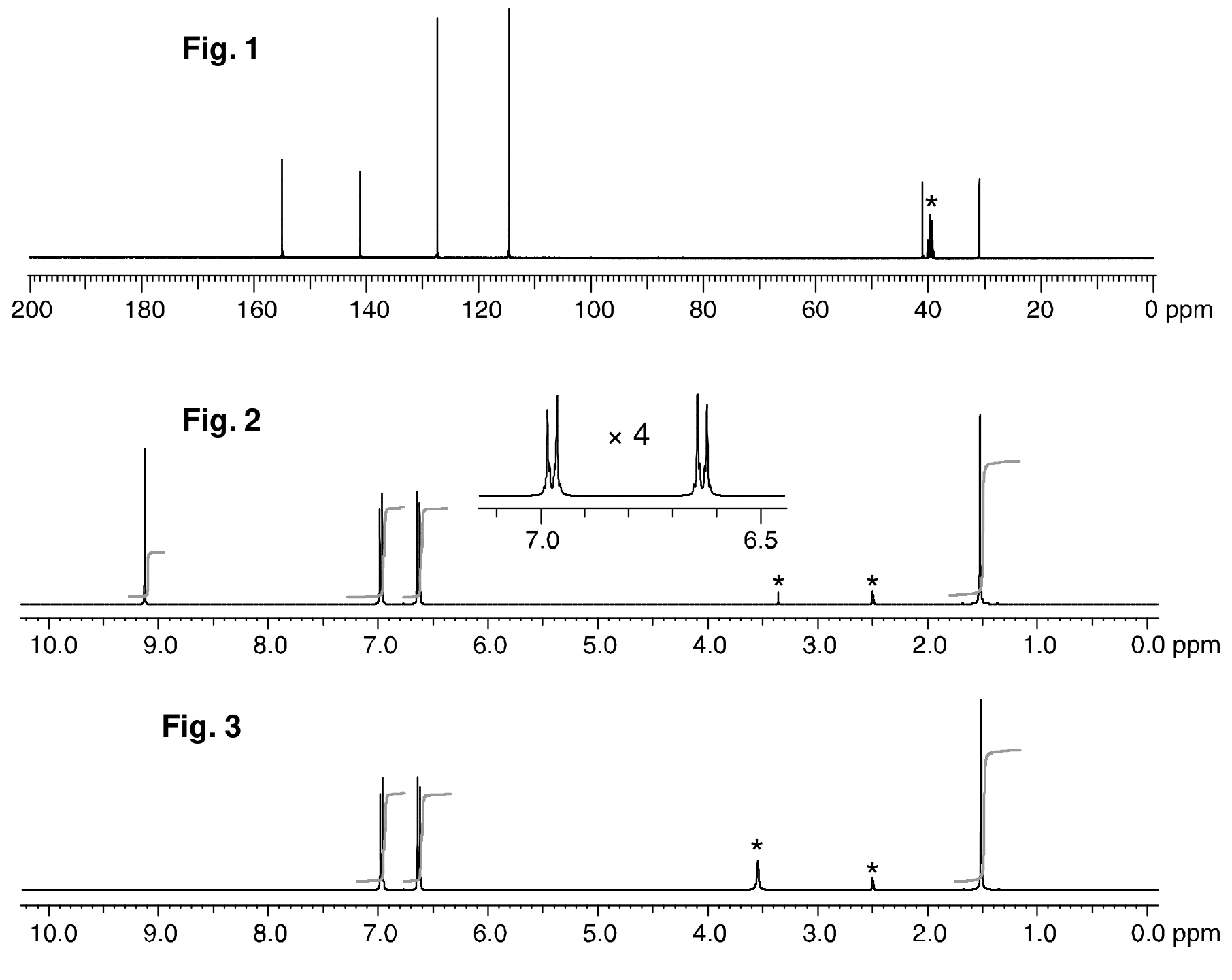
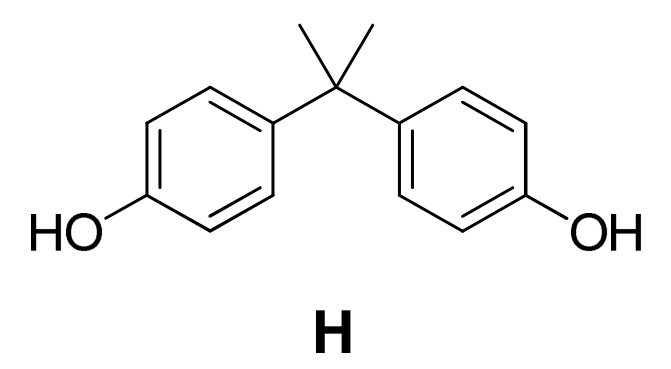
Exposure of phenol and acetone to hydrochloric acid gives compound H. The ¹³C NMR spectrum for H is shown in Fig. 1. The ¹H NMR spectrum is shown in Fig. 2 together with a four-fold expansion of the region 6.5 – 7.1 ppm. The ¹H NMR spectrum after the addition of a drop of D₂O, is shown in Fig. 3. Peaks due to the solvent are marked with an asterisk (*).
5.5 Draw the structure of H.
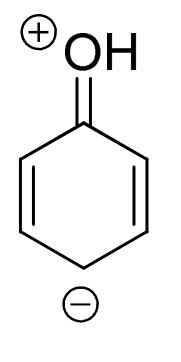
5.6 Draw one resonance structure of phenol which explains the regioselective formation of H.
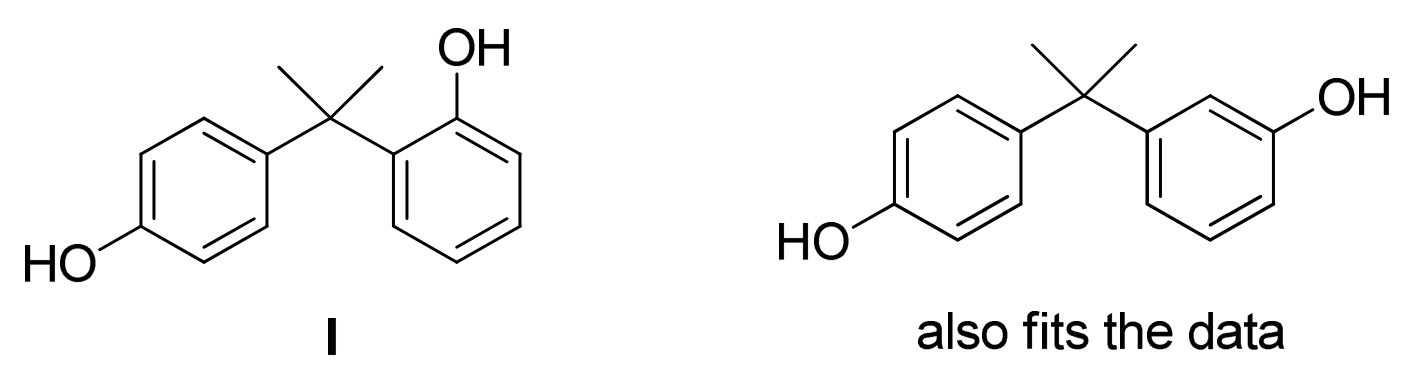
A second compound, I, is also formed in the reaction of phenol with acetone. The ¹³C NMR spectrum of I has 12 signals. The ¹H NMR spectrum has the following signals: δ7.50 – 6.51 (8H, m), 5.19 (1H, s), 4.45 (1H, s), 1.67 (6H, s); addition of D₂O results in the disappearance of the signals at δ= 5.19 and 4.45
5.7 Draw a structure for I.
Excess phenol reacts with epichlorohydrin C in the presence of base to give compound L which has 6 signals in its ¹³C NMR spectrum. If the reaction is stopped before completion compounds J and K can also be isolated. Compound L is formed from compound K and compound K is formed from compound J.

5.8 Draw the structures of J, K and L.
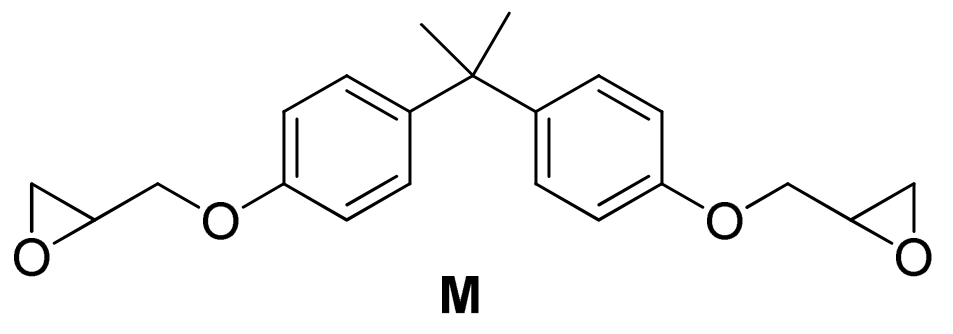
Treatment of H with a large excess of epichlorohydrin C and base gives a monomeric bis-epoxide M. M contains no chlorine atoms or OH groups.
5.9 Draw the structure of M.
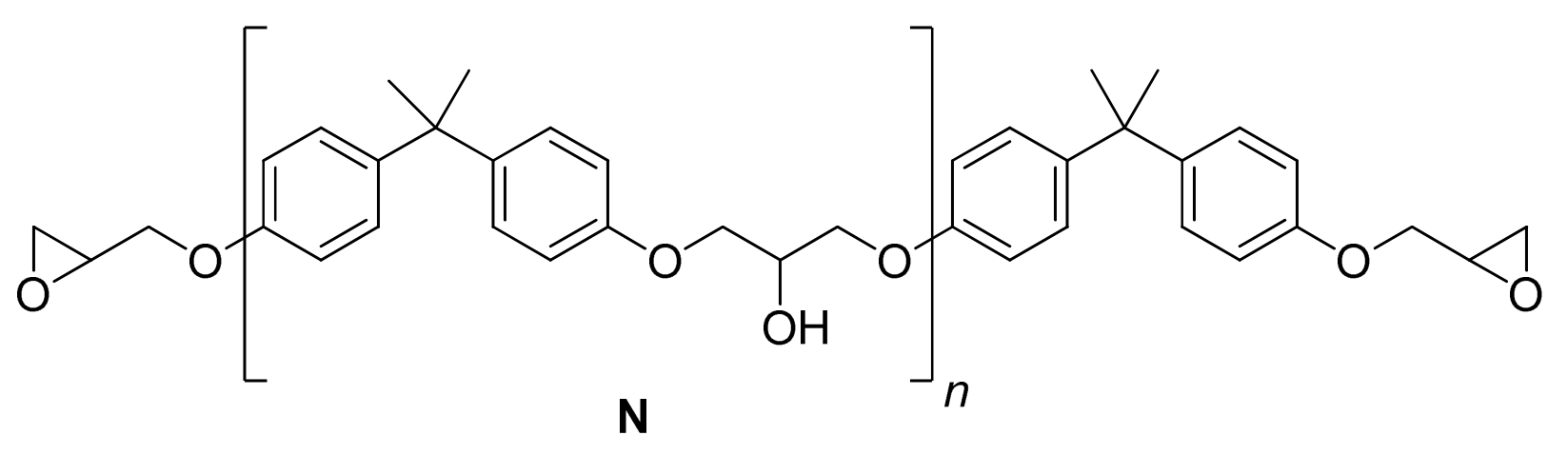
Treatment of H with a small excess of epichlorohydrin and base gives N. N has the form: endgroup 1-[repeat unit]ₙ-endgroup 2 where n is approximately 10 – 15. N does not contain chlorine atoms and contains one OH group per repeat unit.
5.10 Draw the structure of N in the form indicated above: (endgroup 1-[repeat unit]ₙ-endgroup 2).
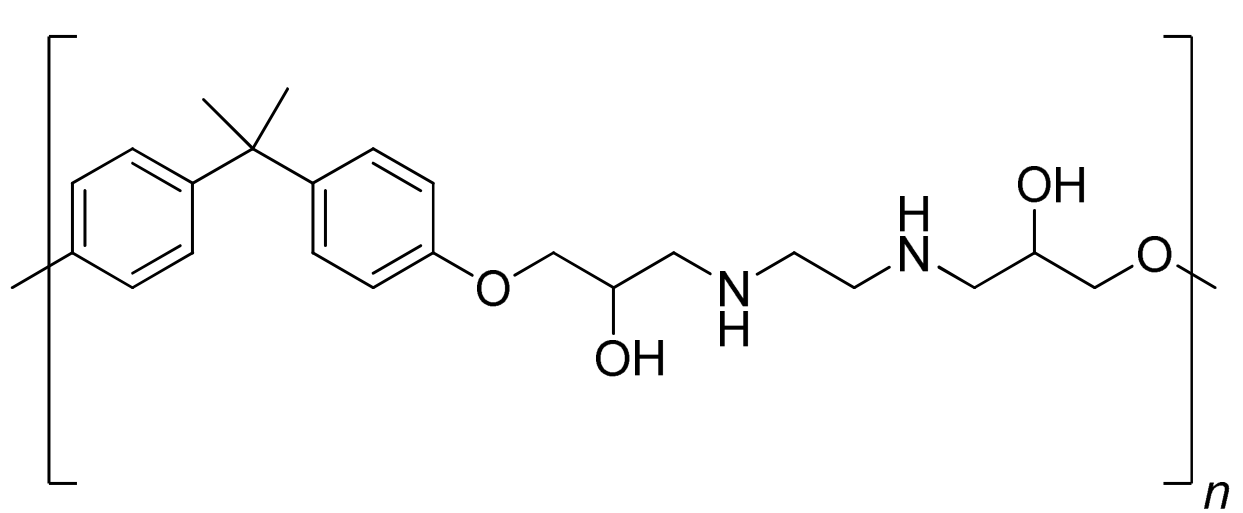
5.11 Draw the repeat unit of the polymeric epoxy resin O formed from the reaction of the bis-epoxide M with ethane-1,2-diamine.
Решение
5.1
5.2 NaOH,or the formula of another suitable base.
5.3
5.4
5.5
5.6
5.7 Both printed structures are retained; the second also fits the data.
5.8

5.9
5.10
5.11
Оригинал в Архива: IChO 41st-45th.pdf · решение от архива: IChO 41st-45th.pdf · допълнителни данни: IChO 41st-45th.pdf