IChO 2009, Теория — Задача 6. Theoretical problem6 — Transition metal complexes
41st International Chemistry Olympiad — Cambridge2009 — Theoretical problems (Volume3 collection edition2014)
Внимание: Бележка към темата
Source edition: The Competition Problems from the International Chemistry Olympiads, Volume 3, edited by Anton Sirota, IUVENTA / IChO International Information Centre, Bratislava, 2014. The collection normalizes task numbering and omits some original grading points, practical instructions and data-dependent key material. Every item actually printed in this Cambridge 2009 section is retained. The referenced practical answer booklet, TLC template and Practical 1 carbon NMR spectrum were not obtained. Reproduced for teaching purposes with the printed Volume 3 attribution and rights notice; commercial publication/distribution requires permission from the copyright holder.
Collection edition and native section
The Competition Problems from the International Chemistry Olympiads, Volume3,41st–45th IChO2009–2013. Edited by Anton Sirota. IUVENTA–Slovak Youth Institute, Bratislava2014. This scoped paper preserves only the41st International Chemistry Olympiad,18–27July2009, Cambridge, United Kingdom.
Native rights statement and archive qualification
You are free to copy, distribute, transmit or adapt this publication or its parts for unlimited teaching purposes, you are obliged, however, to attribute your copies, transmissions or adaptations with a reference to "The Competition Problems from the International Chemistry Olympiads, Volume 3" as it is commonly required in the chemical literature. The problems copied cannot be published and distributed for commercial proposes. The above conditions can only be waived if you get permission from the copyright holder.
Copyright2014IUVENTA–IChO International Information Centre; ISBN978-80-8072-154-1. Attribution: The Competition Problems from the International Chemistry Olympiads, Volume3, edited by Anton Sirota, Bratislava2014.
Source note: This wording permits copying, distribution, transmission and adaptation for unlimited teaching purposes with the required Volume3 reference. It forbids commercial publication/distribution unless the copyright holder waives the conditions. This free educational archive retains the required Volume 3 attribution and this rights notice. Reproduction is presented for teaching purposes under the printed grant; no commercially unrestricted permission is claimed. The publisher must assess this obtained statement before adoption.
Issued by IUVENTA – Slovak Youth Institute in 2014 with the financial support of the Ministry of Education of the Slovak Republic. Number of copies: 250. Not for sale.
International Chemistry Olympiad, International Information Centre, IUVENTA – Slovak Youth Institute, Búdková 2, SK 811 04 Bratislava 1, Slovakia. E-mail: anton.sirota@stuba.sk. Web: www.icho.sk.
Full native editorial preface
Preface This publication contains 39 theoretical and 14 practical competition problems from the 41st – 45th International Chemistry Olympiads (IChO) organized in the years 2009 – 2013. It has been published by the IChO International Information Centre in Bratislava (Slovakia) as a continuation of the preceding Volumes 1 and 2 published on the occasion of the 40th anniversary of the IChO with the titles: • The competition problems from the International Chemistry Olympiads, Volume 1, 1st – 20th IChO, 1968 – 1988 (IUVENTA, Bratislava, 2008). • The competition problems from the International Chemistry Olympiads, Volume 2, 21st – 40th IChO, 1989 – 2008 (IUVENTA, Bratislava, 2009). Not less than 318 theoretical and 110 practical problems were set in the IChO during the forty-five years of its existence. In the elaboration of this collection the editor had to face certain difficulties because the aim was not only to make use of past recordings but also to give them such a form that they may be used in practice and further chemical education. Consequently, it was necessary to make some corrections in order to unify the form of the problems (numbering the tasks of the particular problems, solution inserted immediately after the text of the problem, solutions without grading points and special graphs used for grading of practical problems). Nevertheless, the mentioned corrections and changes do not concern the contents and language of the competition problems. The practical problems set in the IChO competitions, contain as a rule some instructions, list of apparatuses available, chemicals on each desk and those available in the laboratory, and the risk and safety phrases with regard to the chemicals used. All of these items are important for the competitors during the competition but less important for those who are going to read the competition tasks of this collection and thus, they are omitted. Some parts of the solutions of practical problems are also left out since they require the experimental data which could be obtained by experiments during the practical part of the IChO competition. In this publication SI quantities and units are preferred. Only some exceptions have been made when, in an effort to preserve the original text, the quantities and units have been used that are not SI. Although the numbers of significant figures in the results of some solutions do not obey the criteria generally accepted, they were left without change.
Unfortunately, the authors of the particular competition problems are not known and due to the procedure of creation of the IChO competition problems, it is impossible to assign any author's name to a particular problem. Nevertheless, responsibility for the scientific content and language of the problems lies exclusively with the organizers of the particular International Chemistry Olympiads. This review of the competition problems from the 41st – 45th IChO should serve to both competitors and their teachers as a source of further ideas in their preparation for this difficult competition. For those who have taken part in some of these International Chemistry Olympiads the collection of the problems could be of help as archival and documentary material. In the previous forty-five years many known and unknown people - teachers, authors, pupils, and organizers proved their abilities and knowledge and contributed to the success of this already well known and world-wide competition. We wish to all who will organize and attend the future International Chemistry Olympiads, success and happiness. Bratislava, July 2014 Anton Sirota, editor
Source note: The preface describes general editorial omissions. This Cambridge section nevertheless prints practical chemical lists, procedures and selected grading graphs, all retained. Missing original answer-booklet/NMR material is not invented.
Условие
Alfred Werner used the technique of ‘isomer counting’ to deduce the structure of metal complexes with coordination number six. Three of the shapes he considered are shown below.
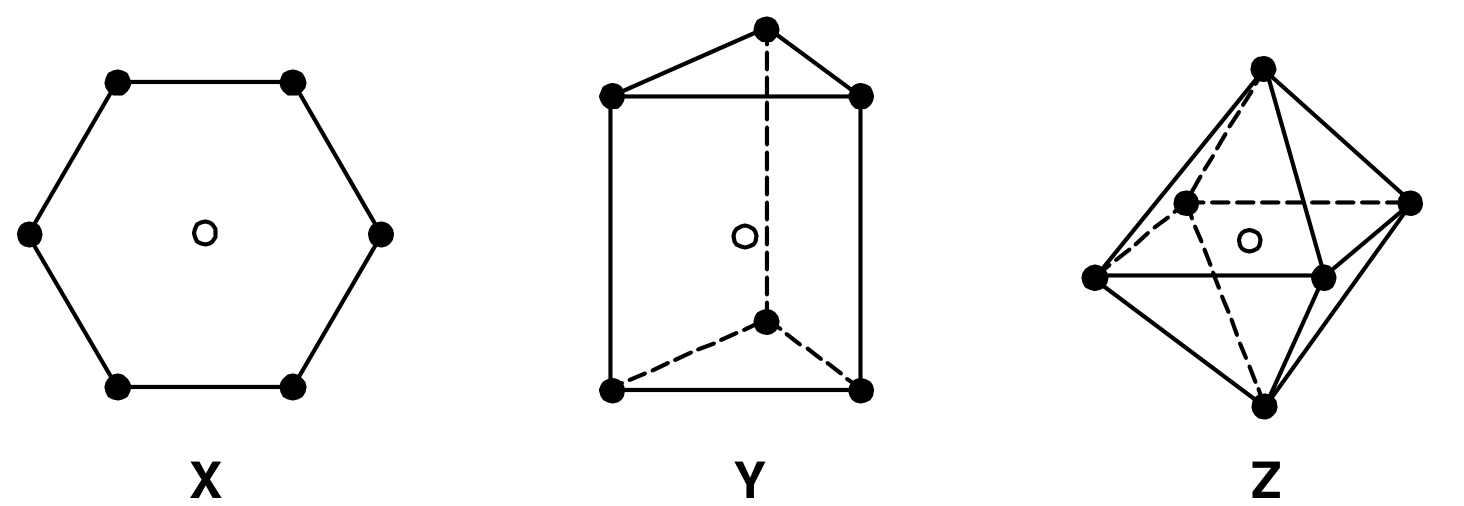
In each structure, the empty circle shows the location of the central metal atom and the filled circles show the location of the ligands. Structure X is hexagonal planar, structure Y is trigonal prismatic and structure Z is octahedral. For each of the three shapes, there is just one structure when all of the ligands are the same, i.e. when the complex has the general formula MA6 where A is the ligand. However, when achiral ligands A are substituted by one or more achiral ligands, it may be possible for each structure to form geometrical isomers. It might also be possible for one or more of the geometrical isomers to be optically active and exist as pairs of enantiomers.
6.1 Fill in the table below to indicate how many geometrical isomers may be formed for each structure X, Y, and Z as the monodentate ligands A are substituted by monodentate ligands B or by symmetrical bidentate ligands, denoted C–C. Bidentate ligand C–C can only link between two atoms on adjacent positions, i.e. those positions connected by a line in the structures X, Y, and Z. In each case write the number of geometrical isomers in the space provided. If one of the isomers exists as a pair of enantiomers, include an asterisk, *, in the box. If two exist as two pairs of enantiomers, include two asterisks and so on. For example, if you think there are five geometrical isomers of a particular structure, three of which exist as pairs of enantiomers, write 5***
| Complex | Hexagonal planar X | Trigonal Prismatic Y | Octahedral Z |
|---|---|---|---|
| MA₆ | 1 | 1 | 1 |
| MA₅B | □ | □ | □ |
| MA₄B₂ | □ | □ | □ |
| MA₃B₃ | □ | □ | □ |
| MA₄(C–C) | □ | □ | □ |
| MA₂(C–C)₂ | □ | □ | □ |
| M(C–C)₃ | □ | □ | □ |
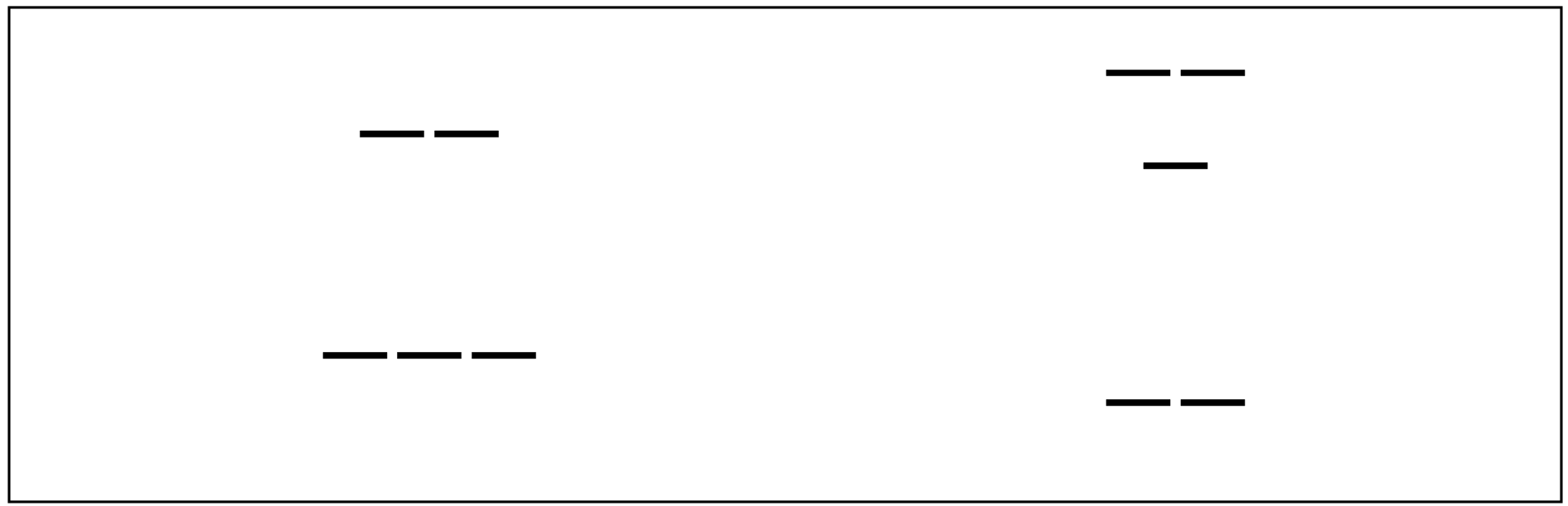
There are no known complexes that adopt the hexagonal planar geometry X, but structures are known for both the trigonal prismatic geometry Y and the octahedral geometry Z. In these complexes, the orbitals derived from the metal d orbitals have different energies depending on the geometry of the complex. The splitting patterns for the trigonal prismatic geometry and for the octahedral geometry are shown below.
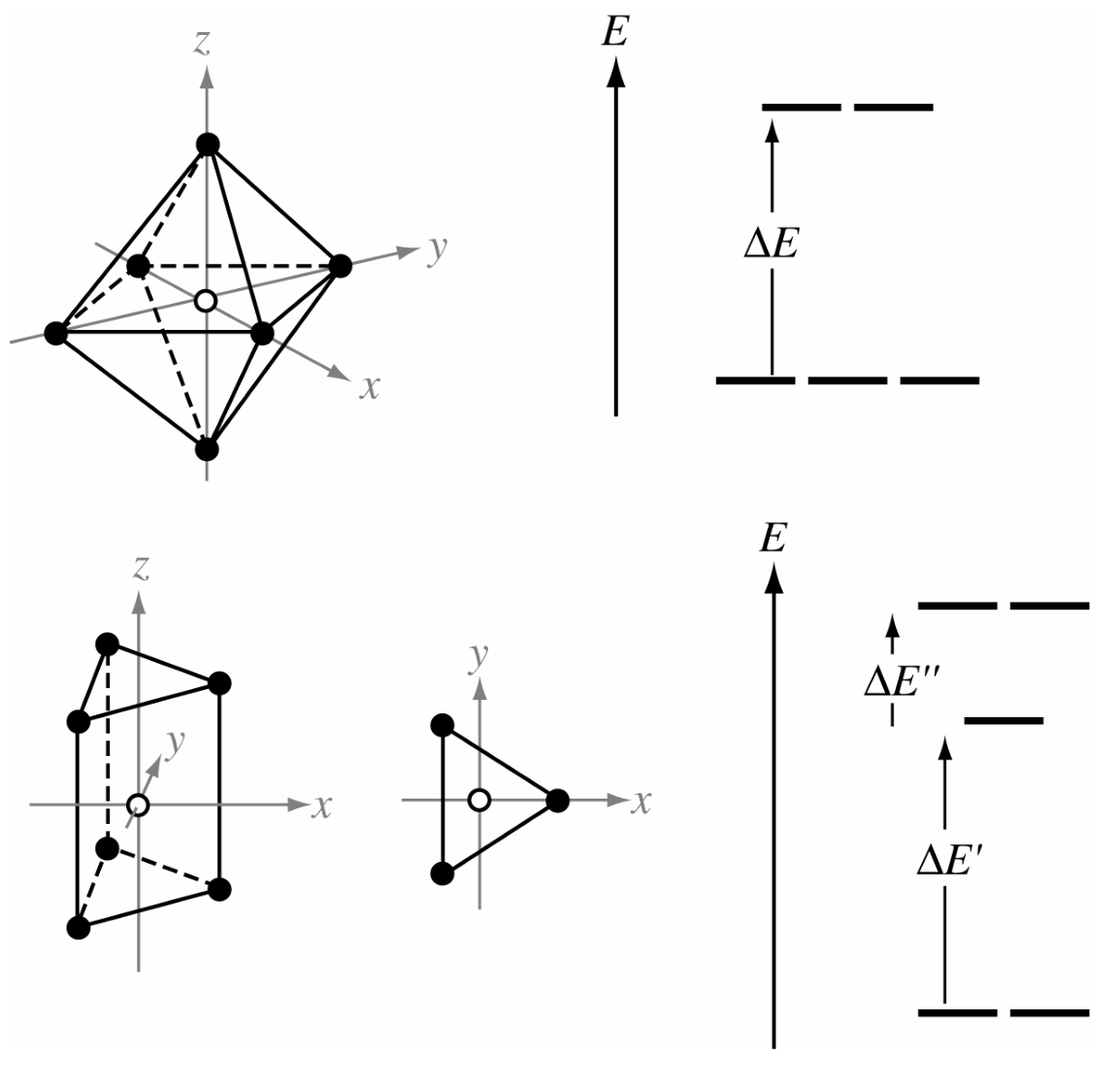
The separations in energy, ∆E, ∆E’ and ∆E’’ depend on the particular complex.
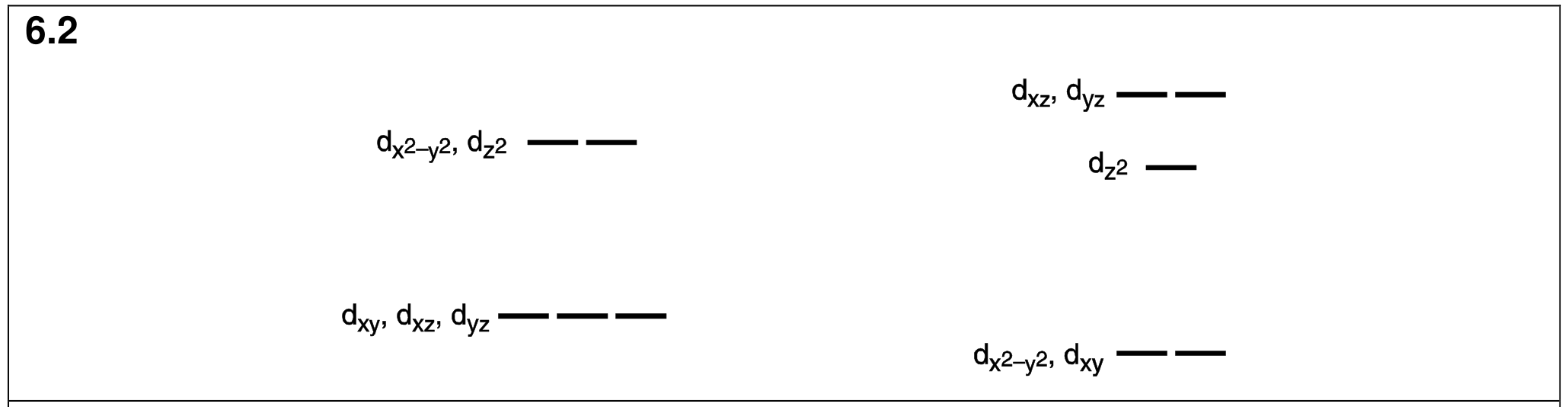
6.2 For each of the splitting patterns shown below label which d orbitals are which.
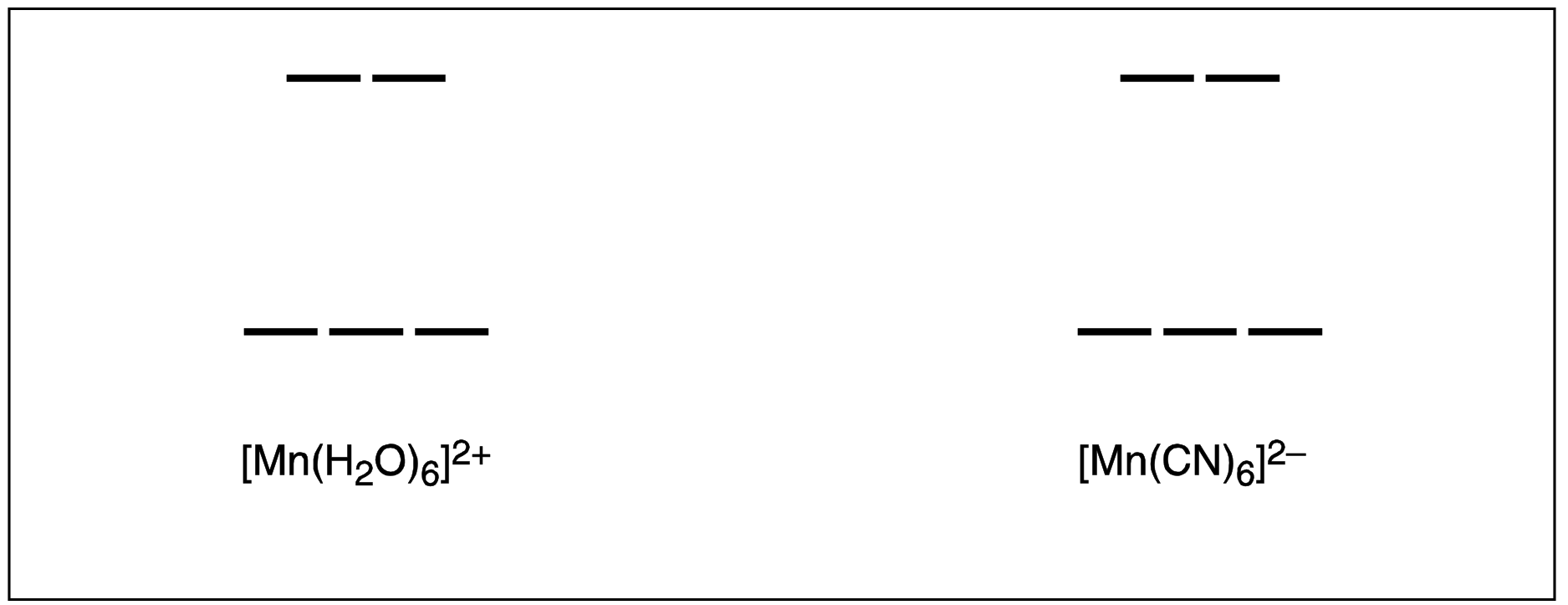
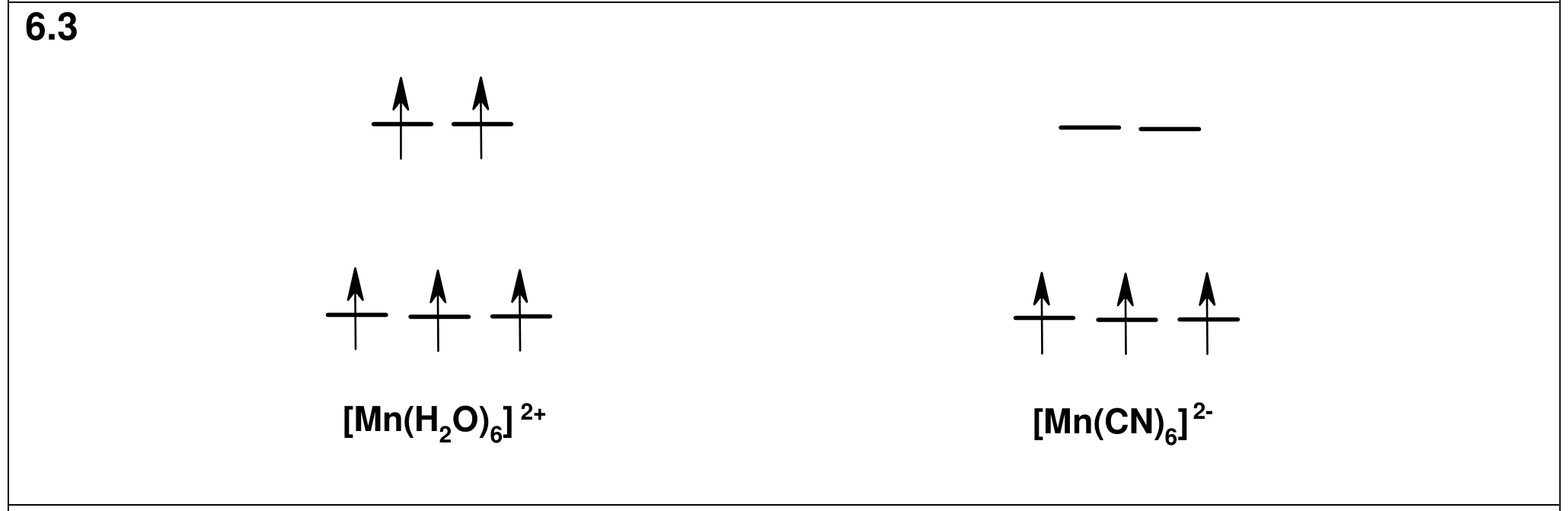
The two complexes [Mn(H₂O)₆]²⁺ and [Mn(CN)₆]²⁻ are both octahedral. One has a magnetic moment of 5.9 BM, the other has a magnetic moment of 3.8 BM but you must decide which is which.
6.3 On the diagram below, draw the electronic arrangements for each of the complexes.
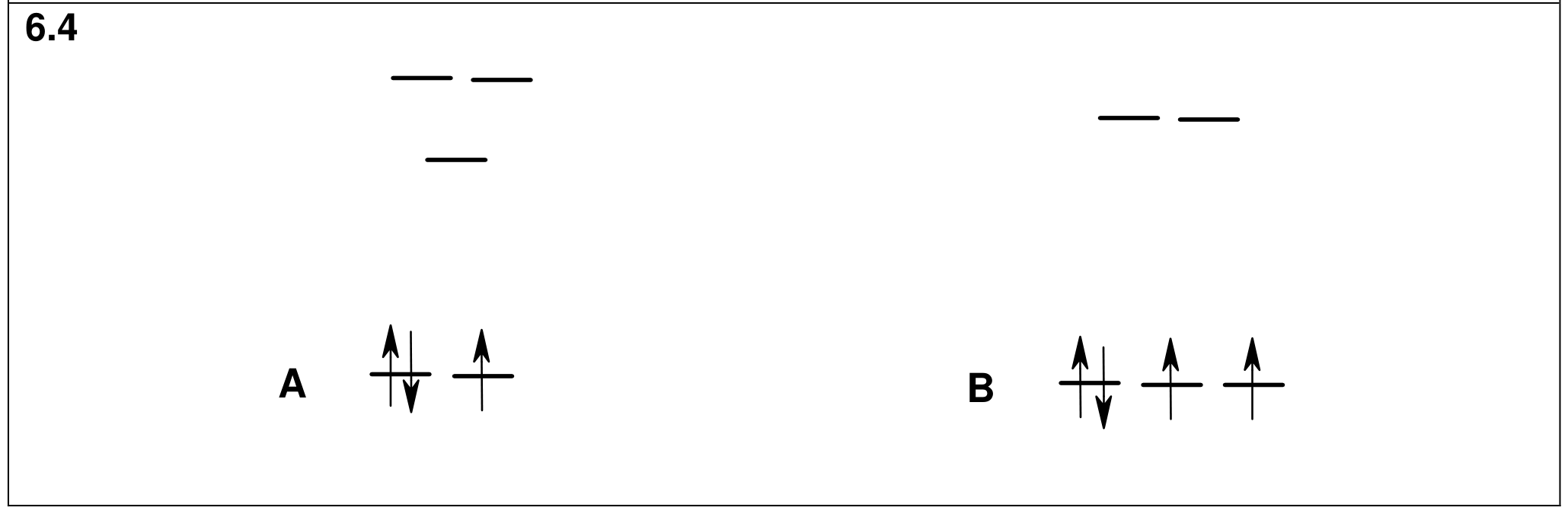
The magnetic moments of complexes A and B shown below have been measured and found to be 1.9 and 2.7 BM but you must decide which is which.
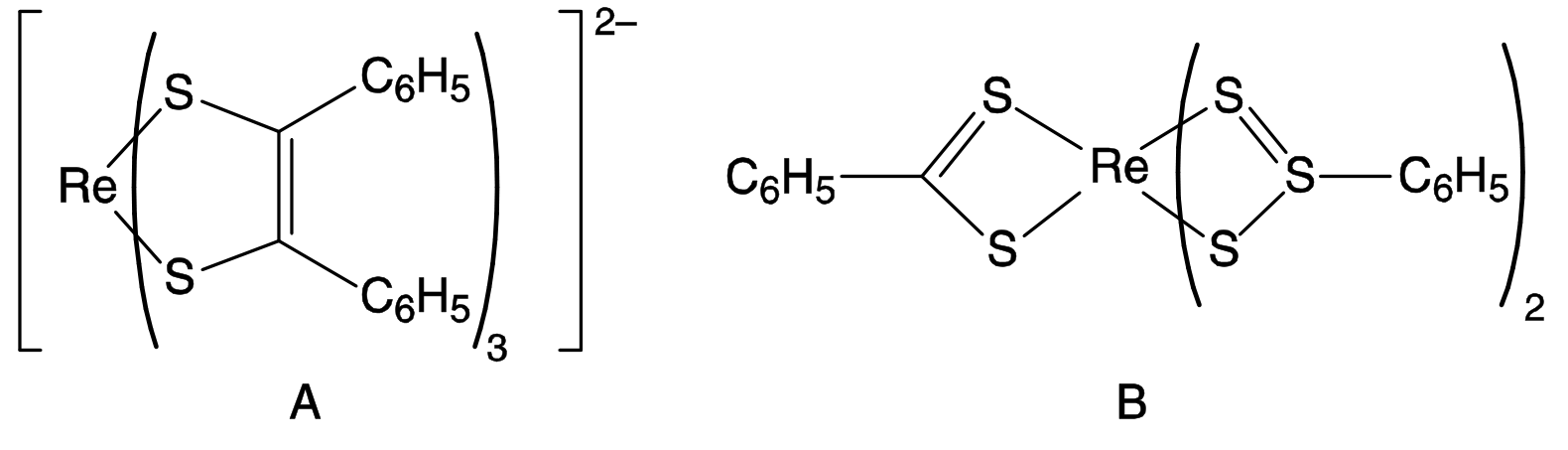
6.4 Draw the orbital splitting diagrams for the two complexes, including the arrangements of the electrons.
Octahedral complexes are far more common than trigonal prismatic. Werner isolated five compounds C – G containing Co(III), Cl, and NH₃ only, each of which contained one octahedral complex. (There is actually a sixth compound but Werner could not isolate it.) Werner’s five compounds had the molar conductivities shown below. The conductivities are extrapolated to infinite dilution and are expressed in arbitrary units. Compound G does not react with aqueous AgNO₃; compounds C, D, and E react with different stoichiometric ratios of aqueous AgNO₃; E and F react with the same stoichiometric ratio of aqueous AgNO₃.
| Compound | C | D | E | F | G |
|---|---|---|---|---|---|
| molar conductivity | 510 | 372 | 249 | 249 | ~0 |
6.5 As far as you are able, suggest a structure for each of the compounds C – G.
Werner was also the first person to separate the enantiomers of an octahedral compound, H, which contained no carbon atoms. The compound, H, is composed of only cobalt, ammonia, chloride and an oxygen species which could be either H₂O, or HO⁻ or O²⁻. The compound contains octahedrally coordinated cobalt ions. All of the chloride is easily removed from the compound by titration with aqueous silver nitrate. A 0.2872 g sample of H (containing no water of crystallization) required 22.8 cm³ of a silver nitrate solution (c = 0.100 mol dm⁻³) to exchange all of the chloride.
6.6 Calculate the percentage, by mass, of chloride in H.
H is stable to acids, but is hydrolysed in alkali. A 0.7934 g sample of H (containing no water of crystallization) was heated with excess aqueous sodium hydroxide. Cobalt(III) oxide was formed and ammonia gas given off. The ammonia produced was distilled off and absorbed into 50.0 cm³ of aqueous HCl (cHCl = 0.500 mol dm⁻³). The residual HCl required 24.8 cm³ of aqueous KOH solution (cKOH = 0.500 mol dm⁻³) to be neutralized. The remaining suspension of cobalt(III) oxide was allowed to cool, approximately 1 g of potassium iodide was added, and then the mixture was acidified with aqueous HCl. The liberated iodine was then titrated with aqueous solution of sodium thiosulfate (c = 0.200 mol dm⁻³) and required 21.0 cm³ for complete reaction.
6.7 Calculate the percentage, by mass, of ammonia in H.
6.8 Give the equation for the reaction of cobalt(III) oxide with potassium iodide in aqueous acid.
6.9 Calculate the percentage, by mass, of cobalt in H.
6.10 Calculate the identity of the oxygen species contained in H. Show your working.
6.11 Give the empirical formula of H.
6.12 Suggest a structure for the chiral compound H.
Решение
6.1 Number of predicted geometrical isomers
| Complex | Hexagonal planar X | Trigonal Prismatic Y | Octahedral Z |
|---|---|---|---|
| MA₆ | 1 | 1 | 1 |
| MA₅B | 1 | 1 | 1 |
| MA₄B₂ | 3 | 3* | 2 |
| MA₃B₃ | 3 | 3* | 2 |
| MA₄(C–C) | 1 | 2 | 1 |
| MA₂(C–C)₂ | 2 | 4* | 2* |
| M(C–C)₃ | 1 | 2 | 1* |
6.2
6.3
6.4
6.5
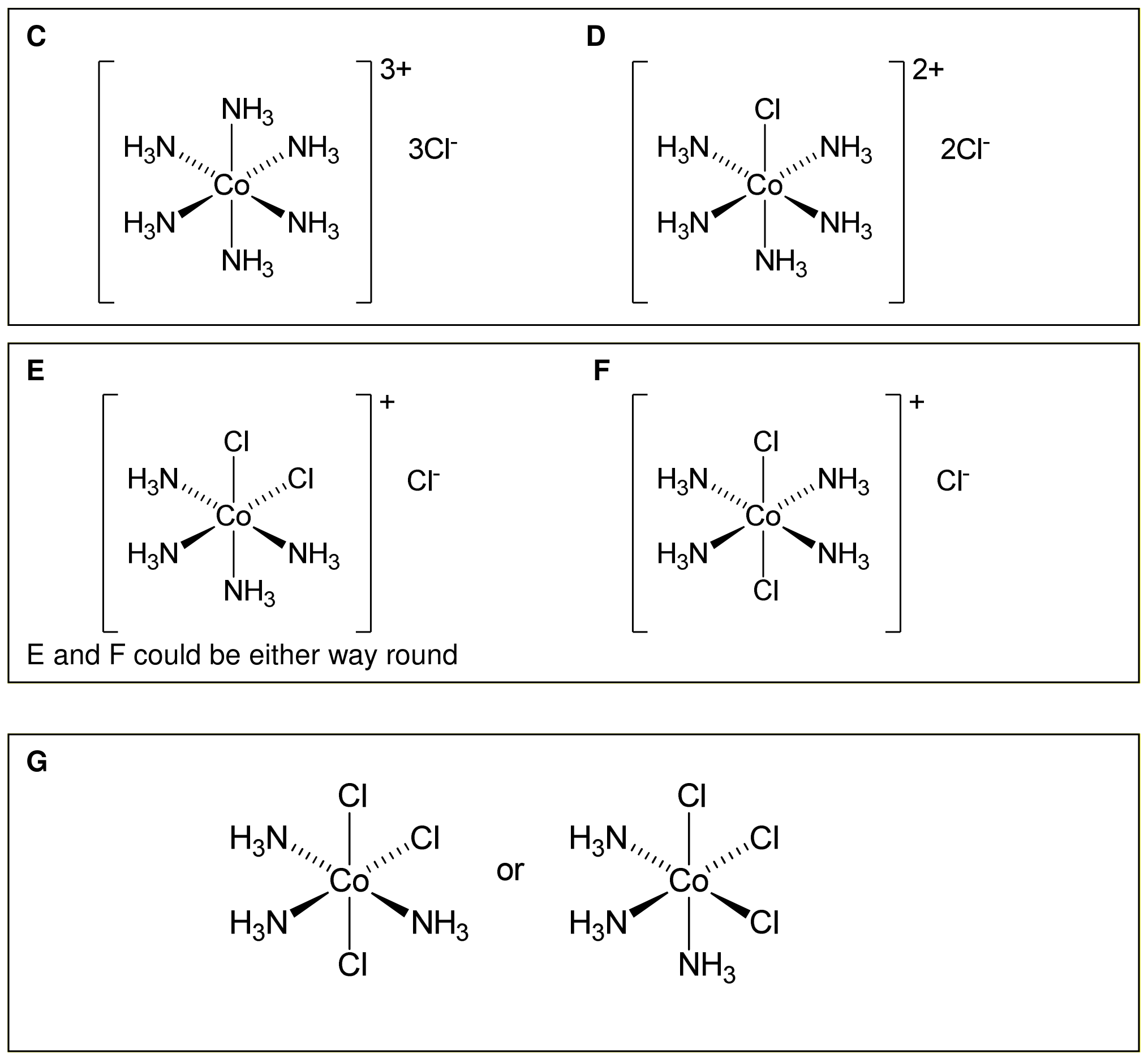
E and F could be either way round. Both printed G alternatives are retained.
6.6 ; ; .
6.7 n(KOH)=0.0124mol. n(HCl)neutralised by ammonia=0.025mol−0.0124mol=0.0126mol. m(NH₃)=17.034g mol⁻¹×0.0126mol=0.2146g.
6.8 Co₂O₃+2KI+6HCl→2CoCl₂+I₂+3H₂O+2KCl.
6.9 2Na₂S₂O₃+I₂→2NaI+Na₂S₄O₆.
; ; ; .
6.10 Assuming100g of complex,there is13.6g unaccounted.for molar ratio of
Missing species is eitherO²⁻,OH⁻orH₂O with similar molar mass≈17g mol⁻¹. Molar fraction of missing oxygen species≈13.6/17=0.8i.e.the same as theCl. Considering charge balance,2(+3)+6(0)+3(−1)=+3,it is needed−3to balance i.e.the missing species must beOH⁻.
6.11 Empirical formula of H:Co₂N₆H₂₁O₃Cl₃.
6.12 Structure must fit the empirical formula worked out above,contain only octahedral cobalt,and be chiral. Some marks deducted if chloride is directly coordinated to cobalt,or if any single ammonia molecule is coordinated to more than one cobalt atom.
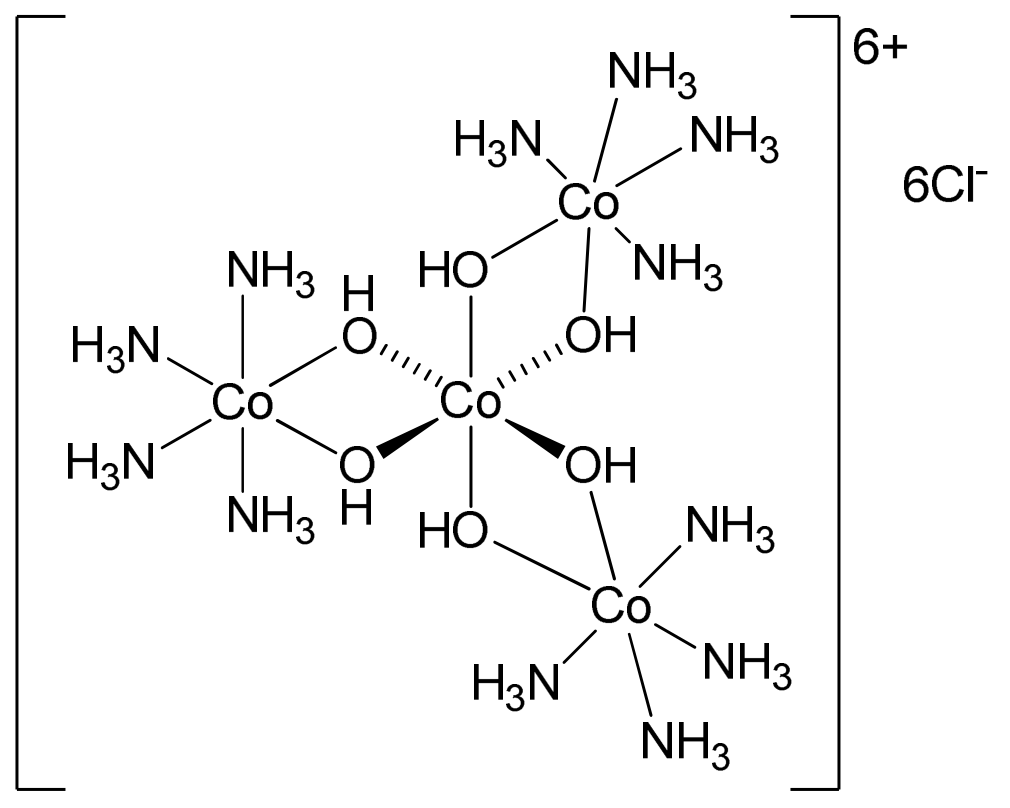
Source note: The thiosulfate equation in6.9 is reproduced exactly as printed on native39; it does not balance sodium. The empirical formula and larger four-cobalt structural formula are both retained as printed.
Оригинал в Архива: IChO 41st-45th.pdf · решение от архива: IChO 41st-45th.pdf · допълнителни данни: IChO 41st-45th.pdf