IChO 1990, Подбрани задачи 1980–1990 · семинар Амстердам 1990 — Задача 1. Problem No. 1 — Physical chemistry (periodic system, quantum numbers)
The best ICHO-tasks of the last years — Amsterdam workshop, October 1990 (selection from 1980–1990) · 12 т.
Внимание: Бележка към темата
This archive copy is the 1990 Amsterdam workshop top-twelve selection, containing eight theoretical tasks and four independent practical experiments from earlier Olympiads. 1990 identifies the workshop, not the year of every selected task. Solutions are attributed to the archive copy; no established official authorship is inferred. Practical1,2 and4 have no supplied keys. Separate report/answer forms referenced by Practical1,2 and3 are absent; Practical4 includes its blank answer sheet. Printed scientific and numerical discrepancies are retained.
Third International Workshop on the Development of the International Chemistry Olympiads (Amsterdam, October 1990)
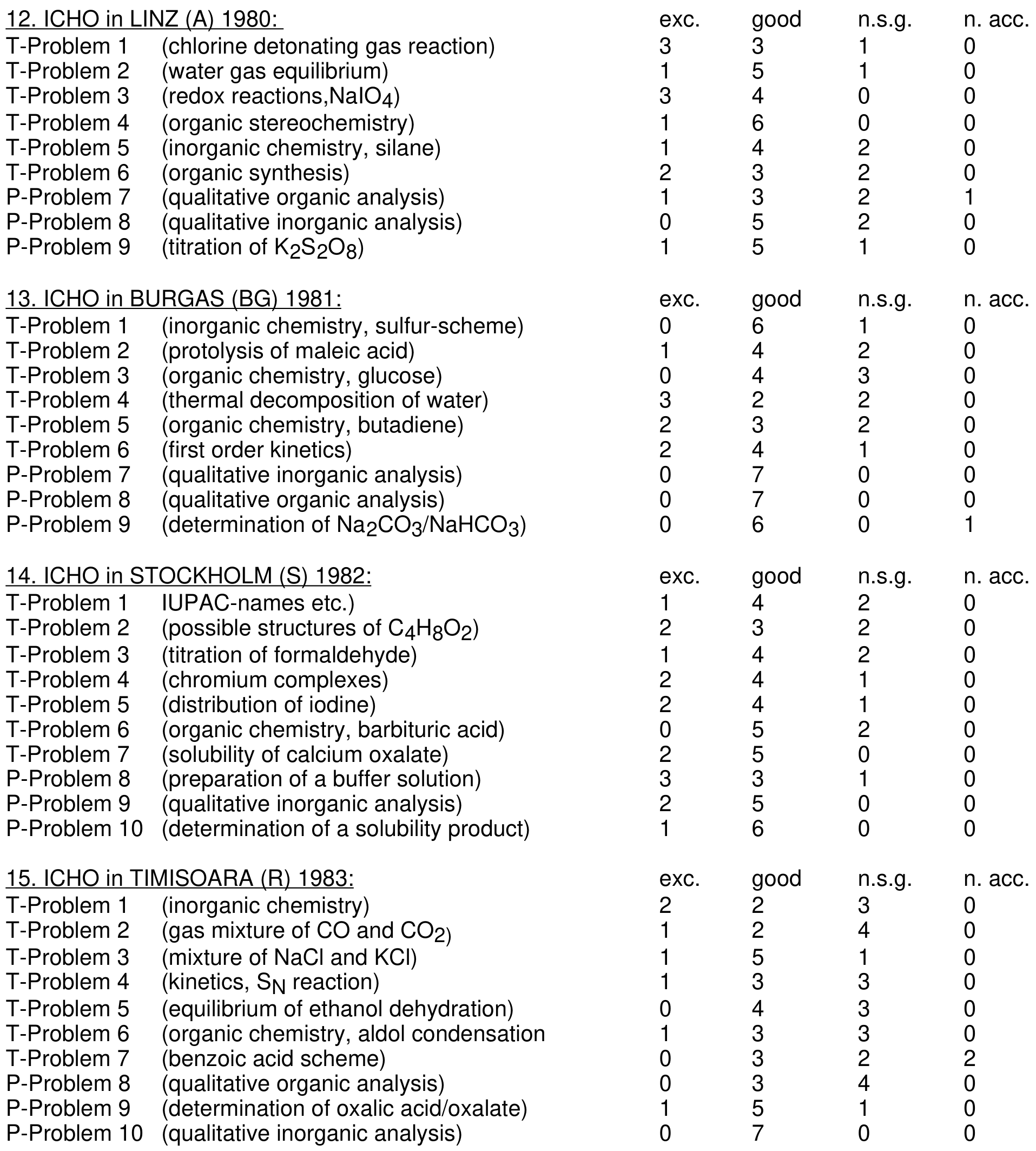
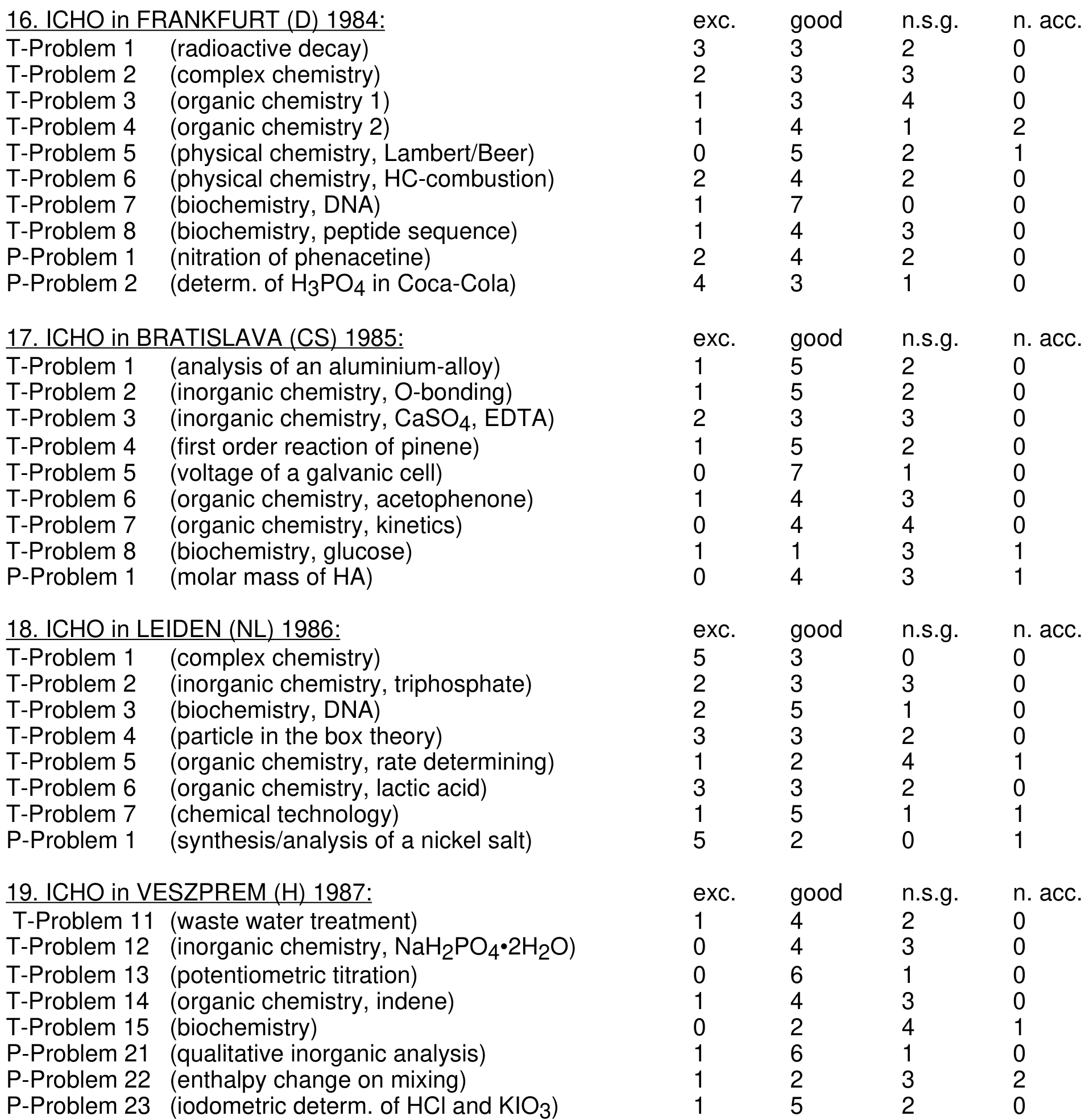
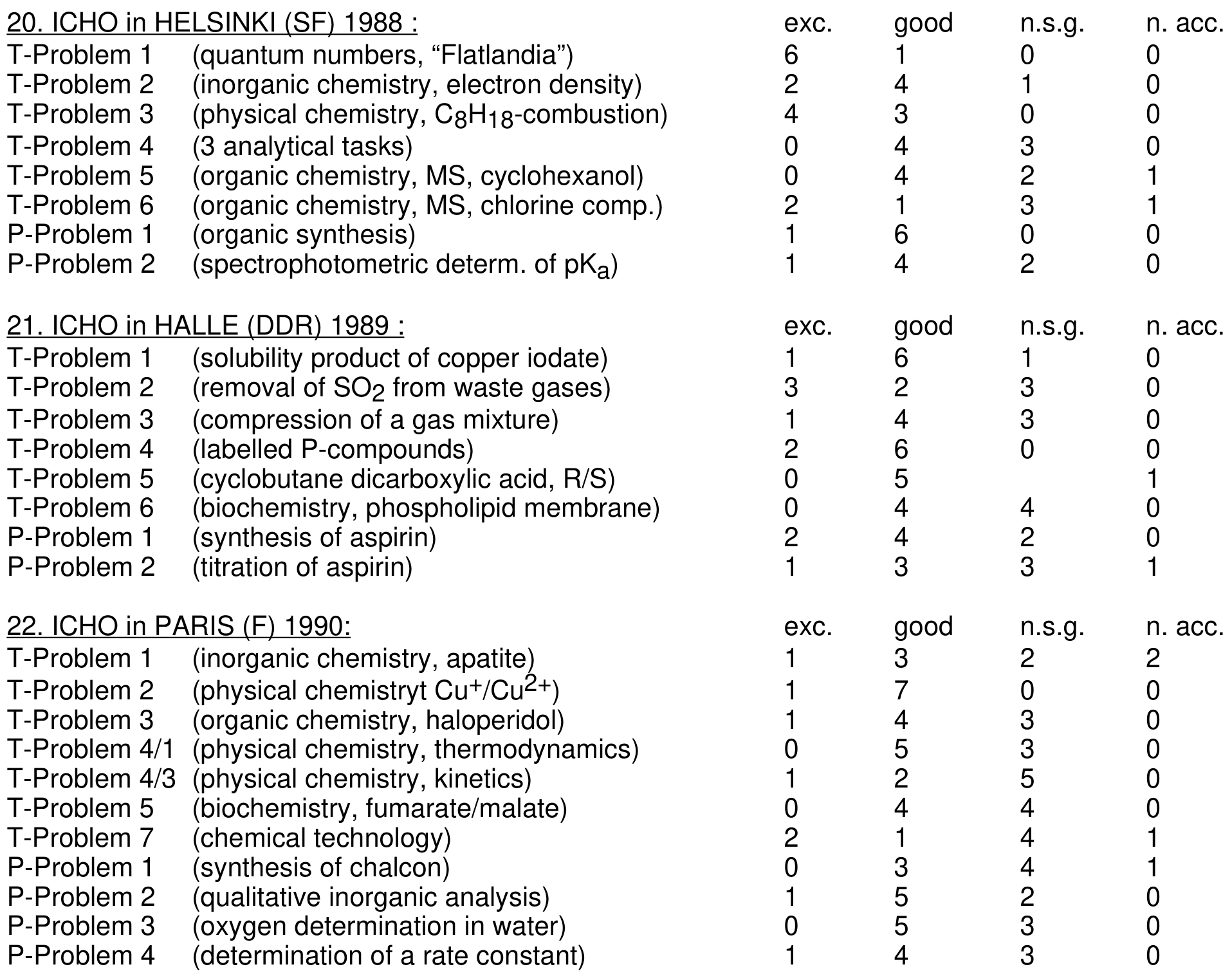
According to the decision of the work shop of Amsterdam the delegation leaders of 8 countries made an attempt to rank the ICHO-tasks of the years 1980 ~ 1990 into the categories excellent / good / not so good / not acceptable The following pages indicate the ”top-twelve”, i.e. is the best tasks of the last years. This collection should be an aid for the ICHO-designers of the next years. Examples for tasks considered as ”not acceptable” are available for the next organisers too.
Original ranking tables (1980–1990)
The workshop’s complete native ranking tables are retained below. Ratings exc., good, n.s.g. and n.acc. are those printed by the source.
Условие
The periodic system of the elements in our three-dimensional world is based on the four electron quantum numbers ; ; ; and .
Let us move to Flatlandia. It is a two-dimensional world where the periodic system of the elements is based on three electron quantum numbers: ; ; and . plays the combined role of and of the three dimensional worlds (For example s, p, d,... levels are related to ).
The following tasks and the basic principles relate to this two-dimensional Flatlandia where the chemical and physical experience obtained from our common three-dimensional world is applicable.
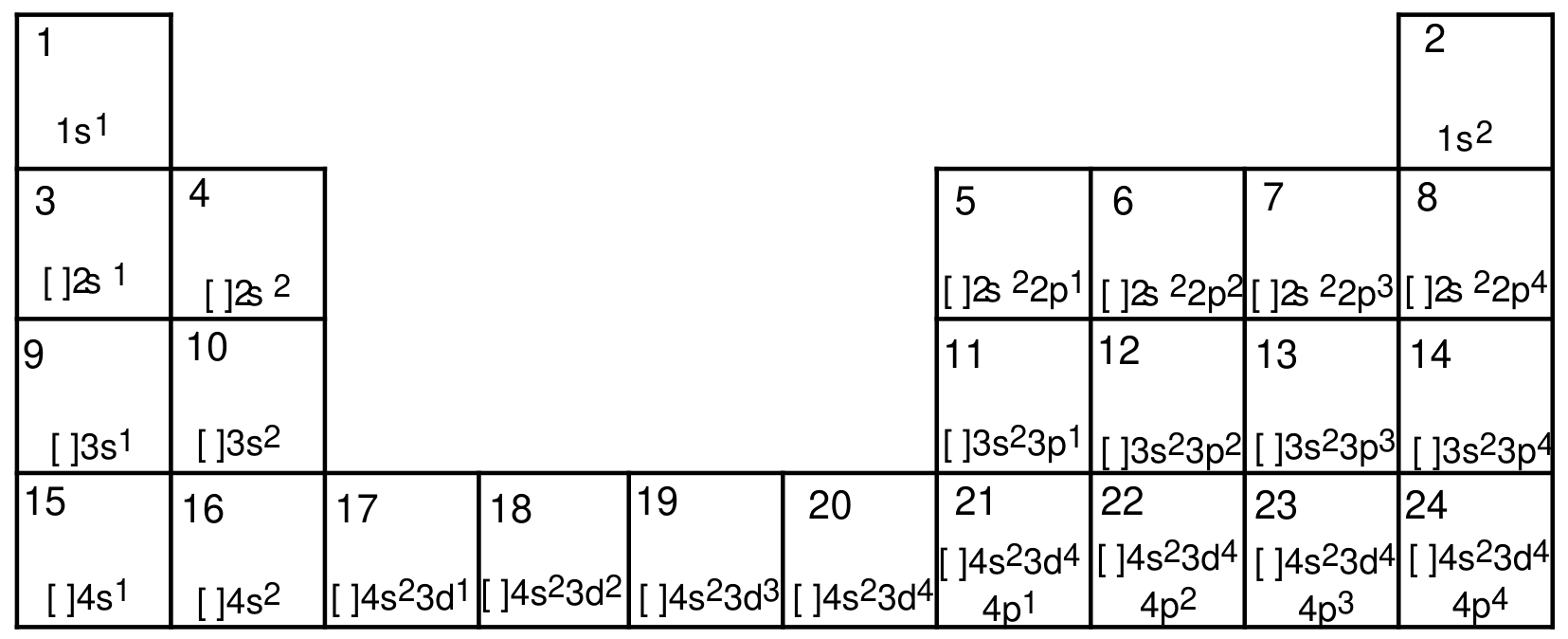
a) Draw the first four periods of the Flatlandian periodic table of the elements. Number the elements according to their nuclear charge. Use the atomic numbers (Z) as the symbols of the elements. Write the electron configuration of each element. [3 т.]
b) Draw the hybrid-orbitals of the elements with n = 2. Which element is the basis for the organic chemistry in Flatlandia (use the atomic number as a symbol)? Find the Flatlandian analogues for ethane, ethene and cyclohexane. What kind of aromatic ring compounds are possible in Flatlandia? [2 т.]
c) Which rules in Flatlandia correspond to the octet and 18-electron rules in the three-dimensional world? [1 т.]
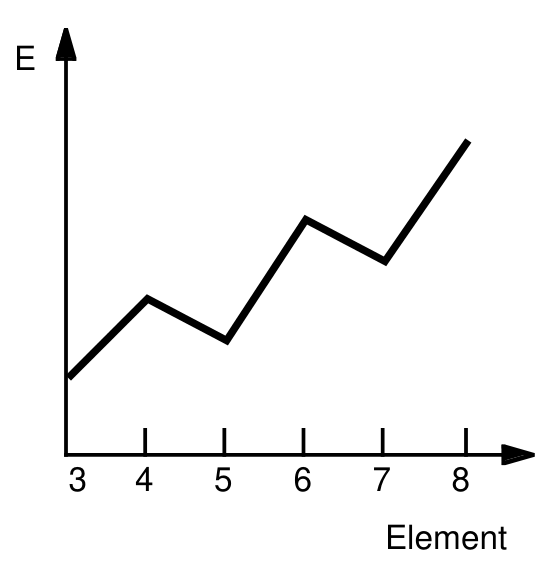
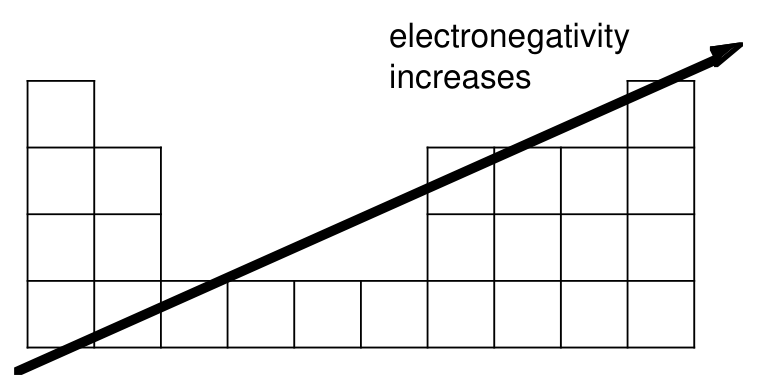
d) Predict graphically the trends in the first ionisation energies of the Flatlandian elements with n = 2. Show graphically how the electronegativities of the elements increase in the Flatlandian periodic table. [1 т.]
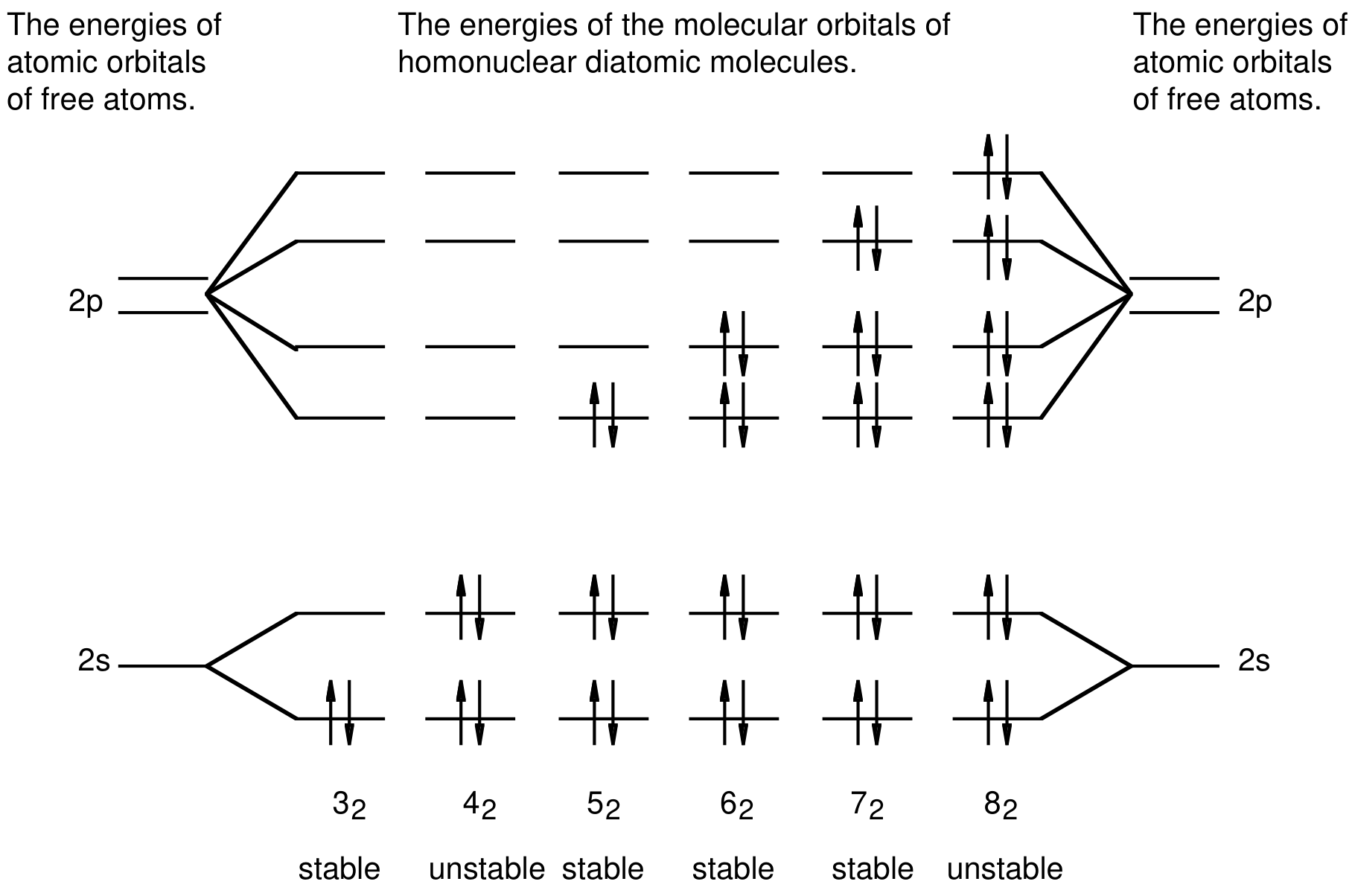
e) Draw the molecular orbital energy diagrams of the neutral homonuclear diatomic molecules of the elements with n = 2. Which of these molecules are stable in Flatlandia? [2 т.]
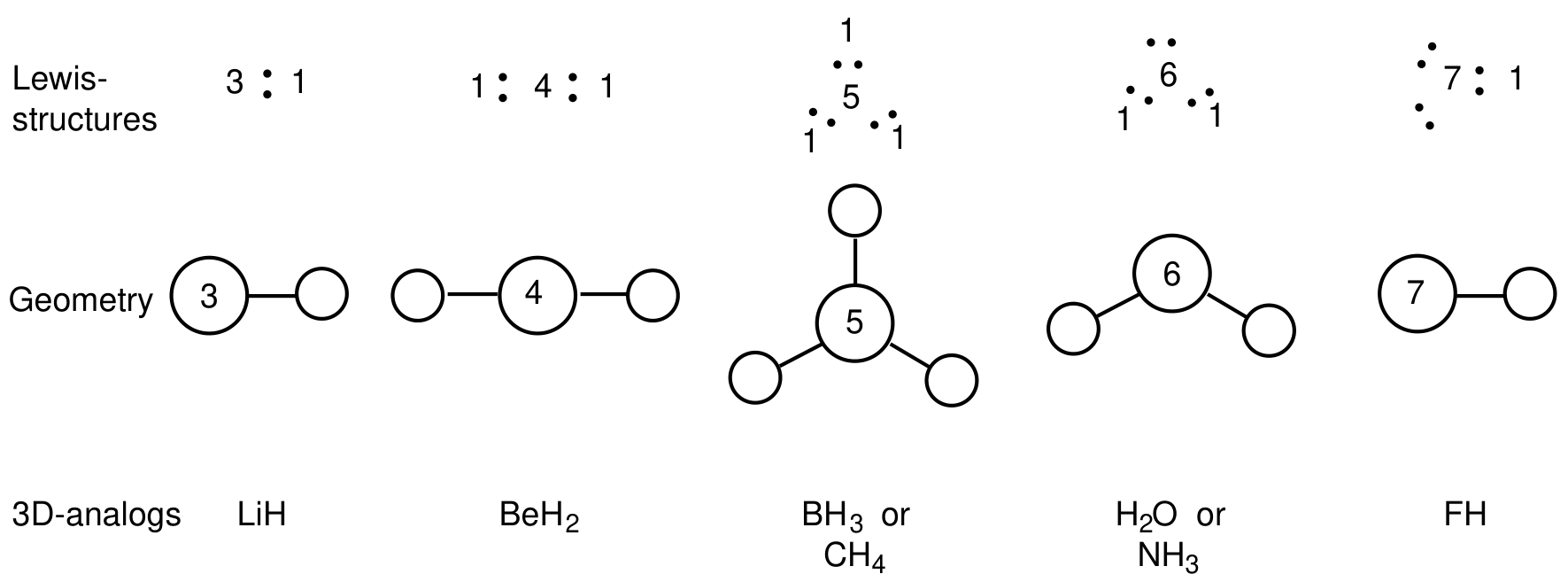
f) Consider simple binary compounds of the elements (n = 2) with the lightest element (Z = 1). Draw their Lewis-structures, predict geometries and propose analogues for them in the three-dimensional world. [2 т.]
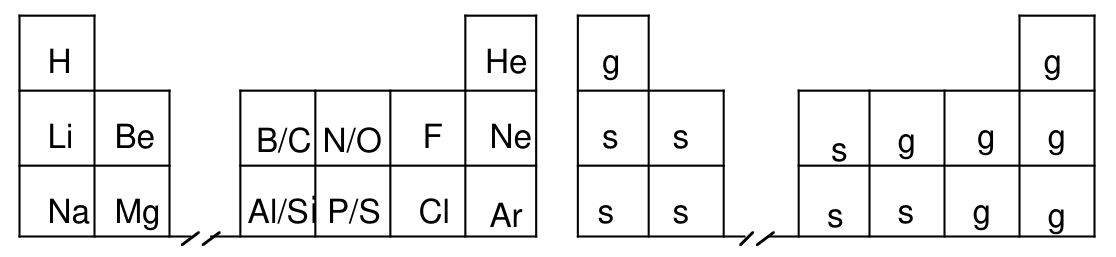
g) Consider elements with n ≤ 3. Propose an analog and write the chemical symbol from our three-dimensional world for each Flatlandian element. On the basis of this chemical and physical analogy predict which two-dimensional elements are solid, liquid or gas at the normal pressure and temperature. [1 т.]
Решение
Solution of problem No. 1:
a)
The Flatlandian periodic table:
b)
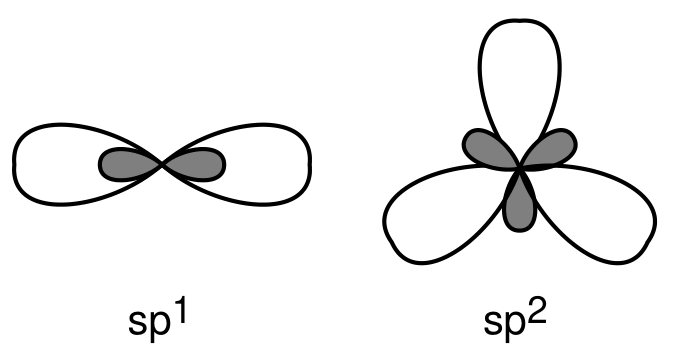
The element of Life: 5
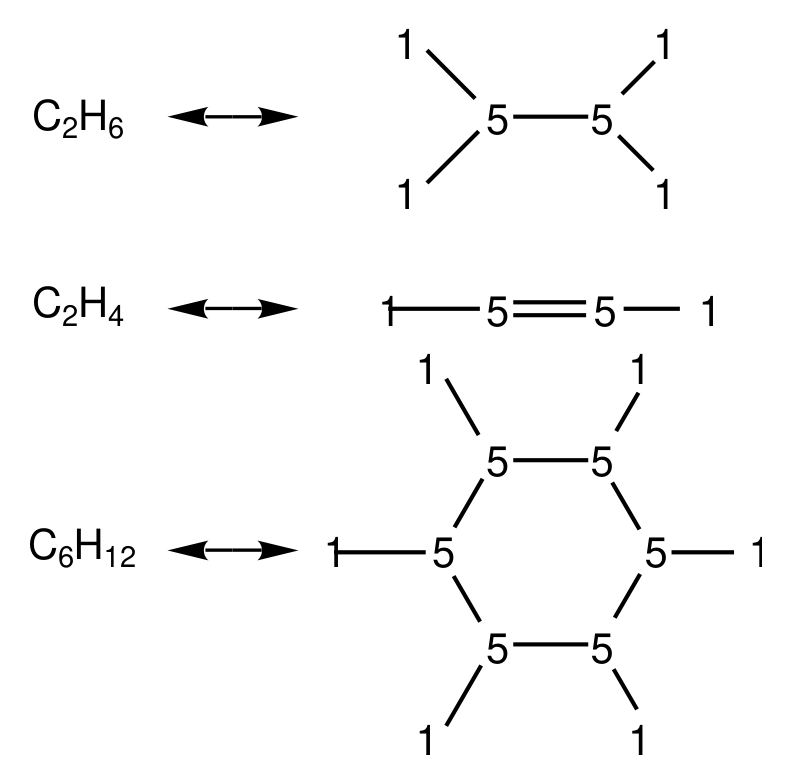
There are no aromatic ring compounds.
c)
Sextet rule: 10 electron rule
d)
The ionisation energies and the trends in electronegativity:
e)
The molecular orbital diagram of the homonuclear X₂ molecules:
f)
The Lewis structures and geometries:
g)
The three-dimensional analogs and the states of Flatlandian elements:
Оригинал в Архива: best_problems_1980-1990.pdf · решение от архива: best_problems_1980-1990.pdf · допълнителни данни: IChO 21st-40th.pdf