IChO 1990, Подбрани задачи 1980–1990 · семинар Амстердам 1990 — Задача 2. Problem No. 2 — Inorganic chemistry (complex chemistry)
The best ICHO-tasks of the last years — Amsterdam workshop, October 1990 (selection from 1980–1990)
Внимание: Бележка към темата
This archive copy is the 1990 Amsterdam workshop top-twelve selection, containing eight theoretical tasks and four independent practical experiments from earlier Olympiads. 1990 identifies the workshop, not the year of every selected task. Solutions are attributed to the archive copy; no established official authorship is inferred. Practical1,2 and4 have no supplied keys. Separate report/answer forms referenced by Practical1,2 and3 are absent; Practical4 includes its blank answer sheet. Printed scientific and numerical discrepancies are retained.
Third International Workshop on the Development of the International Chemistry Olympiads (Amsterdam, October 1990)
According to the decision of the work shop of Amsterdam the delegation leaders of 8 countries made an attempt to rank the ICHO-tasks of the years 1980 ~ 1990 into the categories excellent / good / not so good / not acceptable The following pages indicate the ”top-twelve”, i.e. is the best tasks of the last years. This collection should be an aid for the ICHO-designers of the next years. Examples for tasks considered as ”not acceptable” are available for the next organisers too.
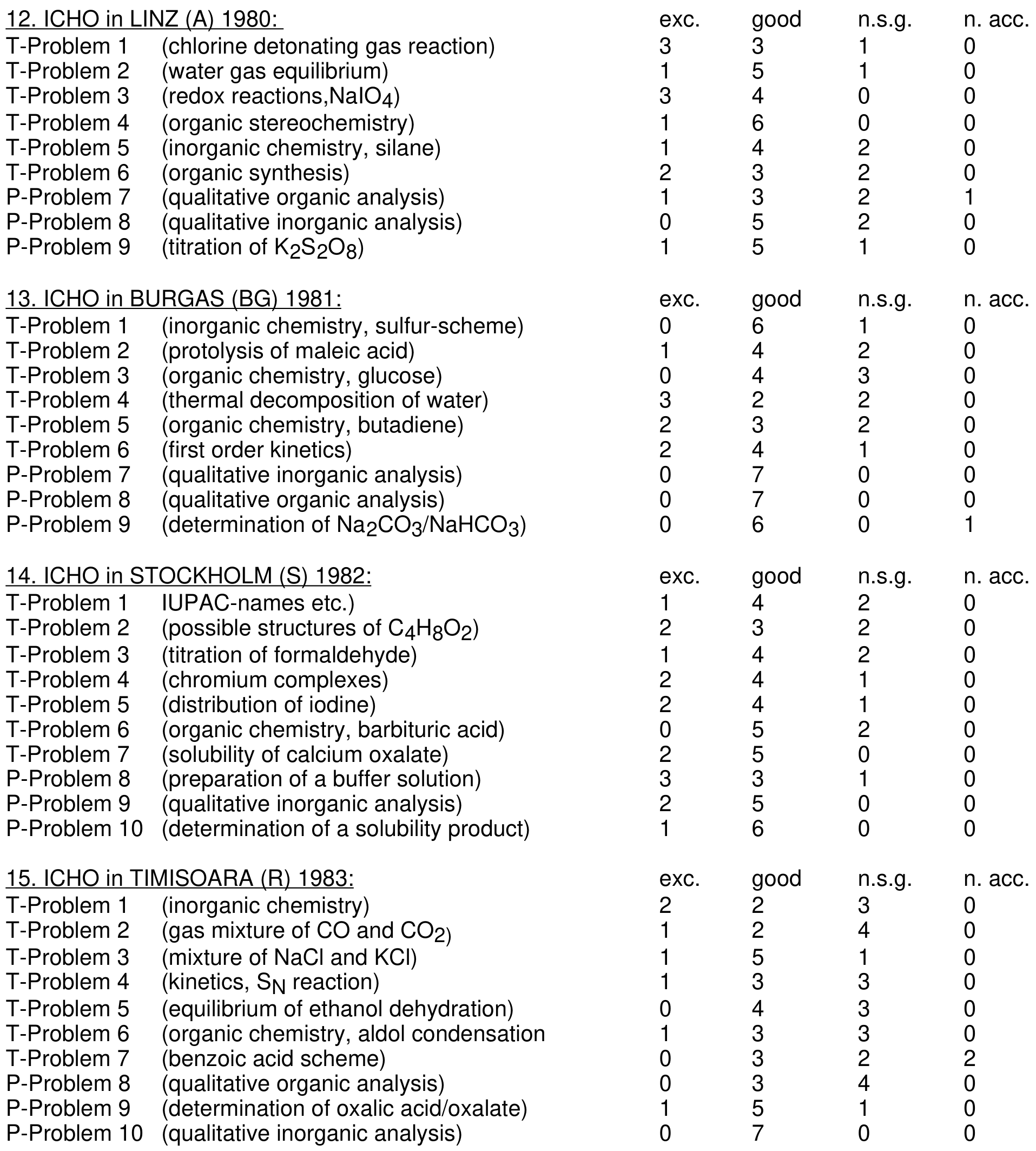
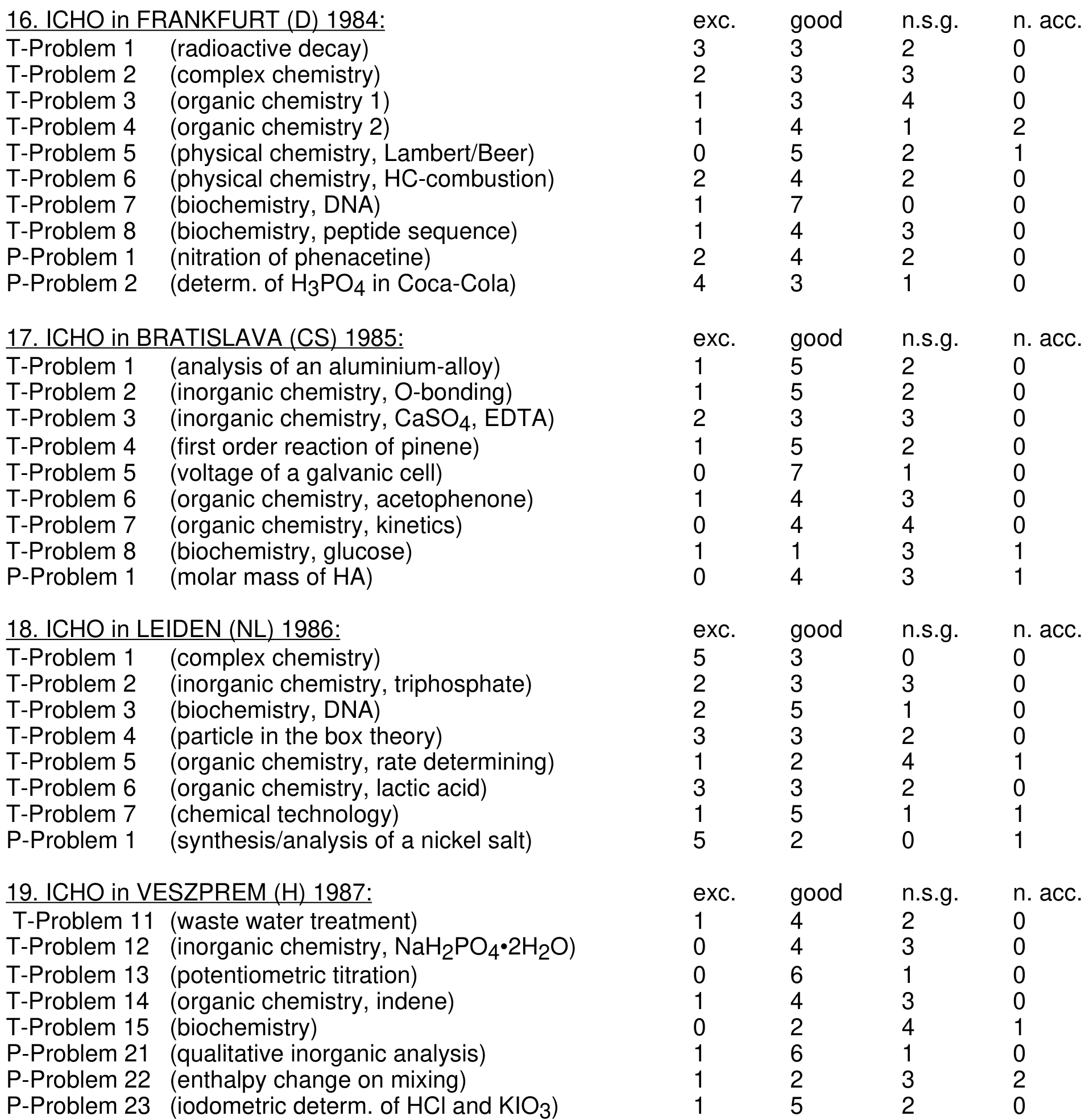
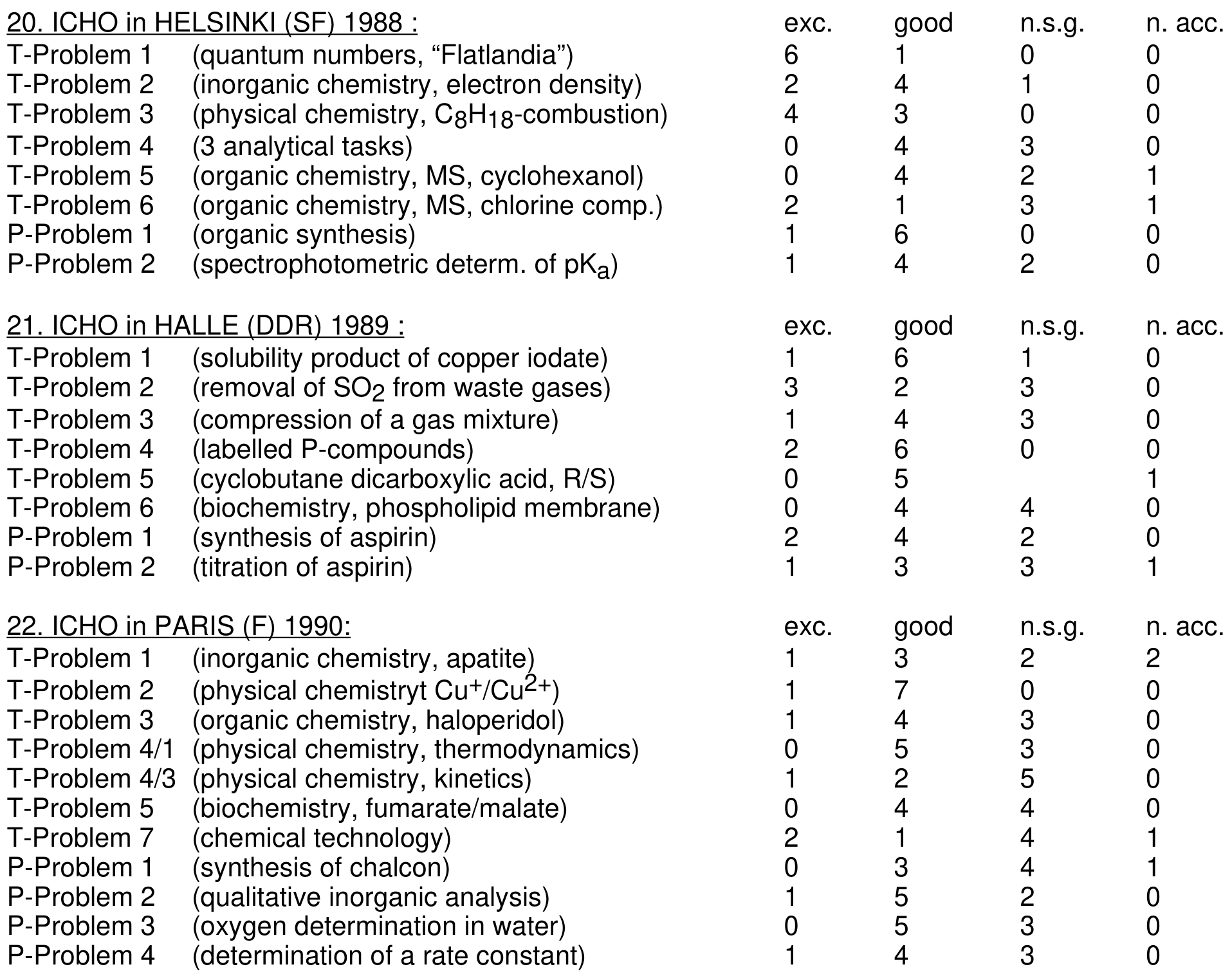
Original ranking tables (1980–1990)
The workshop’s complete native ranking tables are retained below. Ratings exc., good, n.s.g. and n.acc. are those printed by the source.
Условие
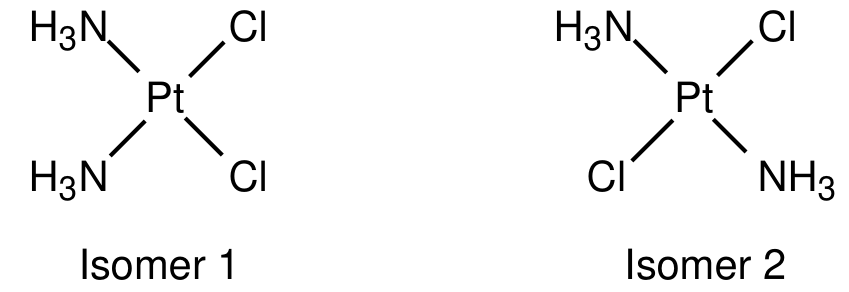
Compounds containing divalent platinum with the general formula [PtX₂(amine)₂] (where X = Cl or X₂ = SO₄, malonate, etc.) have over the last few years enjoyed an increasing scientific interest because of their biological activity, particularly in view of their properties in the treatment of tumours. The best known compound, which is used on a large scale clinically, is [PtCl₂(NH₃)₂]. This compound, in which the platinum is coordinated in a square planar arrangement, has two geometrical isomers of which one shows the anti tumour activity.
a) Sketch the spatial structures of the two possible isomers.
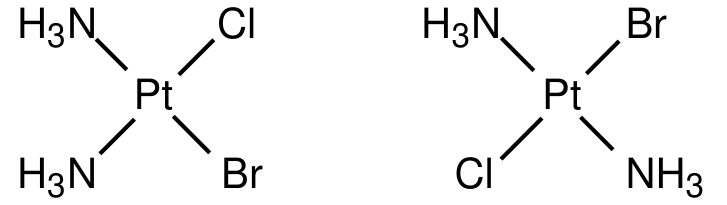
b) How many isomers has [PtBrCl(NH₃)₂]? Sketch these isomers.
It is possible to replace the two ammine ligands by one ligand containing two donor atoms (N). Then one obtains a chelating ligand such as 1,2-diaminoethane (en for short).
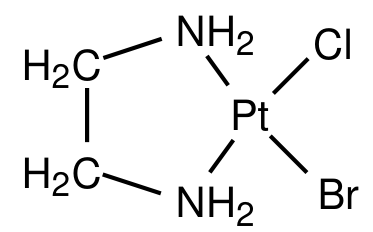
c) Show by a drawing that [PtBrCl(en)] has only one stable structure.
The ligand (en) can be changed by substitution. For instance via methylation one can obtain:
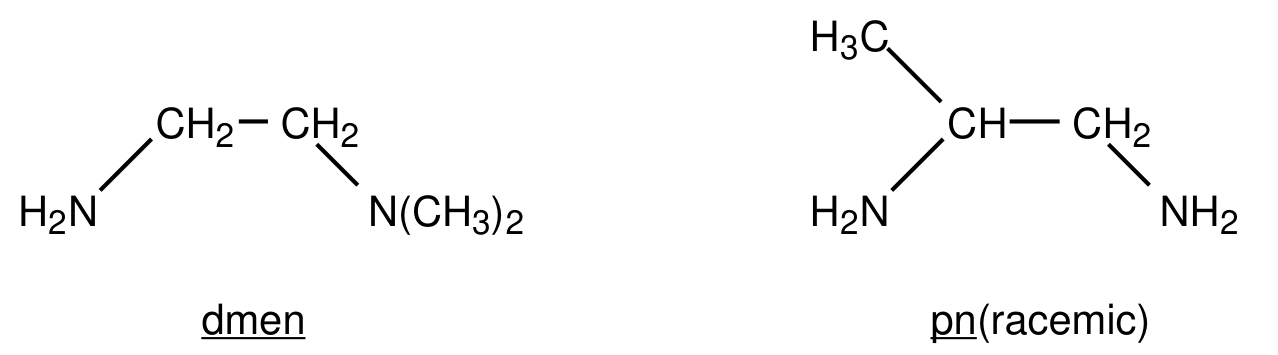
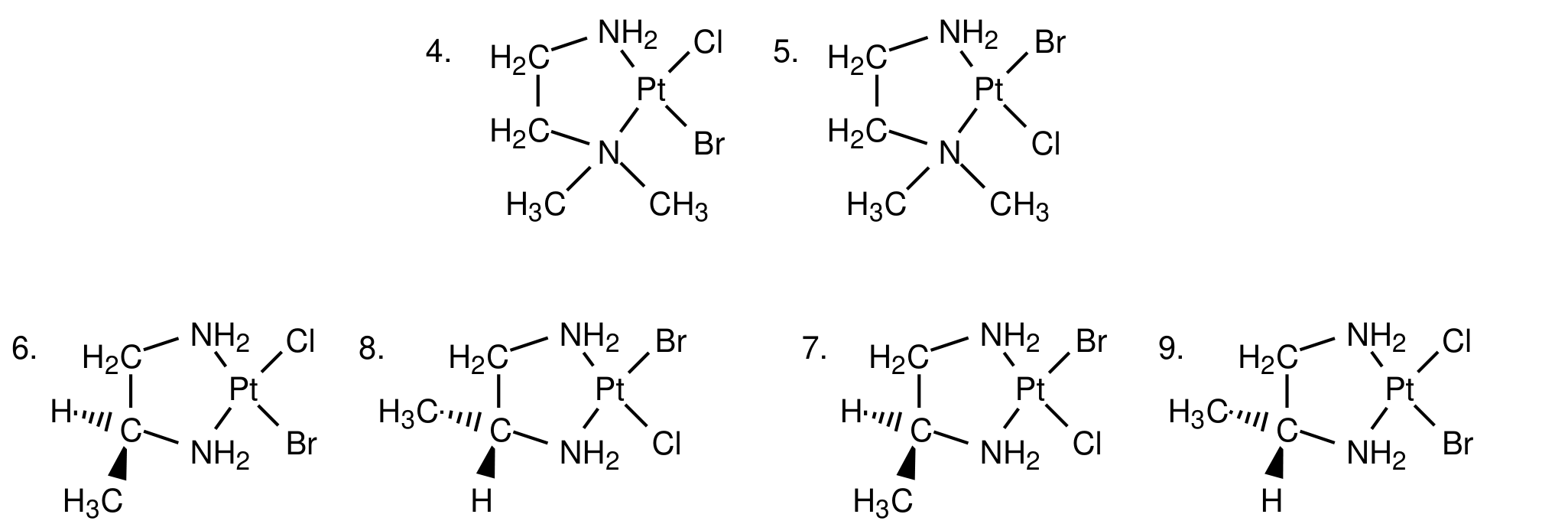
d) Give spatial structures of all isomers of the following compounds: [PtCl₂ (dmen)] [PtCl₂ (pn)] [PtBrCl (dmen)] [PtBrCl (pn)]
Platinum compounds and in particular the analogous palladium compounds (which are also square planar coordinated when they contain bivalent metal ions) can isomerise in aqueous solutions, i.e. some isomers can transform into one another. Such an isomerisation usually proceeds through dissociation of a ligand, the weak ligand water transiently replaces one or more of the stronger ligands. Cl⁻ and Br⁻ are replaced relatively easily, but it is more difficult to replace the amine ligand, it usually requires heating the solution.
e) Considering each one of the isomers in answers 1a-1d, which can be converted to another isomer at room temperature? N.B. In your answer give both the original molecule and the products.
f) Which compound would one expect and in what proportion, when one carries out the reaction of [PtCl₂(en)] and Br⁻ in a molar proportion of 1:2 at room temperature. You can assume that the Pt—Br and Pt—Cl bonds are equally strong and that there is no perturbing influence from hydrolysis.
The compound [PtCl₂(NH₃)₂] hydrolyses slowly in water to (amongst other compounds) [Pt(H₂O)₂(NH₃)₂]²⁺ and 2Cl⁻. Patients are given the non-hydrolysed compound via injection into the bloodstream. The action in the tumour cell appears to derive from the special way in which bonding to the DNA occurs. In cells the Cl⁻ concentration is low, in blood it is fairly high (0.1 M)
g) Show with the aid of the equations for chemical equilibrium that hydrolysis hardly occurs in the blood, but that it does in the cells.
After hydrolysis in the tumour cell a reactive platinum ion is formed to which two NH₃ groups are still bound. It turns out that these NH₃ groups are still bound to platinum in the urine of patients treated with this compound. The reactive platinum ion appears to be bound to cellular DNA, where the bonding occurs via guanine to one of the N-atoms.
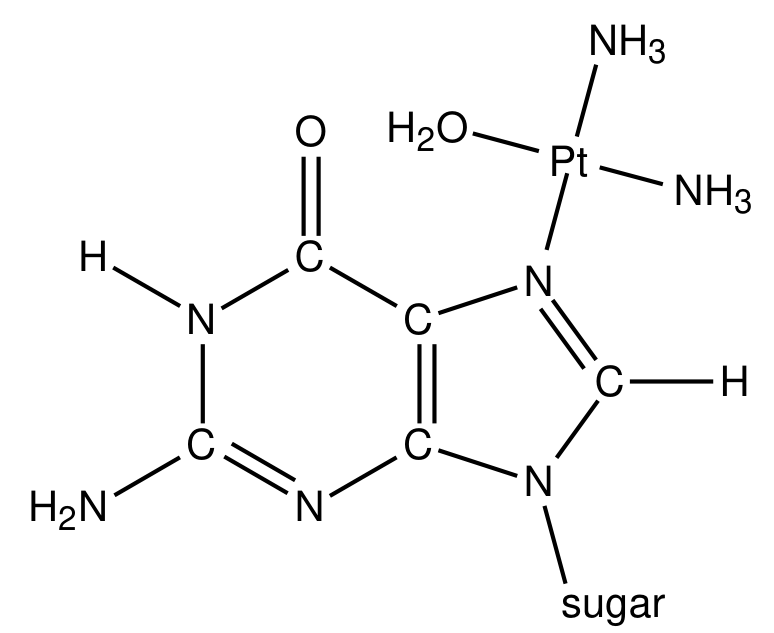
Because the platinum has two reactive sites and two unreactive NH₃ ligands, it can form a second bond to DNA in addition to the one shown above. Biochemical research has shown that this happens in particular with a second guanine base of the same strand of the DNA..
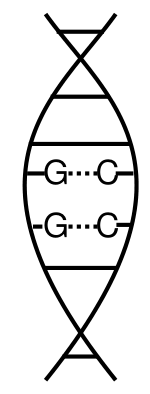
h) Show by means of a calculation which of the two isomers in question a) can form this bond. (Note: Pt—N distance = 210 pm, DNA base distance = 320 pm).
Решение
Solution of problem No. 2:
a)
b)
The isomers are:
c)
The structure is:
d)
The isomers of PtCl₂(dmen) and PtCl₂(pn) are:

The isomers of [PtBrCl(dmen)] and [PtBrCl(pn)] are:
e)
In a),b),c), no change. In d) 4 and 5 transform into one another, just like 6 and 7 and 8 and 9.
BONUS: If one realises that [PtCl₂(dmen)], [PtBr₂(dmen)], [PtCl₂(pn)] and [PtBr₂(pn)] are also formed, even though they are not isomers.
f)
One expects the products [PtCl₂(en)], [PtBr₂(en)] and [PtBrCl(en)] in the proportions 1:1:2.
g)
We are concerned with the following equations for chemical equilibrium.
![Exact native hydrolysis scheme, including source’s detached terminal ]²⁺ and printed bracket placement.](https://pub-43290baaaff14857b5dd59610ea438c7.r2.dev/problems/icho-best-1980-1990/p2-sol-fig6-v2.png)
In blood the hydrolysis does not occur to any great extent because the concentration of Cl⁻ is rather high and the equilibrium is on the left side.
h)
The bond is due to the cis isomer because in that case the distance between the bases (320 pm) has to change only , and with the trans compound .
Оригинал в Архива: best_problems_1980-1990.pdf · решение от архива: best_problems_1980-1990.pdf · допълнителни данни: IChO 21st-40th.pdf