IChO 1990, Подбрани задачи 1980–1990 · семинар Амстердам 1990 — Задача 3. Problem No. 3 — Chemistry of ions (redox reactions)
The best ICHO-tasks of the last years — Amsterdam workshop, October 1990 (selection from 1980–1990)
Внимание: Бележка към темата
This archive copy is the 1990 Amsterdam workshop top-twelve selection, containing eight theoretical tasks and four independent practical experiments from earlier Olympiads. 1990 identifies the workshop, not the year of every selected task. Solutions are attributed to the archive copy; no established official authorship is inferred. Practical1,2 and4 have no supplied keys. Separate report/answer forms referenced by Practical1,2 and3 are absent; Practical4 includes its blank answer sheet. Printed scientific and numerical discrepancies are retained.
Third International Workshop on the Development of the International Chemistry Olympiads (Amsterdam, October 1990)
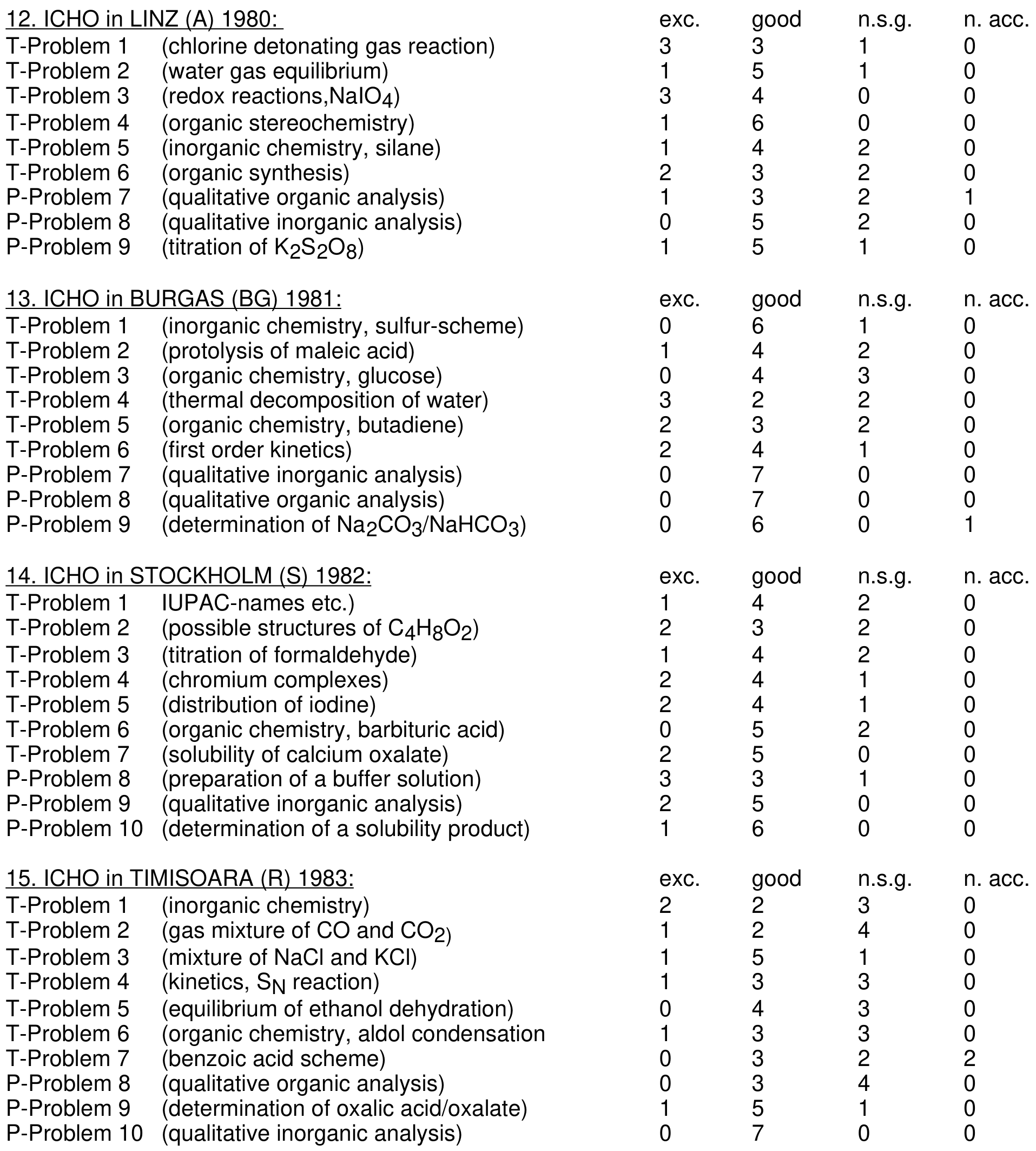
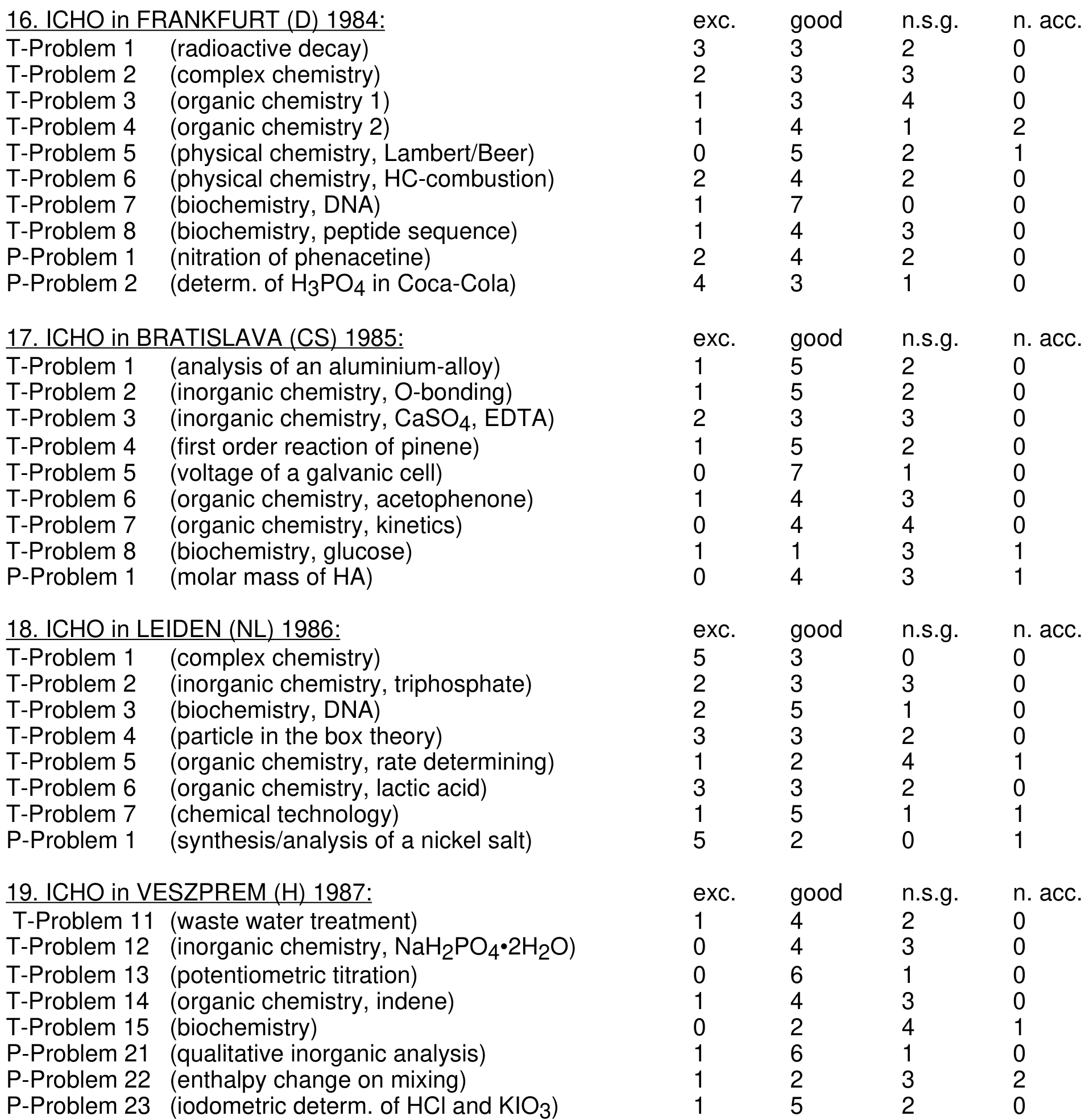
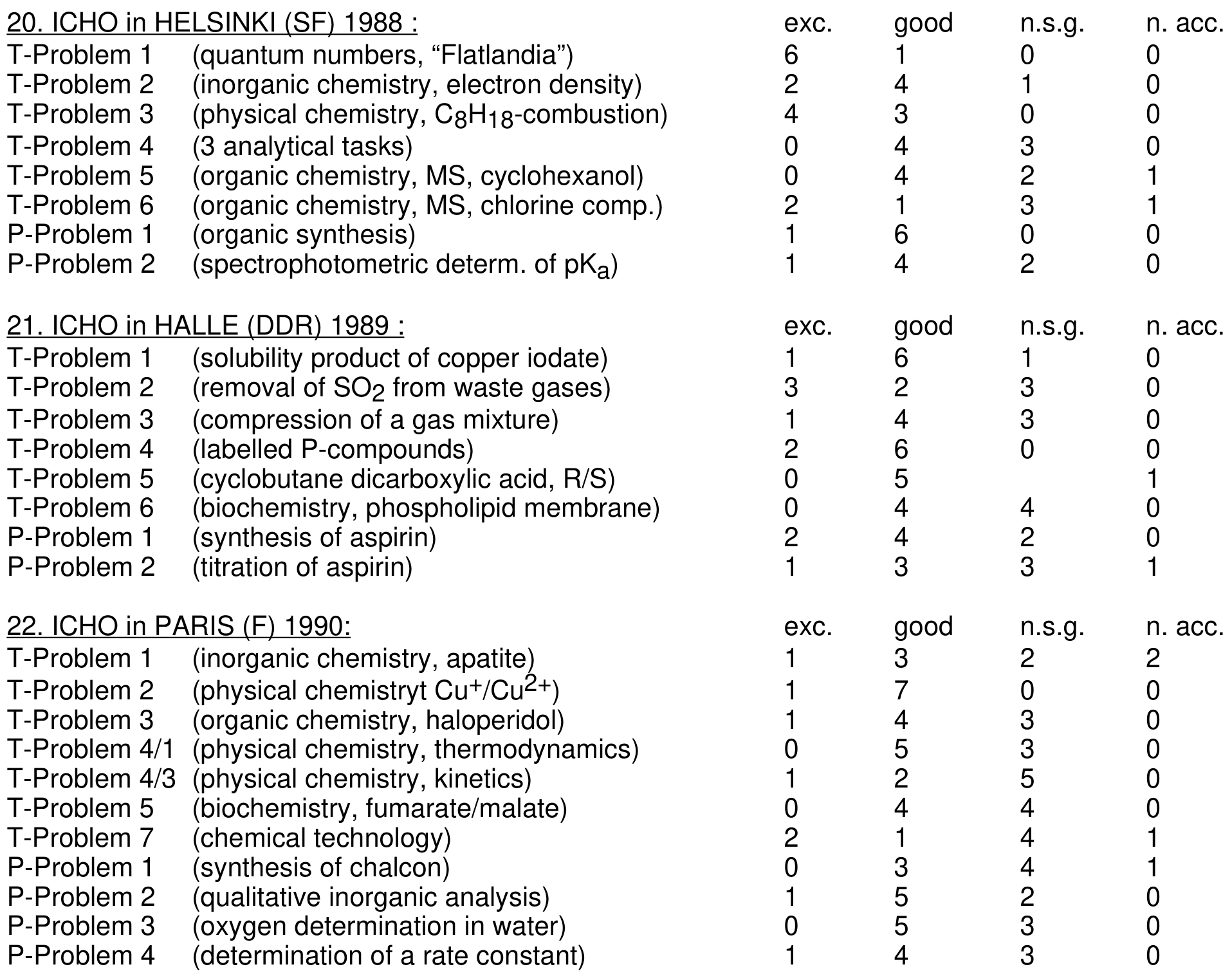
According to the decision of the work shop of Amsterdam the delegation leaders of 8 countries made an attempt to rank the ICHO-tasks of the years 1980 ~ 1990 into the categories excellent / good / not so good / not acceptable The following pages indicate the ”top-twelve”, i.e. is the best tasks of the last years. This collection should be an aid for the ICHO-designers of the next years. Examples for tasks considered as ”not acceptable” are available for the next organisers too.
Original ranking tables (1980–1990)
The workshop’s complete native ranking tables are retained below. Ratings exc., good, n.s.g. and n.acc. are those printed by the source.
Условие
A white, crystalline solid exhibits the following reactions:
The flame of a Bunsen burner is intensely yellow coloured.
An aqueous solution is neutral; dropwise addition of sulfurous acid (an SO₂ solution) leads to a deep brown solution which is discoloured in the presence of excess sulfurous acid.
If an AgNO₃ solution is added to the discoloured solution obtained in 2. and acidified with HNO₃, a yellow precipitate that is insoluble on addition of NH₃, but that can be readily dissolved by adding CN⁻ or S₂O₃²⁻, is obtained.
If an aqueous solution of the solid is treated with KI and dilute H₂SO₄, a deep brown solution is formed that can be discoloured by addition of sulfurous acid or a Na₂S₂O₃ solution.
An amount of 0.1000 g of the solid is dissolved in water, 0.5 g KI and a few mL of dilute H₂SO₄ are added. The deep brown solution formed is titrated with a 0.1000 M Na₂S₂O₃ solution until the solution is completely discoloured; the consumption, 37.40 mL.
a) What elements are contained in the solid?
b) What compounds can be considered as present on the basis of reactions 1-4.? Calculate their molecular weights.
c) Formulate the reactions corresponding to 2-4. for the compounds considered and write them as equations in the ionic form.
d) Decide on the basis of reaction 5 which compound is present.
Решение
Solution of problem No. 3:
a)
The solid must contain Na and I: The yellow colouration of the flame of the Bunsen burner indicates the presence of Na; a yellow silver salt that is dissolved only by strong complexing agents, such as CN⁻ or S₂O₃²⁻ must be AgI.
b)
Reactions 1–4 indicate a Na salt of an oxygen-containing acid containing iodine. Both SO₂ and I are oxidised, while in the first case I⁻ is formed with an intermediate of I₂ (or I₃⁻ brown solution) and in the second I₂ (or I₃⁻) is formed. As the solution is neutral, NaIO₃ and NaIO₄ come into consideration.
c)
d)
Experiment: 0 1000 g of the compound … 3.740×10⁻³ moles S₂O₃²⁻.
- Hypothesis: The compound is NaIO₃.
The hypothesis is false.
- Hypothesis: The compound is NaIO₄.
The compound is NaIO₄.
Оригинал в Архива: best_problems_1980-1990.pdf · решение от архива: best_problems_1980-1990.pdf · допълнителни данни: IChO 21st-40th.pdf