IChO 1990, Подбрани задачи 1980–1990 · семинар Амстердам 1990 — Задача 4. Problem No. 4 — Inorganic and physical chemistry (dissociation of chlorine)
The best ICHO-tasks of the last years — Amsterdam workshop, October 1990 (selection from 1980–1990)
Внимание: Бележка към темата
This archive copy is the 1990 Amsterdam workshop top-twelve selection, containing eight theoretical tasks and four independent practical experiments from earlier Olympiads. 1990 identifies the workshop, not the year of every selected task. Solutions are attributed to the archive copy; no established official authorship is inferred. Practical1,2 and4 have no supplied keys. Separate report/answer forms referenced by Practical1,2 and3 are absent; Practical4 includes its blank answer sheet. Printed scientific and numerical discrepancies are retained.
Third International Workshop on the Development of the International Chemistry Olympiads (Amsterdam, October 1990)
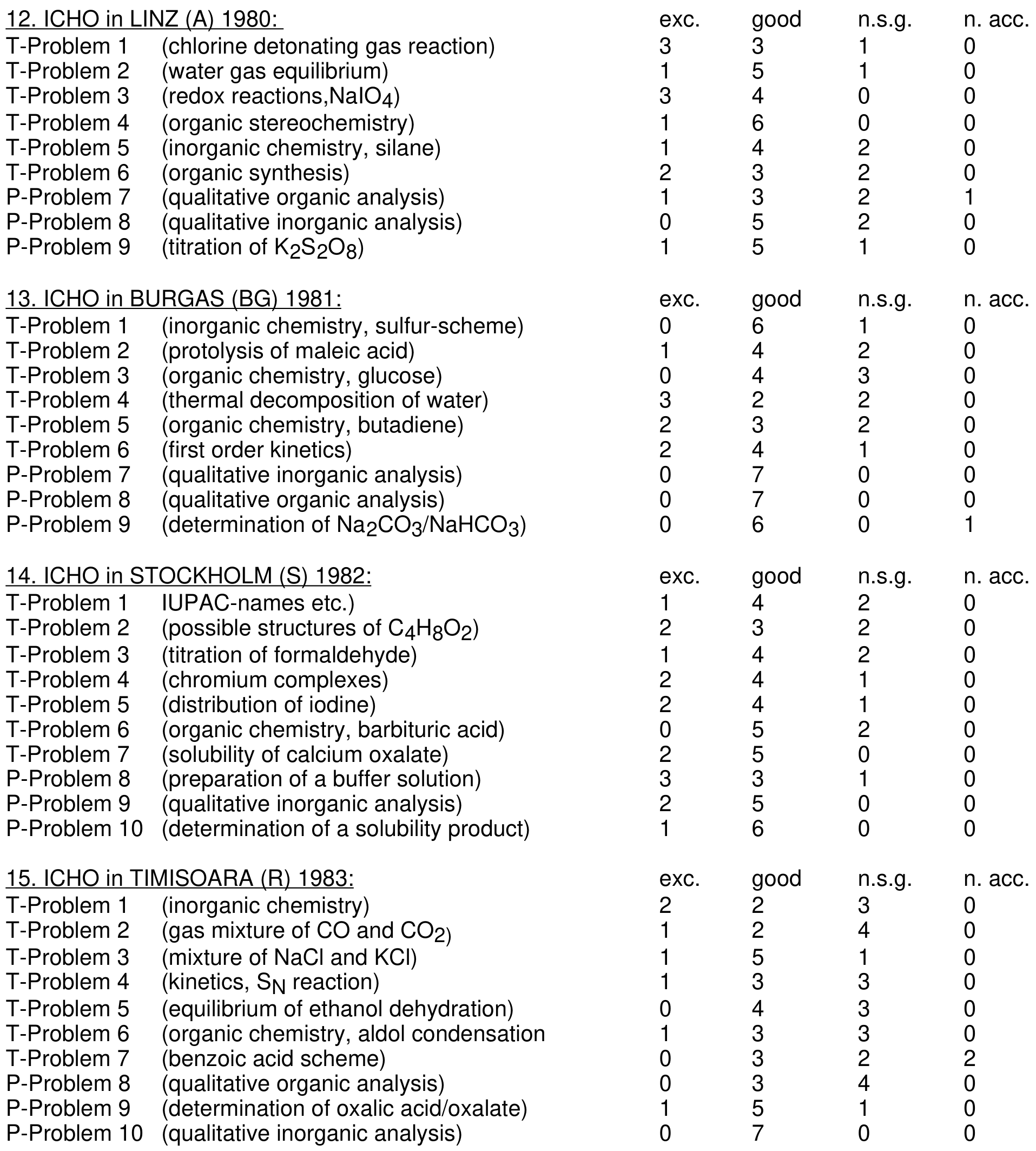
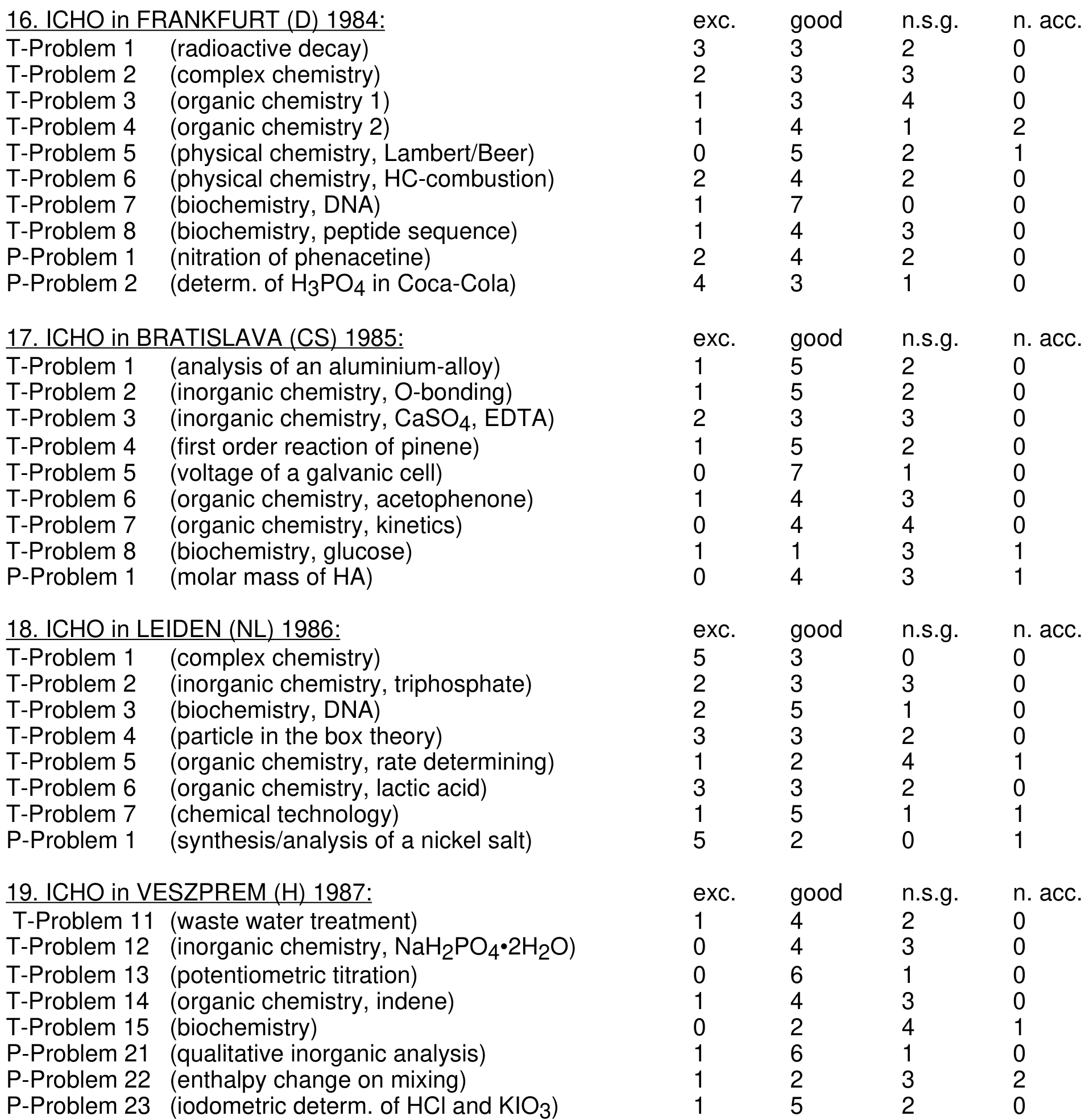
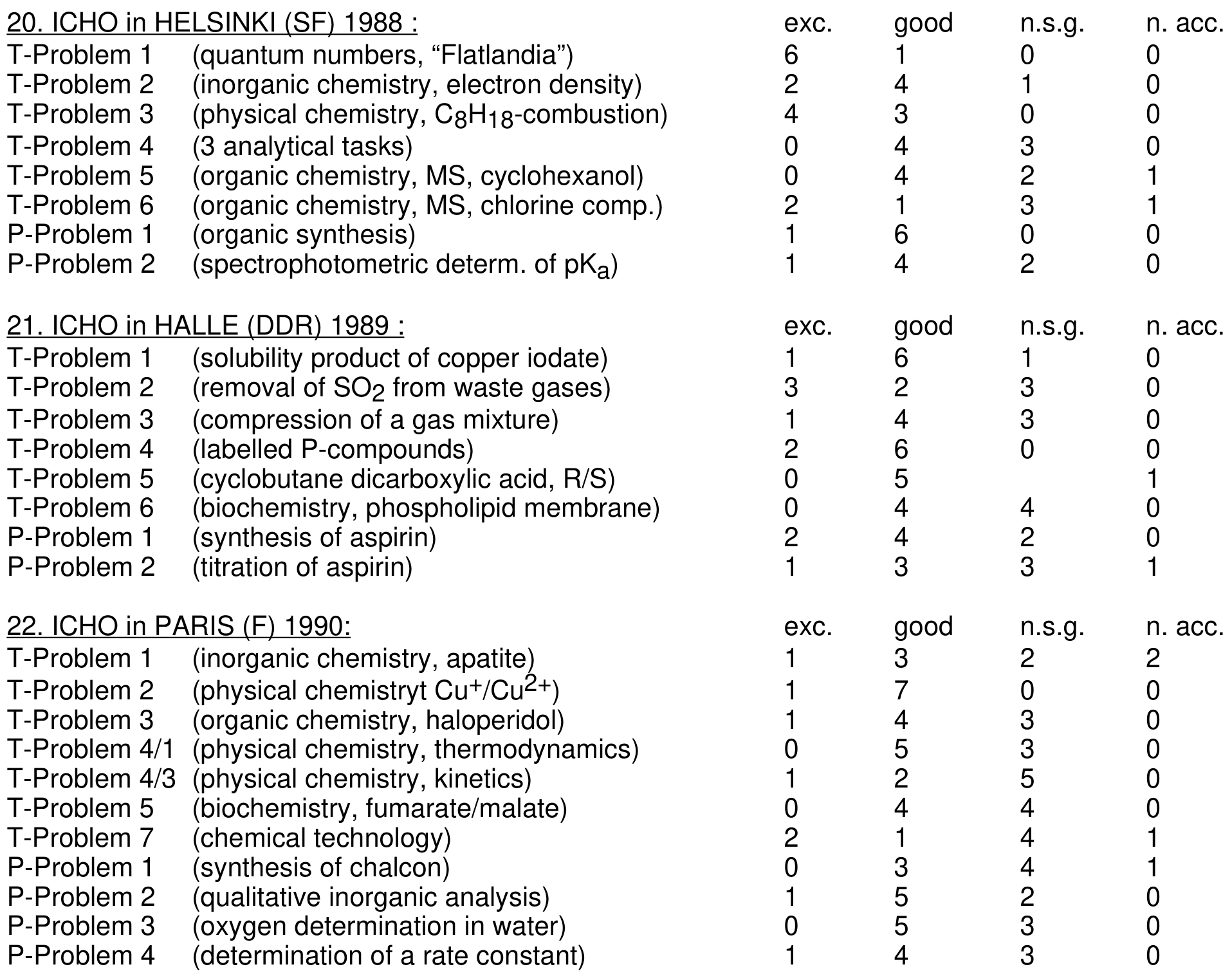
According to the decision of the work shop of Amsterdam the delegation leaders of 8 countries made an attempt to rank the ICHO-tasks of the years 1980 ~ 1990 into the categories excellent / good / not so good / not acceptable The following pages indicate the ”top-twelve”, i.e. is the best tasks of the last years. This collection should be an aid for the ICHO-designers of the next years. Examples for tasks considered as ”not acceptable” are available for the next organisers too.
Original ranking tables (1980–1990)
The workshop’s complete native ranking tables are retained below. Ratings exc., good, n.s.g. and n.acc. are those printed by the source.
Условие
The dissociation of (molecular) chlorine is an endothermic process, ∆H = 24.36 kJ mol–1. The dissociation can also be attained by the effect of light.
1) At what wavelength can the dissociating effect of light be expected?
2) Can this effect also be obtained with light whose wavelength is smaller or larger than the calculated critical wavelength?
3) What is the energy of the photon with the critical wavelength?
When light that can effect the chlorine dissociation is incident on a mixture of gaseous chlorine and hydrogen, hydrogen chloride is formed. The mixture is irradiated with a mercury UV-lamp (λ = 253.6 nm. The lamp has a power input of 10 watt. An amount of 2% of the energy supplied is absorbed by the gas mixture (in a 10 litre vessel). Within 2.5 seconds of irradiation, 65 millimoles of HCl is formed.
4) How large is the quantum yield (= the number of the product molecules per absorbed photon)?
5) How can the value obtained be (qualitatively) explained? Describe the reaction mechanism.
Решение
Solution of problem No. 4:
1)
, from it follows that
Source note: the original question prints 24.36 kJ mol⁻¹, this denominator prints 2.436×10⁻⁵ and the key prints 491 nm. These conflicting native values are retained.
2)
Short-wave light is effective, as its photons have a greater energy than required, whereas the photons of longer-wavelength light are too poor in energy to effect the dissociation.
3)
4)
The quantum yield(φ)=the number of HCl molecules formed/the number of absorbed photons.
Now the number of HCl molecules formed= and the number of photons absorbed=, i.e.
.
5)
The observed quantum yield is based on a chain mechanism.
The start of the reaction chain:
The propagation of the chain:
The chain termination, mainly by
Source note: the first propagation reaction’s coefficient 2 is printed in the source and retained.
Оригинал в Архива: best_problems_1980-1990.pdf · решение от архива: best_problems_1980-1990.pdf · допълнителни данни: IChO 21st-40th.pdf