IChO 1990, Подбрани задачи 1980–1990 · семинар Амстердам 1990 — Задача 5. Problem No. 5 — Physical chemistry (thermodynamics)
The best ICHO-tasks of the last years — Amsterdam workshop, October 1990 (selection from 1980–1990) · 12 т.
Внимание: Бележка към темата
This archive copy is the 1990 Amsterdam workshop top-twelve selection, containing eight theoretical tasks and four independent practical experiments from earlier Olympiads. 1990 identifies the workshop, not the year of every selected task. Solutions are attributed to the archive copy; no established official authorship is inferred. Practical1,2 and4 have no supplied keys. Separate report/answer forms referenced by Practical1,2 and3 are absent; Practical4 includes its blank answer sheet. Printed scientific and numerical discrepancies are retained.
Third International Workshop on the Development of the International Chemistry Olympiads (Amsterdam, October 1990)
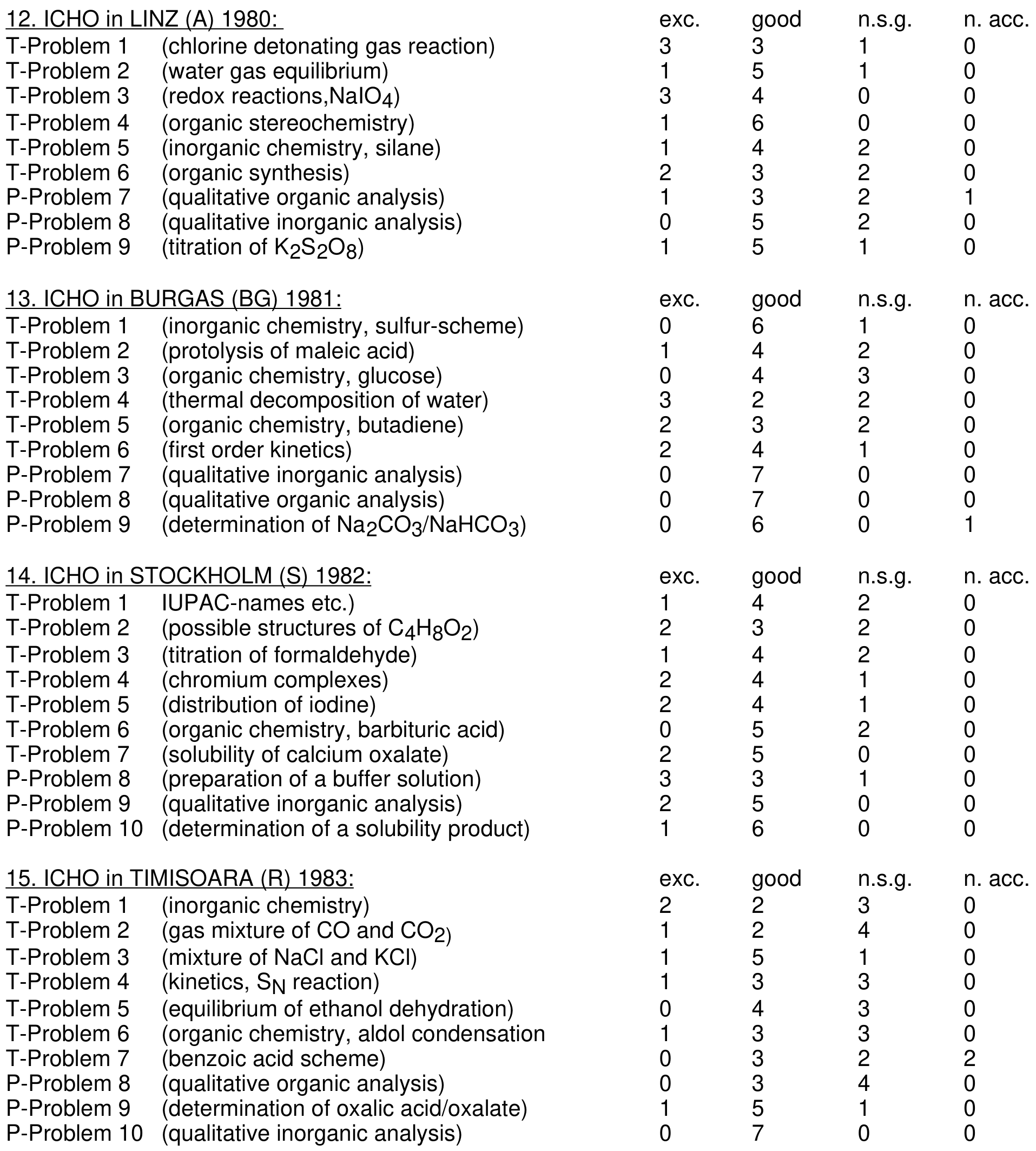
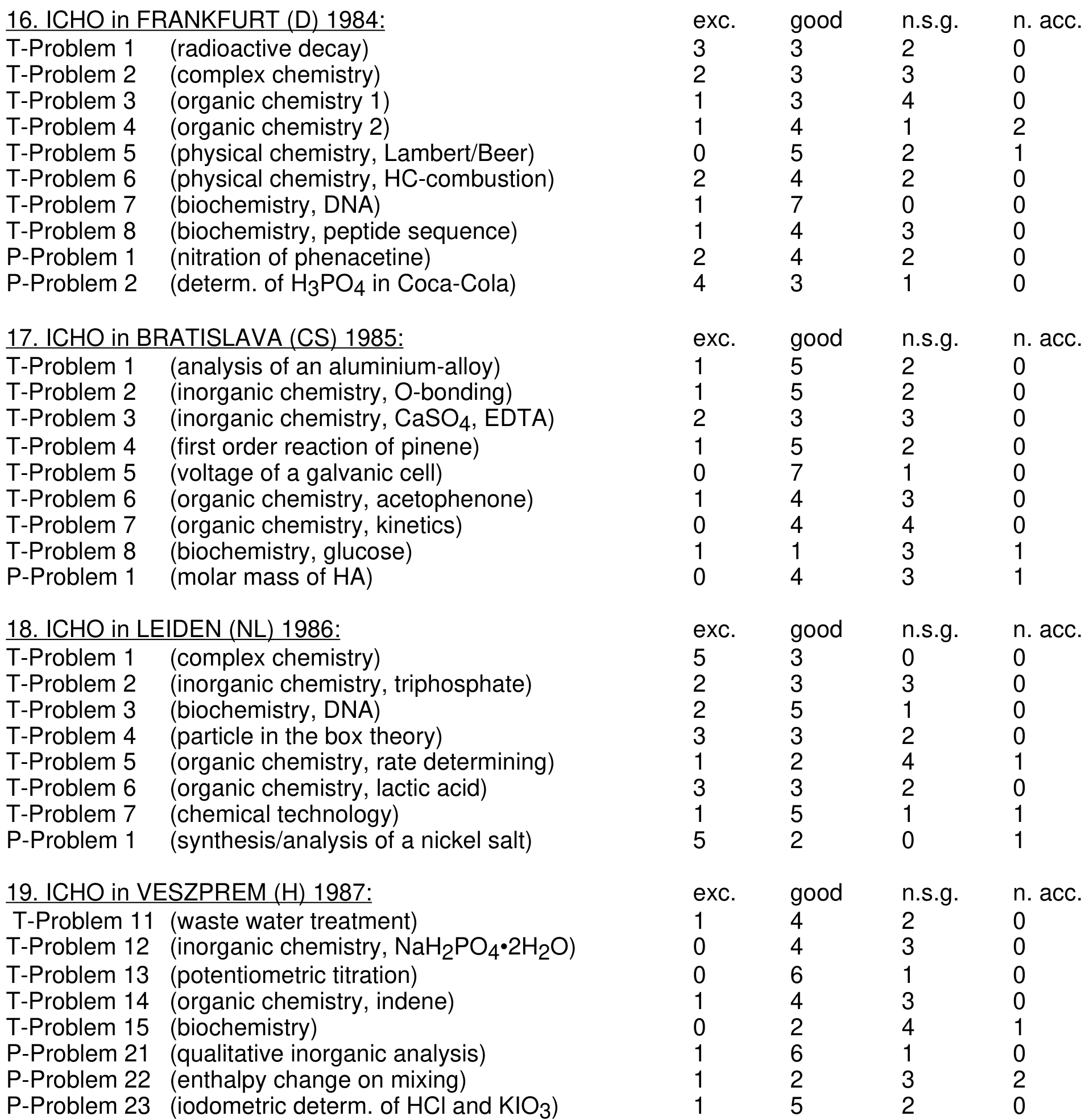
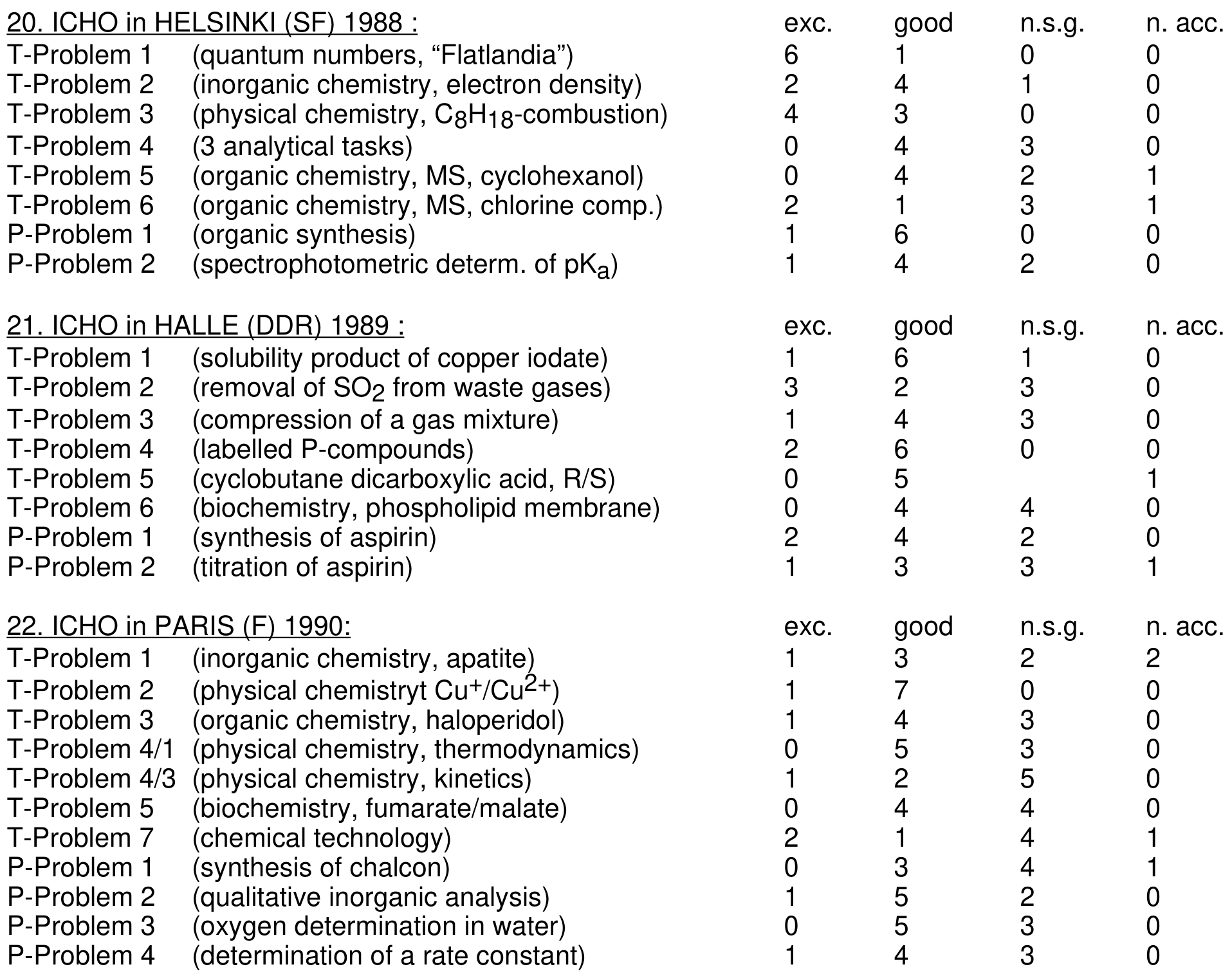
According to the decision of the work shop of Amsterdam the delegation leaders of 8 countries made an attempt to rank the ICHO-tasks of the years 1980 ~ 1990 into the categories excellent / good / not so good / not acceptable The following pages indicate the ”top-twelve”, i.e. is the best tasks of the last years. This collection should be an aid for the ICHO-designers of the next years. Examples for tasks considered as ”not acceptable” are available for the next organisers too.
Original ranking tables (1980–1990)
The workshop’s complete native ranking tables are retained below. Ratings exc., good, n.s.g. and n.acc. are those printed by the source.
Условие
Carbon monoxide is one of the most serious environmental hazards caused by automobiles and extensive investigation is being carried out to develop efficient catalysts for the conversion of CO present in the exhaust gases to CO₂. Consider a typical family car. It has four cylinders with a total cylinder volume of 1600 cm³ and a fuel consumption of 7.0 dm³ /100 km when driving at a speed of 90 km/h. During one second each cylinder goes through 25 burn cycles and consumes 0.400 g of fuel. Assume that the fuel is composed of 2,2,4-trimethylpentane, C₈H₁₈. The compression ratio of the cylinder is 1:8 (the ratio between the smallest and the largest volume within the cylinder as the piston moves to and fro).
a) Calculate the air intake of the engine (m³/s). The gasified fuel and air are introduced into the cylinder when its volume is largest until the pressure in the cylinder is 101.0 kPa. You may assume that the temperature of both the incoming fuel and air is 100.0 °C. (2.0 points)
Air contains 21.0% by volume of O2 and 79.0% by volume of N2. It is assumed that 10.0l% of carbon forms CO upon combustion and that nitrogen remains inert.
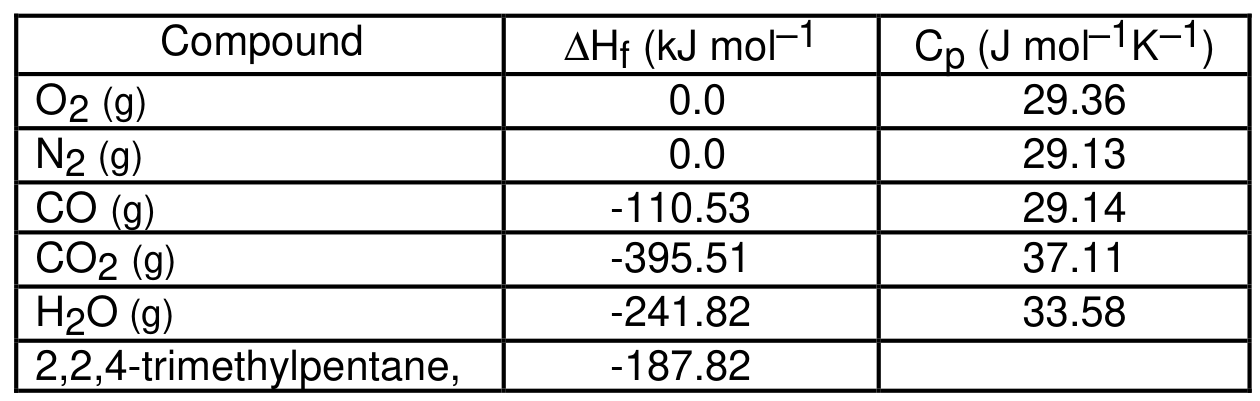
b) The gasified fuel and the air are then compressed until the volume in the cylinder is at its smallest. They are ignited. Calculate (1) the composition (% by volume) and (2) the temperature (K) of the exhaust gases immediately after the combustion (the exhaust gases have not yet started to expand). The following thermodynamic values are known. You can assume that both the enthalpies of formation and the molar heat capacities are independent of temperature and may be used in an approximate calculation of the temperature change. (5.0 points)
c) Calculate the final temperature of the exhaust gases leaving the cylinder assuming that the piston has moved to expand the gases to the maximum volume in the cylinder, the gas mixture obeys the ideal gas equation and that the final pressure in the cylinder is 200.0 kPa. (2.0 points)
d) To convert the CO(g) to CO₂(g) the exhaust gases are led through a bed of catalyst. The catalyst has the following work function:
where [n(CO)/n(CO₂)] is the molar ratio of CO and CO₂ leaving the catalyst, [n(CO)/n(CO₂)]ᵢ is the molar ratio before the catalyst, v is the flow rate of the exhaust gases (mol s⁻¹), T is the temperature of the exhaust gases entering the catalyst (assumed to be the same as the final temperature of the gases leaving the cylinder). T₀ is a reference temperature (373 K) and k is a constant (3.141 s mol⁻¹).
Calculate the composition (% by volume) of the exhaust gases leaving the catalyst. (3.0 points)
Решение
Solution of problem No. 5:
a)
.
Consider one cylinder. During each burn cycle:
Cylinder volume:; pressure:; temperature:.
Air intake(m³ s⁻¹)(one cylinder;25 burn cycles):
The air intake(engine;m³ s⁻¹):
Source note: the first printed fuel amount is 1.4004×10⁻⁴ and the displayed volume numerator has “4 4 10⁻⁴”; their later forms differ. Both original occurrences are retained.
b)
- Composition of the exhaust gases(consider one cylinder and one burn cycle).
Before combustion:
| No. of moles | C₈H₁₈ | O₂ | CO | CO₂ | H₂O |
|---|---|---|---|---|---|
| before combustion | 1.404×10⁻⁴ | 2.709×10⁻³ | 0 | 0 | 0 |
| after combustion | 0 | 10.10×10⁻⁴ | 1.123×10⁻⁴ | 10.11×10⁻⁴ | 12.63×10⁻⁴ |
After combustion:.
The composition of the gas after combustion:
| Component | mol×10⁻⁴ | % |
|---|---|---|
| N₂ | 101.91 | 75.0 |
| O₂ | 10.10 | 7.4 |
| CO | 1.12 | 0.8 |
| CO₂ | 10.11 | 7.5 |
| H₂O | 12.63 | 9.3 |
| nG | 135.87 | 100.0 |
- The temperature of gas immediately after combustion:
Source note: the integral has no printed differential and the numerical heat-capacity multiplier is printed 10⁴; these are retained.
c)
Temperature of the exhaust gas leaving the cylinder.
, ; .
d)
Composition of the exhaust gas after the catalyst.
Mass stream of the exhaust gas from all four cylinders:
The molar ratio can be calculated considering the amounts of exhaust gas components from one cycle.
Catalysed reaction:.
| moles×10⁴(from 4 cylinders) | CO | O₂ | CO₂ |
|---|---|---|---|
| Initial | 4.48 | 40.40 | 40.44 |
| Final | 4.48−x | 40.40−0.5x | 40.44+x |
Composition of the gas after the catalyst(one cycle):
| Component | moles×10⁴ | = | value | % |
|---|---|---|---|---|
| N₂ | 407.64 | = | 407.64 | 75.26 |
| O₂ | 40.40−0.5x | = | 8.55 | 7.12 |
| CO | 4.48−x | = | 0.78 | 0.15 |
| CO₂ | 40.44+x | = | 44.14 | 8.14 |
| H₂O | 50.52 | = | 50.52 | 9.33 |
| total | 541 63 | 100.00 |
Source note: the numerical substitution omits the preceding 1/4 factor; the flow line prints 01359; the final O₂ row prints 8.55 and total “541 63”. These native inconsistencies are retained.
Оригинал в Архива: best_problems_1980-1990.pdf · решение от архива: best_problems_1980-1990.pdf · допълнителни данни: IChO 21st-40th.pdf