IChO 1990, Подбрани задачи 1980–1990 · семинар Амстердам 1990 — Задача 11. Practical problem No. 3 — Preparation of a buffer solution
The best ICHO-tasks of the last years — Amsterdam workshop, October 1990 (selection from 1980–1990)
Внимание: Бележка към темата
This archive copy is the 1990 Amsterdam workshop top-twelve selection, containing eight theoretical tasks and four independent practical experiments from earlier Olympiads. 1990 identifies the workshop, not the year of every selected task. Solutions are attributed to the archive copy; no established official authorship is inferred. Practical1,2 and4 have no supplied keys. Separate report/answer forms referenced by Practical1,2 and3 are absent; Practical4 includes its blank answer sheet. Printed scientific and numerical discrepancies are retained.
Third International Workshop on the Development of the International Chemistry Olympiads (Amsterdam, October 1990)
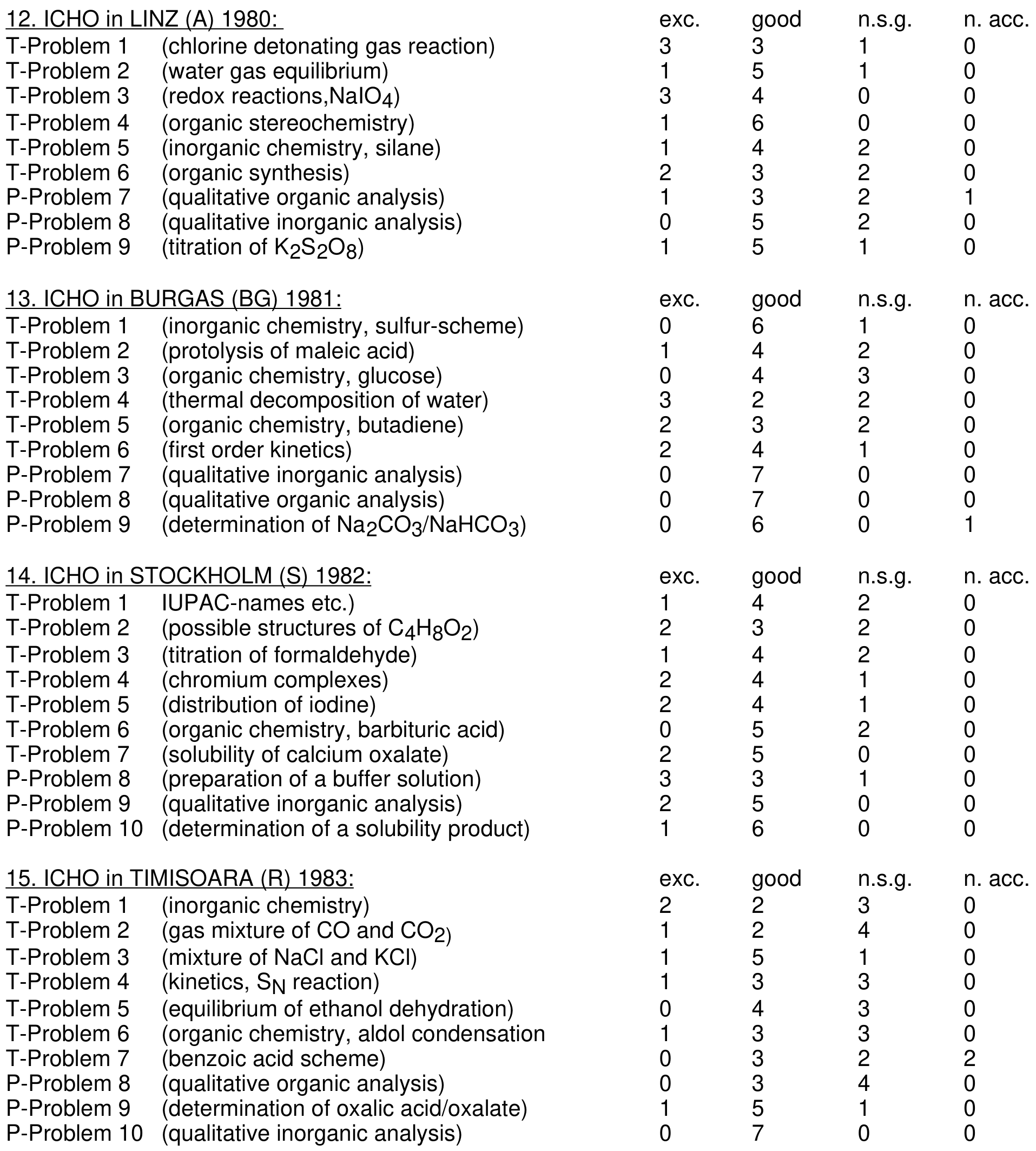
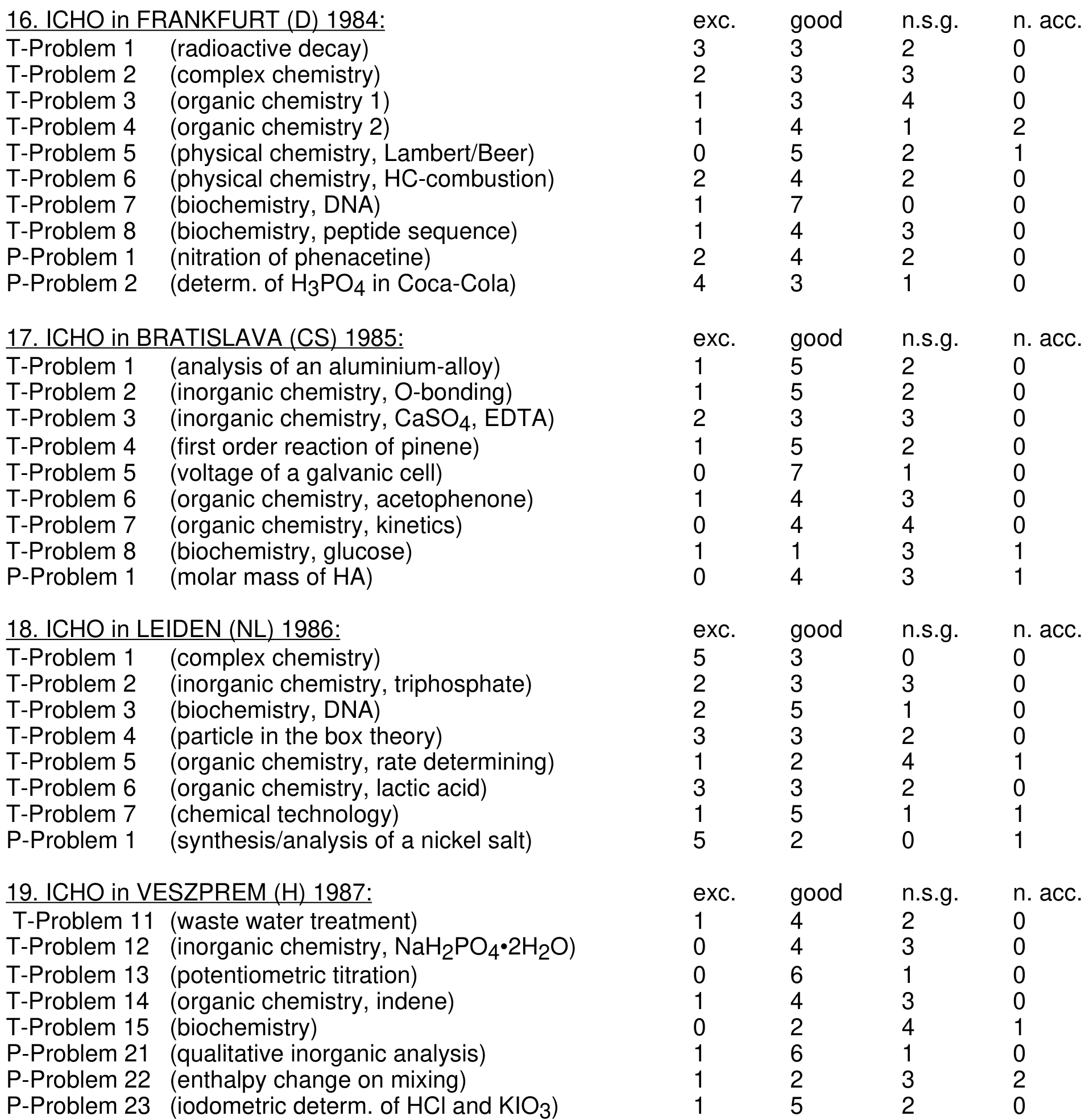
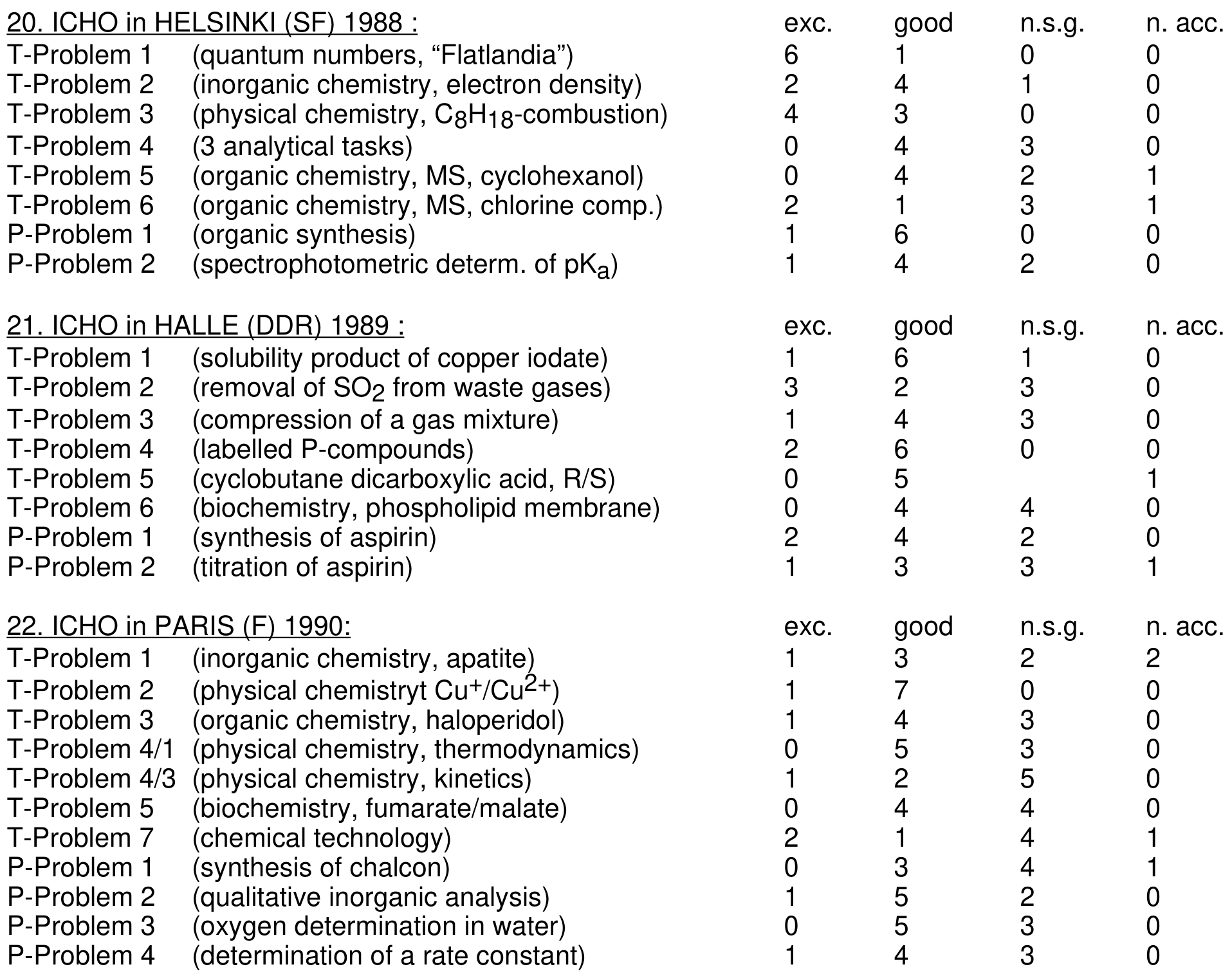
According to the decision of the work shop of Amsterdam the delegation leaders of 8 countries made an attempt to rank the ICHO-tasks of the years 1980 ~ 1990 into the categories excellent / good / not so good / not acceptable The following pages indicate the ”top-twelve”, i.e. is the best tasks of the last years. This collection should be an aid for the ICHO-designers of the next years. Examples for tasks considered as ”not acceptable” are available for the next organisers too.
Original ranking tables (1980–1990)
The workshop’s complete native ranking tables are retained below. Ratings exc., good, n.s.g. and n.acc. are those printed by the source.
Условие
A pH buffer solution has a well specified acidity, which changes only very slightly upon addition of moderate quantities of strong acid or base. The larger the quantity of acid or base that must be added to a certain volume of buffer solution in order to change its pH by a specified amount, the better its buffer action is said to be. A buffer solution is prepared by mixing a weak acid and its conjugate base in appropriate amounts in solution. An example of a useful buffer system in aqueous solution is the phosphate system. Your task is to prepare a phosphate buffer solution with properties specified by the following two conditions:
pH = 7.20 in the buffer solution
pH = 6.80 in a mixture of 50.0 cm³ of the buffer solution and 5.0 cm³ hydrochloric acid with a concentration of 0.100 mol/dm³.
Chemicals and equipment: Aqueous solution of phosphoric acid, sodium hydroxide solution of known concentration, hydrochloric acid (0.100 mol/dm³), solution of bromocresol green, distilled water. Burettes, pipettes (25 cm³ and 5 cm³), Erlenmeyer flasks (100 cm³ and 250 cm³), volumetric flask (100 cm³), beaker, and funnel.
Procedure: Determine the concentration of the phosphoric acid solution by titration with the sodium hydroxide solution using bromocresol green as an indicator (pH range 3.8 < pH < 5.4). Make the buffer solution by mixing calculated volumes of phosphoric acid and sodium hydroxide solution in the volumetric flask and filling the flask to the mark with distilled water. Mix 50.0 cm³ buffer solution with 5.0 cm³ hydrochloric acid in an Erlenmeyer flask. Hand in your answer sheet to the referees who will also measure the pH of your two solutions and note your result. The pKₐ values of phosphoric acid are pKₐ₁ = 1.75, pKₐ₂ = 6.73 and pKₐ₃ = 11.50.
Решение
The buffer solution must contain H₂PO₄⁻ (concentration a mol/dm³) and HPO₄²⁻ (concentration b mol/dm³). The concentrations should satisfy the condition
After addition of HCl, the condition will be
From these equations, a=0.0122, b=0.0361.
Total concentration of the phosphate system=0.0483 mol/dm³.
Total concentration of Na⁺=(a+2b) mol/dm³=0.0844 mol/dm³.
If the concentrations of both phosphoric acid and sodium hydroxide solutions are 0.500 mol/dm³, then 100.0 cm³ buffer solution will require
Оригинал в Архива: best_problems_1980-1990.pdf · решение от архива: best_problems_1980-1990.pdf · допълнителни данни: IChO 21st-40th.pdf