IChO 1990, Подбрани задачи 1980–1990 · семинар Амстердам 1990 — Задача 12. Practical problem No. 4 — Synthesis of aspirin
The best ICHO-tasks of the last years — Amsterdam workshop, October 1990 (selection from 1980–1990)
Внимание: Бележка към темата
This archive copy is the 1990 Amsterdam workshop top-twelve selection, containing eight theoretical tasks and four independent practical experiments from earlier Olympiads. 1990 identifies the workshop, not the year of every selected task. Solutions are attributed to the archive copy; no established official authorship is inferred. Practical1,2 and4 have no supplied keys. Separate report/answer forms referenced by Practical1,2 and3 are absent; Practical4 includes its blank answer sheet. Printed scientific and numerical discrepancies are retained.
Third International Workshop on the Development of the International Chemistry Olympiads (Amsterdam, October 1990)
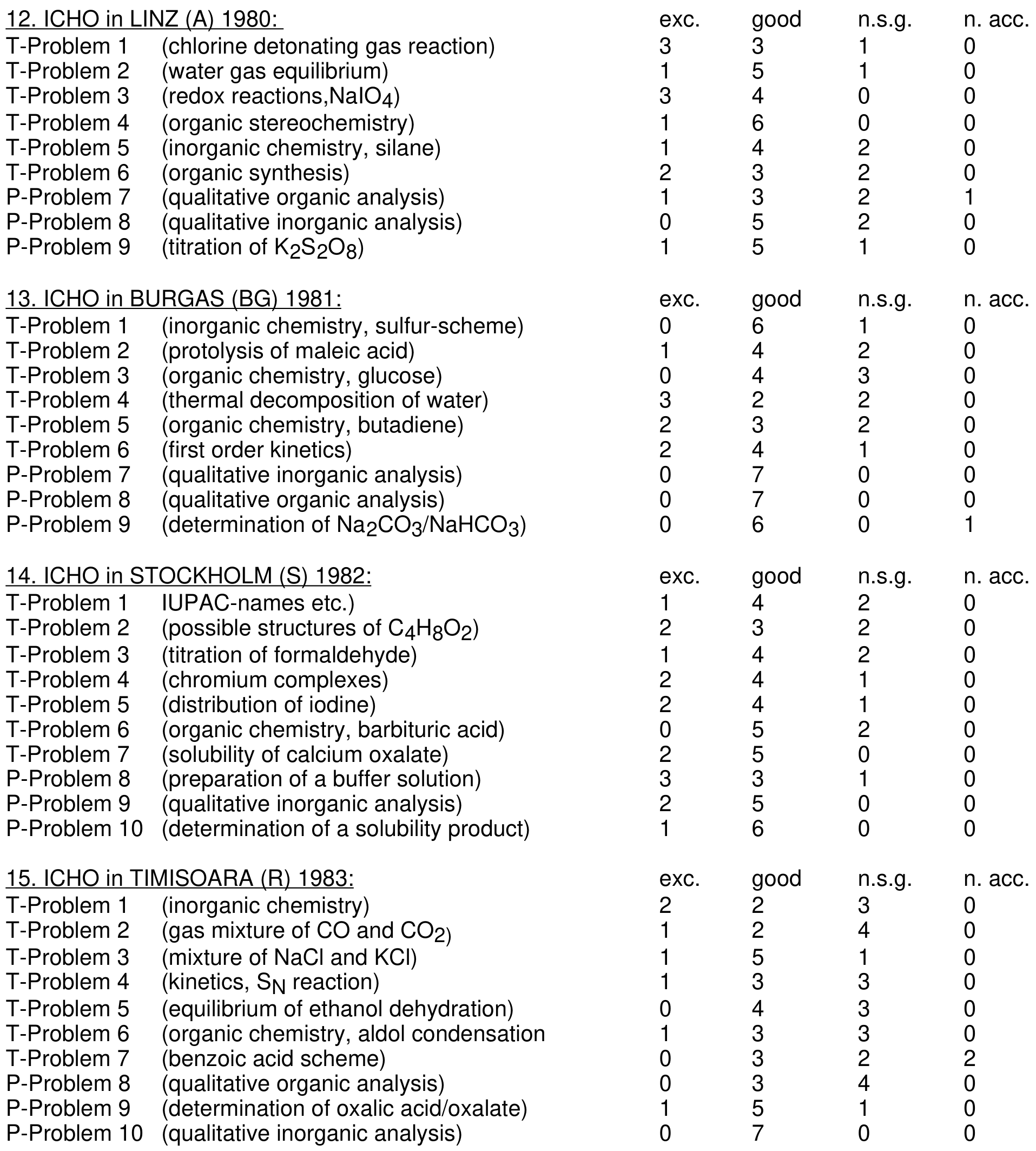
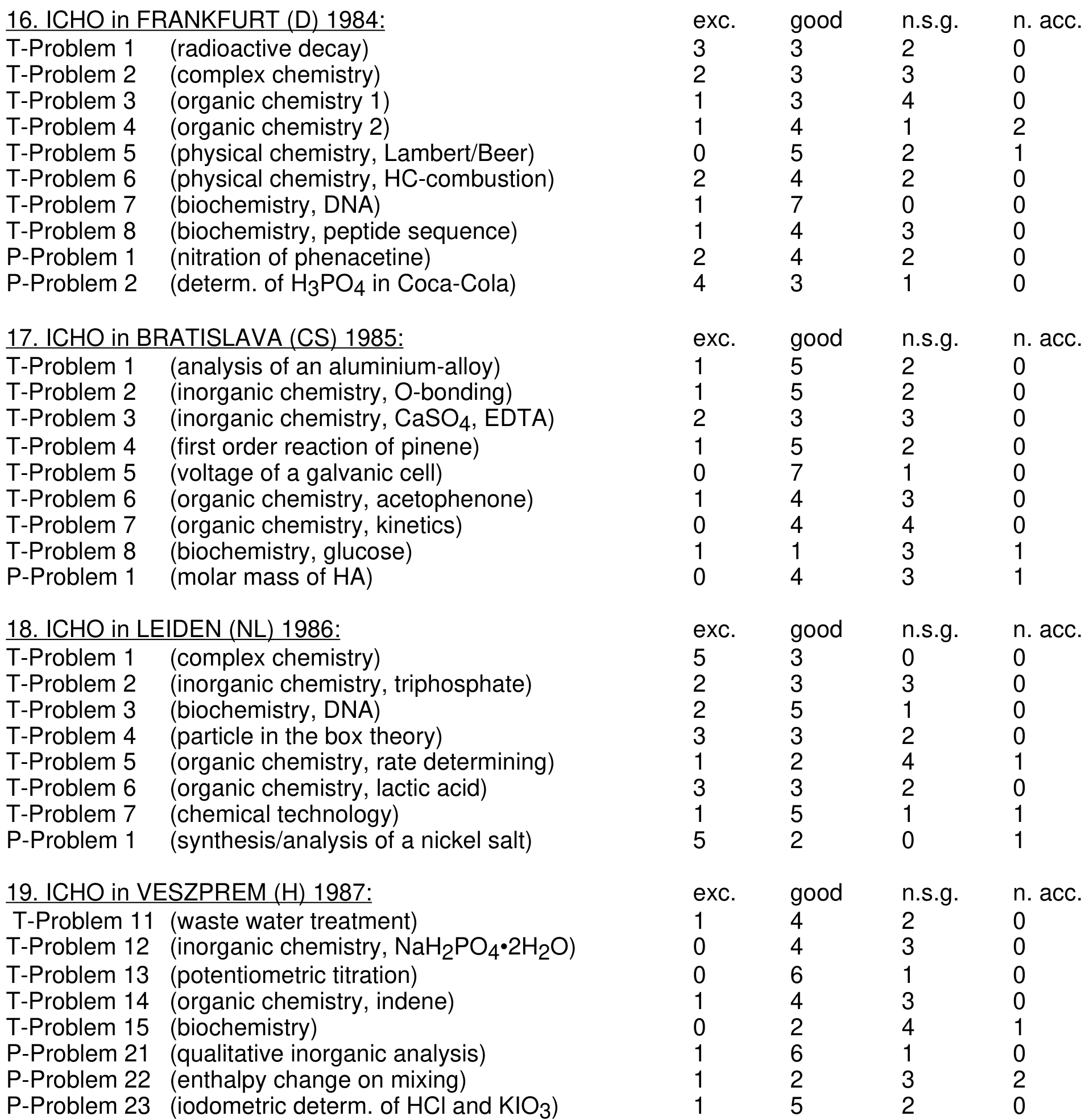
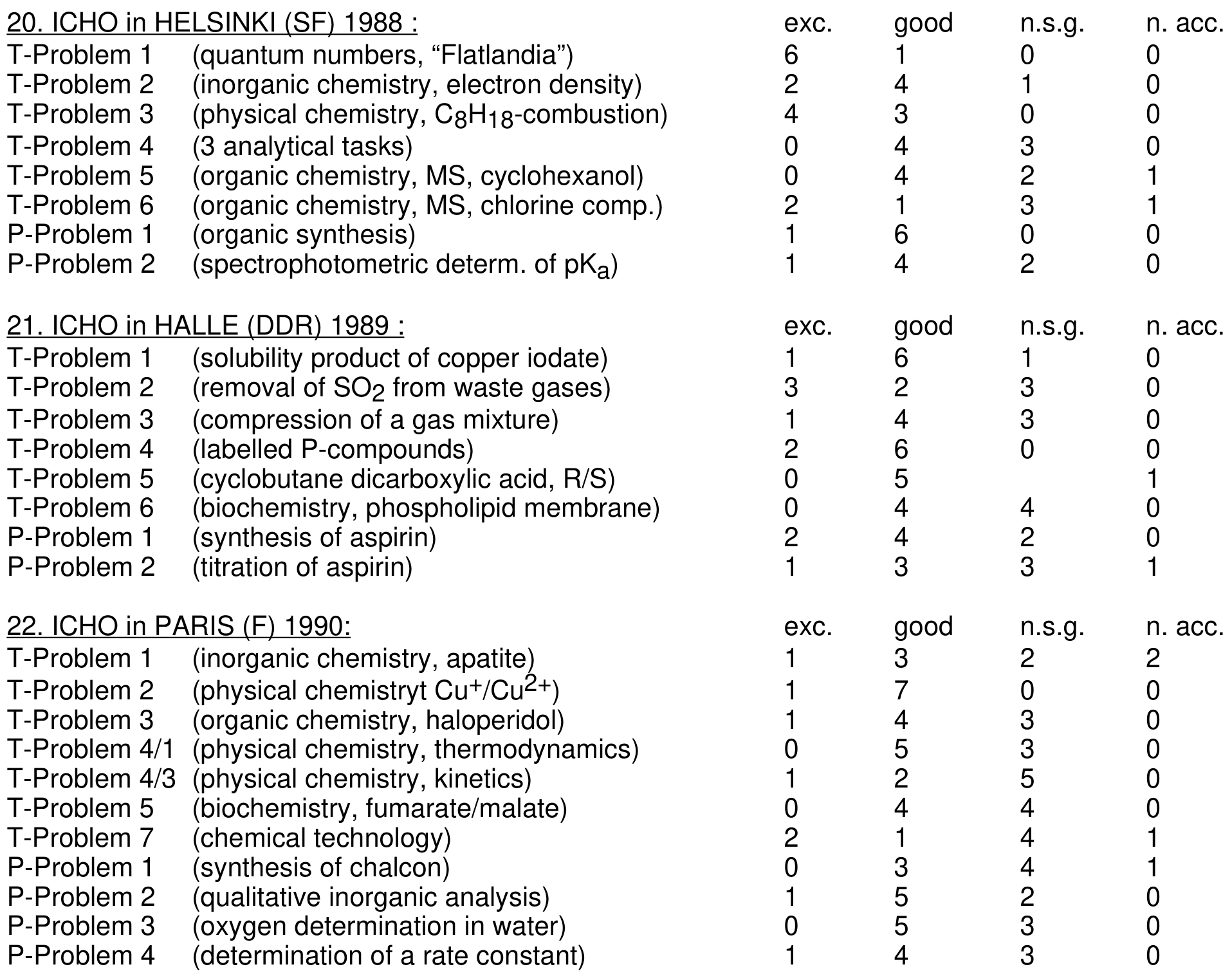
According to the decision of the work shop of Amsterdam the delegation leaders of 8 countries made an attempt to rank the ICHO-tasks of the years 1980 ~ 1990 into the categories excellent / good / not so good / not acceptable The following pages indicate the ”top-twelve”, i.e. is the best tasks of the last years. This collection should be an aid for the ICHO-designers of the next years. Examples for tasks considered as ”not acceptable” are available for the next organisers too.
Original ranking tables (1980–1990)
The workshop’s complete native ranking tables are retained below. Ratings exc., good, n.s.g. and n.acc. are those printed by the source.
Условие
Prepare 2-ethanoyloxybenzoic acid (acetylsalicylic acid, also known as aspirin) by ethanoylation (acetylation) of 2-hydroxybenzoic acid (salicylic acid) with ethanoic anhydride (acetic anhydride). Relative atomic masses: C : 12.011; O : 15.999; H : 1.008.
Reagents:
- 2-hydroxybenzoic acid (melting point 158 °C)
- Ethanoic anhydride (boiling point 140 °C)
- Phosphoric acid (85 % H₃PO₄)
- Ethanol
- Deionised/distilled water
Question 1 Write the balanced chemical equation for the reaction using structural formulae.
Procedure
Take a 100 cm³ Erlenmeyer/conical flask. In the flask, mix the 2.760 g of 2-hydroxybenzoic acid from weighing bottle A, the 5.100 g of ethanoic anhydride from flask B, and with cautious swirling, add 5 - 7 drops of 85 % phosphoric acid. Heat the flask to 70 - 80 °C in a beaker of near boiling water and maintain the mixture at this temperature for 15 minutes. Remove the flask from the water bath and, with gentle swirling, add dropwise 1 cm³ of deionised water to the still hot flask; then immediately add 20 cm³ of the cold deionised water all at once to the reaction flask. Place the flask in an ice bath. If no crystals are deposited or if an oil appears, gently scratch the inner surface of the flask with a glass rod whilst the flask remains in the ice bath. Using the Buchner funnel, filter the product under suction. Rinse the flask twice with a small amount of cold deionised water. Recrystallise the crude product in a 100 cm³ Erlenmeyer/conical flask using suitable amounts of water and ethanol. If no crystals form, or if an oil appears, gently scratch the inner surface of the flask with a glass rod. Filter the crystals under suction and wash with a small amount of cold deionised water. Place the crystals on the porous plate to draw water from them. When the crystals have been air dried, transfer the product to the small glass dish labelled C. This dish has previously been weighed. The dish containing the product should be given to a technician who will dry it in an oven for 30 minutes at 80 °C. A technician should then weigh the cooled dish containing your product in your presence. Record that mass. The melting point will subsequently be taken by a technician to check the purity of your product.
Question 2 What is the percentage yield?
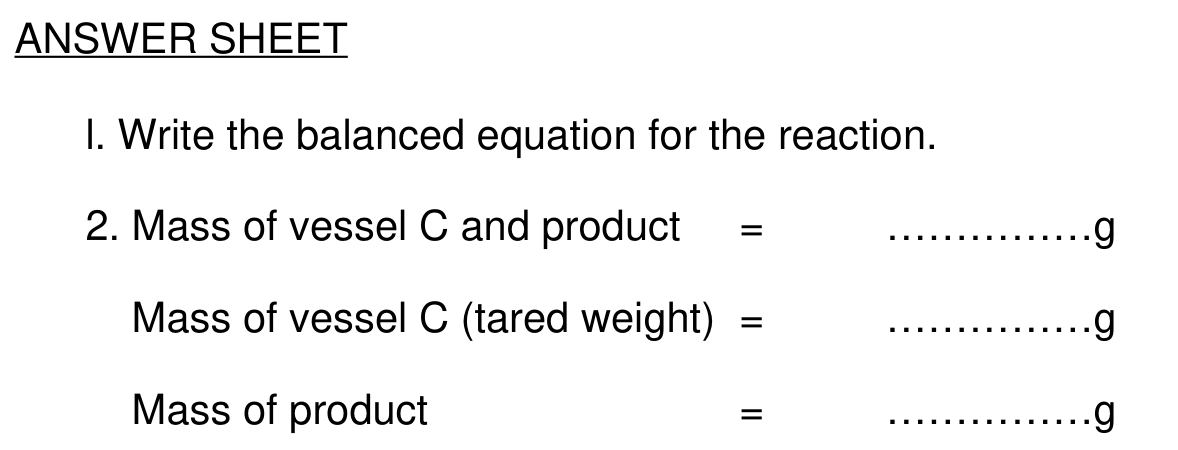
ANSWER SHEET
Решение
Внимание: Непълно решение
No solution for this practical experiment is supplied in the complete obtained 31-page workshop selection. Referenced separate forms and measured experimental values are not invented.
Question 1 — printed Halle 1989 reaction
The retained workshop incomplete-key warning above describes the 31-page workshop edition. The corresponding Halle 1989 practical Problem 1 prints this structural reaction answer for Question 1 only.

Anton Sirota (editor), The Competition Problems from the International Chemistry Olympiads, Volume 2, IUVENTA, 2009: Halle 1989 compiler edition. The primary source remains the Amsterdam workshop selection of October 1990.
Question 2 — missing measured-data key
Volume 2 supplies no measured dish/product mass, melting point or percentage-yield calculation for Question 2. The original blank workshop ANSWER SHEET and its three mass-entry fields remain intact. No participant measurement, yield answer or missing form is inferred.
Оригинал в Архива: best_problems_1980-1990.pdf · решение от архива: IChO 21st-40th.pdf · допълнителни данни: IChO 21st-40th.pdf