IChO 1990, Подбрани задачи 1980–1990 · семинар Амстердам 1990 — Задача 9. Practical problem No. 1 — Synthesis and analysis of a nickel complex
The best ICHO-tasks of the last years — Amsterdam workshop, October 1990 (selection from 1980–1990)
Внимание: Бележка към темата
This archive copy is the 1990 Amsterdam workshop top-twelve selection, containing eight theoretical tasks and four independent practical experiments from earlier Olympiads. 1990 identifies the workshop, not the year of every selected task. Solutions are attributed to the archive copy; no established official authorship is inferred. Practical1,2 and4 have no supplied keys. Separate report/answer forms referenced by Practical1,2 and3 are absent; Practical4 includes its blank answer sheet. Printed scientific and numerical discrepancies are retained.
Third International Workshop on the Development of the International Chemistry Olympiads (Amsterdam, October 1990)
According to the decision of the work shop of Amsterdam the delegation leaders of 8 countries made an attempt to rank the ICHO-tasks of the years 1980 ~ 1990 into the categories excellent / good / not so good / not acceptable The following pages indicate the ”top-twelve”, i.e. is the best tasks of the last years. This collection should be an aid for the ICHO-designers of the next years. Examples for tasks considered as ”not acceptable” are available for the next organisers too.
Original ranking tables (1980–1990)
The workshop’s complete native ranking tables are retained below. Ratings exc., good, n.s.g. and n.acc. are those printed by the source.
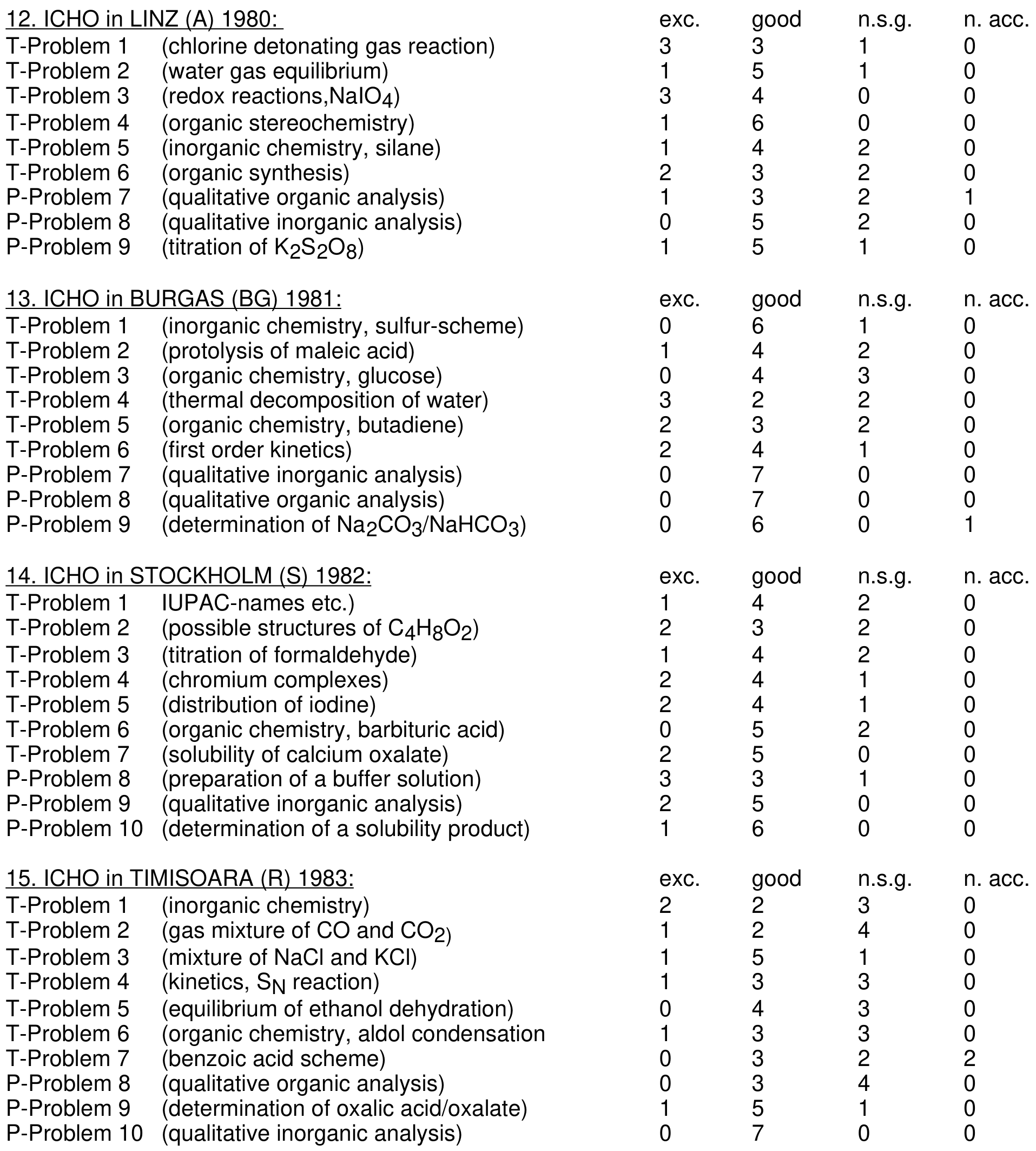
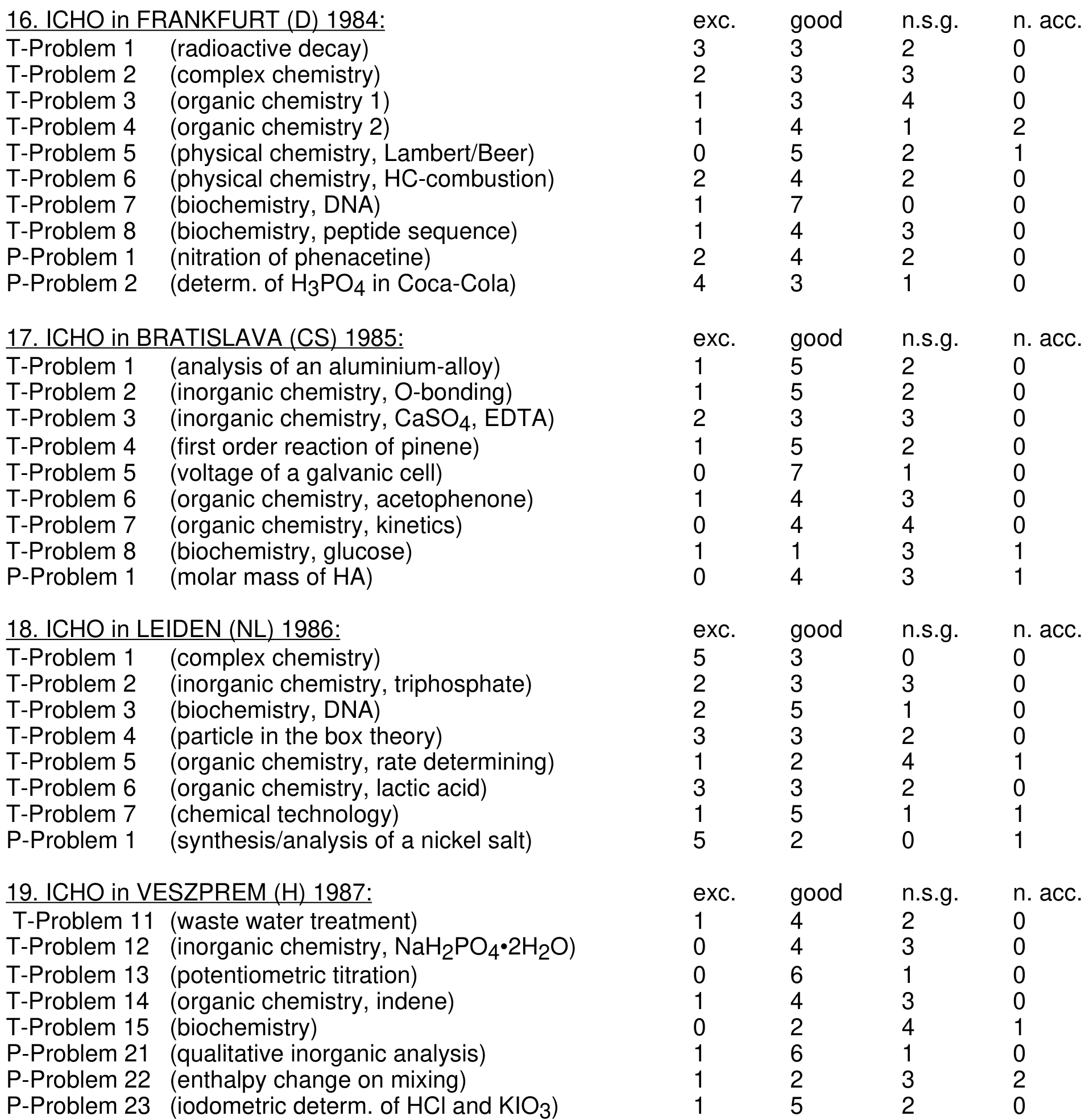
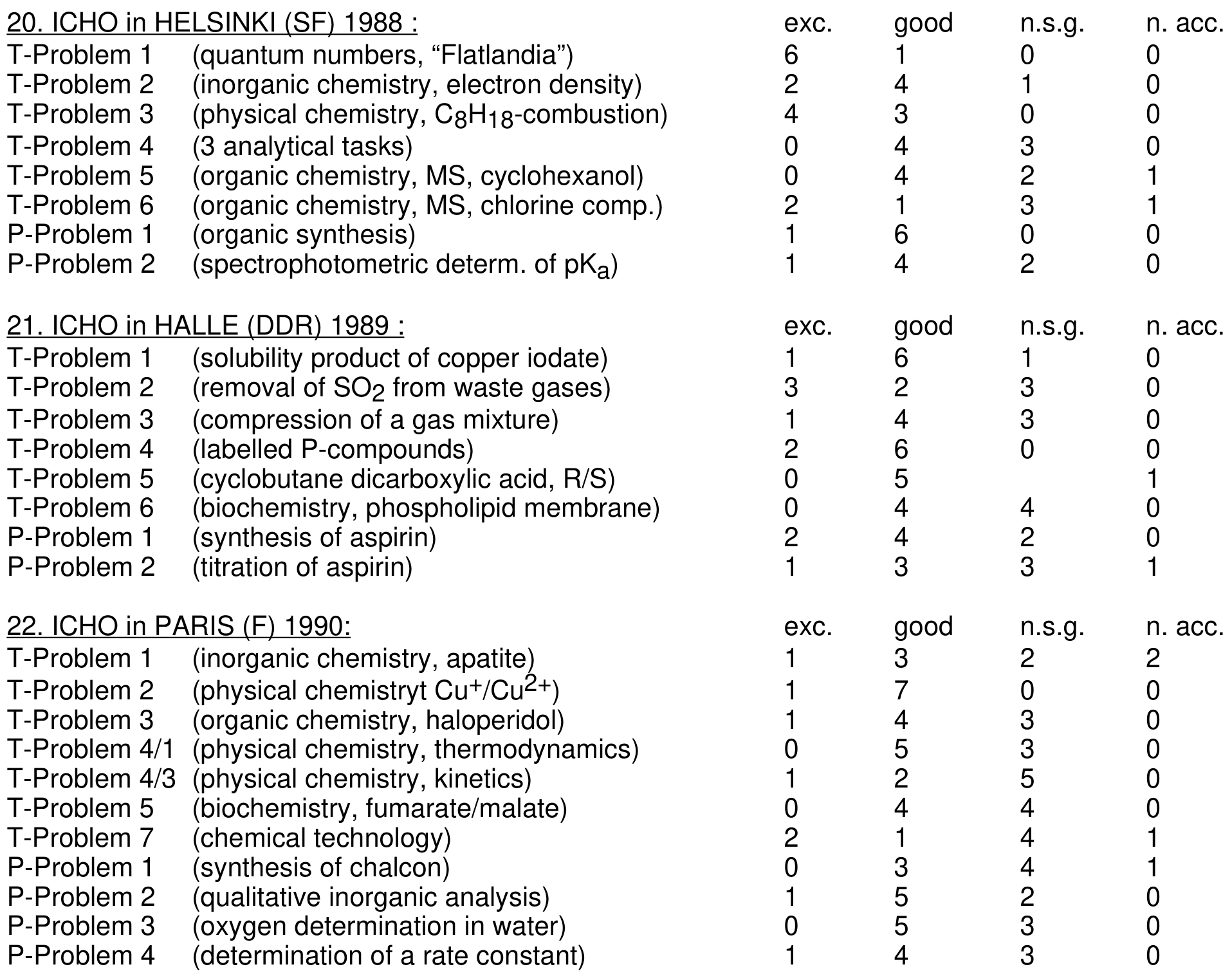
Условие
The experimental assignment consists of the synthesis and subsequently, the analysis of an amminenickel chloride: NiClₓ(NH₃)ᵧ. The synthesis proceeds in three steps:
a) preparation of a solution of nickel nitrate from nickel and concentrated nitric acid (green solution), time required about 20 min.;
b) preparation of amminenickel nitrate (blue crystals); and
c) preparation of amminenickel chloride (blue-violet crystals).
The analysis encompasses the determination of the percentages of the three components (ammonia, nickel and chlorine) of the salt, according to the instructions given in 2.
Report
Record in the indicated places on the report form the data asked in the experimental part 1, and all relevant experimental data, the calculation and the results from part 2.
1. Synthesis of the Nickel Salt.
All work on the synthesis must be carried out in the fume hood. Use of (safety) glasses is obligatory. If necessary use other safety equipment such as rubber gloves and pipetting balloons.
a) Put a “dubbeltje” (Dutch coin of 10 c, containing 1.5 g of nickel), in a conical flask (Erlenmeyer flask) of 100 mL and add 10 mL of concentrated nitric acid (65%). Fit the flask with an “air cooled” condenser (no water) and heat the contents on a hot plate until a violent reaction occurs. Continue heating carefully until all metal has been dissolved. Cool the green solution in an ice-water mixture. Write in the report form the equation of the chemical reaction that has occurred.
b) Add, continuously cooling, in small portions 25 mL of ammonia solution (25%) to the ice cold solution. As soon as about 15 mL has been added, salt crystals start to precipitate. Having added all ammonia solution, filter the cold solution through a sintered glass filtering crucible by applying a vacuum with an aspirator. Wash the crystals three times with small portions of a cold ammonia solution(25%). Remove as much liquid as possible from the crystalline mass by maintaining the vacuum.
c) Dissolve the moist crystalline mass in 10 mL of hydrochloric acid (18%). Cool the blue solution in an ice water mixture and then add slowly 30 mL of a solution of 30 g ammonium chloride in 100 mL of ammonia solution (25%). This yields a blue-violet coloured crystalline mass. Cool the mixture and filter as in b). Wash with ammonia solution (25%), then with ethanol and finally with diethyl ether. Leave the crystals in air until all ether has evaporated. Determine the mass of the dry product and record this on the report form.
2. Analysis of the Nickel salt.
For the analysis of the salt, only one sample solution is prepared. The determination of the components is achieved by titrating each time 25 mL of the sample solution in duplicate. For the determination of the ammonia and chlorine content a back titration is carried out. For that purpose a certain amount of reagent is added in excess. The total amount of reagent, available for the sample, is determined by following the same procedure for 25 mL of a blank solution. This titration should not be carried out in duplicate. Prepare the following solutions: A) Sample solution: Pipette 25 mL 1.6 M nitric acid into a volumetric flask of 250 mL. Add a sample of about 1.2 g of the amminenickelchloride and dilute with water to a volume of 250 mL. B) Blank solution: Pipette 25 mL of the same 1.6 M nitric acid and dilute this with water to a volume of 250 mL.
Note: 1) For the chlorine determination use conical (erlenmeyer) flasks with a ground glass stopper. 2) The nitric acid contains a small amount of hydrochloric acid. The total acid content is 1.6 M.
a) Determination of the ammonia content. Titrate the solutions with a standard solution of NaOH (about 0.1 M). Indicator: methyl red, 0.1% solution in ethanol. Calculate the percentage of ammonia in the salt.
b) Determination of the nickel content. Add about 100 mL of water, 2 mL of ammonia solution (25%) and 5 drops of murexide solution to the nickel solution, which now should have a yellow colour. Titrate the solution with a standard solution of EDTA (about 0.025 M) until a sharp colour change from yellow to violet is observed. Calculate the percentage of nickel in the salt.
c) Determination of the chlorine content. Execute the titrations as quickly as possible after the addition of the reagent! Add to each solution 25 mL of 0.1 M silver nitrate solution. Add about 5 mL of toluene, shake vigorously, add indicator and titrate with the standard solution of ammonium thiocyanate (rhodanide, about 0.05 M) until a permanent colour change to red is observed. At the end of the titration, shake vigorously again. The red coloration should persist. Indicator: 1 mL of a saturated solution of iron(III)sulphate. Calculate the percentage of chlorine in the salt. Data: Atomic masses: H = 1; Cl = 35.5; N = 14; Ni = 58.7.
d) Calculate from the results obtained the molar ratio of the components, to two decimal points and enter this on the report form in the format: Ni : Cl: NH₃ = 1.00 : x : y.
Решение
Внимание: Непълно решение
В архива няма официално решение на тази задача.
Оригинал в Архива: best_problems_1980-1990.pdf · допълнителни данни: IChO 21st-40th.pdf