IChO 1990, Подбрани задачи 1980–1990 · семинар Амстердам 1990 — Задача 8. Problem No. 8 — Biochemistry (DNA)
The best ICHO-tasks of the last years — Amsterdam workshop, October 1990 (selection from 1980–1990)
Внимание: Бележка към темата
This archive copy is the 1990 Amsterdam workshop top-twelve selection, containing eight theoretical tasks and four independent practical experiments from earlier Olympiads. 1990 identifies the workshop, not the year of every selected task. Solutions are attributed to the archive copy; no established official authorship is inferred. Practical1,2 and4 have no supplied keys. Separate report/answer forms referenced by Practical1,2 and3 are absent; Practical4 includes its blank answer sheet. Printed scientific and numerical discrepancies are retained.
Third International Workshop on the Development of the International Chemistry Olympiads (Amsterdam, October 1990)
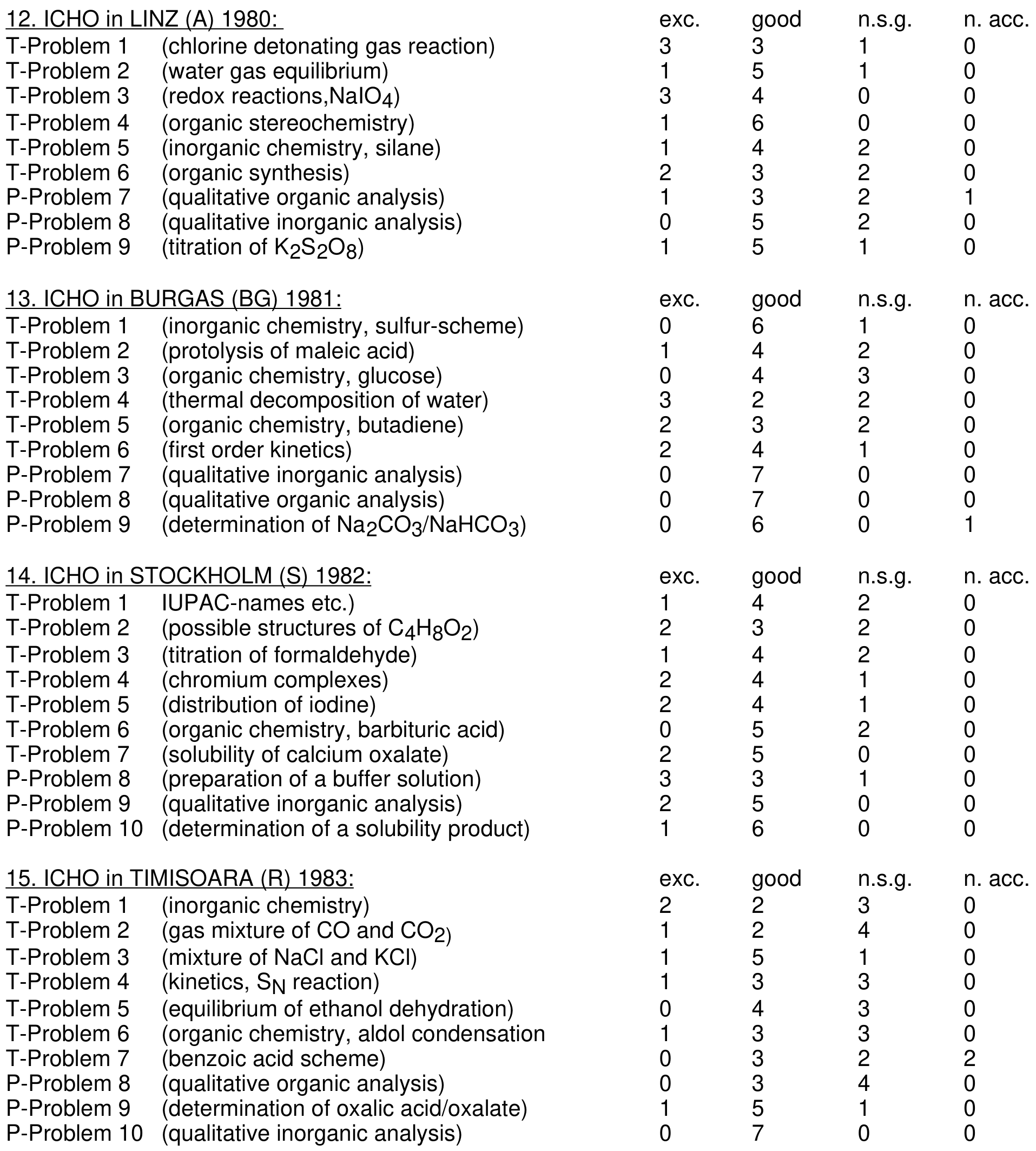
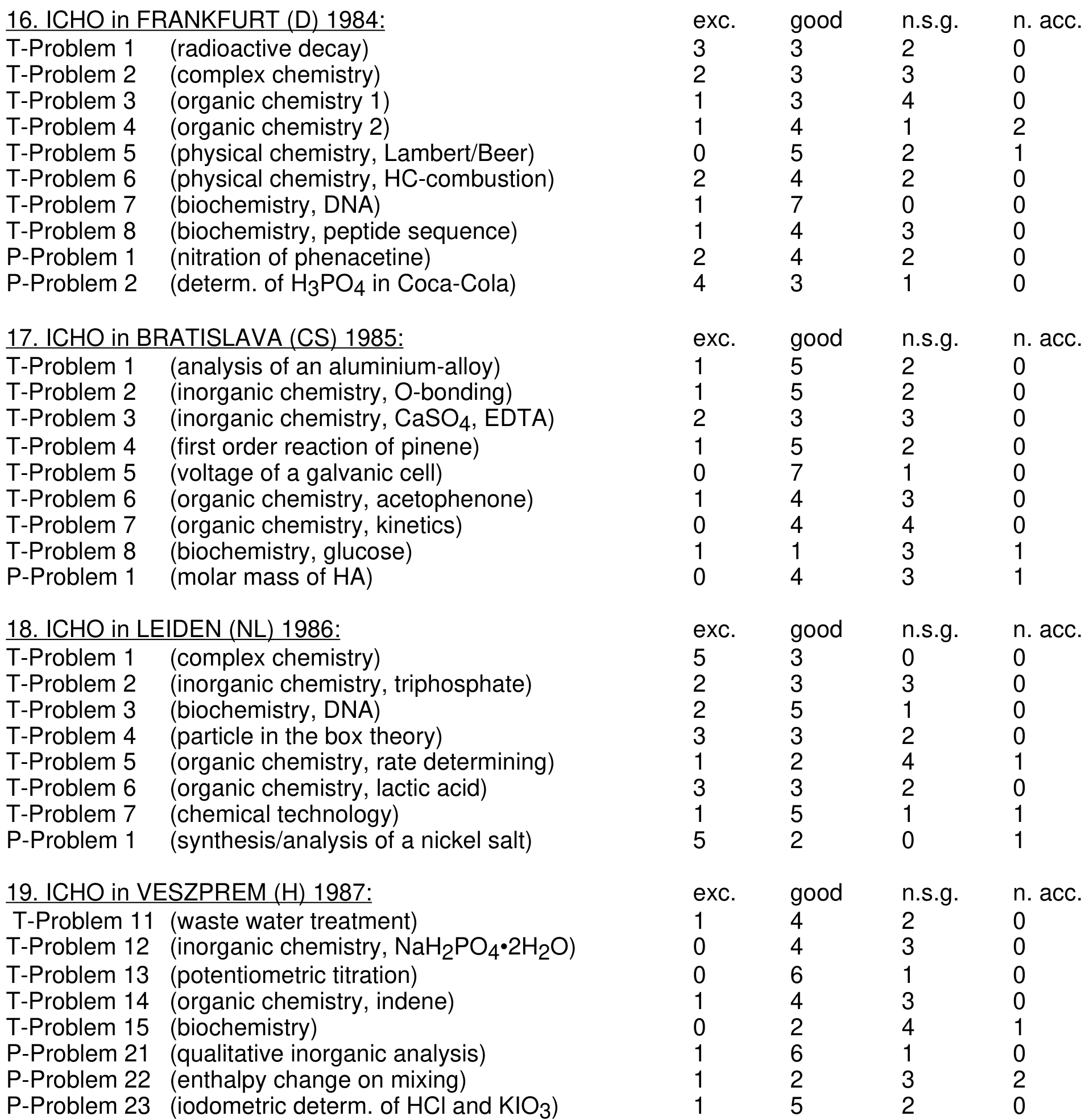
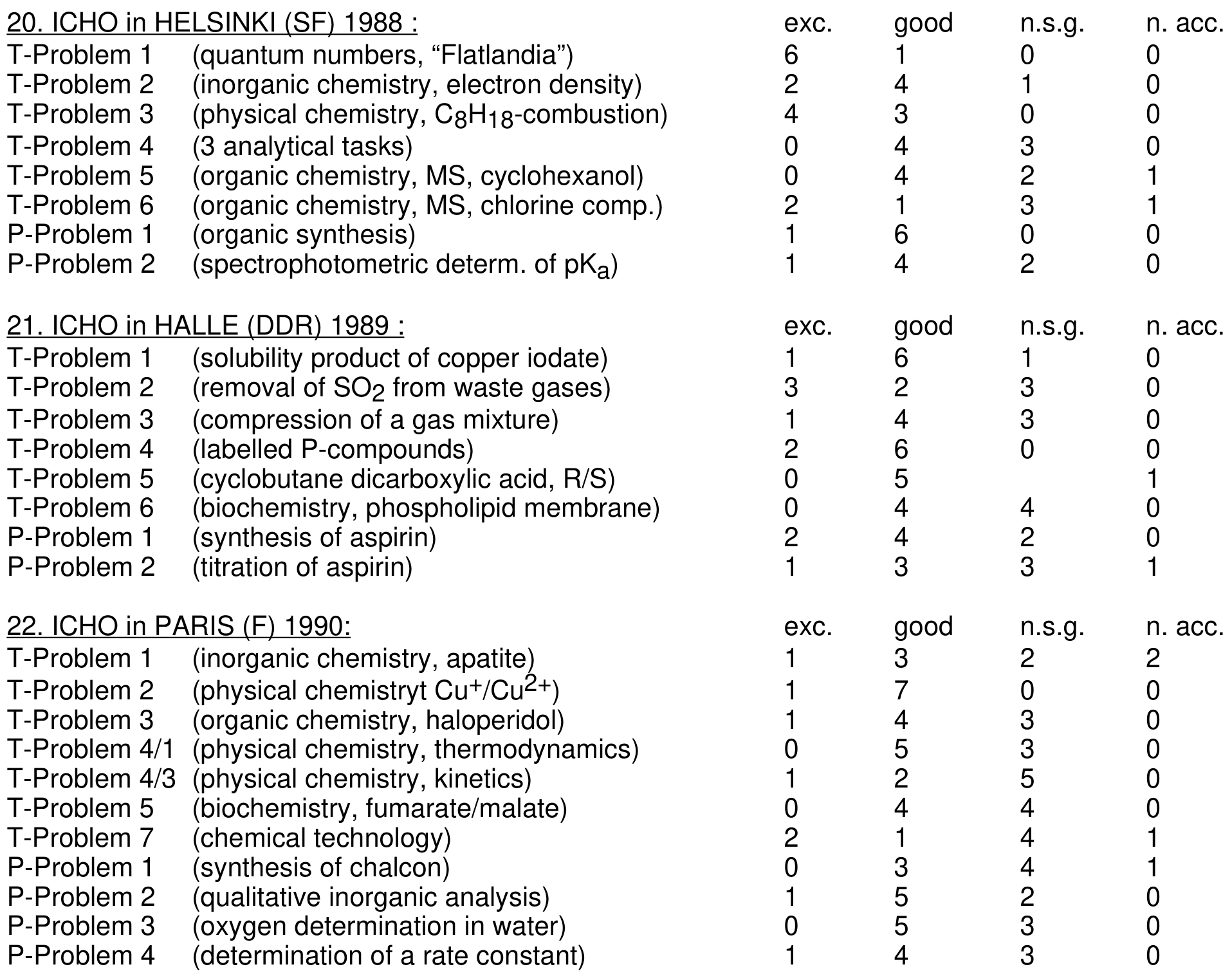
According to the decision of the work shop of Amsterdam the delegation leaders of 8 countries made an attempt to rank the ICHO-tasks of the years 1980 ~ 1990 into the categories excellent / good / not so good / not acceptable The following pages indicate the ”top-twelve”, i.e. is the best tasks of the last years. This collection should be an aid for the ICHO-designers of the next years. Examples for tasks considered as ”not acceptable” are available for the next organisers too.
Original ranking tables (1980–1990)
The workshop’s complete native ranking tables are retained below. Ratings exc., good, n.s.g. and n.acc. are those printed by the source.
Условие
In recombinant DNA technology one makes use of specific endonucleases. These are enzymes which recognise specific nucleotide sequences in double strand DNA and which catalyse the hydrolysis of a phosphoric ester bond in each of both strands. In this problem we consider two different endonucleases which carry the names Cla I and Taq I. Cla I hydrolyses the bond between two nucleotides in the sequence:
a) Give the base sequence of the complementary strand in the 5’→3’ direction and indicate with an arrow the location where the hydrolysis by Cla I occurs.
b) How often on average will this sequence occur in one strand of a DNA molecule of 10⁵ base pairs? You can assume that the four bases occur equally often and that they are randomly distributed in the two chains.
Taq I hydrolyses a long double strand DNA molecule into fragments which are on average 256 base pairs long. The 3’ end of these fragments created by cleavage turns out to be a thymine(T), and the 5’ end is a cytosine(C).
c) How long is the sequence recognised by Taq I?
d) Give the two possible base sequences (in the direction 5’→3’) which form the recognition pattern for Taq I.
It will be evident from the foregoing that the recognised part of DNA has a certain symmetry. The DNA of a phage which occurs as a close circle contains only one 5’–pApTpCpGpApT–3’ sequence in each of the two strands. After treatment of this DNA with a Cla I an equilibrium is established: .
e) Give a schematic drawing of the circular and linear molecules. Indicate the bases adjacent to the cleaving site in both strands. Indicate also the 3’ and 5’ ends.
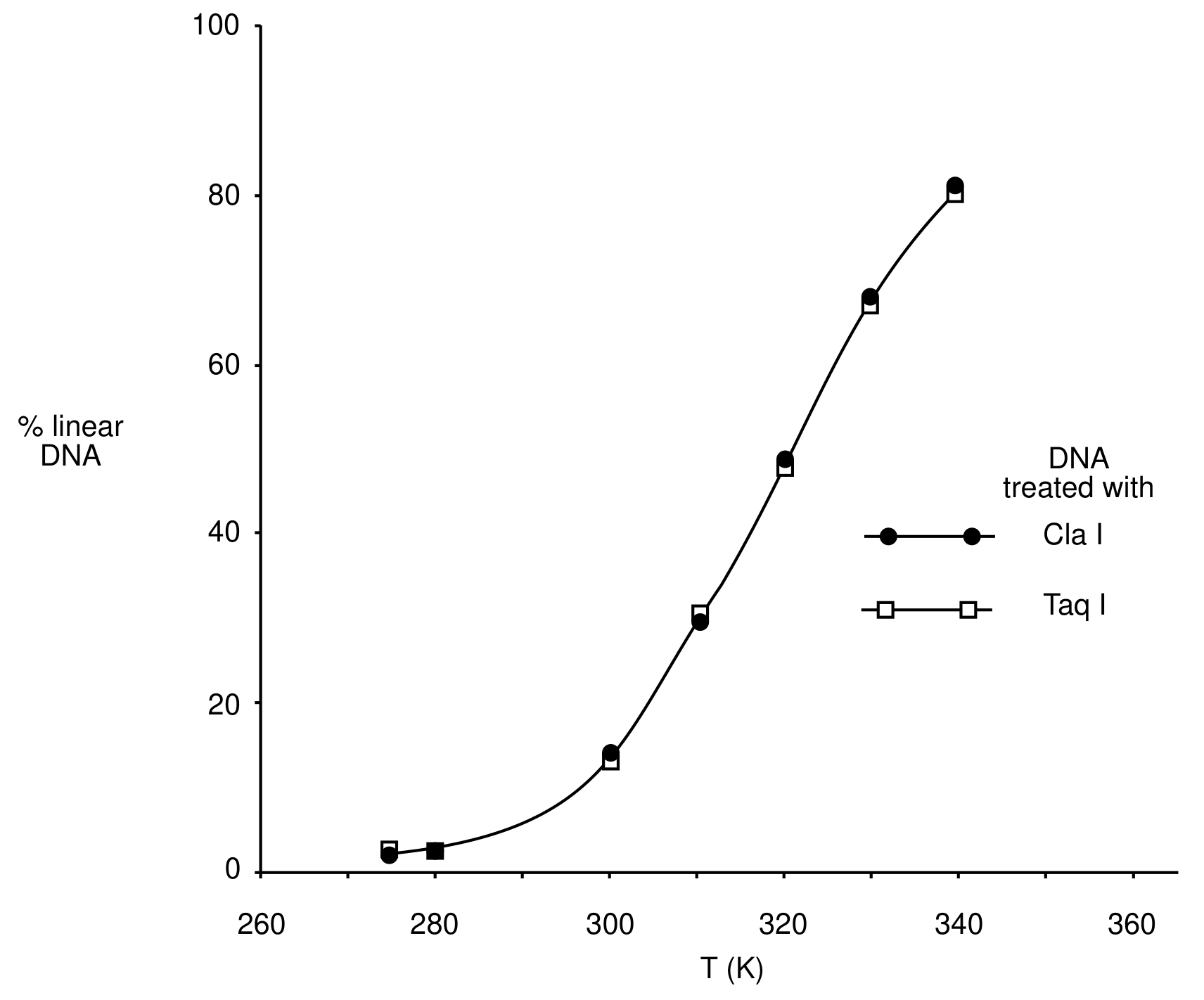
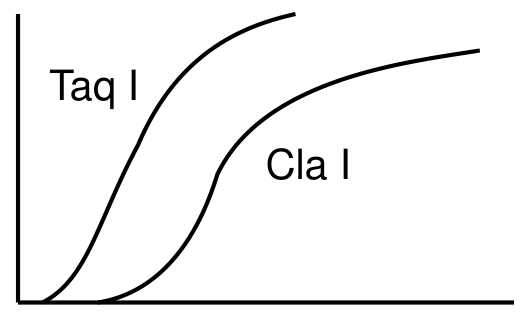
In the figure on the next page the percentage of linear DNA molecules is given as a function of temperature, as measured in a solution of 0.15 M NaCl buffered with citrate at pH = 6.5.
f) Is the reaction as written endothermic or exothermic? Explain why.
This particular phage also has only one cleavage site for the endonuclease Taq I. The figure also shows the percentage of linear DNA versus temperature after cleavage by Taq I. As is evident, one obtains the same curve as after cleavage with Cla I.
g) Show, considering the information above, which of the two base sequences of the answer to d) is the correct one.
h) Copy the figure completely and show how the curve for Taq I would have been if the recognition pattern had been the other possibility of d).
A large DNA molecule is cut into fragments with the aid of Cla I. One fragment is isolated and purified. This fragment is then mixed one to one with phage DNA which was also cleaved with Cla I. So-called recombinant molecules can be formed through the reaction: .
i) Would the of this reaction be positive, negative, or about zero?
k) Which combination of temperature, DNA concentration, and ionic strength (high or low in each case) will give the maximum percentage of recombinant molecules?
These recombinant molecules are used in genetic manipulation.
Решение
Solution of problem No. 8:
a)
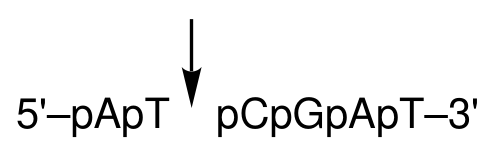
b)
1 in 4096, or about 25 times.
c)
4 bases.
d)
5′–pTpCpGpA–3′ or 5′–pGpApTpC–3′
(one sequence of four bases occurs in 256 times)
e)
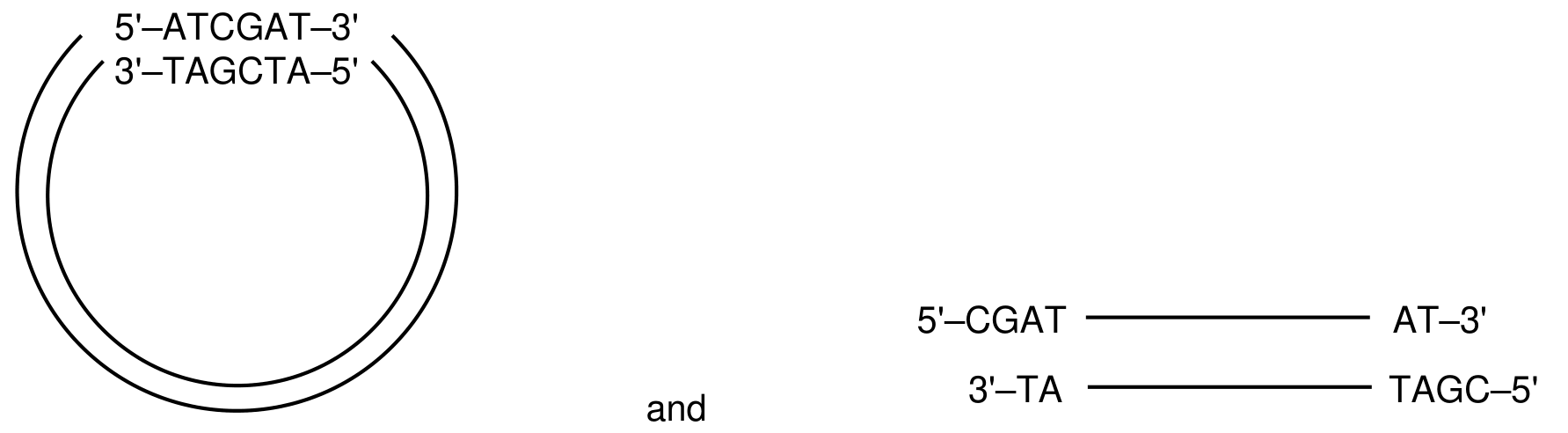
f)
The reaction has a positive , because the hydrogen bonds (between the G and the C bases) in the complementary strands are broken.
g)
The two reactions show the same dependence on temperature. Therefore the of the two reactions is the same. Then the interaction in the overlapping part of the double helix must be identical and therefore we must choose for the first recognition sequence of question d). The cleavage in the two cases occurs as follows:

h)
i)
is negative.
k)
Temperature low, concentration DNA high, ionic strength high.
Оригинал в Архива: best_problems_1980-1990.pdf · решение от архива: best_problems_1980-1990.pdf · допълнителни данни: IChO 21st-40th.pdf