IChO 1990, Подбрани задачи 1980–1990 · семинар Амстердам 1990 — Задача 7. Problem No. 7 — Organic chemistry (stereochemistry)
The best ICHO-tasks of the last years — Amsterdam workshop, October 1990 (selection from 1980–1990)
Внимание: Бележка към темата
This archive copy is the 1990 Amsterdam workshop top-twelve selection, containing eight theoretical tasks and four independent practical experiments from earlier Olympiads. 1990 identifies the workshop, not the year of every selected task. Solutions are attributed to the archive copy; no established official authorship is inferred. Practical1,2 and4 have no supplied keys. Separate report/answer forms referenced by Practical1,2 and3 are absent; Practical4 includes its blank answer sheet. Printed scientific and numerical discrepancies are retained.
Third International Workshop on the Development of the International Chemistry Olympiads (Amsterdam, October 1990)
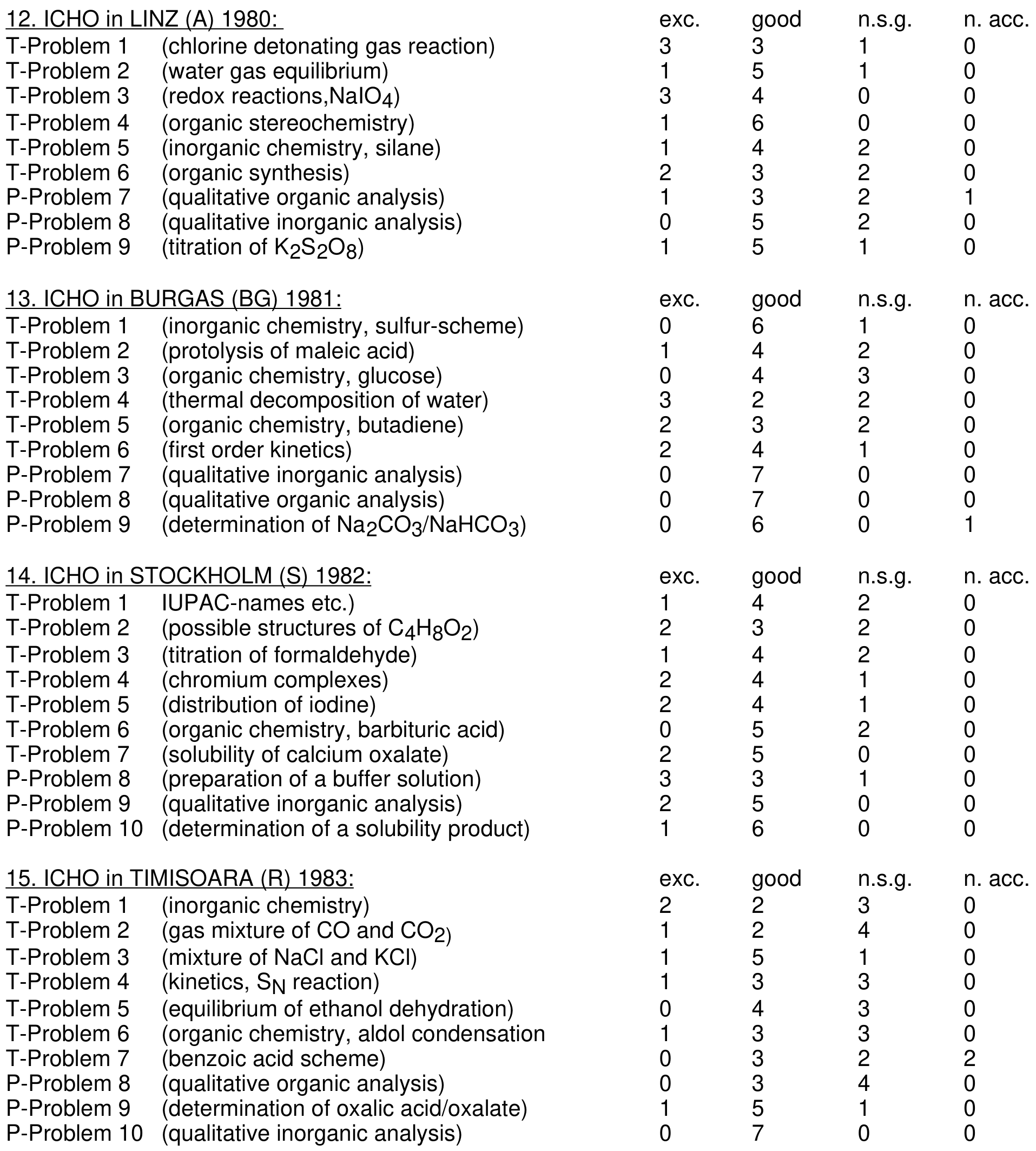
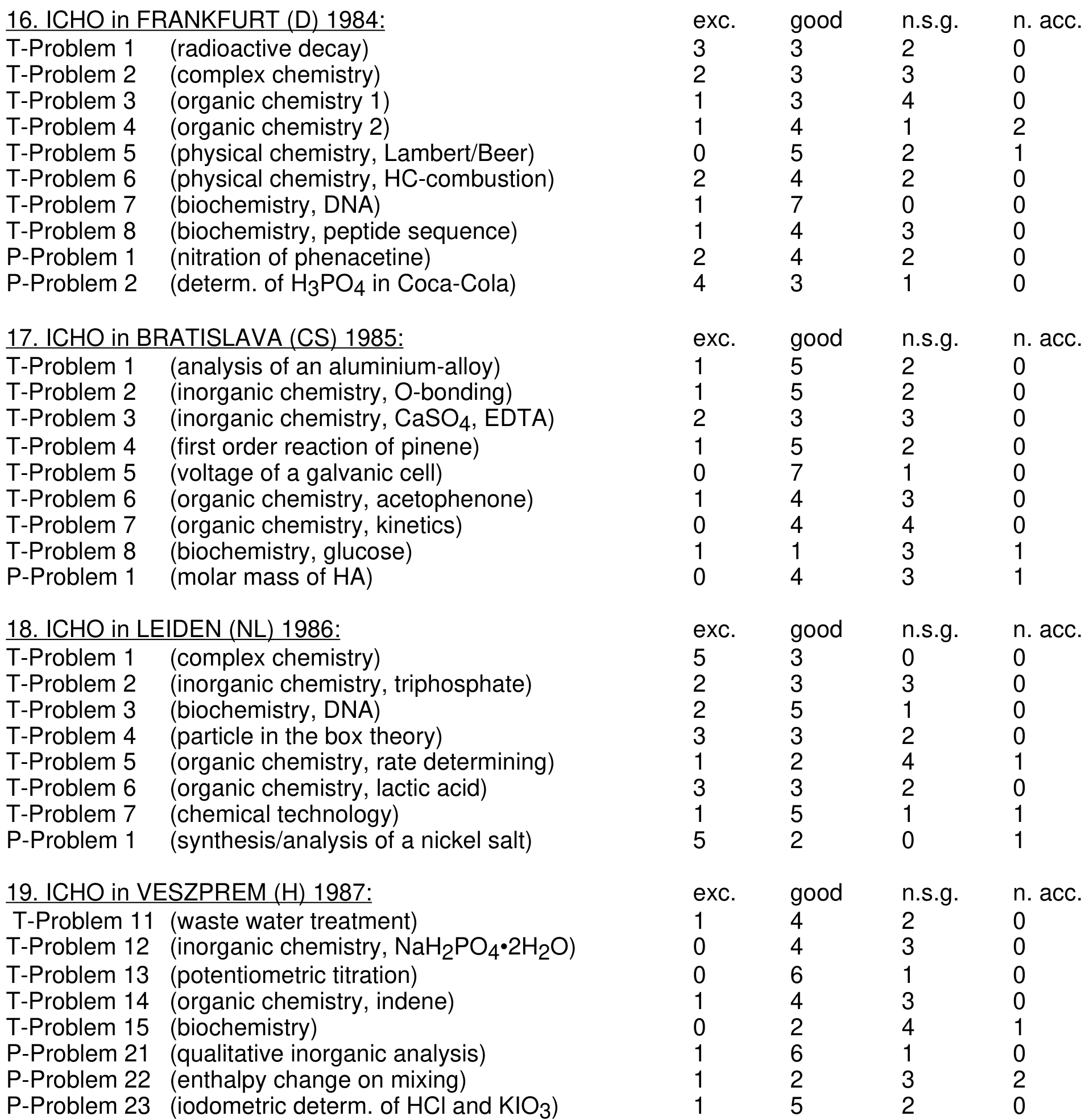
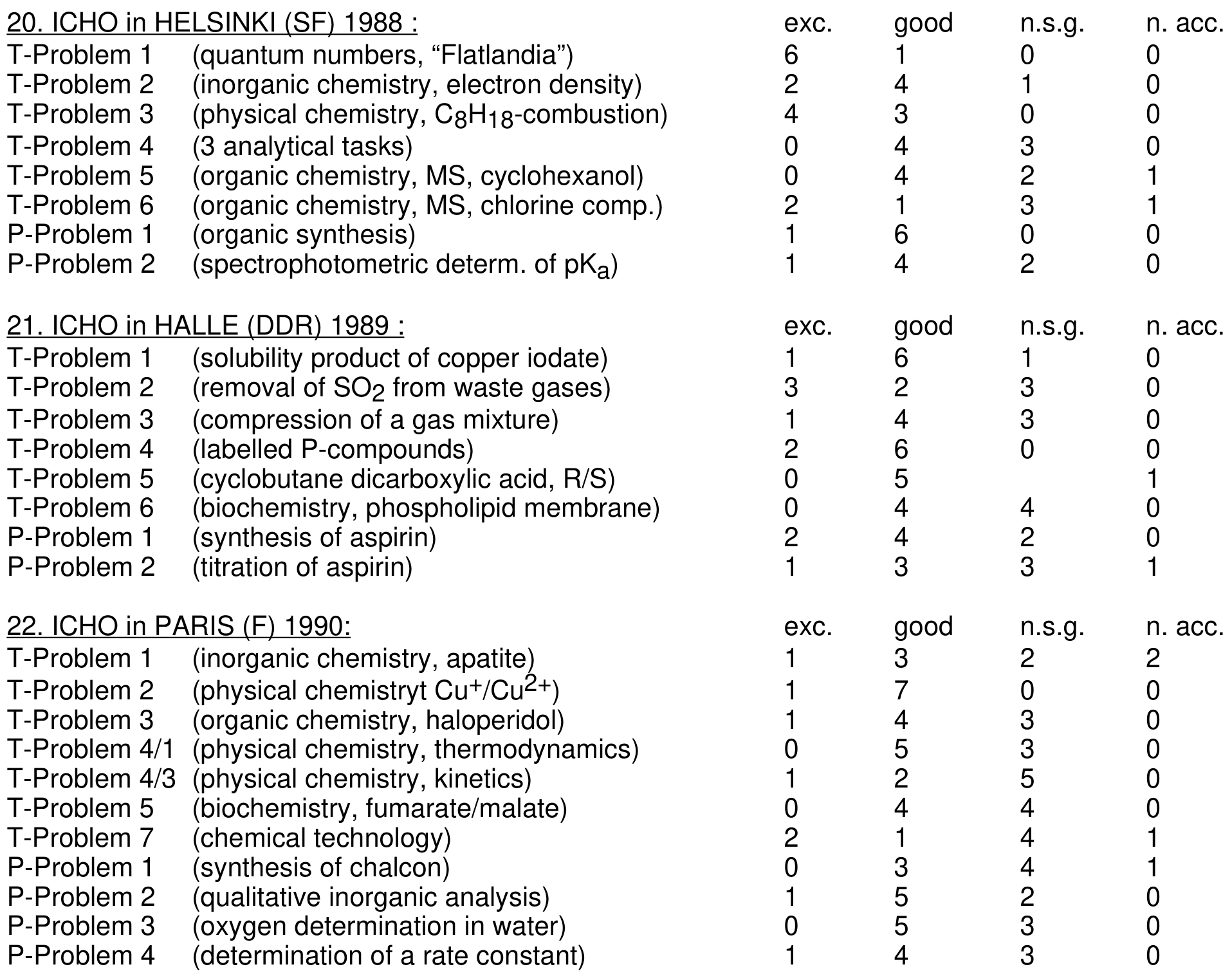
According to the decision of the work shop of Amsterdam the delegation leaders of 8 countries made an attempt to rank the ICHO-tasks of the years 1980 ~ 1990 into the categories excellent / good / not so good / not acceptable The following pages indicate the ”top-twelve”, i.e. is the best tasks of the last years. This collection should be an aid for the ICHO-designers of the next years. Examples for tasks considered as ”not acceptable” are available for the next organisers too.
Original ranking tables (1980–1990)
The workshop’s complete native ranking tables are retained below. Ratings exc., good, n.s.g. and n.acc. are those printed by the source.
Условие
Lactic acid is produced industrially (by CCA-Biochem, the Netherlands) through the bacterial conversion of saccharose. In this process (S)-(+)-2-hydroxypropanoic acid (L-(+)-lactic acid) is formed, which is used in the food sector and also as a starting material for a number of chemical products.
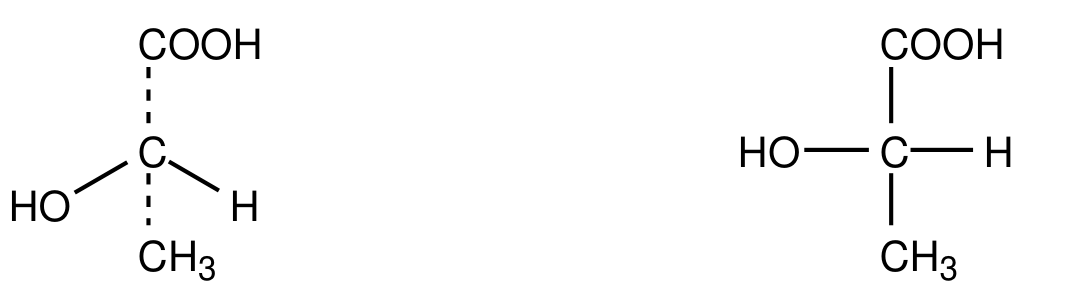
a) Give the spatial formula and the Fischer projection of L-(+)-lactic acid.
A fine-chemical produced from L-(+)-lactic acid is the so-called dilactide, a cyclic ester in which 2 molecules have been esterified with one another. This dilactide is polymerized to a polylactide, which among other things is being used in surgery as a “biodegrading” thread in the suturing of surgical wounds.
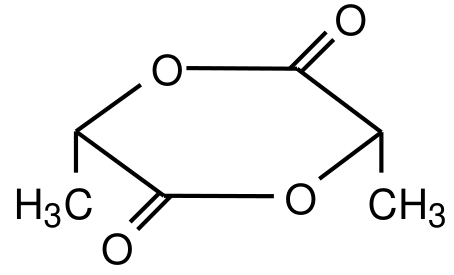
b) Draw the spatial structure of the dilactide prepared from (+)-lactic acid.
c) Sketch the spatial structure of the polylactide discussed above (at least three units). What is its tacticity? (isotactic, syndiotactic, atactic)
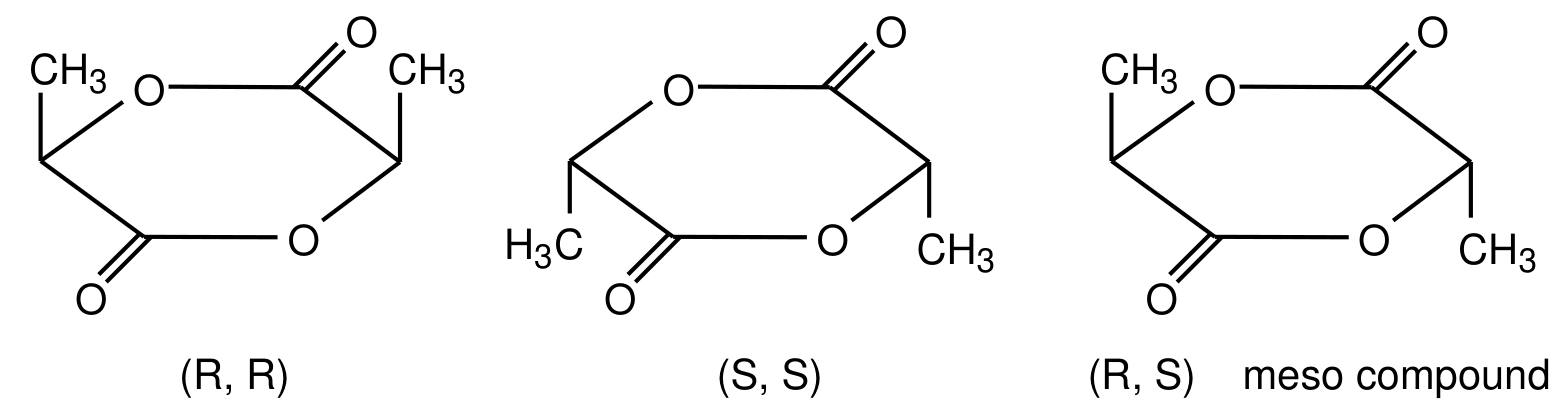
d) Draw the isomeric dilactides, which occur when one starts with racemic lactic acid and show the configuration of the chiral centres.
Note: In the questions b) and d), for convenience the ring may be considered planar.
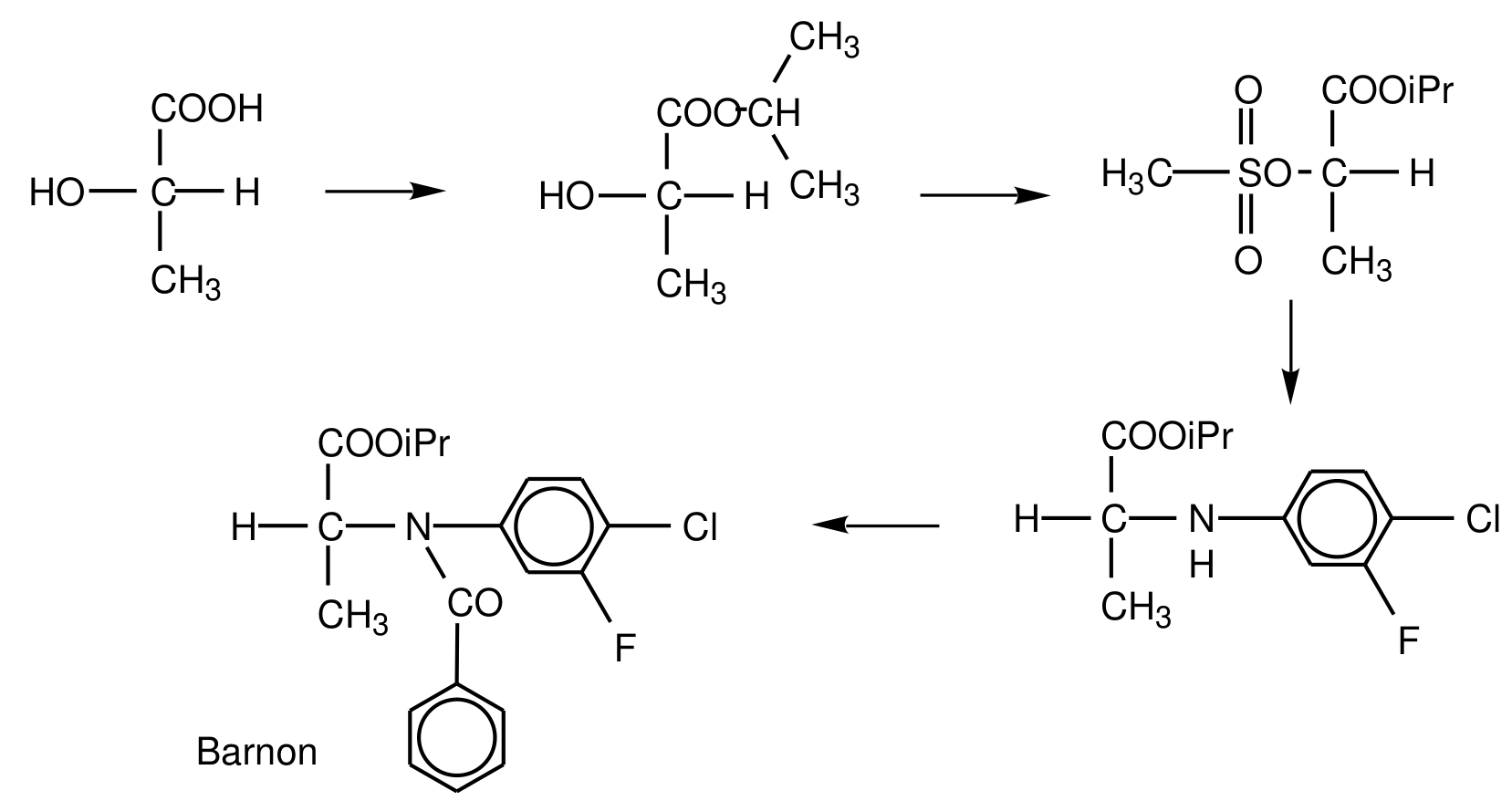
L-(+)-lactic acid is also one of the starting materials for the preparation of the herbicide Barnon (manufactured by Shell Chemicals, used against wild oats). In this case (+)-lactic acid is esterified with 2-propanol and then the hydroxyl group is treated with methanesulfonyl chloride:
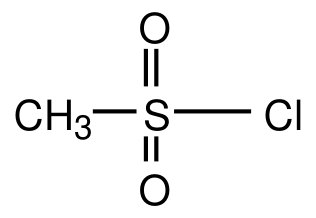
The product obtained is then submitted to a Sₙ2-reaction with 3-fluoro-4-chloroaniline*, in which reaction the methanesulfonate group leaves as . Finally a benzoyl group is introduced with the aid of benzoylchloride.
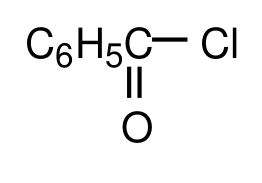
e) Draw the Fischer projection of the various consecutive reaction products.
*3-fluoro-4-chloroaniline is the same as 3-fluoro-4-chloro-phenylamine.
Решение
Solution of problem No. 7:
a)
L-(+)-lactic acid; spatial formula and Fischer projection:
b)
Dilactide of L-(+)-lactic acid, spatial formula:
c)
Polylactide of L-(+)-lactic acid; spatial formula:
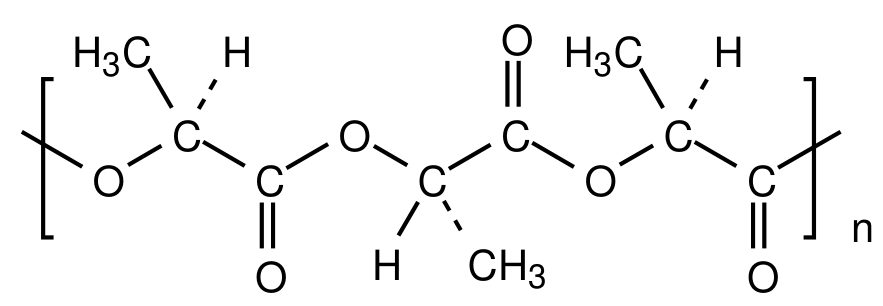
Tacticity: isotactic.
d)
Dilactides of racemic lactic acid; spatial formulae with configurations:
e)
Consecutive products in Fischer projection:
Оригинал в Архива: best_problems_1980-1990.pdf · решение от архива: best_problems_1980-1990.pdf · допълнителни данни: IChO 21st-40th.pdf