IdPhO 2020, Теория — Задача 1A. Part A. Cubic oscillations
Theory — IdPhO 2020 — Q1 — Problem mix (10 points) · 2,5 т.
Условие
Part A. Cubic oscillations (2.5 points)
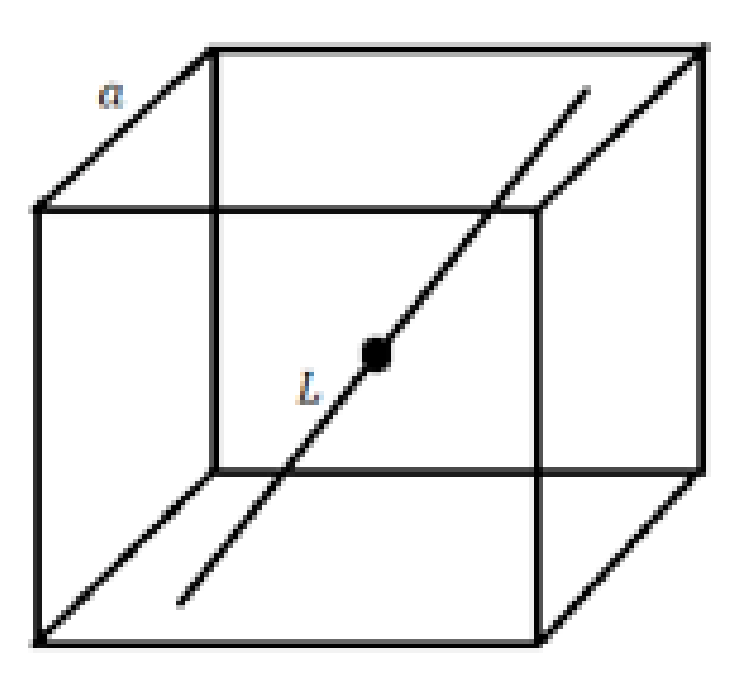
A.1 A narrow straight channel passes through the center of a fixed cube with a side . The cube is uniformly charged, the charge density is . The distance from the cube center to the point of intersection of the channel and a face is . In the channel there is a particle of a mass and a charge . Find the period of small oscillations of the particle near the center. The gravitational interaction of the particle and the cube can be neglected. The cube and the particle are oppositely charged. [2,5 т.]
Отговори
- A.1
Решение
We will use a coordinate system with axes parallel to the cube’s edges, with the origin set at the cube’s center. Assuming the particle is at coordinates , , , we will find the force acting on the particle, by splitting the cube into a rectangular cuboid and three square plates of thickness , and .
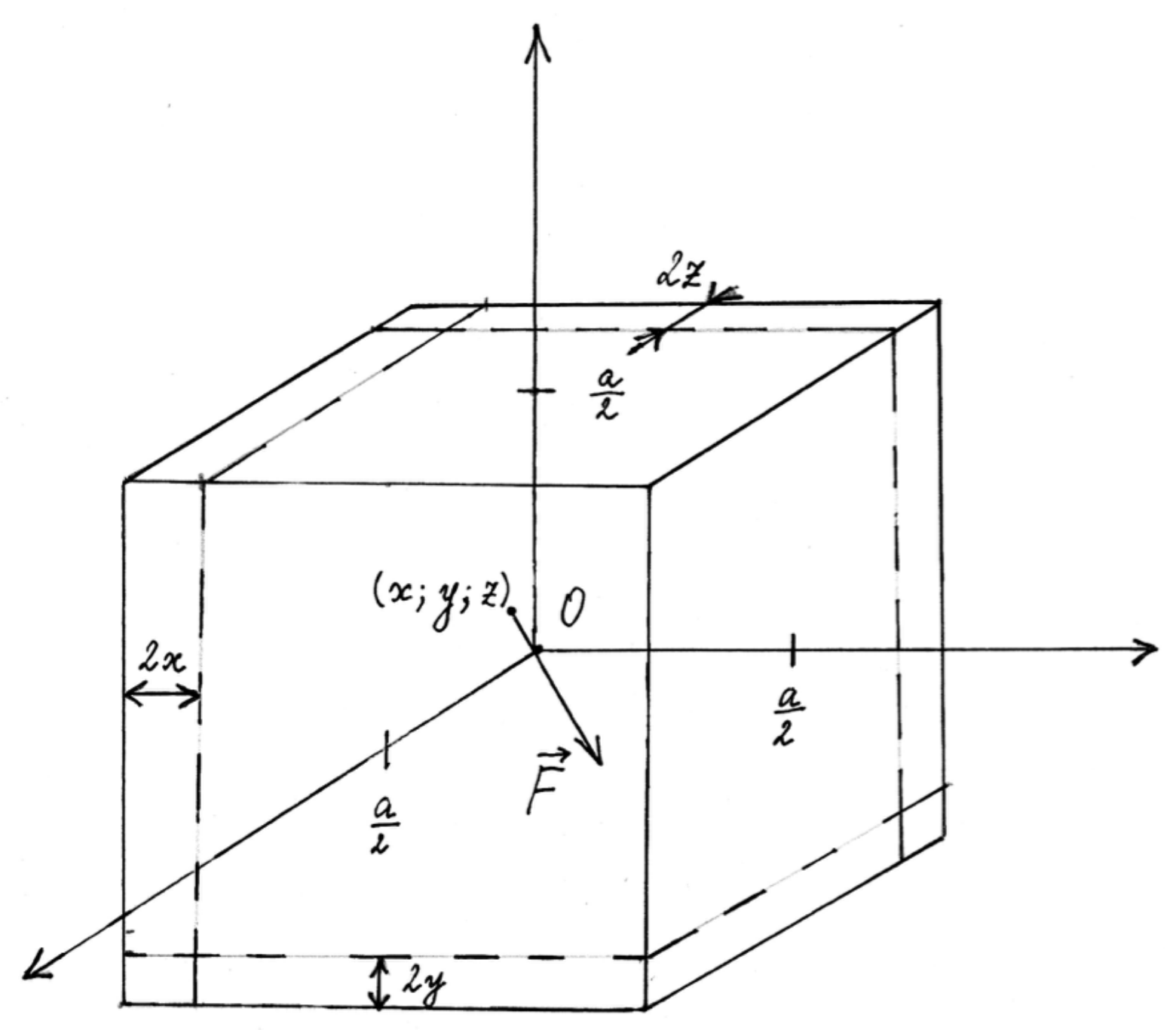
The particle is in the center of the cuboid, so there is no force from the cuboid.
Let us find the force between a particle with a charge and a uniformly charged square plate of small thickness and edge length . The plate’s charge density is , the particle is placed above the center of the plate at distance .
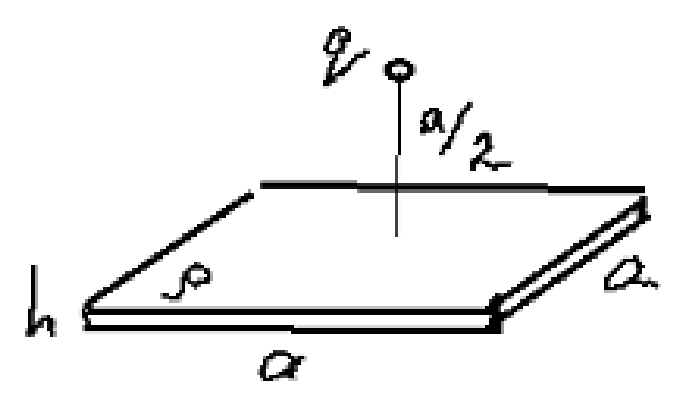
Due to symmetry and Gauss’s law, the flux of the particle’s electric field through the plate is
Hence, the force
where is plate’s surface charge density.
Three square plates act on the particle with forces , , and . Net force , where is the position vector of the particle.
The particle’s equation of motion
is an equation of simple harmonic motion with period
Оригинал в Архива: IPhO_2020_Q1.pdf · официални решения: IPhO_2020_S1.pdf