iGeo 2013, Писмен тест — Задача 11. Section C: Managing Urban Areas — Question 1
10th International Geography Olympiad — Kyoto, Japan — 30 July – 5 August 2013 — Written Response Test — Question and Answer Booklet · 30 юли 2013 г. · 4 т.
Корица
Do NOT open the Booklet before instructed to do so by a supervisor.
Name: … Team: …
Student number: …
Instructions for the Students
- Fill in your name, team and iGeo student number on the front page of this Question and Answer Booklet.
- Fill in your iGeo student number in the boxes on top of the pages in this Booklet.
- This test consists of 6 Sections.
- The maximum total mark is 90. The mark for each question is given at the beginning of the question.
There are a maximum of 15 marks for each Section. - Answer all questions in the spaces provided in this Booklet.
- Check the backs of pages as questions are printed on both sides of a page.
- Give only the required number of answers (reasons, examples, etc.). For instance, if the question asks for 2 reasons and you give more than 2, only the first 2 reasons will be marked.
- You must use the Diercke International Atlas during the test where referred to in the questions and at your convenience.
- The Resource Booklet contains Sources referred to in the questions.
- You may use a calculator during the test.
- Time: 180 minutes for students not educated in English, 150 minutes for students educated in English.
- Students not educated in English are allowed to use bilingual dictionaries during the test.
Good luck!
Instructions for the Markers
- Check if the iGeo Student Numbers are on each sheet before dividing up the paper.
- This test consists of 6 Sections.
- One whole Section per marker and double-checker.
- Check whether the answer continues outside designated area. No credits will be given to answers in the Resource Booklet.
- The maximum total mark is 90. The mark for each question is given at the beginning of the question.
There are a maximum of 15 marks for each Section. - Get the hang of the full range of answers by reading through a few papers with your co-marker before you start your marking.
- These answers are not exhaustive. Credit any relevant answer.
- Mark only the required number of answers (reasons, examples, etc.). For instance, if the question asks for 2 reasons and there is more than 2, only the first 2 reasons will be marked.
- Put your mark next to the question number in the column on the left – it eases the work of the person who has to put the numbers into MS Excel. Total the marks by the title of the Section.
- Usually whole marks with only these exceptions: A1, B1, C3, E6.
- The Moderators (Sue and Anu) will sample the marking of all teams.
Условие
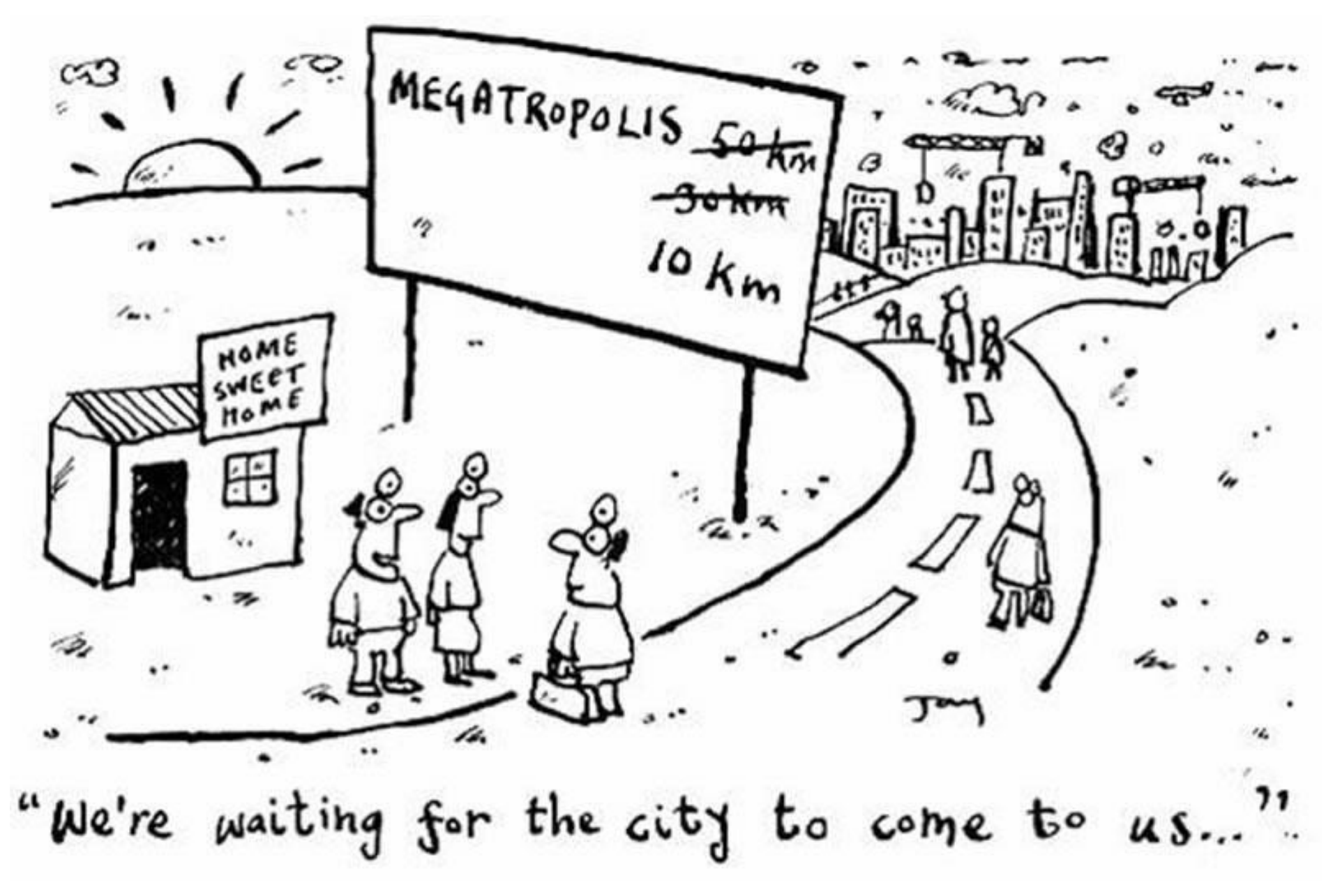
Study the cartoon which makes a comment on the process of urban sprawl.
Explain the causes and the consequences of urban sprawl.
Решение
Answer: 4 marks: maximum of 2 marks if only causes or consequences are addressed.
Causes – centrifugal population movement due to push and pull factors:
- Push: congestion and high land values in the city centre mean that people want to move out.
- Pull: open space, cleaner air, less congestion and cheaper land at the rural-urban fringe or beyond.
- People attracted to the city live in the suburbs rather than the city centre because it is too expensive to live in the centre.
- People who have lived in the centre move to the suburbs for larger accommodation, more open space, greater safety.
Consequences – increased commuting, traffic congestion, pollution and stress if this movement is spontaneous, unplanned and on a large scale.
- Costs of (government-provided) infrastructure (e.g. water, public transport) are greater in the lower-density fringe.
- Isolation, e.g. young mothers moving away from family support structure.
- Changes in fringe land uses if farmers sell land for housing developments through diversification.
Оригинал в Архива: 2013KyotoWRTQuestionAndAnswerBooklet.pdf · официални решения: 2013KyotoWRTMarkingScheme.docx