iGeo 2016, Писмен тест — Задача 5. Section E: Population Trends and Challenges
13th International Geography Olympiad — Beijing, China — 16–22 August 2016 — Written Response Test — Question and Answer Booklet · 16 август 2016 г. · 15 т.
Cover of the Question and Answer Booklet
13th International Geography Olympiad
Beijing, China
16–22 August 2016
Written Response Test
Question and Answer Booklet
Do NOT open the Booklet before instructed to do so by a supervisor.
Name: ........ Team: ........
iGeo student number: ........
Instructions for Students
Fill in your name, team and iGeo student number on the front page of this Question and Answer Booklet.
Fill in your iGeo student number in the boxes on top of the pages in this Booklet.
This test consists of 6 Sections.
The maximum total mark is 90.
The mark for each question is given in the margin at the beginning of the question.
There is a maximum of 15 marks for each Section.
- Answer all questions in the spaces provided in this Booklet in English.
Keep the left margin free for markers.
Please write clearly.
Please use blue (or black) pen, not pencil.
Check the backs of pages as questions are printed on both sides of a page.
There are blank pages which you can use as additional space for your notes.
Please cross through any notes so that we know they are not part of your answers.
If you use these pages for answers, please label them clearly with the Section and question number (e.g. A1).
Where appropriate, please write sentences or phrases not single words.
Give only the required number of answers (reasons, examples, etc.).
For instance, if the question asks for 2 reasons and you give more than 2, only the first 2 reasons will be marked.
The Resource Booklet contains Figures referred to in this Booklet.
You may use a calculator during the test.
Time: 180 minutes for students not educated in English (+10 minutes reading time),
150 minutes for students educated in English (+10 minutes reading time).
- Students not educated in English are allowed to use bilingual dictionaries during the test.
Good luck!
Written Response Test
Contributions from: Belgium, China–Hong Kong, Czech Republic, Indonesia, Poland, Singapore
Committee Convenor: Anu Printsmann (Estonia)
Deputy: Dubravka Spevec (Croatia)
Editors: Jason Flowers (USA), Celestine Hang (Singapore), Alexey Naumov (Russia)
Director of Tests: Susan Lomas (UK)
Booklet layout
Every answer page carries a box „Student number:“ at the top. Pages 5, 6, 9, 16 and 20 end with „This Section continues on the next page.“ Pages 14 and 18 print only:
This page is intentionally blank (you can use it for your notes (please cross them through afterwards) or for answers, which are clearly labelled with the Section and question number).
The booklet ends with „end ■“ on page 21.
Cover of the Marking Scheme
13th International Geography Olympiad
Beijing, China
16–22 August 2016
Written Response Test
Marking Scheme
Instructions for Markers
Check if the iGeo student numbers are on each sheet (on odd pages) before dividing up the Test.
This test consists of 6 Sections.
The maximum total mark is 90.
The mark for each question is given in the margin at the beginning of the question.
There is a maximum of 15 marks for each Section.
- One whole Section per marker and double-checker.
Some lengthy (more than 2 pages) Sections may be divided for two marker-pairs.
- Get the hang of the full range of answers by reading through a few papers with your co-marker before you start your marking.
You can mark together, or after establishing a consensus on how to mark for thoroughness and consistency, act as each other’s double-checkers by marking half of the test and then swapping the pile.
We strongly recommend whenever in doubt, consult your marking partner and, if appropriate, one of the designated Moderators – Anu or Dubravka.
Please develop your own marking/correcting notation system (using +/-, x/0, √ marks), underlining, comments etc. to ease double-checking and sample marking.
These answers are not exhaustive. Credit any relevant answer.
Check whether the answer continues outside the designated area, in the margins or as clearly marked on blank pages.
No credits will be given to answers in the Resource Booklet.
The Test uses two marking systems: point and level marking.
Half marks can only be given where indicated as the total of 90 marks will yield only 40% of the total olympiad result.
Mark only the required number of answers (reasons, examples etc.).
For instance, if the question asks for 2 reasons and there is more than 2, only the first 2 reasons should be marked.
- Put your final mark next to the question number in the column on the left – it eases the work of the person who has to put the numbers into MS Excel.
Please write your numbers clearly.
Please write down any inconsistencies of the Marking Scheme and additional answers or answers not accepted and hand them in after marking to improve the final Marking Scheme.
The Moderators (Anu and Dubravka) will sample the marking of all teams.
Written Response Test
Contributions from: Belgium, China–Hong Kong, Czech Republic, Indonesia, Poland, Singapore
Committee Convenor: Anu Printsmann (Estonia)
Deputy: Dubravka Spevec (Croatia)
Editors: Jason Flowers (USA), Celestine Hang (Singapore), Alexey Naumov (Russia)
Director of Tests: Susan Lomas (UK)
Условие
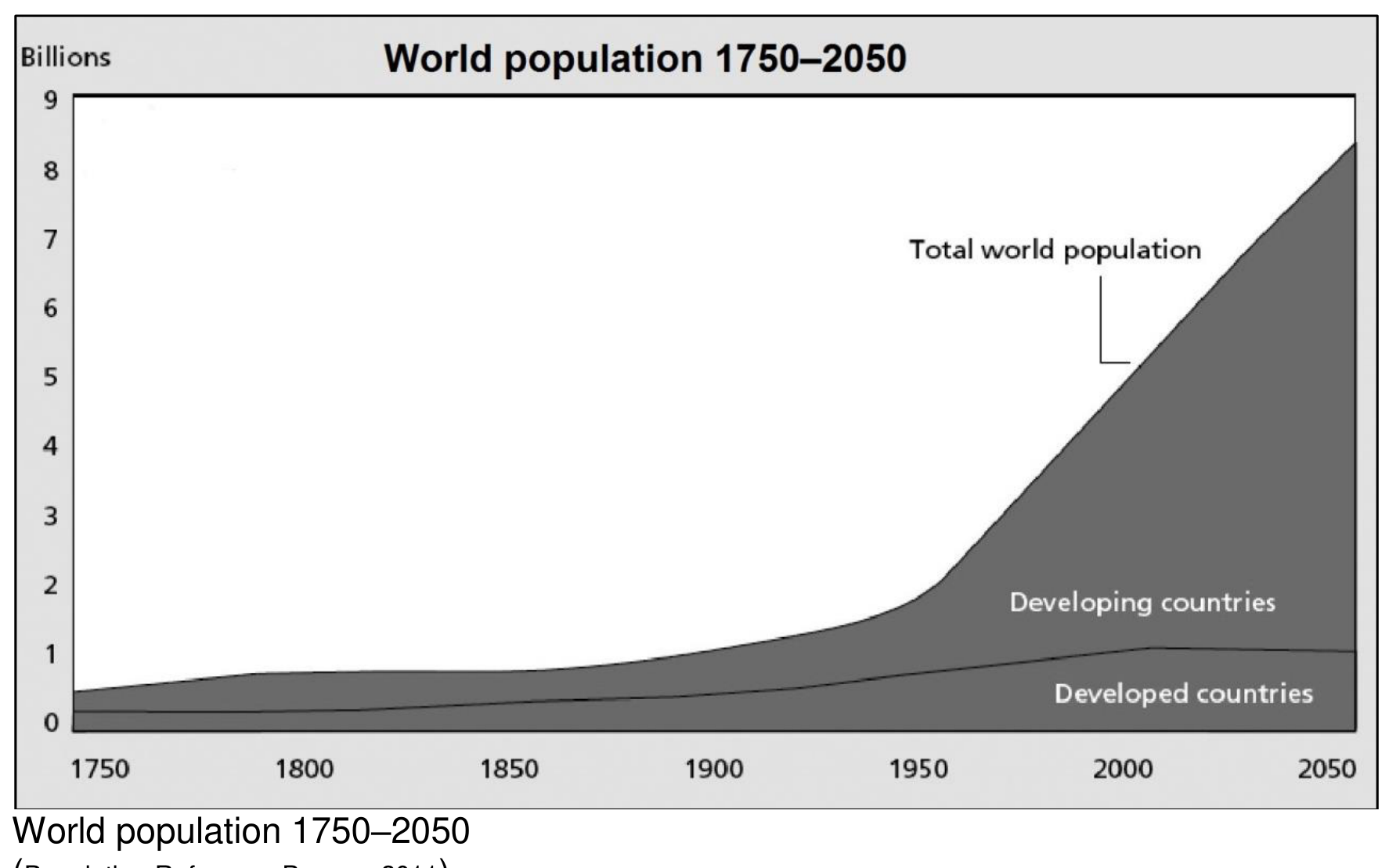
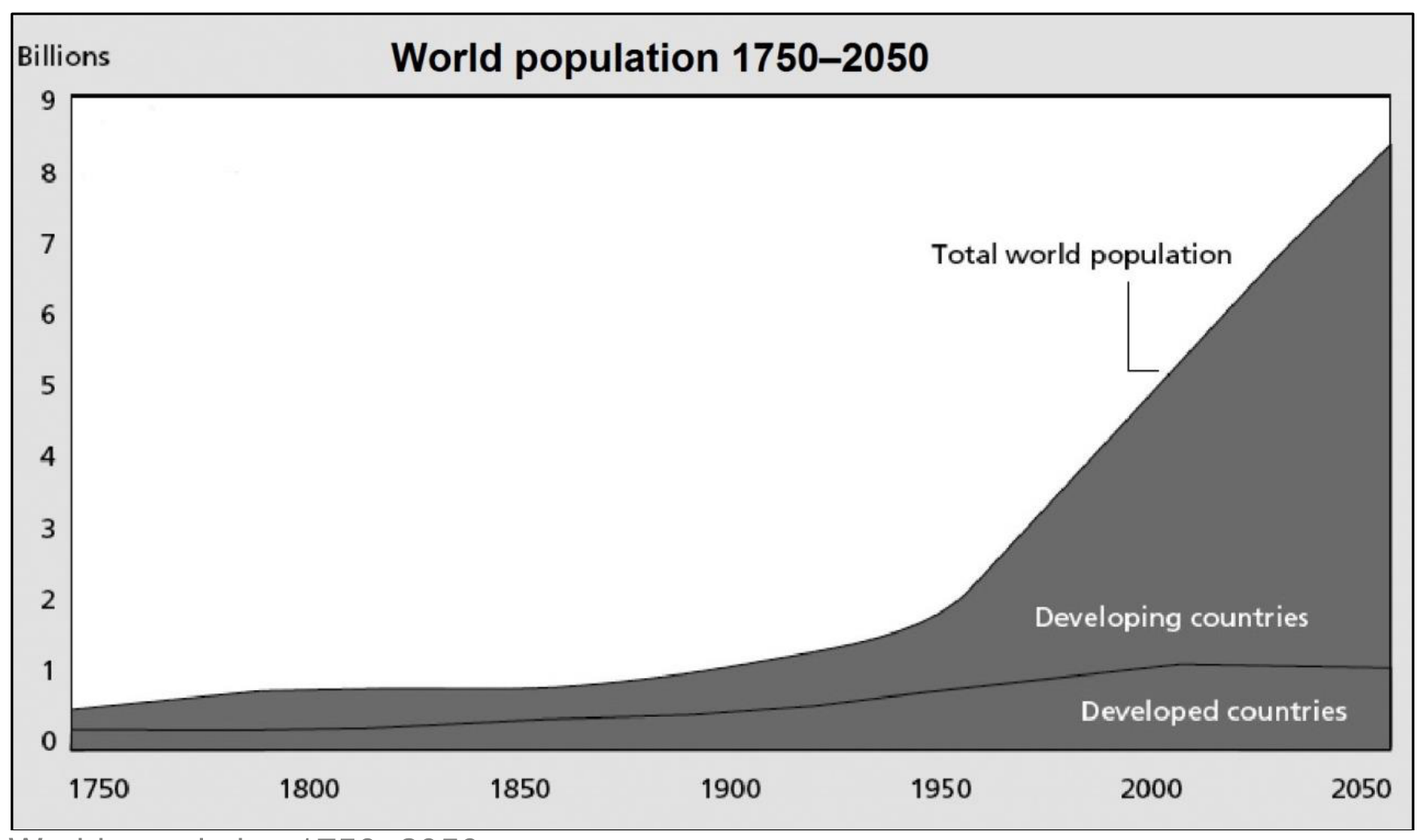
1. Study the figure below: World population 1750–2050.
Give 2 reasons why total world population growth accelerated significantly after 1950. [2 т.]
2. Suggest 4 measures which a fast growing population / country should include in its Family Planning Policy in order to control its population growth in the future. [4 т.]
3. One of the most dominant contemporary demographic processes in developed countries is that of an ageing population.
Outline 2 positive implications of this process. [2 т.]
4. Study Resource Booklet Table E1: Age and sex structure in United Arab Emirates (UAE) (2014).
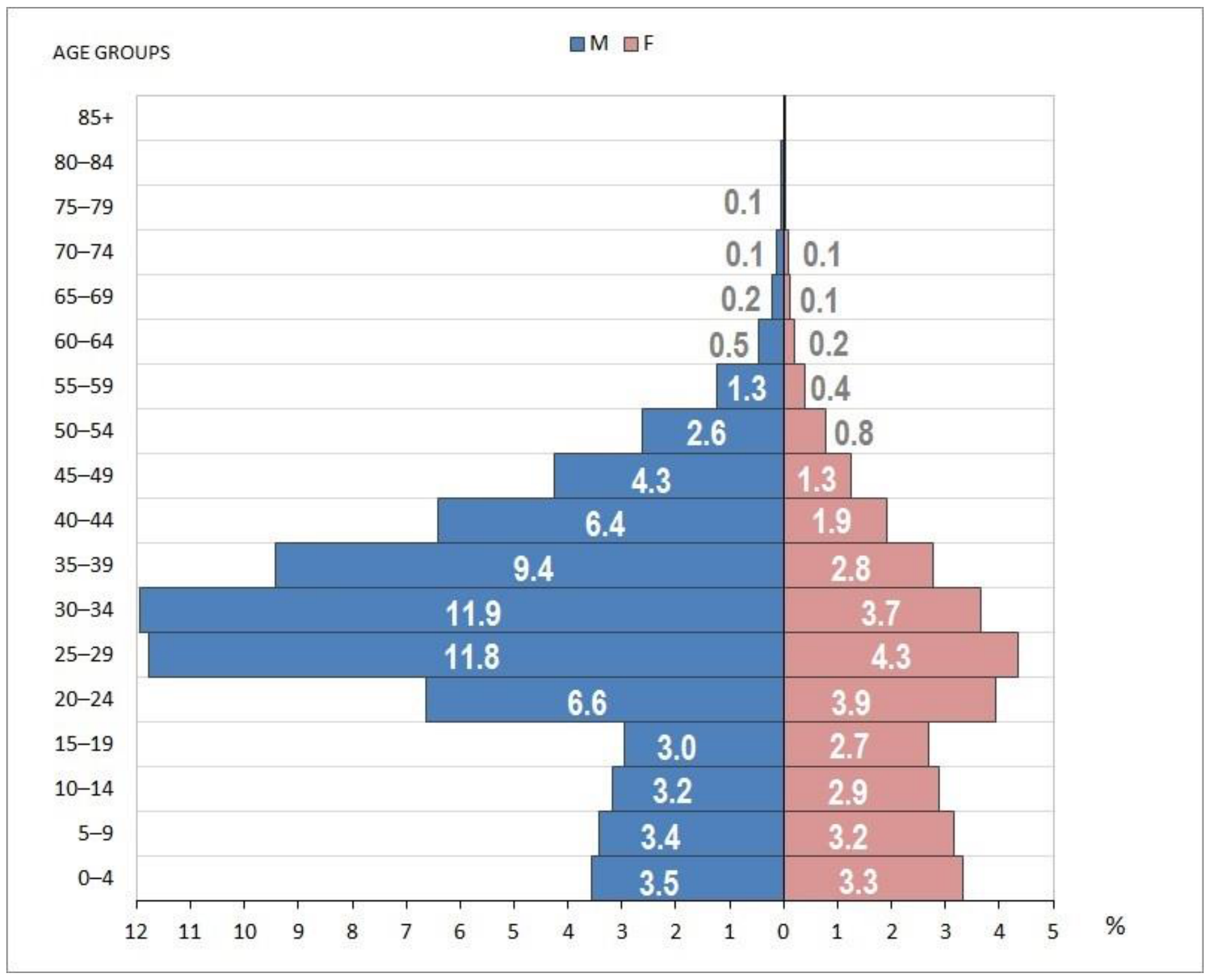
Draw United Arab Emirates’ (UAE) population pyramid showing the share (%) of the population. [5 т.]
5. Study Resource Booklet Tables E1: Age and sex structure in United Arab Emirates (UAE) (2014),
E2: United Arab Emirates (UAE) selected demographic data (2000–2014) and
your population pyramid.
Suggest a reason for the unbalanced age and sex structure of the United Arab Emirates (UAE) population, and explain the underlying cause(s) behind that. [2 т.]
Решение
1. Answer: point marking
- Development of new medical insights / improved public health care influenced on mortality decline.
- Improved living conditions / standard (understanding of the importance of hygiene…).
- Increased food production in developed countries enabled more effective help to developing countries.
2. Answer: point marking
- Encourage more education and awareness about birth control especially in rural areas.
- Award scholarships for education, especially of girls.
- Improve economic and health / medical conditions and raise the standard of living.
- Raise the marriageable age for men and women.
- Suggest 1-child or 2-child family policy.
- Creating more public (door-to-door) campaigns to widespread awareness of family planning (through TV, radio, newspapers etc.).
3. Answer: point marking
- Old retired person can do part-time work (they often have greater skills and experience than younger workers).
- Old retired persons can contribute to their community through voluntary work (services).
- Grandparents often provide free (unpaid) childcare.
4. See next page.
5. Answer: level marking
Unbalanced age and sex ratio in UAE occurred due to international migration (very high net immigration) – many younger economically active foreigners came to work here in the oil fields and on construction sites. The majority of them were men and they mostly arrived unaccompanied by their families.
4. Answer: point marking
- Labelling Y-axis (“Age group(s)”) or writing it in between the male and female columns (0.5m)
- Labelling X-axis (“% of population” or “%”) (0.5m).
- Inserting a legend or writing “M(ale)” and “F(emale)” within a graph (0.5m).
- Correct positioning of male (left) and female (right) (0.5m).
- Correctly locating the “0 – zero” point in the X-axis (1m).
- Correctly drawing male (1m) and
- female (1m) columns.
Notes:
- The pyramid should be adopted to the given box, i.e. not too large or small.
- The share (%) of respective age-sex group is only for informative reasons for markers.
Оригинал в Архива: WRITTEN RESPONSE TEST QUESTION AND ANSWER BOOK _2016iGeo.pdf · официални решения: WRITTEN RESPONSE TEST MARKING SCHEME_2016iGeo.pdf