INPhO 2020, Теория — Задача 5. Bullet, rod and string
Indian National Physics Olympiad – 2020 · 2 февруари 2020 г. · 20 т.
Внимание: Бележка към темата
The complete retained question booklet includes the summary answer boxes, sixteen blank detailed-answer pages and two blank graph sheets. All matching archived HBCSE key content is retained, including its handwritten graph and comment not for grading purposes. Printed sign/symbol discrepancies and the key cover page-count mismatch remain literal with labelled source notes.
Native cover and instructions
Indian National Physics Olympiad – 2020
Date: 02 February 2020. Time: 09:00–12:00 (3 hours). Maximum Marks: 80.
Roll Number: . Extra sheets attached: [blank box]. INO Centre (e.g. Ranchi): [blank line].
(Do not write below this line)
- This booklet consists of 23 pages (excluding this page) and total of 5 questions.
- This booklet is divided in two parts: Questions with Summary Answer Sheet and Detailed Answer Sheet. Write roll number at the top wherever asked.
- The final answer to each sub-question should be neatly written in the box provided below each sub-question in the Questions & Summary Answer Sheet.
- You are also required to show your detailed work for each question in a reasonably neat and coherent way in the Detailed Answer Sheet. You must write the relevant Question Number(s) on each of these pages.
- Marks will be awarded on the basis of what you write on both the Summary Answer Sheet and the Detailed Answer Sheet. Simple short answers and plots may be directly entered in the Summary Answer Sheet. Marks may be deducted for absence of detailed work in questions involving longer calculations. Strike out any rough work that you do not want to be considered for evaluation.
- Adequate space has been provided in the answersheet for you to write/calculate your answers. In case you need extra space to write, you may request additional blank sheets (maximum two) from the invigilator. Write your roll number on the extra sheets and get them attached to your answersheet and indicate number of extra sheets attached at the top of this page.
- Non-programmable scientific calculators are allowed. Mobile phones cannot be used as calculators.
- Use blue or black pen to write answers. Pencil may be used for diagrams/graphs/sketches.
- This entire booklet must be returned at the end of the examination.
Table of Constants
| Constant | Symbol | Value |
|---|---|---|
| Speed of light in vacuum | ||
| Planck’s constant | ||
| Universal constant of Gravitation | ||
| Magnitude of electron charge | ||
| Rest mass of electron | ||
| Value of | ||
| Avogadro’s number | ||
| Acceleration due to gravity | ||
| Universal Gas Constant | ||
| Permeability constant |
| Question | Marks | Score |
|---|---|---|
| 1 | 13 | |
| 2 | 12 | |
| 3 | 15 | |
| 4 | 20 | |
| 5 | 20 | |
| Total | 80 |
HOMI BHABHA CENTRE FOR SCIENCE EDUCATION
Tata Institute of Fundamental Research
V. N. Purav Marg, Mankhurd, Mumbai, 400 088
Native key notice
Please note that alternate/equivalent methods and different way of expressing final solutions may exist.
Source note: The retained key cover says “16 pages (excluding this page)”; the native PDF contains eighteen pages, including its appended handwritten graph. Its cover otherwise repeats the question cover instructions and constants.
Условие
The following is the top view of an assembly kept on a smooth horizontal table.
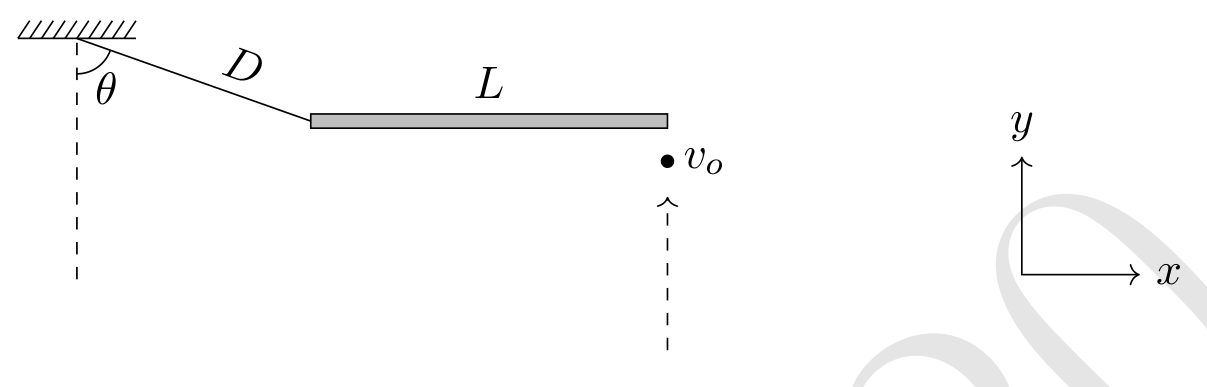
A massless inextensible string of length lies with one end fixed, while the other is attached to one end of a uniform rod of length . The system is initially at rest with the rod aligned along the -axis and the string stretched to its natural length at an angle with the negative -axis (). At a certain instant, a bullet of the same mass as the rod and negligible dimensions is fired horizontally along the positive -direction. The bullet hits the rod at its right end with velocity and gets lodged in it, the impact being nearly instantaneous. What is the tension () in the string immediately after the impact? Assume the string doesn’t break.
Summary answer box: [blank].
Detailed answers can be found on page numbers: [blank].
END OF THE QUESTION PAPER
Решение
Geometry of the problem dictates that the string becomes taut during the impact and hence exerts an impulse. We conclude:
- Angular momentum is conserved only about .
- The velocity of is perpendicular to the string right after the impact (refer to the figure).
We have two unknowns – and .
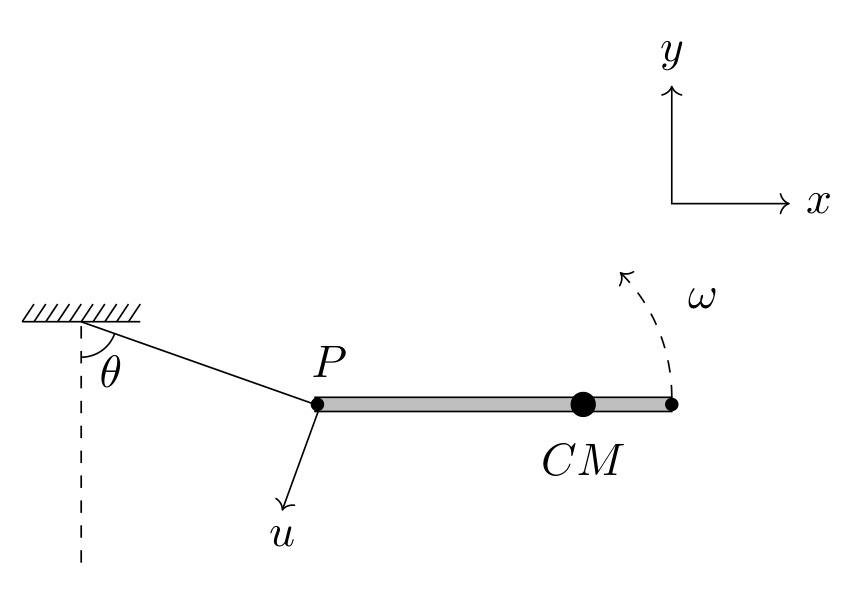
We first note that the momentum of CM is preserved perpendicular to the string since the string applies force only along its length.
where is the velocity of the CM perpendicular to the string. CM is located at a distance from . So,
Applying conservation of angular momentum about ,
Solving equations 5.1 and 5.2, we get
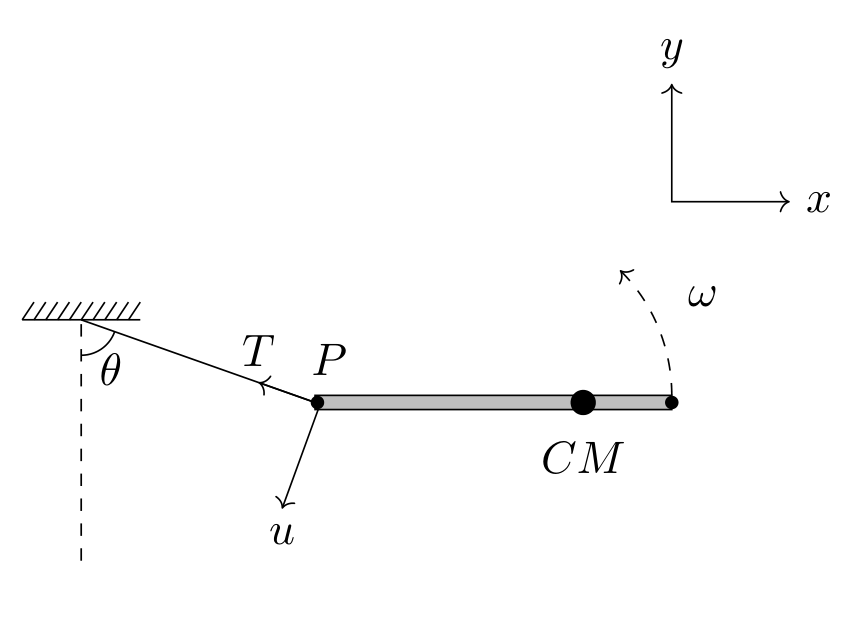
Designate the tension in the string immediately after the impact as . This gives a clockwise angular acceleration of the rod equal to
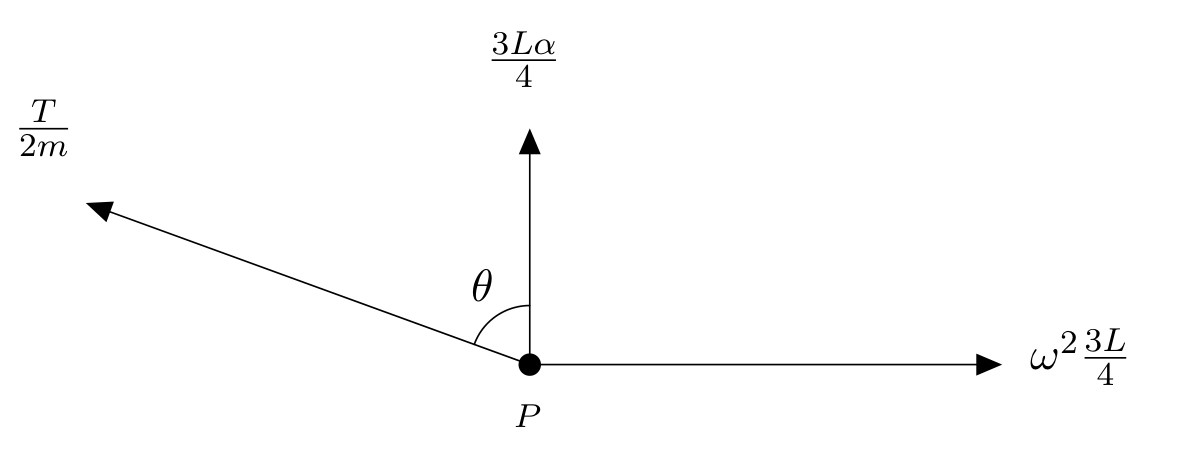
We now calculate the acceleration of on the rod in the direction of the string, (in the ground frame) and set it equal to .
To this end, note that the acceleration of the CM in the direction of the string is equal to . Also, point is instantaneously rotating about the CM with angular velocity in a circle of radius – this gives a centripetal acceleration of directed towards the CM. Furthermore, the tangential acceleration of along its trajectory is given by . Accounting for all these contributions and taking appropriate components, we can write the acceleration of point in the direction of the string as
Now we know
Hence we get
Comment [not for grading purposes]
We assumed above that the string is taut. This is consistent with the solution above, as we found a non-zero answer for the tension. However, if you do not picture that the geometry of the problem requires tension in the string, you can convince yourselves that this is the correct assumption, by assuming that the tension is zero and arriving at a contradiction.
Assume that the string becomes slack. Let the angular velocity of the rod be counter-clockwise, as seen from top, immediately after the impact. Then, noting that velocity of CM remains preserved (because the string is assumed to go slack during the impact) and applying conservation of angular momentum about the point of impact, one gets
where is the moment of inertia of the rod and the bullet system about its center of mass. Now, , thereby yielding
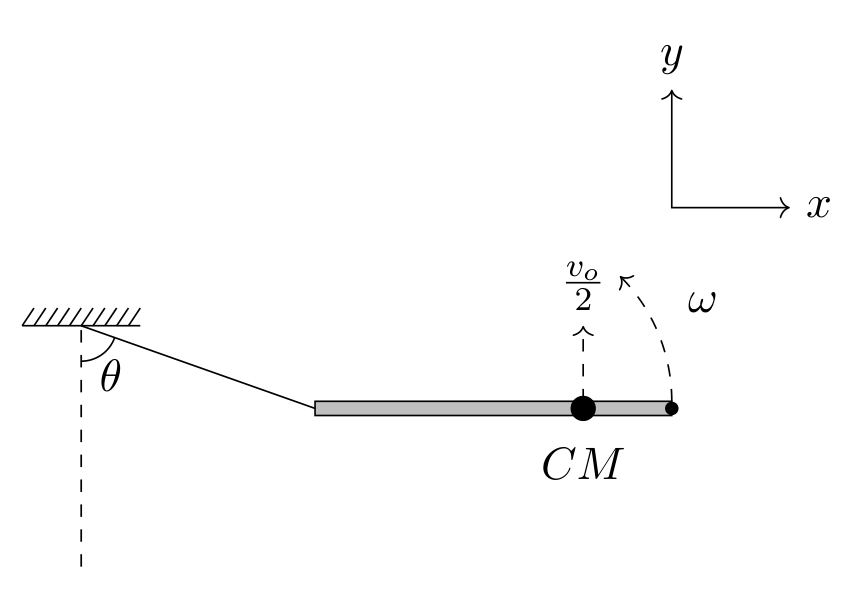
The velocity of the end of the string tied to the rod () immediately after the impact, therefore, would be given by . But this would mean the string would get elongated. Contradiction!
Detailed answers can be found on page numbers: [blank].
END OF THE QUESTION PAPER
Source note: The first momentum equation prints without the subscript used for the bullet speed elsewhere. This native symbol remains literal.
Оригинал в Архива: INPHO2020-Questions-en.pdf · решение от архива: INPHO2020-Solutions-20200220.pdf