INPhO 2021, Теория — Задача 4
Indian Olympiad Qualifier in Physics (IOQP) 2020-2021 — Part II: Indian National Physics Olympiad (INPhO) · 7 февруари 2021 г. · 12 т.
Указания
This booklet consists of 4 pages and total of 5 questions. Write roll number at the top wherever asked.
Booklet to write the answers is provided separately. Instructions to write the answers are on the Answer Booklet.
Marks will be awarded on the basis of what you write on both the Summary Answer Sheet and the Detailed Answer Sheets in the Answer Booklet. Simple short answers and plots may be directly entered in the Summary Answer Sheet. Marks may be deducted for absence of detailed work in questions involving longer calculations.
Strike out any rough work that you do not want to be considered for evaluation. You may also use the space on the Question Paper for rough work – this will NOT be evaluated.
Non-programmable scientific calculators are allowed. Mobile phones cannot be used as calculators.
Last page of the question paper can be used for rough work.
Please submit the Answer Booklet at the end of the examination. You may retain the Question Paper.
Table of Constants
| Quantity | Symbol | Value |
|---|---|---|
| Speed of light in vacuum | ||
| Planck's constant | ||
| Magnitude of electron charge | ||
| Rest mass of electron | ||
| Value of | ||
| Acceleration due to gravity |
Note on solutions
Please note that alternate/equivalent methods and different way of expressing final solutions may exist. A correct method will be suitably awarded.
Условие
Three thin convex lenses , , and with focal lengths , , and , respectively, are arranged in order ( followed by , followed by from left to right) with their principal axes coincident. The distance between and , and the distance between and are such that . If a parallel beam of light incident on at a small angle to the principal axis remains parallel to itself when leaving the system after passing through and , draw the appropriate ray diagram and determine and in terms of , , and .
Отговори
Решение
Solution:
An incoming parallel beam falling on the thin lens will converge to a certain point A on the focal plane of . The point A serves as the point source for whose image is formed on the other side of at a certain point B. The line AB must intersect the principal axis at the pole of . For a parallel beam to emerge from , B must lie in the focal plane of . The necessary ray diagram is drawn below.
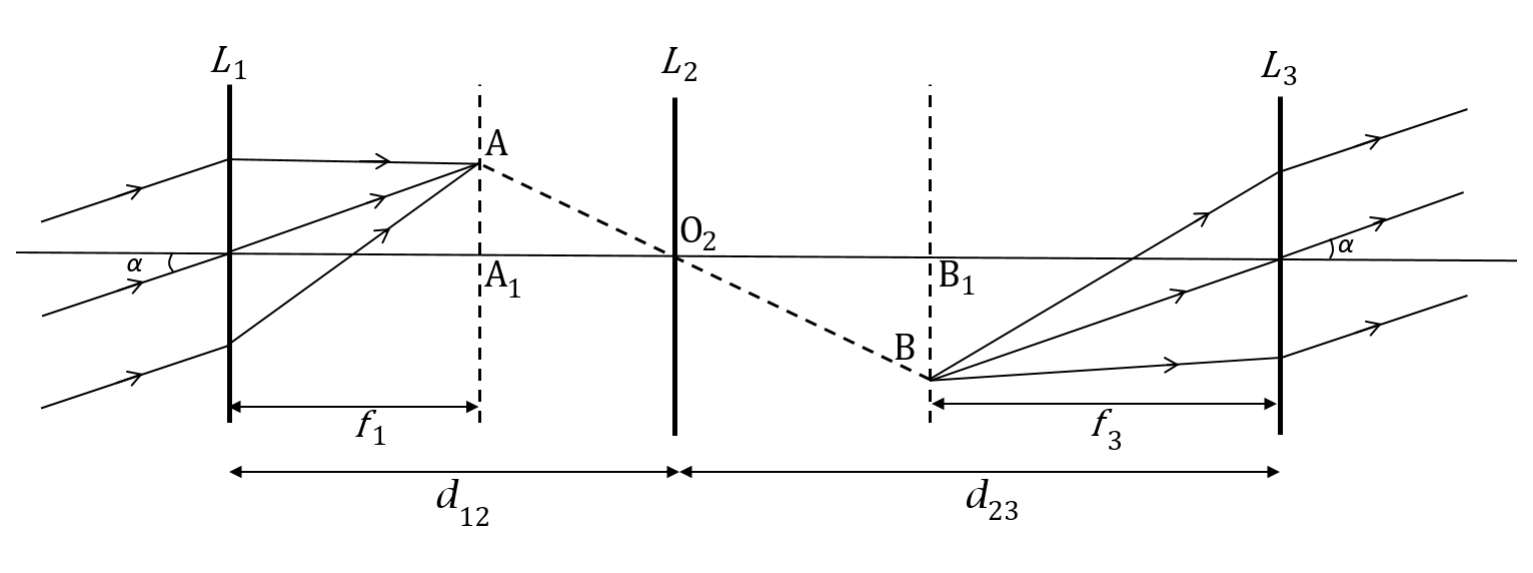
Since , we make the approximations
From magnification formula for lens ,
From the lens equation for lens ,
Then,
Оригинал в Архива: IOQP2021-PartII-Questions-en.pdf · официални решения: IOQP2021-PartII-Solutions-20210217.pdf