INPhO 2021, Теория — Задача 5
Indian Olympiad Qualifier in Physics (IOQP) 2020-2021 — Part II: Indian National Physics Olympiad (INPhO) · 7 февруари 2021 г.
Указания
This booklet consists of 4 pages and total of 5 questions. Write roll number at the top wherever asked.
Booklet to write the answers is provided separately. Instructions to write the answers are on the Answer Booklet.
Marks will be awarded on the basis of what you write on both the Summary Answer Sheet and the Detailed Answer Sheets in the Answer Booklet. Simple short answers and plots may be directly entered in the Summary Answer Sheet. Marks may be deducted for absence of detailed work in questions involving longer calculations.
Strike out any rough work that you do not want to be considered for evaluation. You may also use the space on the Question Paper for rough work – this will NOT be evaluated.
Non-programmable scientific calculators are allowed. Mobile phones cannot be used as calculators.
Last page of the question paper can be used for rough work.
Please submit the Answer Booklet at the end of the examination. You may retain the Question Paper.
Table of Constants
| Quantity | Symbol | Value |
|---|---|---|
| Speed of light in vacuum | ||
| Planck's constant | ||
| Magnitude of electron charge | ||
| Rest mass of electron | ||
| Value of | ||
| Acceleration due to gravity |
Note on solutions
Please note that alternate/equivalent methods and different way of expressing final solutions may exist. A correct method will be suitably awarded.
Условие
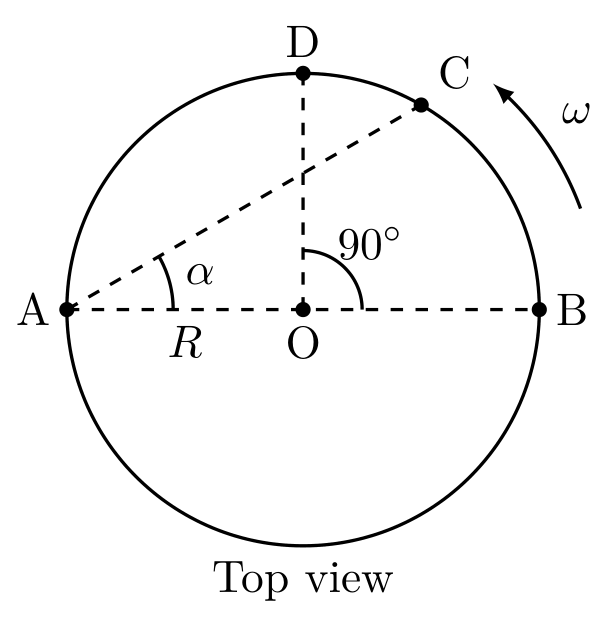
Two friends, Amina (A) and Beena (B), are sitting at diametrically opposite points of a merry-go-round (taken as a circular disk in the horizontal plane) of radius that is rotating at constant angular speed in the anticlockwise direction, when viewed from the top (see figure below).
When Amina is at the position A (as shown in the figure), she throws a ball with velocity (relative to the merry-go-round) in such a manner that Beena catches it when she reaches the position C (). Here makes an angle with respect to the horizontal, and is the angle made by the horizontal projection of with respect to the line AB. Neglect air resistance, friction, and the effect of throwing or catching the ball on the speed of the merry-go-round.
(a) Determine , and , in terms of , , , and other relevant quantities. [6 т.]
(b) If Amina throws the ball with , and appropriate values of and such that Beena can catch it, what is the magnitude of the displacement, , of the ball when it is caught by Beena? For this part only, take , and it is enough to state your answer within a range of . [3 т.]
(c) Determine the speed of throwing if Beena catches the ball at the point D (), instead of C. [0,5 т.]
(d) What should be the angular speed of the merry-go-round for which the speed of throwing will be minimum for Beena to catch the ball at the position D? What is this minimum speed of throwing ? [3 т.]
(e) Consider the case when Amina throws the ball when she is at A, and catches it herself when she reaches the point B (Beena is not involved in this case). Take the angular speed of the merry-go-round to be . Find , and in this case. [2,5 т.]
Отговори
(a)
(b) 2.1 metre < s < 2.6 metre
Any answer that encloses the actual value of 2.4 m and has a range ≤ 0.5 m is acceptable.
(c)
(d)
(e) u = 1.97√(gR), θ = sin⁻¹(0.80) = 52.96°, φ = tan⁻¹(π/2) = 57.52°
Решение
(a) Solution:
Point of throwing: A; Point of catching: C
Position of at instant of projection: B
We take the point A as the origin and the -axis along the diameter AB. The -axis is in the horizontal plane, perpendicular to AB. The -axis is taken along vertical direction.
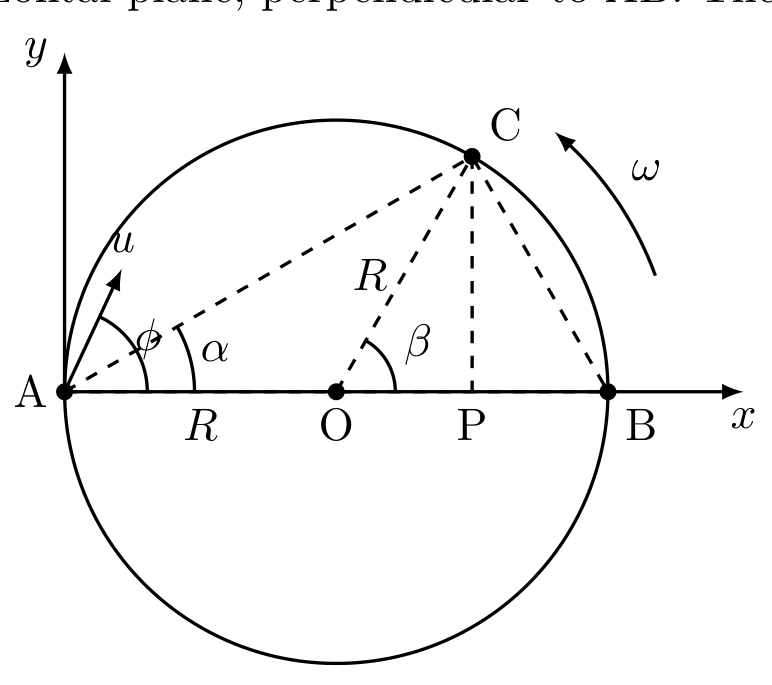
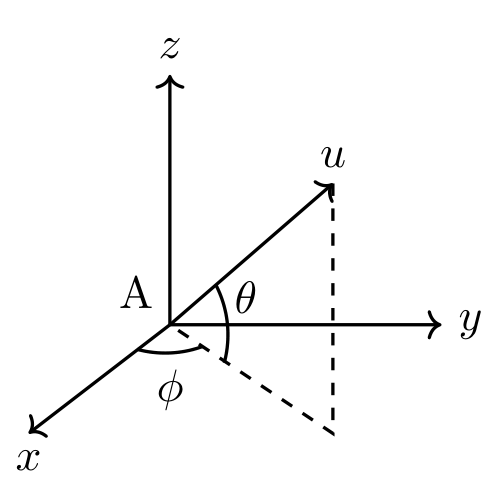
Given, angular speed of rotation; velocity of throwing
Projection angle with respect to horizontal
Projection angle with respect to diameter (-axis)
Time of flight = time taken for to reach
Equations of motion along three directions:
Dividing eq. (5.2) by eq. (5.1),
Squaring eqs. (5.1), (5.2), (5.3) and adding,
From (5.3) and (5.6),
(b) Solution:
The displacement of the ball is the length of AC .
Thus we need to determine when . Equation (5.4) can be used for this. Note that values of and are not needed.
Putting in equation (5.4), we have
This equation cannot be solved analytically. We use trial values of to find the solution by interpolation.
Thus
Putting ,
Any answer that encloses the actual value of and has a range is acceptable.
(c) Solution:
This is a special case of the above, where . Using the above results,
(d) Solution:
This can be determined by finding the minimum of , or equivalently, . From (5.8),
Also,
implying is minimum at .
Alternative solution without calculus
Observe that
where ,
We can write
The first term can be made zero by the choice of
leading to the minimum value of as . Upon substituting the values of and the desired expressions are obtained.
(e) Solution:
This case is NOT a special case of the above.
Now .
Further, .
The equations of motion are:
Dividing eq. (5.10) by eq. (5.9),
Squaring eqs. (5.10) and (5.9), and adding,
Using eqs. (5.11) and (5.12),
Оригинал в Архива: IOQP2021-PartII-Questions-en.pdf · официални решения: IOQP2021-PartII-Solutions-20210217.pdf