INPhO 2022, Теория — Задача 1
Indian Olympiad Qualifier in Physics (IOQP) 2021-2022 — Part II: Indian National Physics Olympiad (INPhO) · 13 март 2022 г. · 12 т.
Указания
This booklet consists of 4 pages and total of 5 questions. Write roll number at the top wherever asked.
Booklet to write the answers is provided separately. Instructions to write the answers are on the Answer Booklet.
Marks will be awarded on the basis of what you write on both the Summary Answer Sheet and the Detailed Answer Sheets in the Answer Booklet. Simple short answers and plots may be directly entered in the Summary Answer Sheet. Marks may be deducted for absence of detailed work in questions involving longer calculations.
Strike out any rough work that you do not want to be considered for evaluation. You may also use the space on the Question Paper for rough work – this will NOT be evaluated.
Non-programmable scientific calculators are allowed. Mobile phones cannot be used as calculators.
Please submit the Answer Booklet at the end of the examination. You may retain the Question Paper.
Условие
A block of mass is attached to a spring (one end fixed to the wall) with spring constant . The block slides on a rough horizontal table along the -axis. Assume that both the coefficients of kinetic () and static friction () are same and constant (). The block is initially displaced to from the unstretched position (normal length of the spring, ) of the spring and released from rest as shown below. Neglect any air resistance. Take the acceleration due to gravity to be .
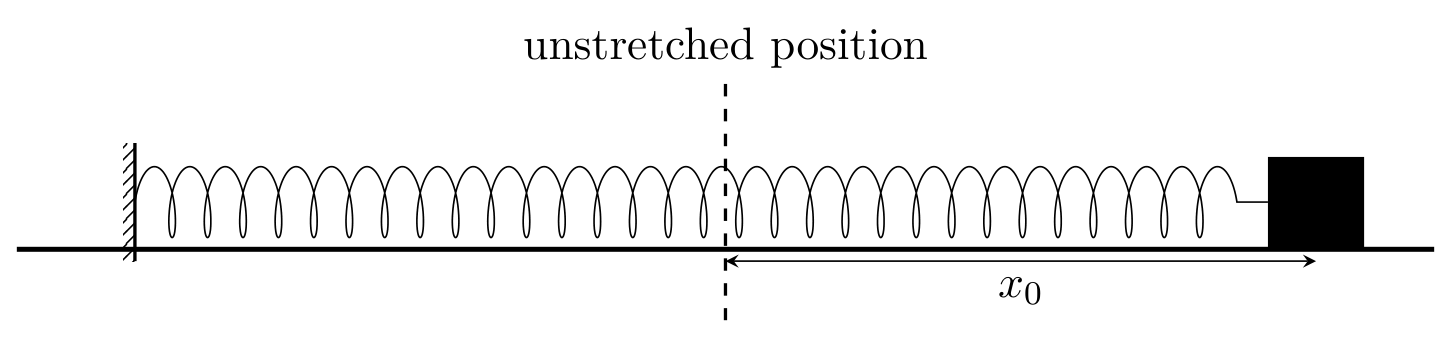
(a) How many times () will the block cross the unstretched position before coming to rest permanently? [3 т.]
(b) Determine the total distance covered by the block before coming to rest. [1 т.]
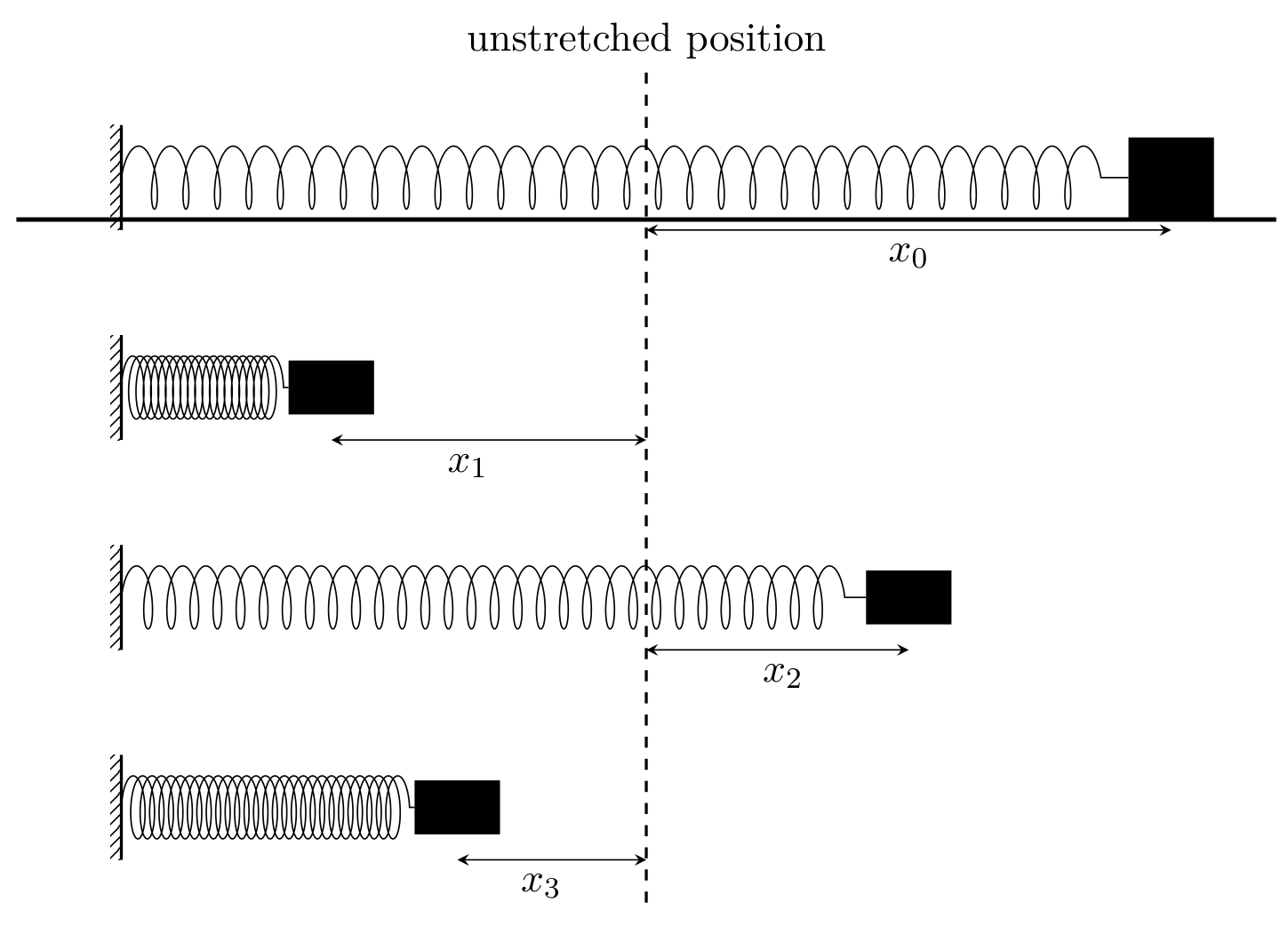
(c) Let us divide one complete oscillation of the block, starting from a fully stretched condition of the spring, into four distinct sections, requiring the following times in order:
(i) : time taken for the block to move from fully stretched to the unstretched position,
(ii) : time taken for the block to move from the unstretched position to fully compressed position,
(iii) : time taken for the block to move from fully compressed to the unstretched position,
(iv) : time taken for the block to move from the unstretched position to fully stretched position.
Let the distance covered during the above intervals be , , , and , respectively.
Also, let and be the time taken to complete the first and the second oscillations, respectively, starting from the initial displacement, .
Compare the above times and distances by inserting an appropriate sign (from among , , or only) between the given quantities in each of the boxes below. Note that you will be penalised for 0.5 marks for giving each incorrect answer in this part. You need not to justify your answer.
[6 т.]
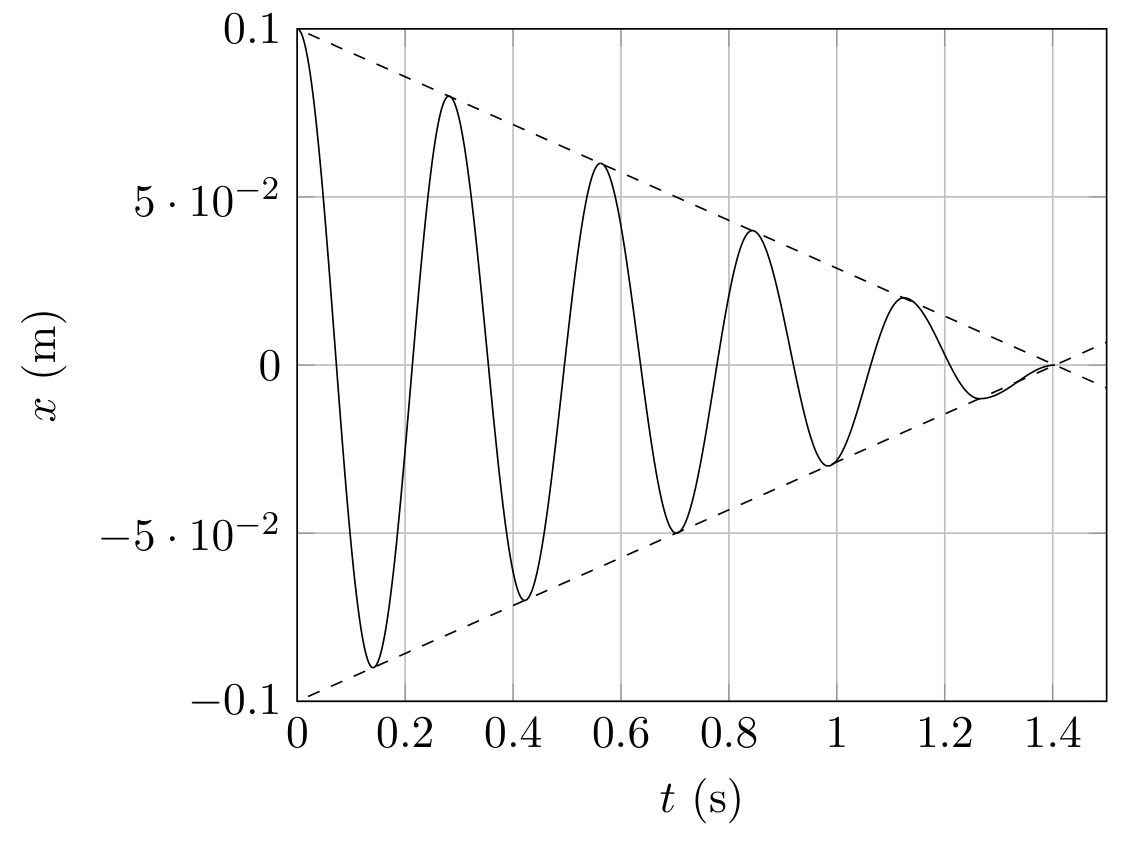
(d) Qualitatively plot the displacement from the unstretched position vs the time . [2 т.]
Отговори
(a) 9
The block crosses the unstretched position 9 times and then comes to rest at the unstretched position.
(b) 1 m
(c) t1 > t2; t2 < t3; t1 < t3; d1 > d2; d2 > d4; T1 = T2
Решение
(a)
where the sign is used so that the friction is opposite to the direction of the velocity of the block. Lets define the ratio of the frictional force to the maximum restoring force to be i.e. . During the first half cycle of the motion, the loss of potential energy is equal to the work done against friction
where is the displacement after one half cycle. This gives
Thus
The block will come to rest permanently at when
For the given values of and , . Thus . The block will cross the unstretched position 9 times and then comes to the rest at the unstretched position.
(b) Total distance
(c)
(d) Equations of motion are
The general solution to the above equation is simply the solution for the SHO and an additive constant.
and velocity and the acceleration are
Using the above equations in Eqs. (1.12) and (1.13)
For the given value of , . Every half swing exhibits simple harmonic motion. Turning points are regularly spaced in time at every intervals. The initial position at each turning point (or the end position of the previous half turn) determines the amplitude and phase for the following half turn. During the time interval between the turning point and
Note, for the compression of the spring, and Comparing Eqs. (1.20) and (1.6)
To summarize the results, the motion of each half swing is essentially the motion of a simple harmonic oscillator centered about either or . At each turning point (), the amplitude of the oscillator decreases by . Before , given by the Eq. (1.8), the mass moves according to
The plot of vs for the given value of is shown below. The displacement lies within a pair of straight lines (shown by the dotted lines) with slopes .
Оригинал в Архива: IOQP2022-PartII-Questions-en.pdf · официални решения: IOQP2022-PartII-Solutions-20220503.pdf