INPhO 2024, Теория — Задача 5. Thermal Tussle
Indian National Physics Olympiad (INPhO)-2024 — Question Paper · 4 февруари 2024 г. · 18 т.
Внимание: Бележка към темата
The original question booklet and the complete available matching key are retained. The separately mentioned Answer Booklet is not included in this retained archive source set. Printed formula, graph-label and prose discrepancies in the key are preserved, rather than silently corrected. In key2(d), only the four vertices of face C′F′E′B′ are explicitly listed, although the question asks for all vertices of the second prism.
Original cover and instructions
Indian National Physics Olympiad (INPhO)-2024
HOMI BHABHA CENTRE FOR SCIENCE EDUCATION
Tata Institute of Fundamental Research
V. N. Purav Marg, Mankhurd, Mumbai, 400 088
Question Paper
Date: 04 February 2024
Time: 09:00-12:00 (3 hours)
Maximum Marks: 80
Instructions — Roll No.:
- This booklet consists of 9 pages and total of 6 questions. Write roll number at the top wherever asked.
- Booklet to write the answers is provided separately. Instructions to write the answers are on the Answer Booklet.
- Non-programmable scientific calculators are allowed. Mobile phones cannot be used as calculators.
- Please submit the Answer Sheet at the end of the examination. You may retain the Question Paper.
| Question Number | 1 | 2 | 3 | 4 | 5 | 6 | Total |
|---|---|---|---|---|---|---|---|
| Maximum Marks | 8 | 18 | 14 | 11 | 18 | 11 | 80 |
Table of Constants
| Universal constant of Gravitation | ||
| Value of | ||
| Avogadro’s number | ||
| Acceleration due to gravity | ||
| Universal Gas Constant | ||
| Molar mass of Helium | ||
| Boltzmann constant | ||
| Earth’s radius | ||
| Earth’s mass | ||
| Moon’s mass | ||
| Moon’s radius |
Native key notice
The matching key cover repeats the cover and instructions with “23 pages”.
Please note that alternate/equivalent methods and different way of expressing final solutions may exist. A correct method will be suitably awarded.
Условие
Consider a horizontal insulated cylindrical tube of very large length. Two identical insulated pistons, each of mass are fitted within the tube separated by a length . The space between the two pistons is filled with one mole of (ideal) helium gas, initially at temperature . The external pressure, everywhere outside the pistons and tube, is zero.
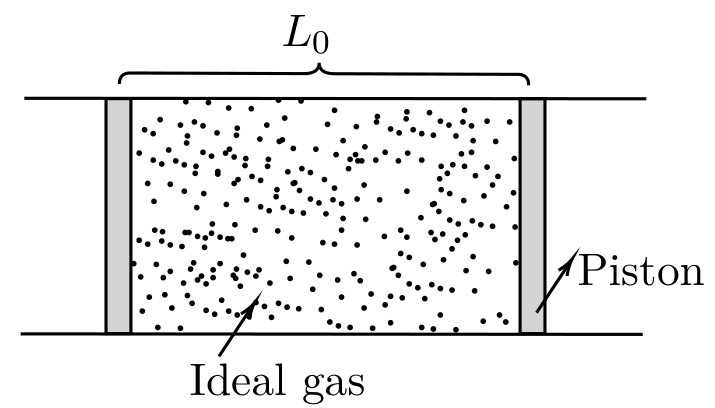
Initially, the pistons are held in place by an external mechanism. At time , the mechanism is released and the pistons move without friction and the process is quasistatic initially. Assume that the gas behaves ideally throughout. Let and be the specific heats of the gas at constant pressure and volume respectively. Also, .
a) Determine the velocity of each piston in terms of the gas temperature and other relevant variables. At what temperature , is the process no longer quasistatic? Calculate . [6 т.]
b) From here, we restrict our analysis only to the quasistatic regime of the process. We define . Obtain the relation between and in the following form
You may leave the answer in terms of a suitable integral involving and other variables. [4 т.]
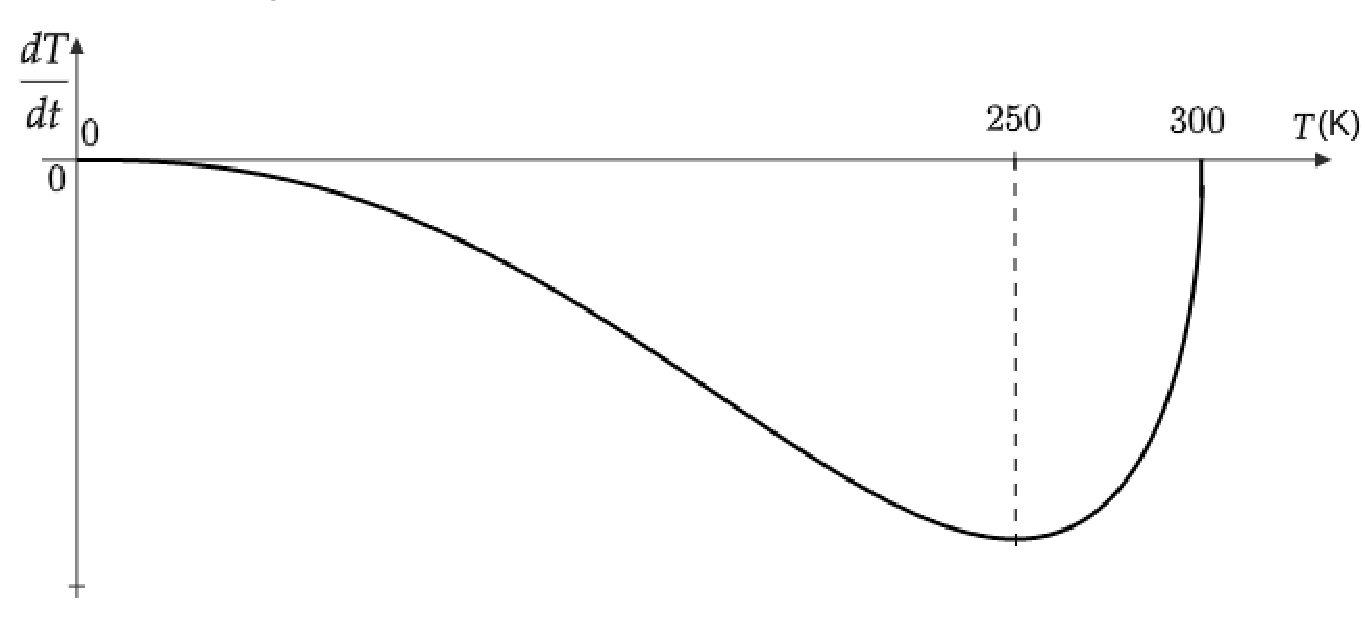
c) Qualitatively plot the rate of change of temperature vs . Mark any significant point(s) on the temperature axis in the plot. [4 т.]
d) At what time does the temperature of the gas reach 20K? What is the piston velocity at this point? [4 т.]
Решение
(a) Solution: Given the initial temperature of the system to be , the initial energy of the system is . When the piston starts moving, from the work-energy theorem, the energy of the system is
Also from conservation momentum, we have .
From above equation, we get
For the process to be quasistatic and adiabatic the piston’s velocity cannot be greater than rms velocity of the gas.
where is molar mass of the gas. Solving the above equation, we get
Below this temperature, the piston’s velocity exceeds rms velocity, which indicates that the piston moves very rapidly. This is where the quasi-static limit will breaks down. For the estimation purpose, we can also take the average velocity or the most probable velocity and the corresponding limit would be 3.5K and 4.4K respectively.
(b) Solution: Since the process adiabatic.
Which implies
To express the temperature as a function of time, Differentiating Eq. (5.8) w.r.t , we get
From Eq. (5.8), we get
Also
Substituting Eq. (5.11) and Eq. (5.12) into Eq. (5.10), we get
For Mono atomic gas , hence above equation becomes
Rearranging above equation, we get,
Where . Integrating above equation, we get
Let , then above integral becomes
(c) Solution: Temperature decreases over time. From Eq. (5.15), it is evident that the derivative of the temperature function is always negative. Additionally, at and , . The function exhibits an extremum at . These details are illustrated in the figure below.
(d) Solution: The integration from Eq. (5.18) can be solved by substituting and using boundary conditions as for , we get
Using above equation, for moles and , the temperature reaches 20K after 0.165s.
From Eq. (5.4) The piston’s velocity at this point is 132.1 m/s.
Source note: The key’s equation references “(5.8)” preceding (5.10) and (5.11), its printed coefficient , and its temperature-axis prose “ and ” are retained literally.
Rough-work pages
Space for rough work — will NOT be submitted for evaluation
The original question and matching key end with blank rough-work pages (question page9 and key page23).
Оригинал в Архива: INPHO2024-Question.pdf · официални решения: INPHO2024-Solution-20240206.pdf