INPhO 2024, Теория — Задача 6. Sonic Sleuth
Indian National Physics Olympiad (INPhO)-2024 — Question Paper · 4 февруари 2024 г. · 11 т.
Внимание: Бележка към темата
The original question booklet and the complete available matching key are retained. The separately mentioned Answer Booklet is not included in this retained archive source set. Printed formula, graph-label and prose discrepancies in the key are preserved, rather than silently corrected. In key2(d), only the four vertices of face C′F′E′B′ are explicitly listed, although the question asks for all vertices of the second prism.
Original cover and instructions
Indian National Physics Olympiad (INPhO)-2024
HOMI BHABHA CENTRE FOR SCIENCE EDUCATION
Tata Institute of Fundamental Research
V. N. Purav Marg, Mankhurd, Mumbai, 400 088
Question Paper
Date: 04 February 2024
Time: 09:00-12:00 (3 hours)
Maximum Marks: 80
Instructions — Roll No.:
- This booklet consists of 9 pages and total of 6 questions. Write roll number at the top wherever asked.
- Booklet to write the answers is provided separately. Instructions to write the answers are on the Answer Booklet.
- Non-programmable scientific calculators are allowed. Mobile phones cannot be used as calculators.
- Please submit the Answer Sheet at the end of the examination. You may retain the Question Paper.
| Question Number | 1 | 2 | 3 | 4 | 5 | 6 | Total |
|---|---|---|---|---|---|---|---|
| Maximum Marks | 8 | 18 | 14 | 11 | 18 | 11 | 80 |
Table of Constants
| Universal constant of Gravitation | ||
| Value of | ||
| Avogadro’s number | ||
| Acceleration due to gravity | ||
| Universal Gas Constant | ||
| Molar mass of Helium | ||
| Boltzmann constant | ||
| Earth’s radius | ||
| Earth’s mass | ||
| Moon’s mass | ||
| Moon’s radius |
Native key notice
The matching key cover repeats the cover and instructions with “23 pages”.
Please note that alternate/equivalent methods and different way of expressing final solutions may exist. A correct method will be suitably awarded.
Условие
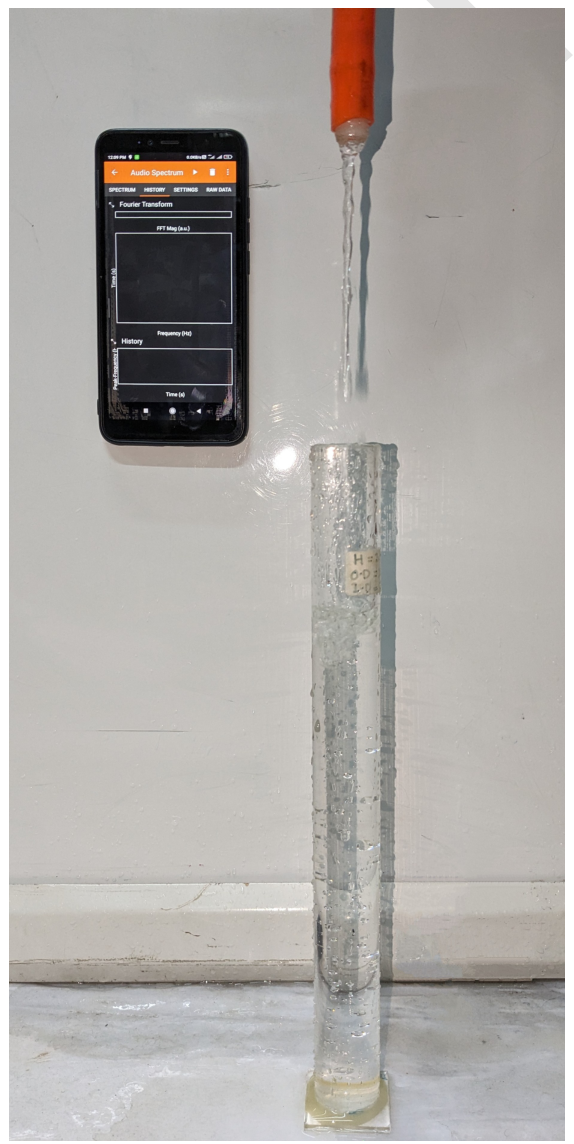
During her summer vacation, Dheera decides to carry out a smartphone based experiment. She utilizes a smartphone’s frequency sensor that can measure the frequency of the audio signal it receives. She takes a long cylindrical tube closed at one end. This tube has a length of and an inner diameter of . Dheera starts filling the tube with water, which is dripping from a tap at a constant rate (measured in milliliters per second (mL/s)).
Dheera positions her smartphone near the open end of the tube to measure the frequency of the sound emitted as water fills the tube. An app on the phone captures a range of frequencies in the recorded audio at any given time. At randomly chosen values of time , one of the frequencies at that time is shown in the following table.
| Time (s) | Frequency (Hz) | Time (s) | Frequency (Hz) |
|---|---|---|---|
| 5.0 | 915 | 36.0 | 434 |
| 7.6 | 320 | 39.6 | 481 |
| 16.2 | 345 | 41.9 | 500 |
| 16.7 | 1008 | 42.5 | 1454 |
| 20.9 | 360 | 51.1 | 1618 |
| 25.7 | 1148 | 51.6 | 574 |
| 28.9 | 1196 | 56.1 | 1782 |
| 31.5 | 410 | 60.2 | 680 |
| 33.3 | 1290 | 66.3 | 820 |
Help her to analyse the experiment.
a) Derive the expression for the velocity of sound in terms of , and constants. [3 т.]
b) Choose a pair of suitable variables and plot a linear graph. Specify the axis labels. Obtain the speed of sound and the rate from this plot. [8 т.]
Решение
(a) Solution: The frequency of the sound in the tube is determined by the formula:
Here, and represent the length of the air column and the diameter of the tube, respectively. The variable is an odd integer representing the fundamental, third, fifth harmonics, and so on. The speed of sound is denoted by , and the term in the denominator accounts for the end correction in the tube.
When water falls at a constant rate , it creates the disturbances in the air column of the tube. These disturbances travel as sound waves through the air column, which we detect and analyze. If the length of the tube is , the equation (6.1) can be modified as:
Here, represents the area of the base, and is an odd integer representing the fundamental, third, fifth harmonics, and so on.
(b) Solution: Since the height of the water level varies linearly with time, we expect the frequency of the sound to increase with time. By linearizing the equation (6.1), we get:
Plotting the relationship between and will yield a linear graph. The values for the plot are as follows.
| Fundamental | 3rd Harmonic | ||||
|---|---|---|---|---|---|
| Time(s) | Frequency(Hz) | (s) | Time(s) | Frequency(Hz) | (s) |
| 7.6 | 320 | 0.00313 | 5 | 915 | 0.00109 |
| 16.2 | 345 | 0.00290 | 16.7 | 1008 | 0.00099 |
| 20.9 | 360 | 0.00278 | 25.7 | 1148 | 0.00087 |
| 31.5 | 410 | 0.00244 | 28.9 | 1196 | 0.00084 |
| 36 | 434 | 0.00230 | 33.3 | 1290 | 0.00078 |
| 39.6 | 481 | 0.00208 | 42.5 | 1454 | 0.00069 |
| 41.9 | 500 | 0.00200 | 51.1 | 1618 | 0.00062 |
| 51.6 | 574 | 0.00174 | 56.1 | 1782 | 0.00056 |
| 60.2 | 680 | 0.00147 | |||
| 66.3 | 820 | 0.00122 |
The presence of two distinct straight lines in the graph indicates the existence of two harmonic frequencies in the dataset. Upon examining the ratio of these frequencies, it becomes evident that these two lines correspond to and . The intercept and slope of the graph can be used to determine the speed of sound and the rate of water filling, respectively.
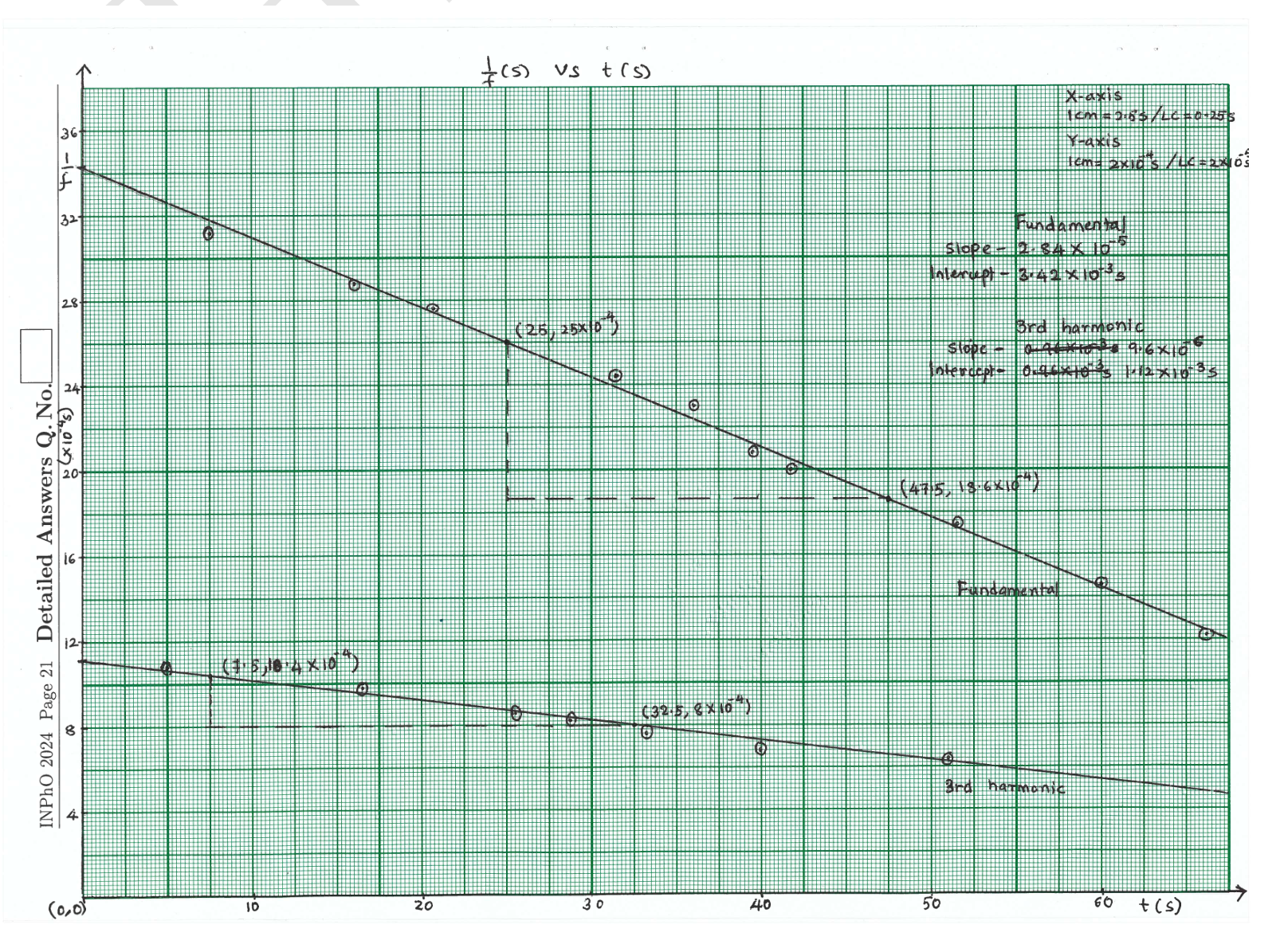
| Fundamental | 3rd Harmonic | |
|---|---|---|
| Slope | ||
| Intercept | ||
| 359 m/s | 366 m/s | |
| 1.20 mL/s | 1.24 mL/s |
Source note: The printed factor placement and unmatched closing parenthesis in (6.2) and (6.3) are preserved; these differ from (6.1) and (6.4). The original handwritten plot and the original typed results table are both retained.
Source note on the handwritten graph: The visible uncrossed third-harmonic slope annotation has magnitude , whereas the typed results table prints . Both original readings are retained; the plotted line descends.
Rough-work pages
Space for rough work — will NOT be submitted for evaluation
The original question and matching key end with blank rough-work pages (question page9 and key page23).
Оригинал в Архива: INPHO2024-Question.pdf · официални решения: INPHO2024-Solution-20240206.pdf