INPhO 2025, Теория — Задача 5. Metalens
Indian National Physics Olympiad (INPhO)-2025 — Question Paper · 2 февруари 2025 г. · 15 т.
Внимание: Бележка към темата
The complete retained original question and matching HBCSE solution packets are transcribed. The separately referenced Answer Booklet is not retained in the matching archive row. Printed key formula/sign/symbol/prose discrepancies and the original handwritten magnetic-data graph remain literal, with separately labelled source notes.
Original cover and instructions
Indian National Physics Olympiad (INPhO)-2025
HOMI BHABHA CENTRE FOR SCIENCE EDUCATION
Tata Institute of Fundamental Research
V. N. Purav Marg, Mankhurd, Mumbai, 400 088
Question Paper
Date: 02 February 2025
Time: 09:00-12:00 (3 hours)
Maximum Marks: 75
Instructions — Roll Number:
- This booklet consists of 9 pages and total of 5 questions. Write roll number at the top wherever asked.
- Booklet to write the answers is provided separately. Instructions to write the answers are on the Answer Booklet.
- Non-programmable scientific calculators are allowed. Mobile phones cannot be used as calculators.
- Please submit the Answer Sheet at the end of the examination. You may retain the Question Paper.
| Question Number | 1 | 2 | 3 | 4 | 5 | Total |
|---|---|---|---|---|---|---|
| Maximum Marks | 8 | 14 | 16 | 22 | 15 | 75 |
Table of Constants
| Speed of light in vacuum | ||
| Magnitude of electron charge | ||
| Value of | ||
| Avogadro’s number | ||
| Acceleration due to gravity | ||
| Universal Gas Constant | ||
| Boltzmann constant | ||
| Permeability constant |
Native key notice
The matching key repeats the cover, constant table, marks table and four instructions with “24 pages” and the title “Solutions”.
Please note that alternate/equivalent methods and different ways of expressing final solutions may exist. A correct method will be suitably awarded.
Условие
A metasurface is a two-dimensional, ultra-thin optical structure consisting of an array of nanospaced optical nano-elements (also known as meta-atoms) on a flat surface (typically an ultra-thin glass plate). The primary function of the nano-elements is to locally introduce a phase shift to the wave, incident at position . This function, , is called the phase profile of the metasurface.
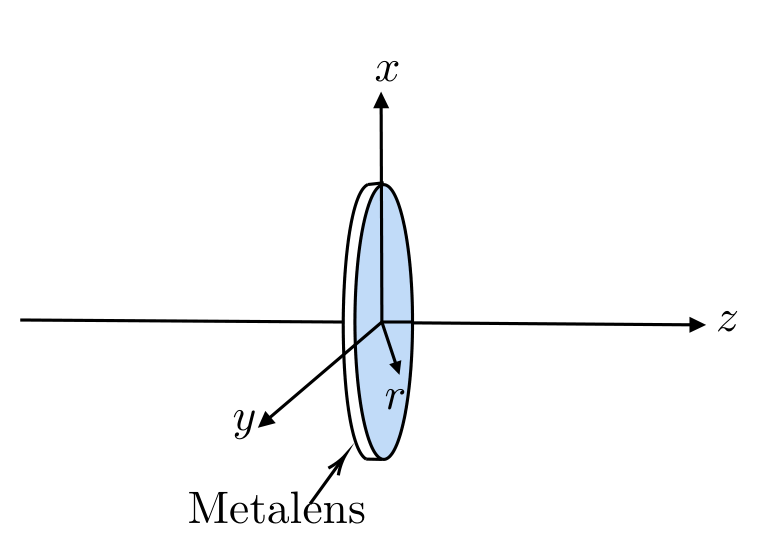
Metalens has a circular metasurface with a circularly symmetric phase profile function, , which depends on the distance of the point from the center of the metalens (see figure below). This type of metalens can be used for focusing incoming parallel rays to a point. Unlike normal lenses, the metalens will look just like an ultrathin circular disc.
Consider two homogeneous media of refractive indices and separated by a metalens as shown in the figure below. Suppose a beam of plane wave is incident at point (at distance from the pole ) on the metasurface at an angle of from medium 1. Assume that the rays falling at are in the plane containing and the axis of the lens (- plane). These rays will be refracted at an angle in the medium 2. The angle of refraction depends on . Thus, the modified law of refraction for the metasurface can be written as
Similarly, the rays falling at , at a distance , will be refracted by an angle .
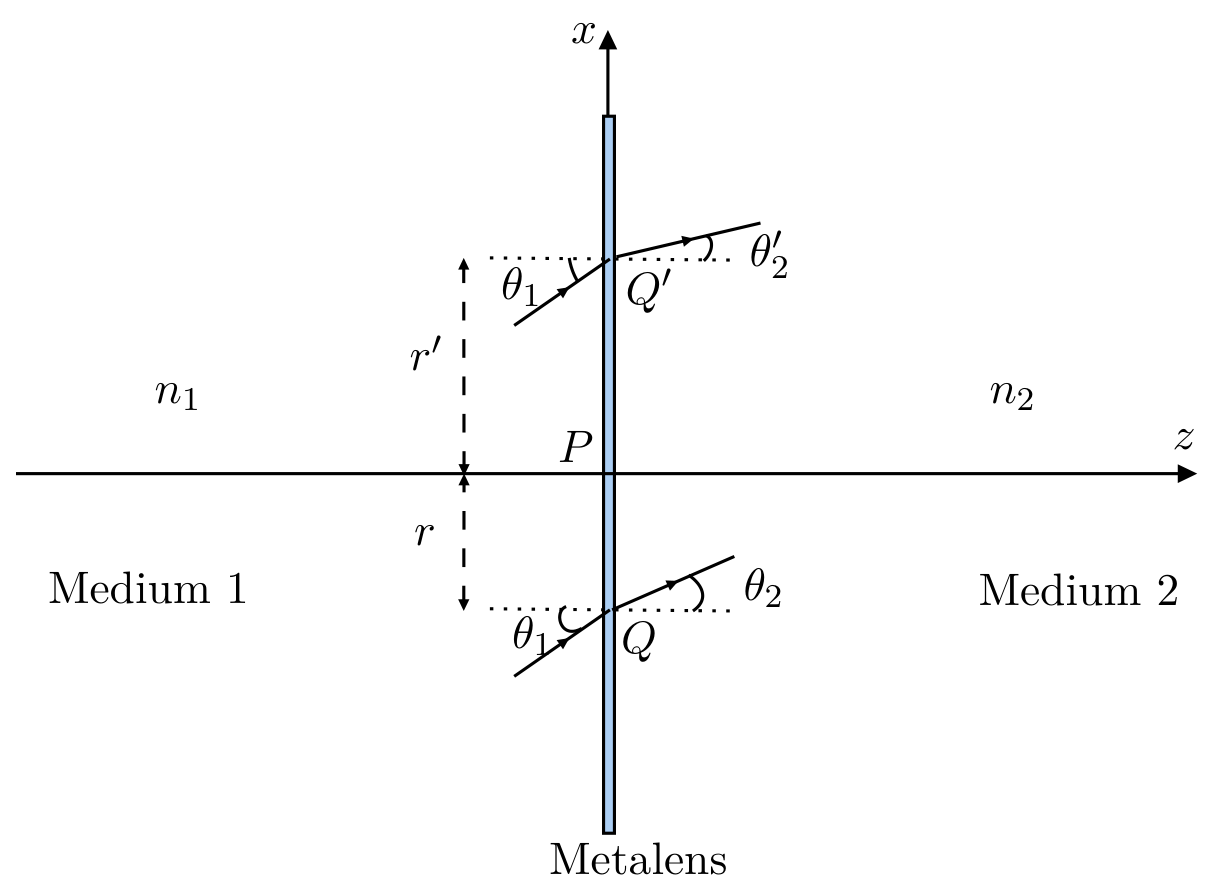
a) Find in terms of and , the wave number of the incoming wave in a vacuum. To determine , assume two rays in - plane incident at an angle at two infinitesimally close points, and , are refracted by the same angle . You don’t need to derive the exact functional form of for this part. [8 т.]
b) Derive an expression for the phase profile , to convert a plane wavefront to spherical wavefront, with light being focused to a point on the axis (see figure below), which is at a distance from the pole P.
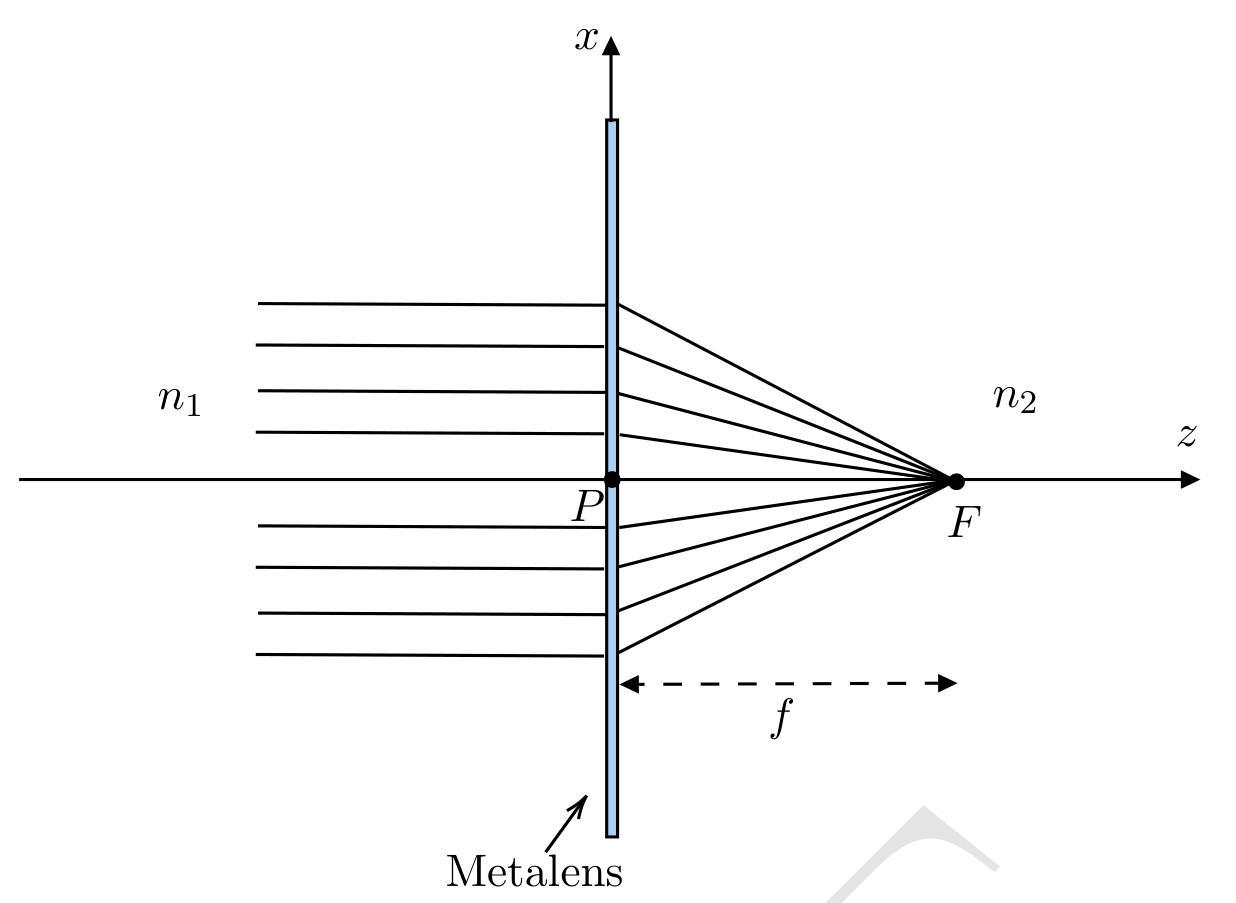
[4 т.]
c) Consider a metalens whose phase profile is obtained in part (b). For the paraxial approximation, derive an expression for the lens equation, having object distance and image distance being , with focal length (see figure below).
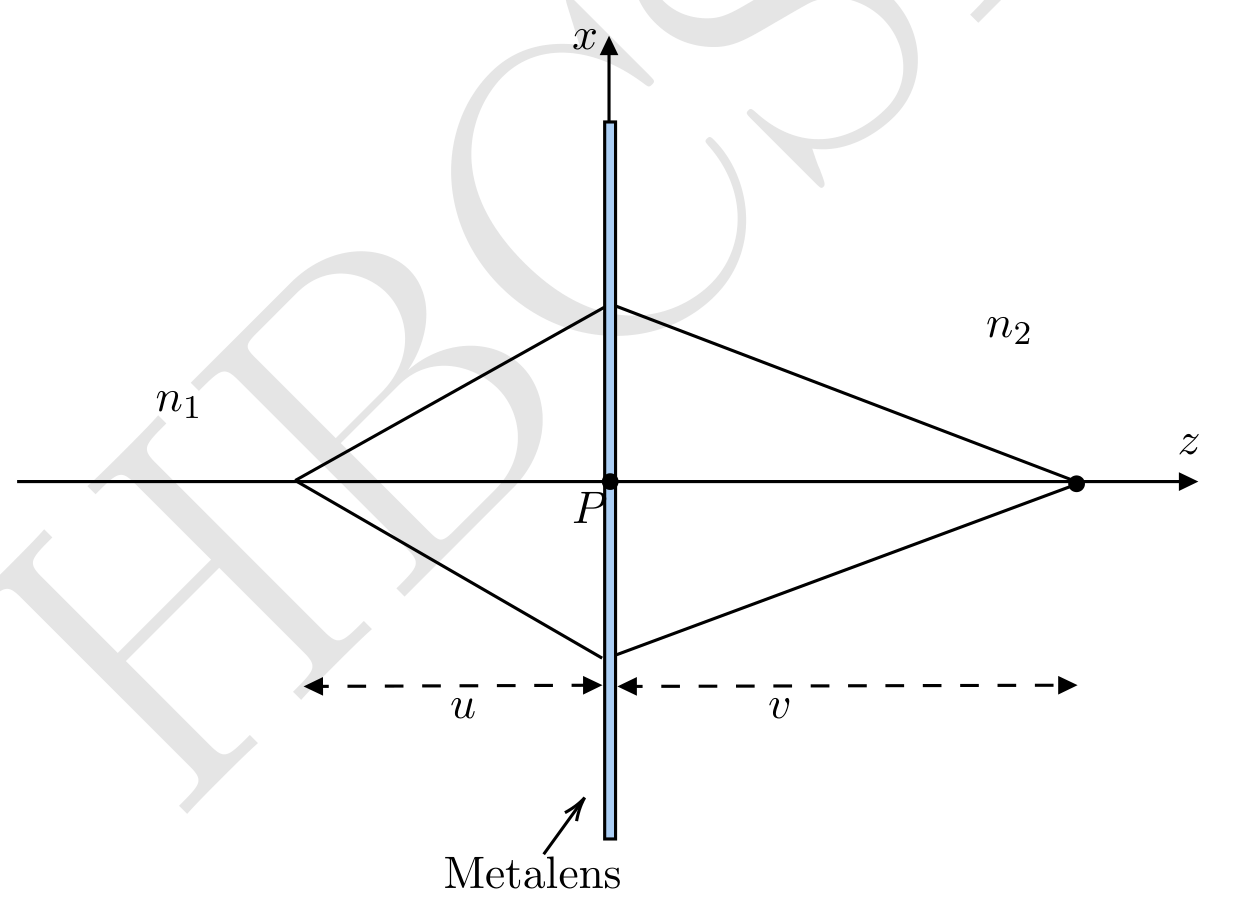
[3 т.]
Решение
(a) Solution:
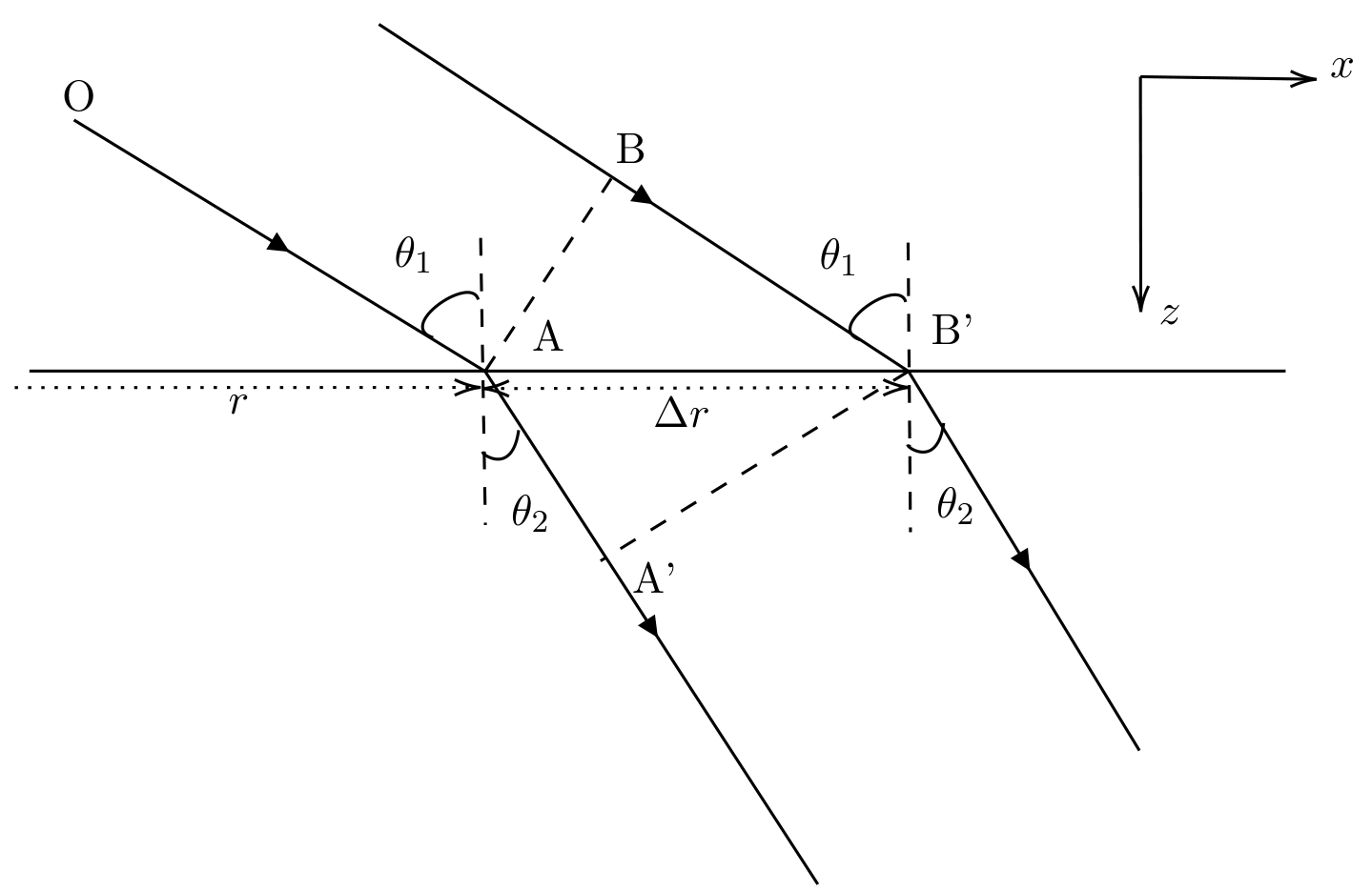
Consider two rays, which are close to each other, incident locally on metalens. The ray is incident at an angle at and exits in medium 2 at an angle . Similarly the ray exits in medium 2 at an angle of from . The rays being very close to each other have a plane wavefront. Let wavefront AB propagate to A’B’ in time . Let and be phases at points and respectively. Then
Since these two phase differences must be equal, we get
Alternate solution:
Time interval for the wavefront to travel from to is equal to the time taken by the wavefront to travel from to .
where is the time it takes for point B on the wavefront (traveling at speed ) to reach point B’, and is the time it takes the transmitted portion of that same wavefront (traveling at speed ) to reach point A’ from point A. The time delays due to the metasurface at points A and B’ are and , respectively. From figure
Substituting above terms in Eq.5.1, we get
Simplifying:
This gives the relation:
(b) Solution: From the previous part
From the above figure, the ray arriving at (with ) must bend by an angle . Thus,
Simplifying above equation, we get
where .
(c) Solution: We know that
For paraxial rays, we can use small angle approximation, and then above equation becomes
We know that
For paraxial approximation, we get
Using these approximations, we get
If , then the above equation becomes
Source note: The question defines with , while the key derives the reverse order. The alternate solution prints in (5.1), in its prose, and in its formulas. It changes lowercase to uppercase , drops in the substitution line, and prints an additional on the finite-difference simplification. The source varies and and gives the phase profile with . All these native expressions, both alternative derivations and the complete paraxial key are retained literally.
Native source end
END OF THE QUESTION PAPER
The key also ends with this native wording on page24. Key page20 is blank apart from running page and roll-number furniture.
Оригинал в Архива: INPhO2025-Question.pdf · официални решения: INPhO2025-Solution-20250219.pdf