IOAA 2007, Анализ на данни — Задача 1. Galilean moons
The 1st International Olympiad on Astronomy and Astrophysics — Chiang Mai, Thailand — Experimental Competition (Data Analysis) — Monday, 3 December, 2007 · 3 декември 2007 г. · 4 т.
Внимание: Бележка към темата
The official marking scheme was written for a slightly different version of the questions (6, 7 and 7 points; Question 2 with GMT +02). Table 1 with the data for Question 3 is not in the archive.
Please read this first:
The time available is 3 hours for the experimental competition (Data analysis). There are three questions (and a set of data table).
Use only the pen provided.
Use only the front side of writing sheets. Write only inside the boxed area.
Begin each question on a separate sheet.
For each question, in addition to the blank writing sheets, there are the Answer Sheets where you must summarize the results you have obtained. Numerical results should be written with as many digits as are appropriate.
Write on the blank writing sheets whatever you consider is required for the solution of the question. Please use as little text as possible; express yourself primarily in equations, numbers, figures, and plots.
Fill the boxes at the top of each sheet of paper with your country code, your student code, the question number, for each question the consecutive number of each sheet (Page Number), and the total number of writing sheets used. If you use some blank writing sheets for notes that you do not wish to be marked, put a large X across the entire sheet and do not include it in your numbering.
Students given questions, writing sheet and answer sheets in English and national language can answer in any one sheet but must return both to the marker (examiner).
At the end of the exam, arrange all sheets for each problem in the following order:
- Answer Sheet(s)
- used writing sheets in order
- the sheets you do not wish to be marked
- unused sheets and the printed question
Place the papers inside the envelope and leave everything on your desk. You are not allowed to take any sheets of paper out of the room.
Some useful information for calculation
| Astronomical unit (A.U.) | 149,597,870 km |
| Mean distance, Earth to Moon | 384,399 km |
| Obliquity of the ecliptic | 23° 26' |
| Earth's mean radius | 6,371.0 km |
| Earth's mean velocity in orbit | 29.783 km/s |
| Sidereal year | 365.2564 days |
| Tropical year | 365.2422 days |
| Sidereal month | 27.3217 days |
| Synodic month | 29.5306 days |
| Mean sidereal day | 23h56m4s.091 of mean solar time |
| Mean solar day | 24h3m56s.555 of sidereal time |
Условие
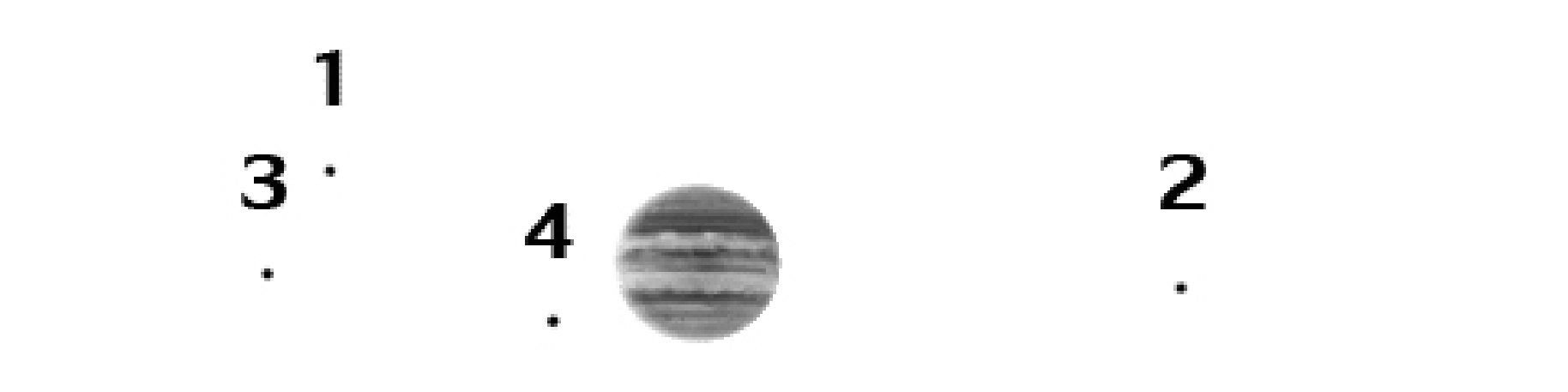
Computer simulation of the planet Jupiter and its 4 Galilean moons is shown on the screen similar to the view you may see through a small telescope. After observing the movement of the moons, please identify the names of the moons that appear at the end of the simulation. (Simulation will be played on screen during the first fifteen minutes and the last fifteen minutes of the exam)
Отговори
- 1 Callisto, 2 Europa, 3 Io, 4 Ganymede
Решение
Question 1 Galilean moons (6 points)
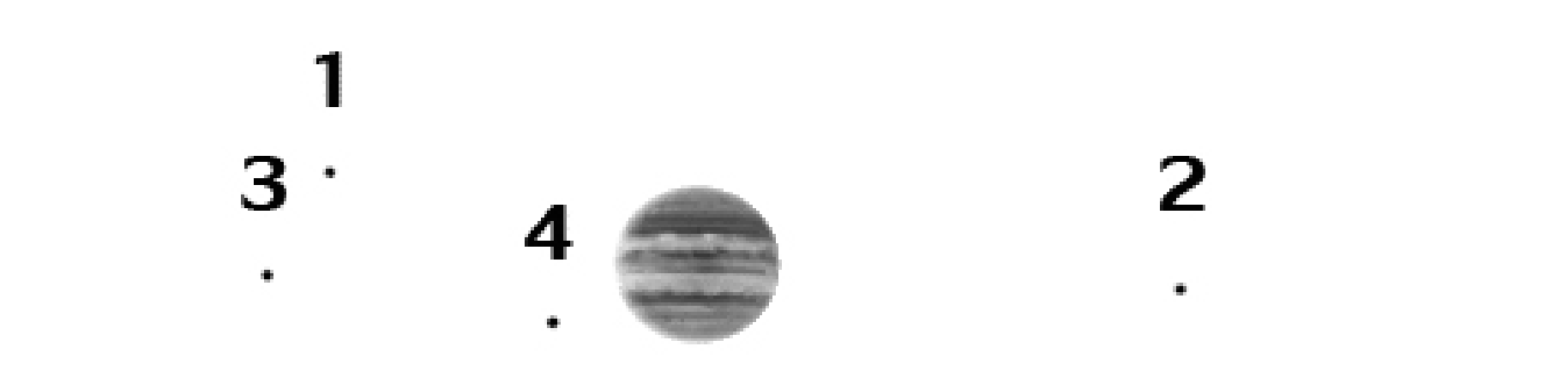
Computer simulation of the planet Jupiter and its 4 Galilean moons is shown on the screen similar to the view you may see through a small telescope. After observing the movement of the moons, please identify the names of the moons that appear at the end of the simulation. (Simulation will be played on screen 3 times)
Names of the Galilean Moons
| 1 | Callisto | (1.5 points) |
| 2. | Europa | (1.5 points) |
| 3. | Io | (1.5 points) |
| 4. | Ganymede | (1.5 points) |
Оригинал в Архива: exam_dataanalysis.pdf · официални решения: exam_dataan_solution.pdf