IOAA 2007, Наблюдения — Задача 1. Experimental Competition (Observation)
The 1st International Olympiad on Astronomy and Astrophysics — Chiang Mai, Thailand — Experimental Competition (Observation) — Sunday, 2 December, 2007 · 2 декември 2007 г. · 20 т.
Внимание: Бележка към темата
This is a live observation test. The supplied marking scheme covers Part II only; no official Part I solution is included.
Условие
The 1st International Olympiad on Astronomy and Astrophysics
Chiang Mai, Thailand
Sunday, 2 December, 2007
Please read this first:
There are 2 parts to the questions. You have to use the provided equipment to point, observe and answer where appropriate.
The time available is 40 minutes in total for the experimental competition (Observation), 20 minutes for each part.
In Part I, use only the provided celestial object pointer to point at the target specified in the questions. No other pointer is allowed. The marker (examiner) at each observation station will then mark the answers directly in the question sheet. You must not write anything in the sheet apart from your country code and student code.
In Part II, use the provided binoculars to observe the objects and then answer the questions by writing or drawing directly in the question sheets.
At the end of both parts, leave the question sheets with the marker (examiner) at each observation station. You are not allowed to take any sheets of paper out of the observation station.
Use only the provided pen or pencil.
Students given questions in English and national language can answer in any one sheet but must return both to the marker (examiner).
Fill the boxes at the top of each sheet of paper with your country code, your student code.
PART I: Use the provided celestial object pointer (10 т.)
1.1 Move the pointer along the celestial equator. [1 т.]
✓ ✗
1.2 Aim the pointer at the vernal equinox. [1 т.]
✓ ✗
1.3 In the constellation of Pegasus and its vicinity there is an obvious square of bright stars (Great Square of Pegasus), aim the pointer at the brightest star of the square. [2 т.]
✓ ✗
1.4 Aim the pointer at the star named alpha-Arietis (α-Ari). [2 т.]
✓ ✗
1.5 Start from the star named Aldebaran (α-Tauri) in the constellation Taurus, turn the pointer 35 degrees northward followed by 6 degrees westward (in equatorial coordinate). Then, aim the pointer at the brightest star in the field of view. [4 т.]
✓ ✗
Signature of Marker ________
PART II: Use the provided binoculars (10 т.)
2.1 The open star cluster “Hyades” in constellation Taurus is one of the nearest clusters to us, being only 151 light years away. From the provided chart with brightness of some stars indicated by the apparent magnitude in parentheses, please estimate the apparent magnitude of the star Gamma-Tauri (γ-Tauri) to the nearest first decimal digit.
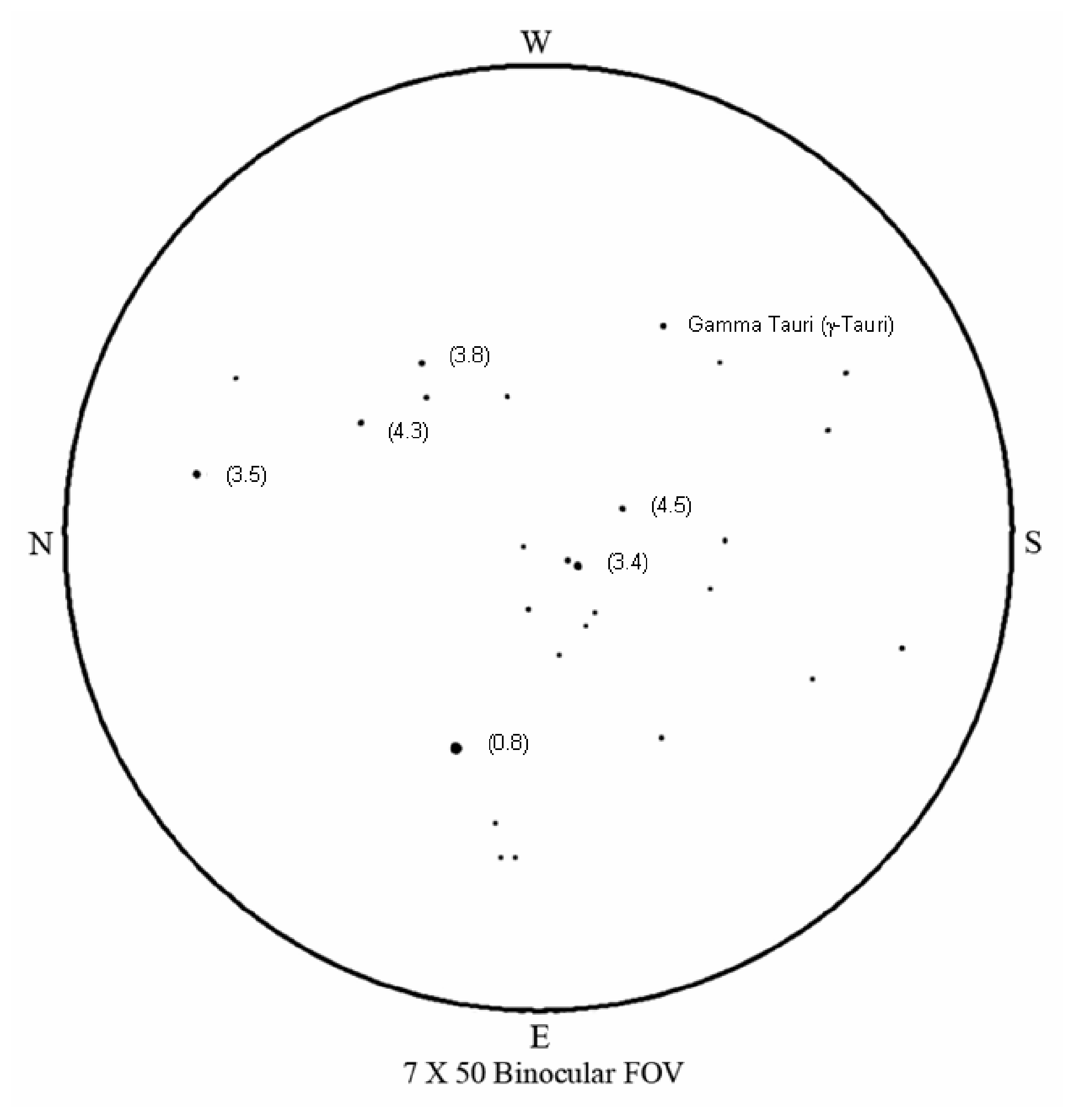
Answer: The apparent magnitude of γ-Tauri = _____________ [5 т.]
Marker (examiner) comments on sky condition: ________
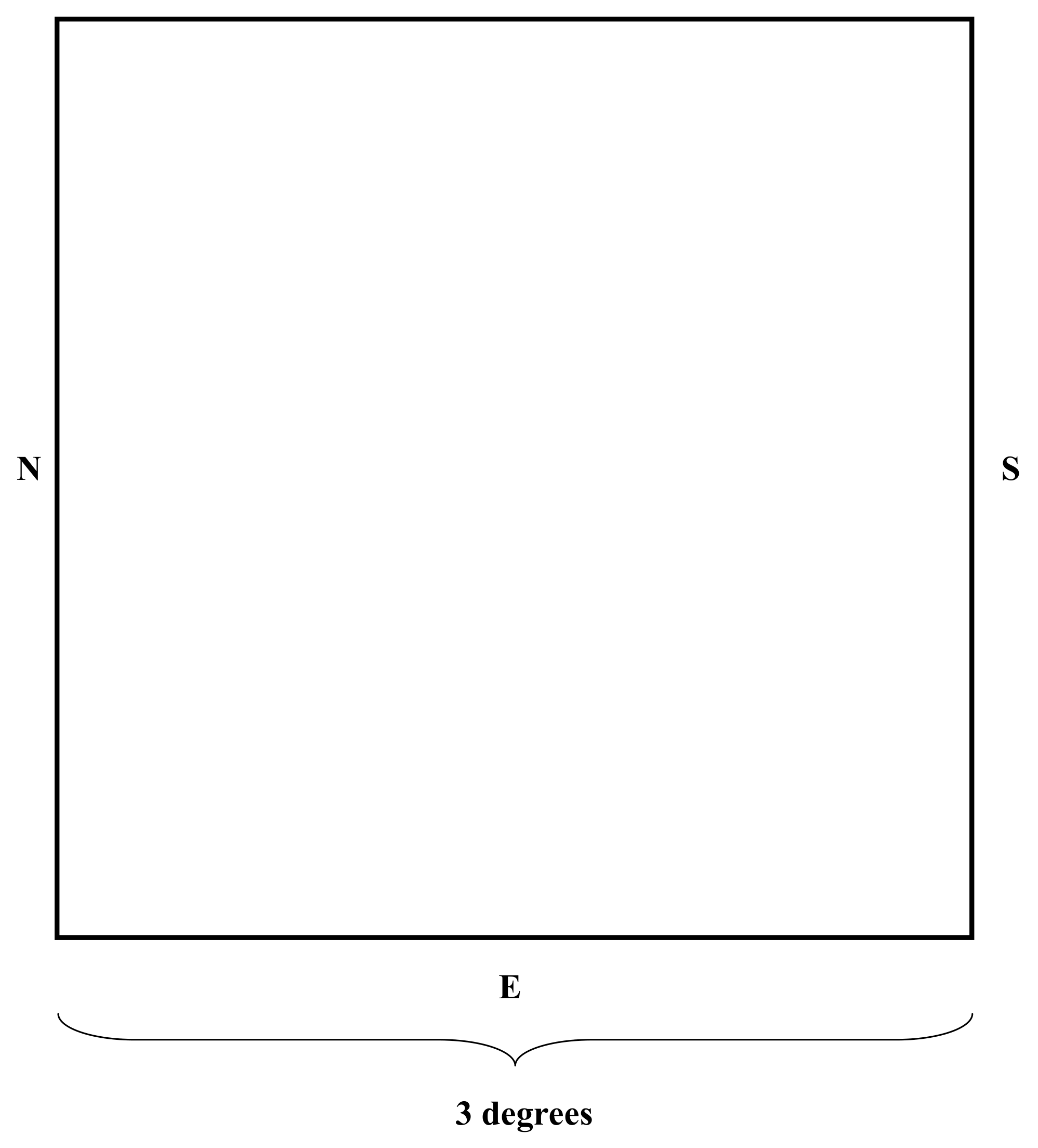
2.2 Observe the Andromeda Galaxy (M31) then draw the approximate shape and size of the galaxy that you see through the binoculars in the frame below with correct orientation (in equatorial coordinates). The field of view of the binoculars is 6.8 degrees. [5 т.]
W
Marker (examiner) comments on sky condition: ________
Решение
Внимание: Непълно решение
The archive's marking scheme covers only Part II; there is no official solution for Part I.
Marking Scheme for Observation Part II
PART II : Use the provided binoculars
2.1 The open star cluster “Hyades” in constellation Taurus is one of the nearest clusters to us, being only 151 light years away. From the provided chart with brightnesses of some stars indicated by the apparent magnitude in parentheses, please estimate the brightness (in apparent magnitude) of the star Gamma-Tauri (γ-Tauri) to the nearest first decimal digit. (5 points)
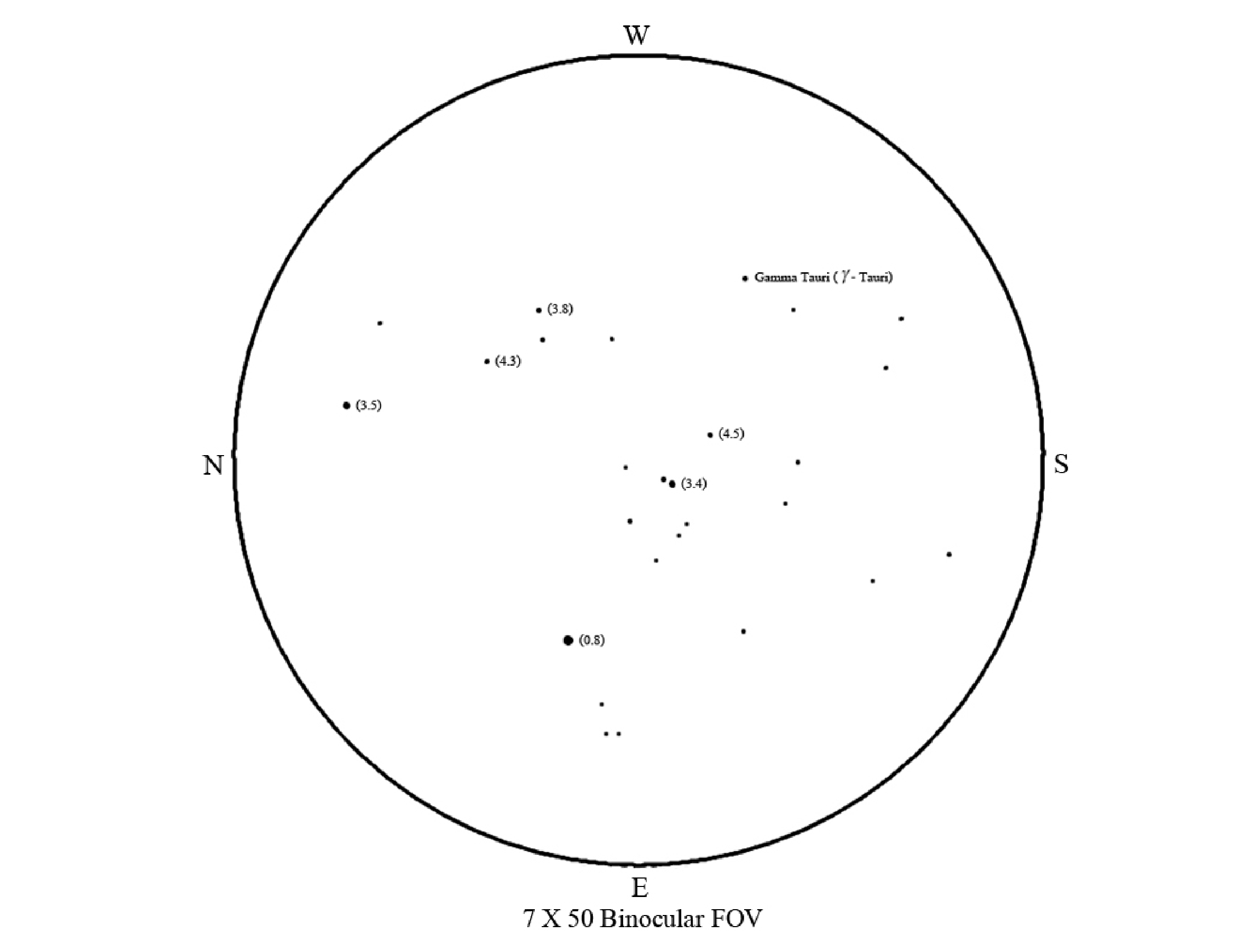
Answer : The correct value of brightness of γ-Tauri = 3.6
If the answer is 3.5, 3.6 or 3.7 (5 points)
If the answer is 3.3, 3.4, 3.8 or 3.9 (3 points)
If the answer is none of the above (0 point)
2.2 Observe the Andromeda Galaxy (M31) then draw the approximate shape and size of the galaxy that you see through the binoculars in the frame below with correct orientation. (5 points)
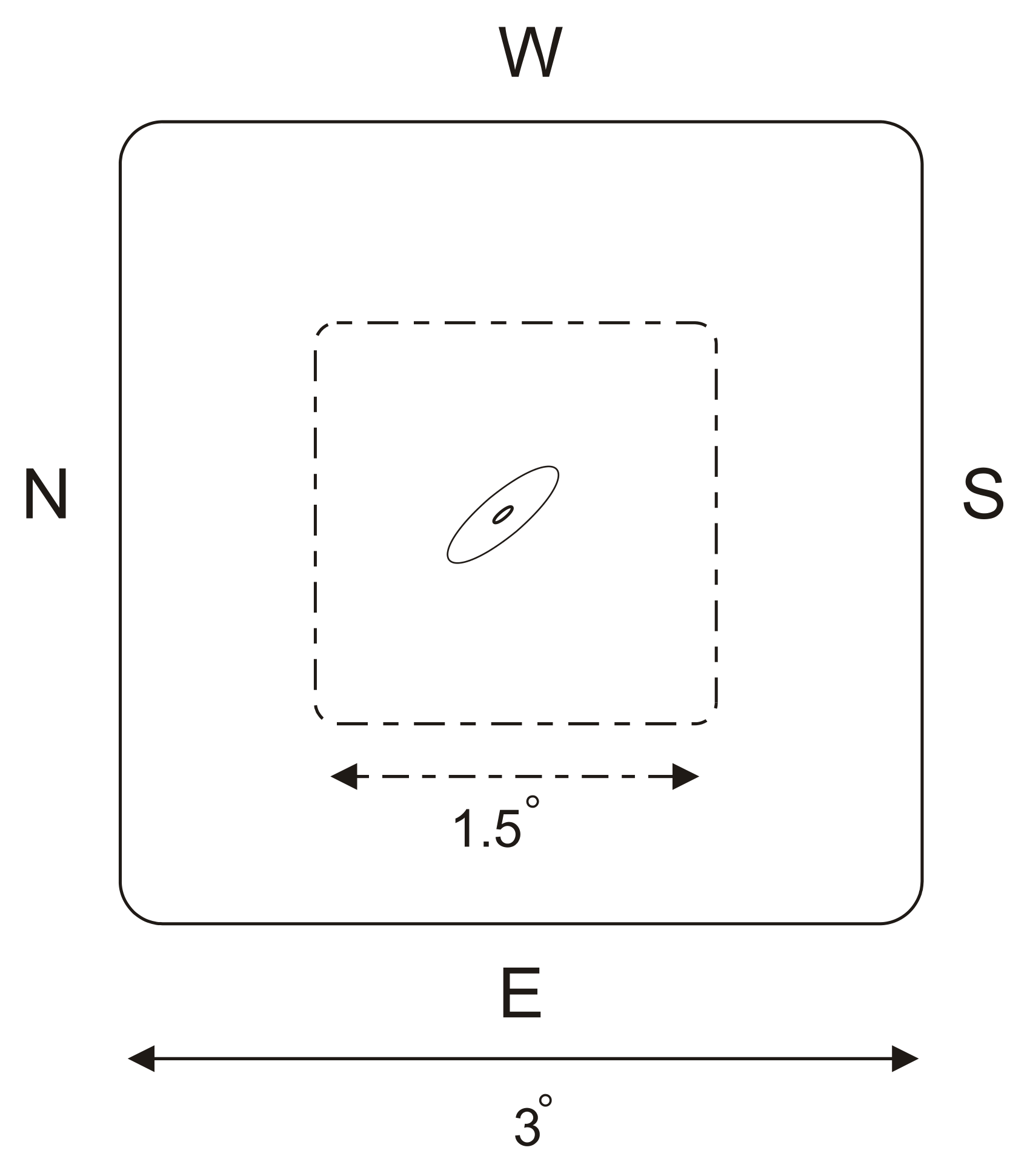
Correct shape and size (between 0.5 to 1 degree) – 3 points
Correct orientation (within 23 degrees of the picture) – 2 points
Теми и трудност
Трудност: неоценена.
Небесна сфера и сферична астрономия · Уреди и наблюдения · Небесна сфера · Небесни координати · Звездни карти и съзвездия · Планиране на наблюдения
Предпоставки: Гимназиална подготовка, Разширена олимпиадна подготовка
Оригинал в Архива: exam_observation.pdf · официални решения: exam_observation_solution.pdf