Theoretical Competition — 1st IOAA — December 5, 2007 · 5 декември 2007 г. · 10 т.
Условие
The deflection of light by a gravitational field was first predicted by Einstein in 1912 a few years before the publication of the General Relativity in 1916.
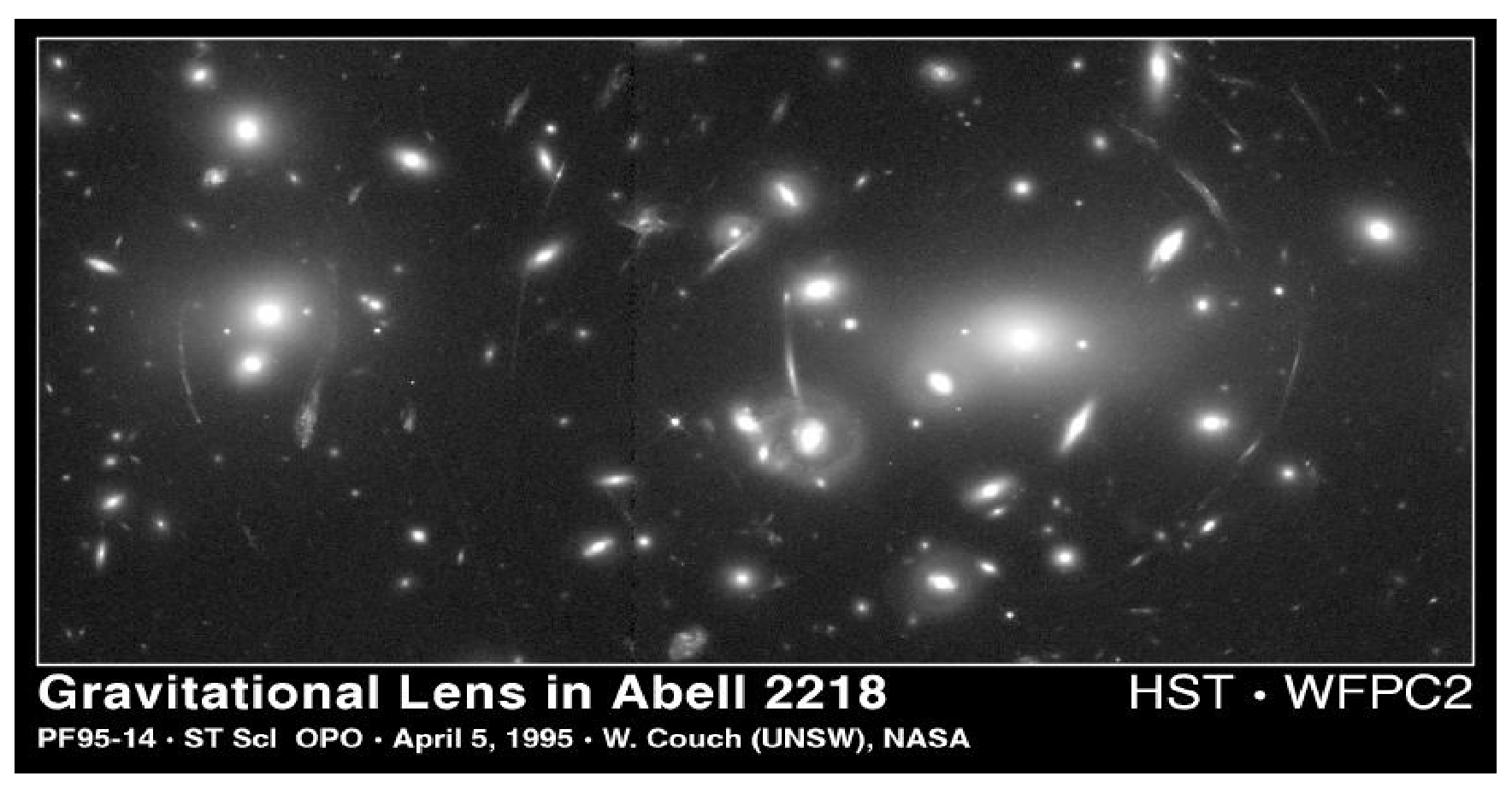
A massive object that causes a light deflection behaves like a classical lens.
This prediction was confirmed by Sir Arthur Stanley Eddington in 1919.
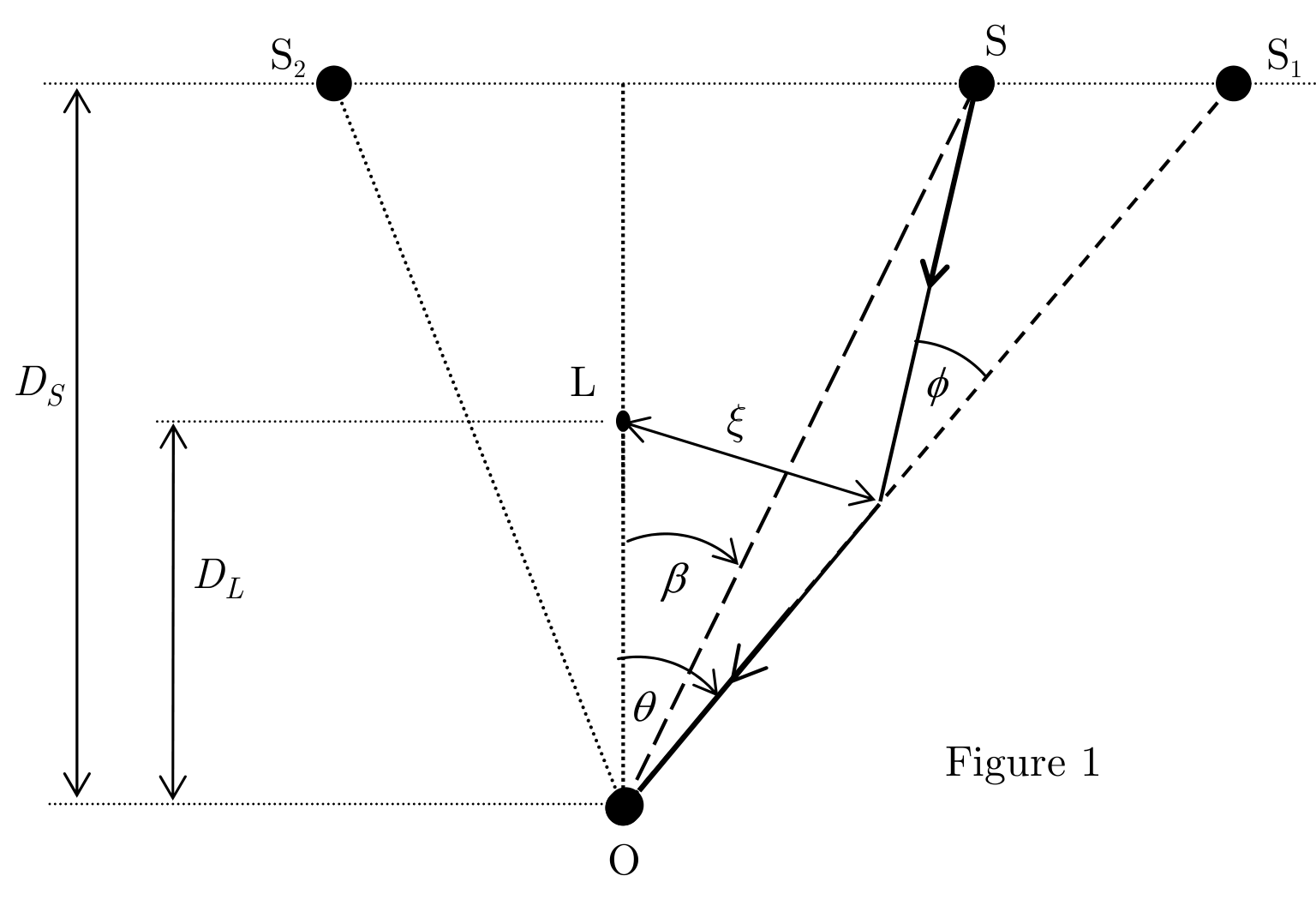
Figure 1
Consider a spherically symmetric lens, with a mass M with an impact parameter ξ from the centre. The deflection equation in this case is given by:
ϕ=ξc24GM, a very small angle
In figure 1, the massive object which behaves like a lens is at L. Light rays emitted from the source S being deflected by the lens are observed by observer O as images S1 and S2. Here, ϕ,β, and θ are very very small angles.
a) For a special case in which the source is perfectly aligned with the lens such that β=0, show that a ring-like image will occur with the angular radius, called Einstein radius θE, given by:
θE=(c24GM)(DLDSDS−DL)
[2 т.]
b) The distance (from Earth) to a source star is about 50 kpc. A solar-mass lens is about 10 kpc from the star. Calculate the angular radius of the Einstein ring formed by this solar-mass lens with the perfect alignment. [1 т.]
c). What is the resolution of the Hubble space telescope with 2.4 m diameter mirror? Could the Hubble telescope resolve the Einstein ring in b)? [2 т.]
d). In figure 1, for an isolated point source S, there will be two images (S1 and S2) formed by the gravitational lens. Find the positions (θ1 and θ2)of the two images. Answer in terms of β and θE. [2 т.]
e). Find the ratio βθ1,2 (βθ1 or βθ2) in terms of η. Here θ1,2 represents each of the image positions in d.) and η stands for the ratio θEβ. [2 т.]
f). Find also the values of magnifications ΔβΔθ in terms of η for θ=θ1,2 (θ=θ1 or θ=θ2), when Δβ≪β, and Δθ≪θ. [1 т.]
Отговори
b) 0.000197 arcsec
Also given as 0.956 × 10⁻⁹ radian.
c).2.54×10−7 rad
For light of wavelength 500 nm; the Hubble telescope could not resolve this Einstein ring.
d).θ1,2=2β±(2β)2+θE2
e).βθ1,2=21[1±ηη2+4]
f).(ΔβΔθ)θ=θ1,2=21[1±η2+4η]
Решение
QUESTION 4 GRAVITATIONAL LENSING
Solution
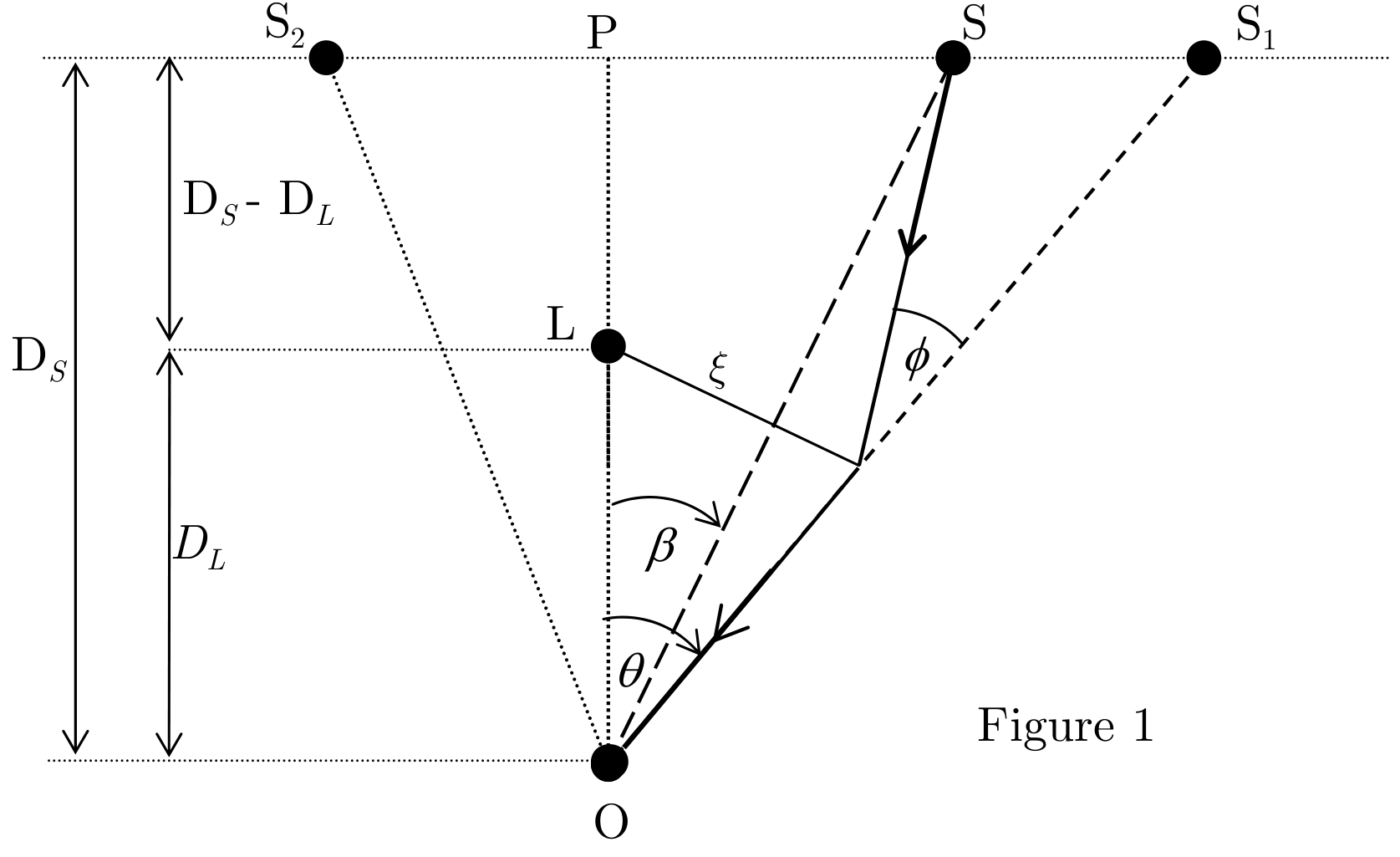
Figure 1
a). From figure 1, for small angles, tanθ≈θ, hence
PS1=PS+SS1
θDS=βDS+(DS−DL)ϕ
θ−β=ξc24GMDS(DS−DL)………………….(1)
( 1 point)
Note that θ=DLξ also, hence,
θ2−βθ=(c24GM)(DLDSDS−DL)………………….(2)
For a perfect alignment in which β=0, we have θ=±θE, where
θE=(c24GM)(DLDSDS−DL)………………….(3)
( 1 point)
b). From equation (3), for a solar-mass lens with DS=50kpc,
DL=50−10=40kpc
θE=(c24GM)(DLDSDS−DL)=0.956×10⁻⁹radian=1.97×10⁻⁴arc second
( 1 point)
c.) The resolution of the Hubble space telescope having diameter of 2.4 m is,