IOAA 2007, Теория — Задача 3. BINARY SYSTEM
Theoretical Competition — 1st IOAA — December 5, 2007 · 5 декември 2007 г. · 10 т.
Условие
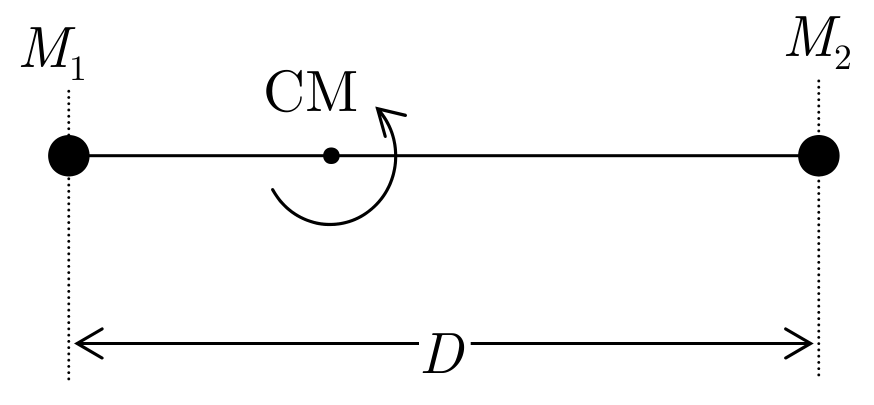
A binary star system consists of and separated by a distance . and are revolving with an angular velocity in circular orbits about their common centre of mass. Mass is continuously being transferred from one star to the other. This transfer of mass causes their orbital period and their separation to change slowly with time.
In order to simplify the analysis, we will assume that the stars are like point particles and that the effects of the rotation about their own axes are negligible.
a) What is the total angular momentum and kinetic energy of the system? [2 т.]
b) Find the relation between the angular velocity and the distance between the stars. [2 т.]
c) In a time duration , a mass transfer between the two stars results in a change of mass in star , find the quantity in terms of , , and . [3 т.]
d) In a certain binary system, , and the orbital period, days. After 100 years, the period has increased by 20 s. Find the value of (in the unit “per year”). [1,5 т.]
e) In which direction is mass flowing, from to , or to ? [0,5 т.]
f) Find also the value of (in the unit “per year”). [1 т.]
You may use these approximations:
, when ;
, when , .
Отговори
- a)
- b)
- c)
- d) per year
- e) From M2 to M1.
- f) per year
Решение
QUESTION 3 BINARY SYSTEM
Solution
a) The total angular momentum of the system is
(0.5 points)
We have also and
which yield
(0.5 points)
The kinetic energy of the system is
(0.5 points)
(0.5 points)
b) From Newton’s laws of motion we have
(1 point)
These equations together with those in a) yield
(1 point)
c) In order to find the quantity , we must also realize that
(0.5 points)
And that, since there is no external torque acting on the system, the total angular momentum must be conserved.
that is,
(0.5 points)
Now, after the mass transfer,
Hence,
After using the approximation and rearranging, we get
(1 point)
From equation (3), is also constant. That is,
This gives,
(0.5 points)
Hence
(0.5 points)
d) Given that
,
orbital period, days
and that has increased by 20 s in the past 100 years,
we have
(0.5 points)
(0.5 points)
(0.5 points)
e) Mass is flowing from to . (0.5 points)
f) From equations (6) and (8):
(1.0 points)
Оригинал в Архива: exam_theory.pdf · официални решения: exam_theory_solution.pdf