IOAA 2011, Анализ на данни — Задача 1. Analysis of times of minima
5th IOAA Silesia Poland 2011 — Data Analysis questions · 25 т.
Указания
In your envelope you will receive an English and native language versions of the questions.
You have 2.5 hours to solve 2 tasks.
You can get maximum 25 points for each task.
You can use only the pen and tools given on the desk.
The solutions of each task should be written on the answer sheets, starting each question on a new page. Only the answer sheets will be assessed.
You may use the blank sheets for additional working. These work sheets will not be assessed
At the top of each page you should put down your code and task number.
If solution exceeds one page, please number the pages for each task.
Draw a box around your final answer.
Numerical results should be given with appropriate number of significant digits with units.
You should use SI or units commonly used in astronomy. Points will be deducted if there is a lack of units or inappropriate number of significant digits.
At the end of the test, all sheets of paper should be put into the envelope and left on the desk.
In your solution please write down each step and partial results.
Graphs for tasks number 1 and 2 should be prepared on the plotting paper.
Условие
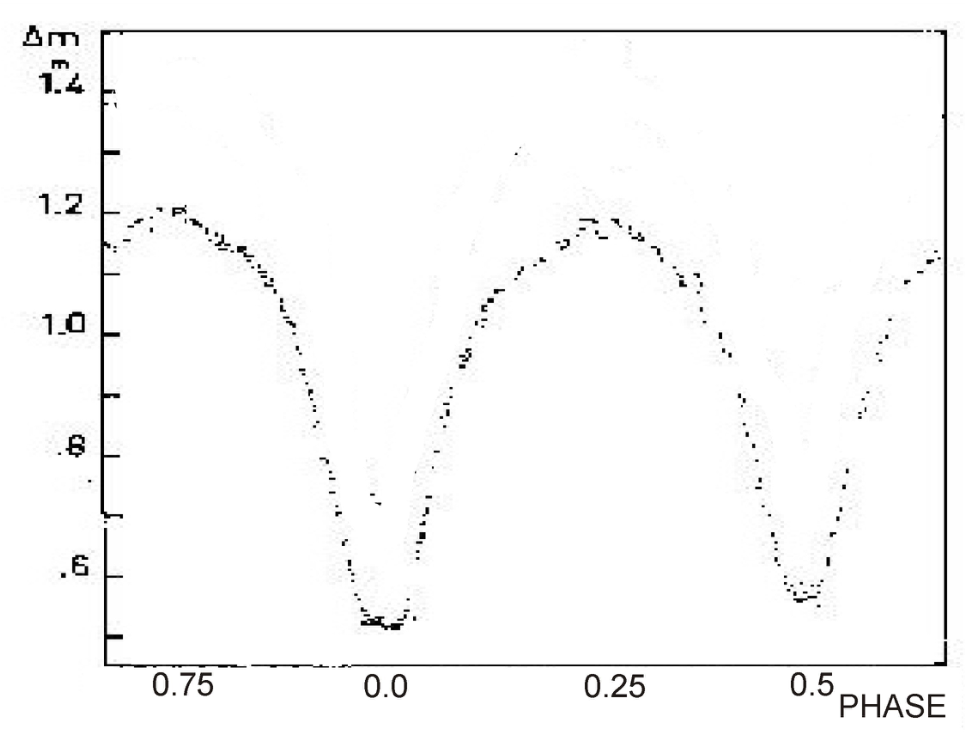
Figure 1 shows the light curve of the eclipsing binary V1107 Cas, classified as a W Ursae Majoris type.
Table 1 contains a list of observed minima of the light variation. The columns contain: the number of the minimum, the date on which the minimum was observed, the heliocentric time of minimum expressed in Julian days and an error (in fractions of a day).
| No. | Date of minimum (UT) | Time of minimum (Heliocentric JD) | Error |
|---|---|---|---|
| 1 | 22 December 2006 | 2 454 092.4111 | 0.0004 |
| 2 | 23 December 2006 | 2 454 092.5478 | 0.0002 |
| 3 | 23 September 2007 | 2 454 367.3284 | 0.0005 |
| 4 | 23 September 2007 | 2 454 367.4656 | 0.0005 |
| 5 | 15 October 2007 | 2 454 388.5175 | 0.0009 |
| 6 | 15 October 2007 | 2 454 388.6539 | 0.0011 |
| 7 | 26 August 2008 | 2 454 704.8561 | 0.0002 |
| 8 | 5 November 2008 | 2 454 776.4901 | 0.0007 |
| 9 | 3 January 2009 | 2 454 835.2734 | 0.0007 |
| 10 | 15 January 2009 | 2 454 847.3039 | 0.0004 |
| 11 | 15 January 2009 | 2 454 847.4412 | 0.0001 |
| 12 | 16 January 2009 | 2 454 847.5771 | 0.0004 |
Table 1: Observed times of minima of V1107 Cassiopeae
Using these data:
(a) Determine an initial period of V1107 Cas, assuming that the period of the star is constant during the interval of observations. Assume that observations during one night are continuous. Duration of the transit is negligible.
(b) Make what is known as an (O−C) diagram (for “observed − calculated”) of the times of minima, as follows: on the -axis put the number of periods elapsed (the “epoch”) since a chosen initial moment ; on the -axis the difference between the observed moment of minimum and the moment of minimum calculated using the formula (“ephemeris”):
where , the epoch, is exactly an integer or half-integer, and is the period in days.
(c) Using this (O−C) diagram, improve the determination of the initial moment and the period , and estimate the errors in their values.
(d) Calculate the predicted times of minima of V1107 Cas given in heliocentric JD occurring between 19h, 1 September 2011 UT and 02h, 2 September 2011 UT.
Решение
Внимание: Непълно решение
В архива няма официално решение на тази задача.
Оригинал в Архива: 2011_Data_Analysis.pdf