IOAA 2012, Анализ на данни, английски — Задача 1. Question 1
6th International Olympiad on Astronomy and Astrophysics, 04 to 14 August, 2012 - Rio de Janeiro - Brazil — Data analysis · 4 август 2012 г. · 13,5 т.
Условие
A few facts about photometry of asteroids:
Asteroids are small, irregularly shaped objects of our Solar System that orbit the Sun in approximately elliptical orbits.
Their brightness observed at a given instant from Earth depend on the surface area illuminated by the Sun and the part of the asteroid which is visible to the observer. Both vary as the asteroid moves.
The way the sunlight is reflected by the surface of the asteroid depends on its texture and on the angle between the Sun, the asteroid and the observer (phase angle), which varies as the Earth and the asteroid move along their orbits. In particular, asteroids with surfaces covered by fine dust (called regoliths) exhibit a sharp increase in brightness at phase angles close to zero (i.e., when they are close to the opposition).
Since the observed flux of any source decreases with the square of distance, the observed magnitude of an asteroid also depends on its distance from the Sun and from the observer at the time of the observation. Their apparent magnitude outside the atmosphere is then
where is usually called reduced magnitude (meaning the magnitude the asteroid would have if its distances from the Sun and the Earth were reduced both to 1 ) and depends only on the visible illuminated surface area and on phase angle effects. and are, respectivelly, the heliocentric and geocentric distances.
Consider now the following scenario. Light curves of a given asteroid were obtained at three different nights at different points of its orbit, and at each time a photometric standard was observed in the same frame of the asteroid. Table 1 shows the geometric configuration of the asteroid at each night (phase angle , in degrees, and in s), and the calibrated magnitude of the photometric standard star that was observed along with the asteroid. Consider the calibrated magnitude as the final apparent magnitude after all the effects are taken into account.
Tables 2, 3 and 4 contain, for each night, the time interval of each observation with respect to the first one (in hours) the air mass, the instrumental magnitude of the asteroid and the instrumental magnitude of the star.
Air mass is the dimensionless thickness of the atmosphere along the line of sight, and is equal to 1 when looking to zenith.
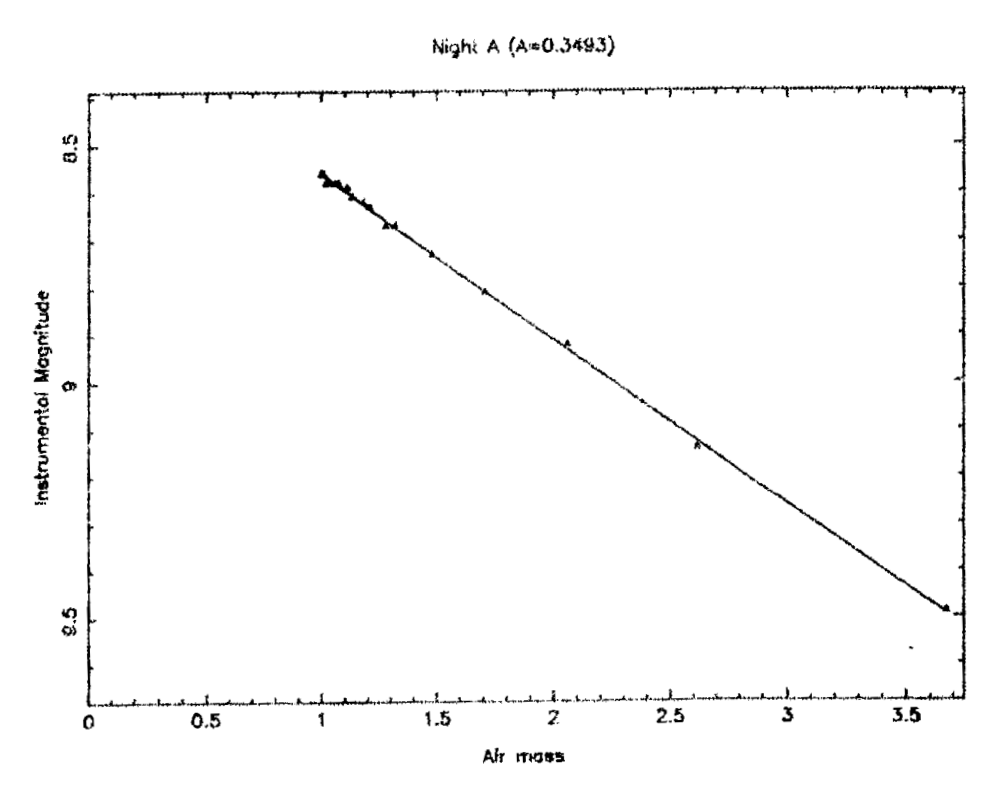
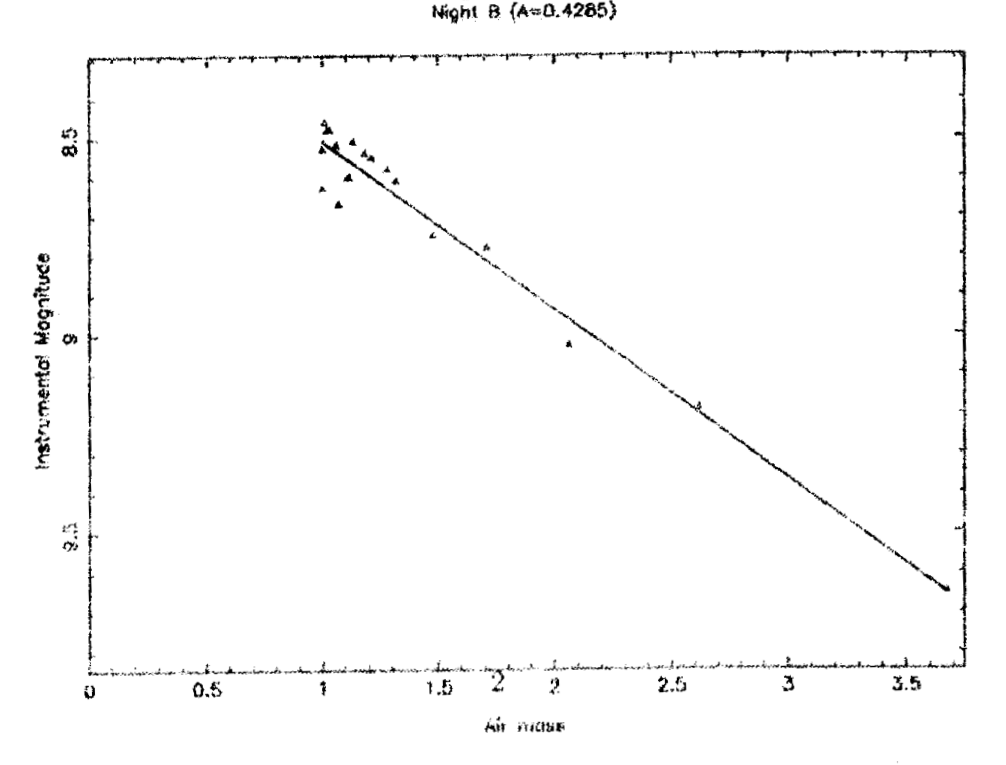
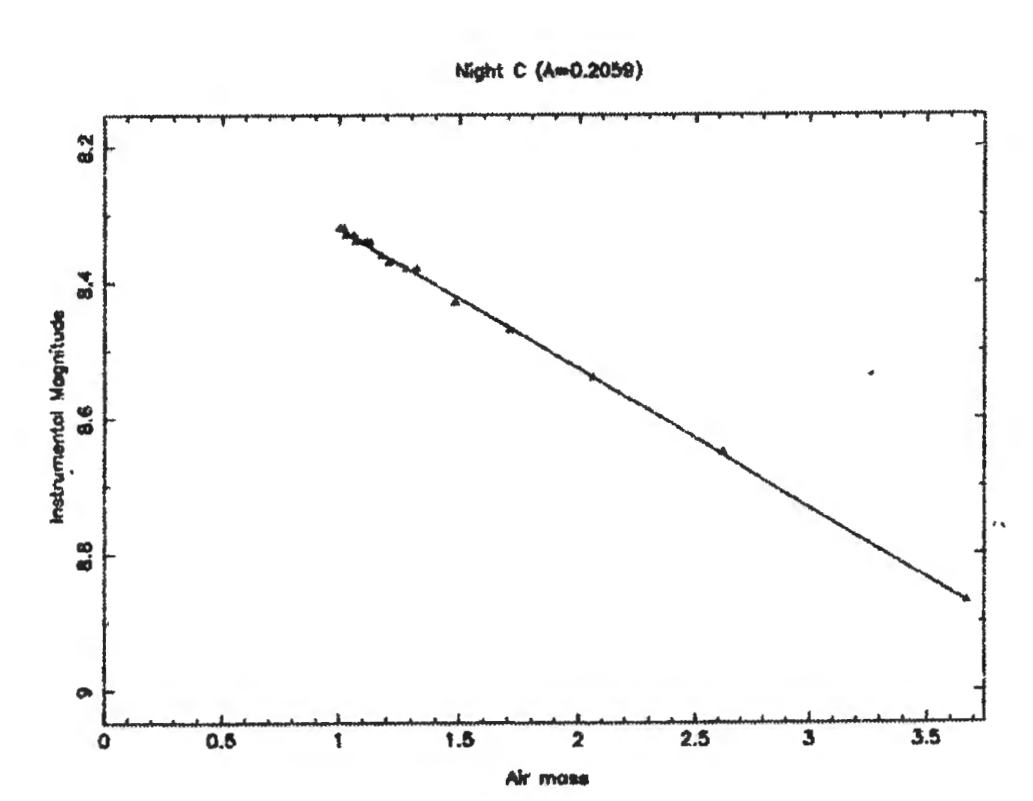
1. Plot the star magnitude versus air mass for each set [1,5 т.]
2. Calculate the extinction coefficient for each night (see Appendix A at the end of the text) [3 т.]
3. Were the observations affected by clouds in one night? Express your answer as: a) Night A, b) Night B, c) Night C, d) None of the nights. [0,5 т.]
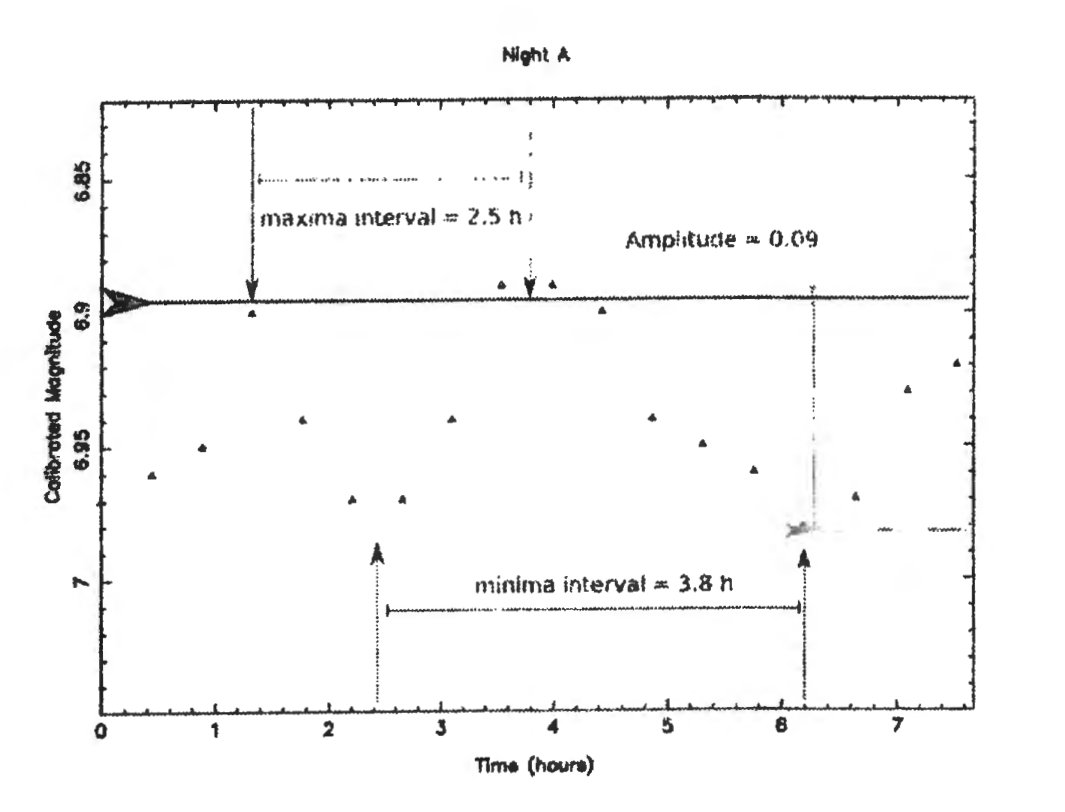
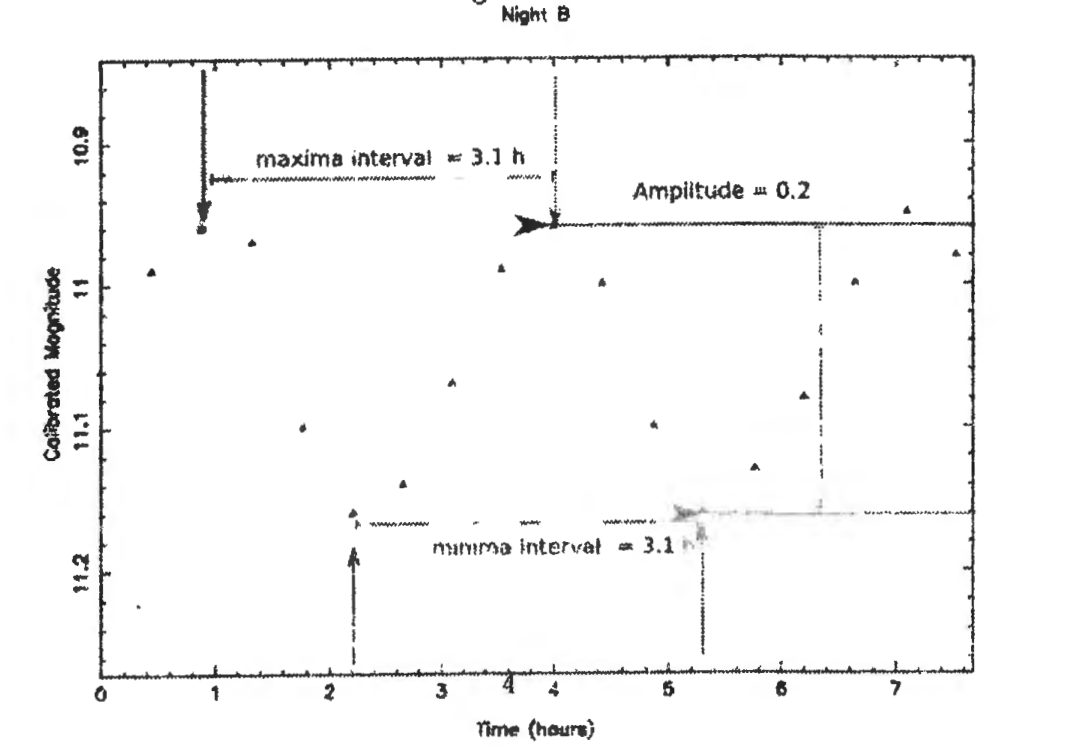
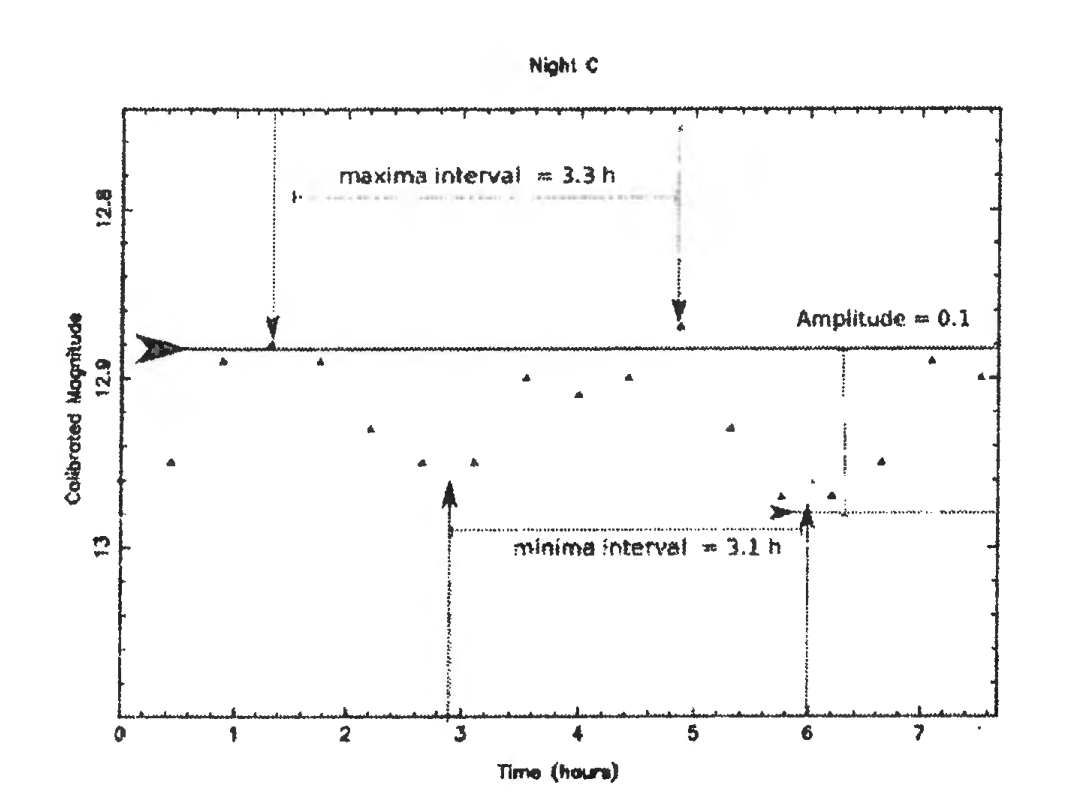
4. Plot the calibrated magnitude versus time for each set of observations of the asteroid (see Appendix B). [3 т.]
5. Determine the rotation period for each night. Consider that the light curve for this asteroid has two minima and two maxima, and that the semi-period is the average of the intervals between the two maxima and the two minima. [1,5 т.]
6. Determine the amplitude (difference from maximum to minimum) of the light curve for each night [1,5 т.]
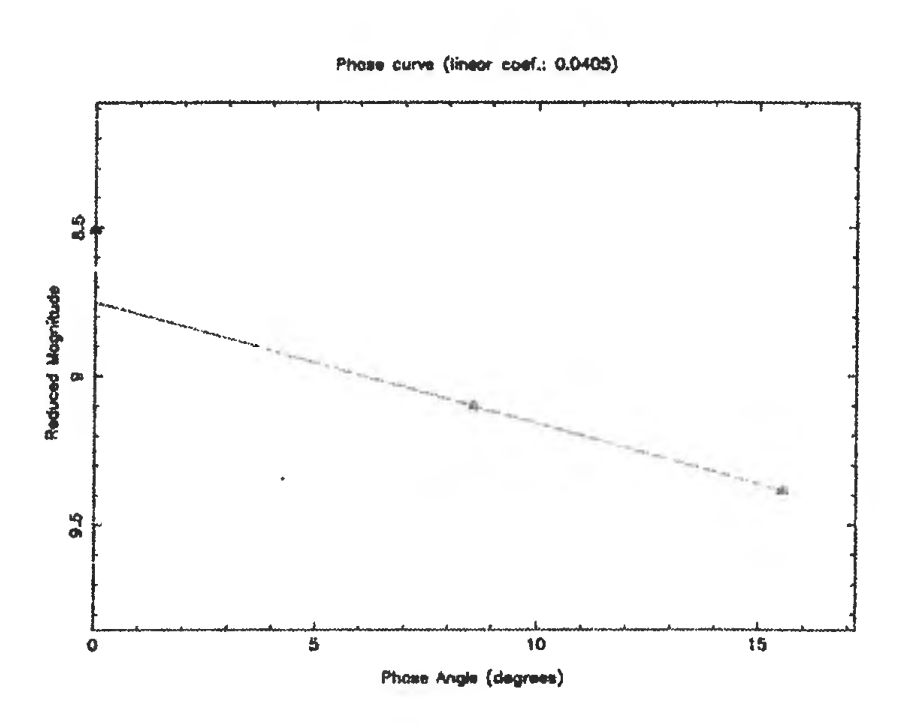
7. Plot the calibrated reduced magnitude M versus phase angle (use the mean value of each light curve) [1,5 т.]
8. Calculate the angular coefficient of the phase curve (the plot of the calibrated reduced magnitude versus the phase angle) considering only the points away from the opposition (See 3 bullet of facts about photometry of asteroids above) [0,5 т.]
9. Is there any reason to assume a surface covered by fine dust (regolith)? Answer YES/NO. [0,5 т.]
Table 1
| Night | D | R | φ | M |
|---|---|---|---|---|
| A | 0.36 | 1.35 | 0.0 | 8.2 |
| B | 1.15 | 2.13 | 8.6 | 8.0 |
| C | 2.70 | 1.89 | 15.6 | 8.1 |
Table 2: Night A
| Δt | Air mass | m | m |
|---|---|---|---|
| 0.00 | 1.28 | 7.44 | 8.67 |
| 0.44 | 1.18 | 7.38 | 8.62 |
| 0.89 | 1.11 | 7.34 | 8.59 |
| 1.33 | 1.06 | 7.28 | 8.58 |
| 1.77 | 1.02 | 7.32 | 8.58 |
| 2.21 | 1.00 | 7.33 | 8.56 |
| 2.66 | 1.00 | 7.33 | 8.56 |
| 3.10 | 1.01 | 7.30 | 8.56 |
| 3.54 | 1.03 | 7.27 | 8.58 |
| 3.99 | 1.07 | 7.27 | 8.58 |
| 4.43 | 1.13 | 7.31 | 8.61 |
| 4.87 | 1.21 | 7.37 | 8.63 |
| 5.31 | 1.32 | 7.42 | 8.67 |
| 5.76 | 1.48 | 7.49 | 8.73 |
| 6.20 | 1.71 | 7.59 | 8.81 |
| 6.64 | 2.06 | 7.69 | 8.92 |
| 7.09 | 2.62 | 7.87 | 9.14 |
| 7.53 | 3.67 | 8.21 | 9.49 |
Table 3: Night B
| Δt | Air mass | m | m |
|---|---|---|---|
| 0.00 | 1.28 | 13.24 | 8.38 |
| 0.44 | 1.18 | 13.21 | 8.36 |
| 0.89 | 1.11 | 13.13 | 8.34 |
| 1.33 | 1.06 | 13.11 | 8.33 |
| 1.77 | 1.02 | 13.11 | 8.32 |
| 2.21 | 1.00 | 13.15 | 8.32 |
| 2.66 | 1.00 | 13.17 | 8.32 |
| 3.10 | 1.01 | 13.17 | 8.32 |
| 3.54 | 1.03 | 13.13 | 8.33 |
| 3.99 | 1.07 | 13.15 | 8.34 |
| 4.43 | 1.13 | 13.14 | 8.34 |
| 4.87 | 1.21 | 13.14 | 8.37 |
| 5.31 | 1.32 | 13.21 | 8.38 |
| 5.76 | 1.48 | 13.30 | 8.43 |
| 6.20 | 1.71 | 13.34 | 8.47 |
| 6.64 | 2.06 | 13.39 | 8.54 |
| 7.09 | 2.62 | 13.44 | 8.65 |
| 7.53 | 3.67 | 13.67 | 8.87 |
Table 4: Night C
| Δt | Air mass | m | m |
|---|---|---|---|
| 0.00 | 1.28 | 11.64 | 8.58 |
| 0.44 | 1.18 | 11.53 | 8.54 |
| 0.89 | 1.11 | 11.56 | 8.60 |
| 1.33 | 1.06 | 11.49 | 8.52 |
| 1.77 | 1.02 | 11.58 | 8.48 |
| 2.21 | 1.00 | 11.79 | 8.63 |
| 2.66 | 1.00 | 11.67 | 8.53 |
| 3.10 | 1.01 | 11.53 | 8.46 |
| 3.54 | 1.03 | 11.47 | 8.48 |
| 3.99 | 1.07 | 11.63 | 8.67 |
| 4.43 | 1.13 | 11.51 | 8.51 |
| 4.87 | 1.21 | 11.65 | 8.55 |
| 5.31 | 1.32 | 11.77 | 8.61 |
| 5.76 | 1.48 | 11.88 | 8.75 |
| 6.20 | 1.71 | 11.86 | 8.78 |
| 6.64 | 2.06 | 12.03 | 9.03 |
| 7.09 | 2.62 | 12.14 | 9.19 |
| 7.53 | 3.67 | 12.63 | 9.65 |
Appendix A: extinction coefficients
The magnitude outside the atmosphere is given by:
where is the extinction coefficient and is the zero point coefficient for the night, is the airmass of the observation and is the instrumental magnitude (that is, the magnitude obtained directly from the image)
Appendix B: calibrated differential magnitude
If the standard star is the same frame as the object, the calibrated magnitude of the object can be obtained by:
Appendix C: least squares estimation of angular coefficients
Given straight lines described by
the least squares estimator of is given by
Отговори
2. See Fig. 1-3.
3. b) Night B
6. Night A: 0.09; Night B: 0.2; Night C: 0.1
Read from the official solution plots (Figures 4–6).
8. 0.0405
Read from the title of official solution Figure 7 (linear coef.: 0.0405), in magnitudes per degree.
9. Yes
Решение
Pontuation
- 1 : 1.5 (0.5 each plot)
- 2 : 3.0 (1 each coefficient)
- 3 : 0.5
- 4 : 3.0 (1 each plot)
- 5 : 1.5 (0.5 each)
- 6 : 1.5 (0.5 each)
- 7 : 1.5
- 8 : 0.5
- 9 : 0.5
Answers:
- Itens 1,2 See Fig. 1-3.
- Item 3: Night B
- Itens 4,5,6 See Fig. 4-6.
- Itens 7,8 See Fig. 7.
- Item 9 Yes
Оригинал в Архива: DataAnalysisFINAL.doc · официални решения: DataAnalysis_Solutions.pdf