8th IOAA · Preliminary data analysis · Extra solar tests · 50 т.
Внимание: Бележка към темата
This is the archived preliminary whole Problem 3, with Parts A and B together. The final photographed exam separates thermodynamics into Problem 2 and replaces the seven-star Big Dipper data with a four-star Mizar table in Problem 3. The preliminary edition and its complete supplied key are preserved separately; source calculation discrepancies are retained.
Условие
A. Thermodynamic test
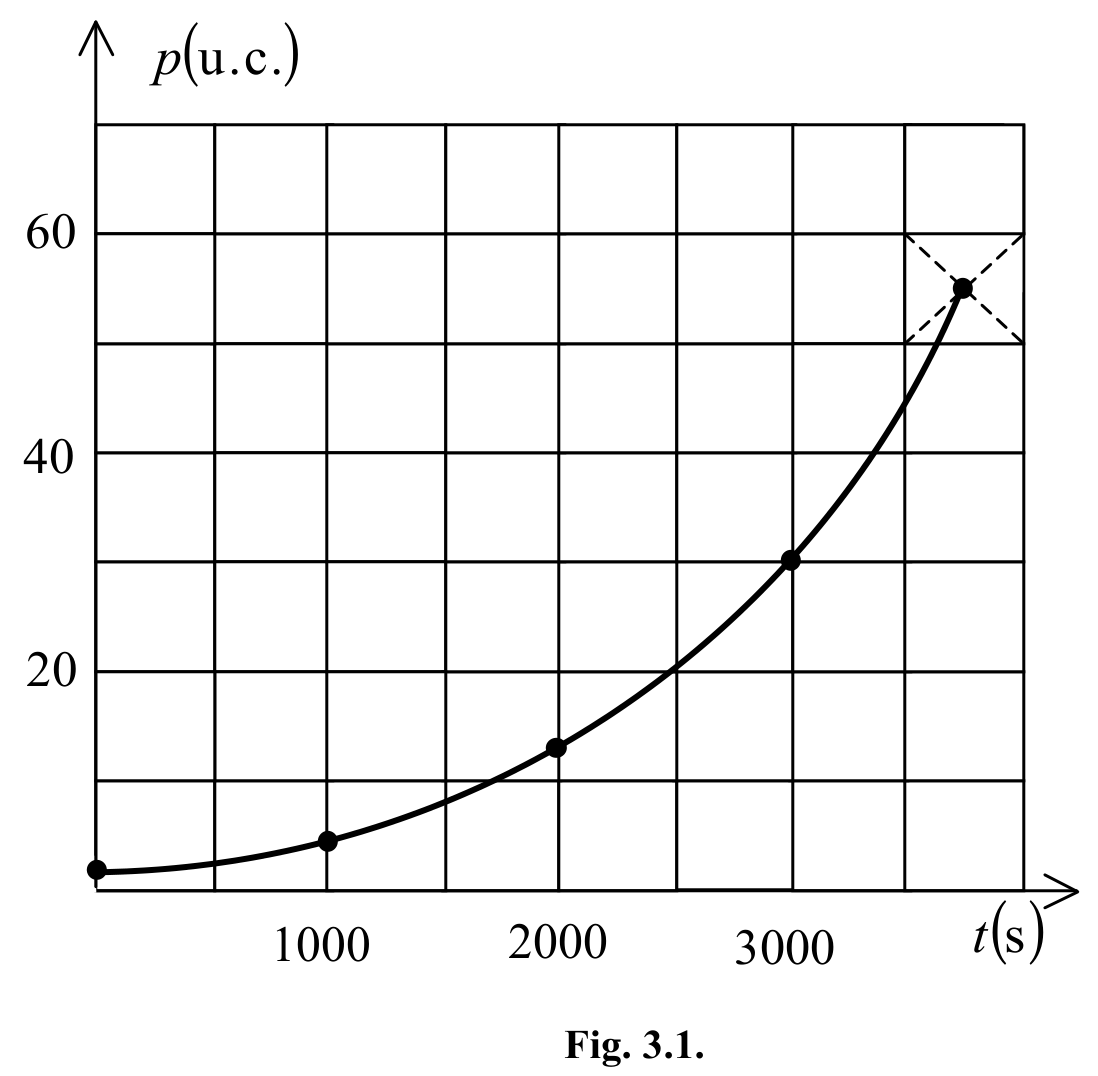
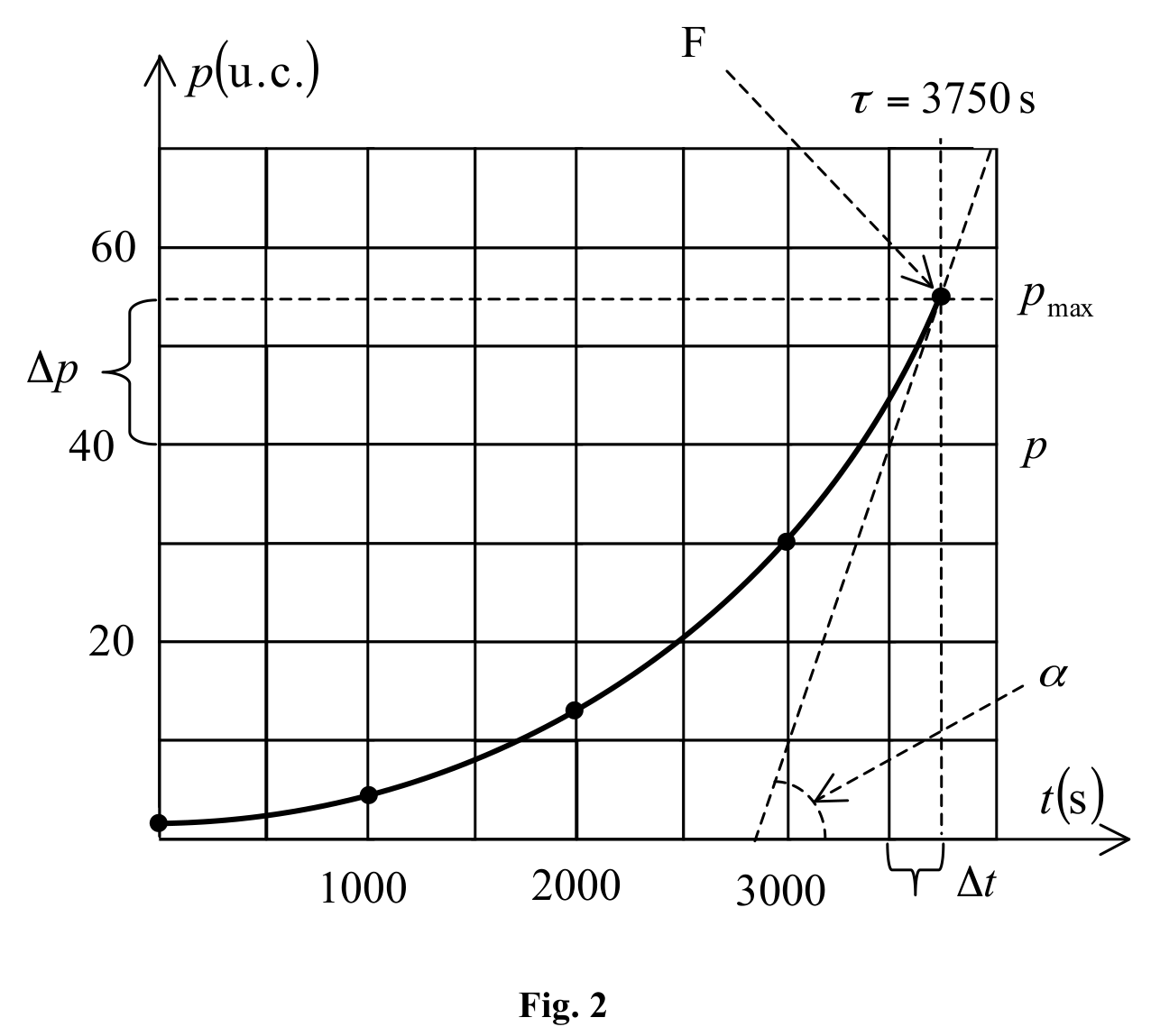
A shuttle was launched to investigate the CO2 atmosphere of two planets P1 and P2. When the shuttle was near the each planet, a radio probe was launched toward each of the planet, in vertical direction (the planet radius direction). When the radio-probe movement becomes uniform, it starts sending values of the pressure of the atmosphere. In fig. 3.1 was plotted the atmospheric pressure values (conventional units) of the planet P1 as function of the time of descending. When the probe touched the surface of the planet P1 it sends the value of the temperature T0=700K and respectively the value of gravitational acceleration g0=10ms−2.
Fig. 3.1. Pressure versus descent time on P₁.
a Find out the altitude h0 from where the radio-probe R1 starts the uniform descending and thus starts the transmitting information.
b Find out the temperature of the planet P1 at the altitude h=39.6km. You know: The universal gas constant R=8.3J/molK; the molar mass of CO2, μ=44g/mol.
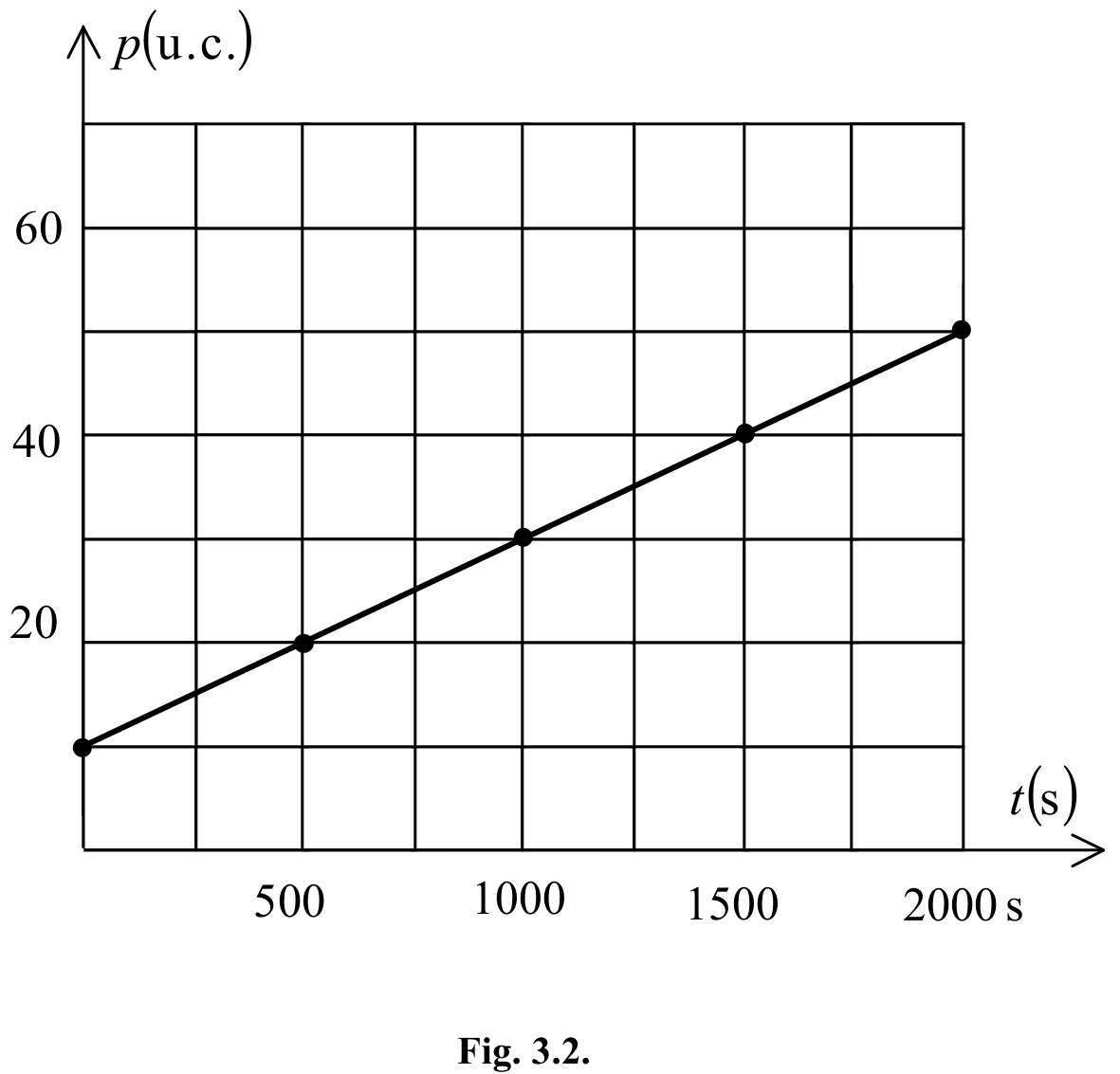
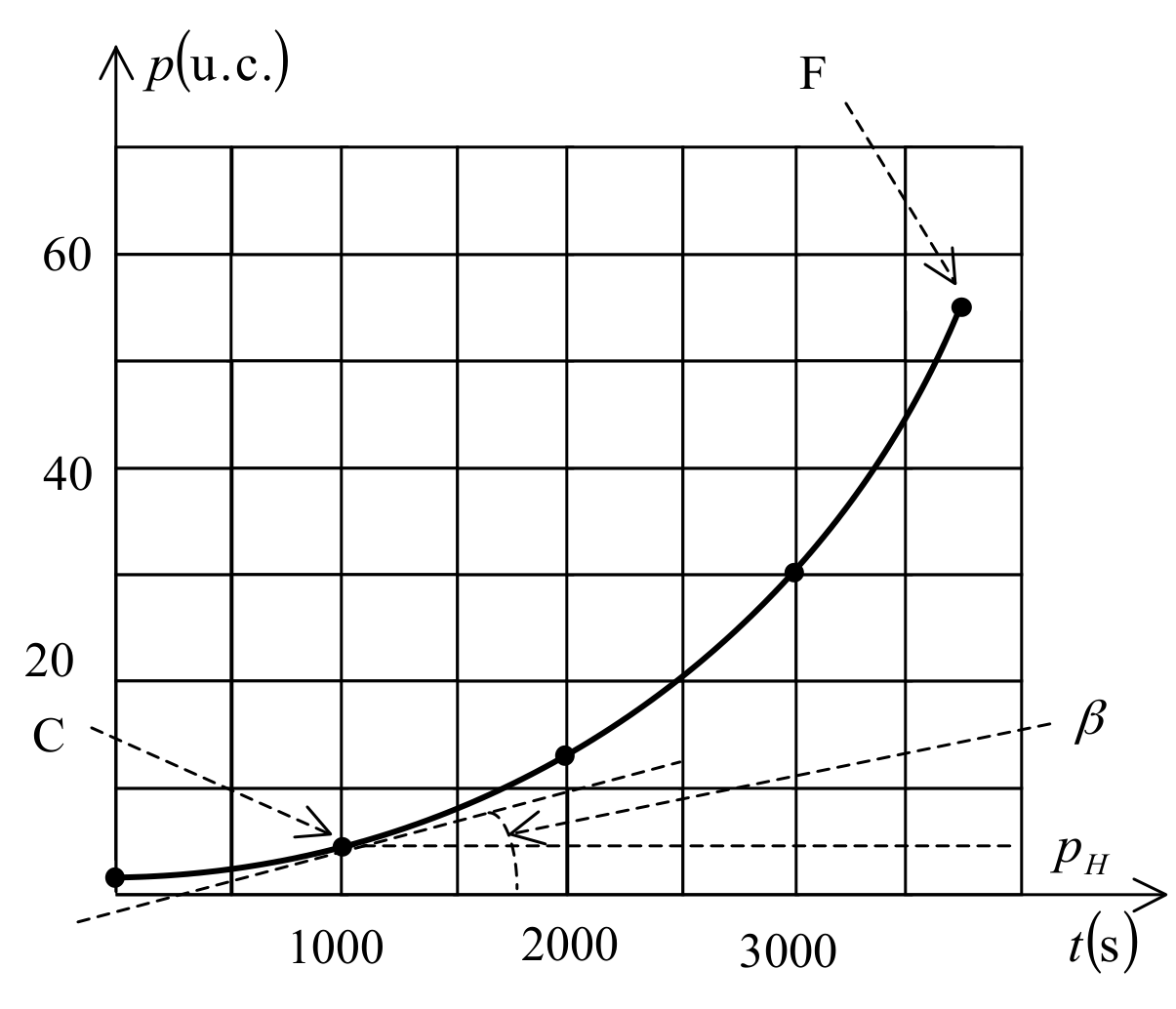
c In fig. 3.2. was plotted the atmospheric pressure values (conventional units) as function of the time of descending in the planet P2 atmosphere. When the probe touched the surface of the planet P2, it sends the value of the temperature T0=750K and respectively the value of gravitational acceleration g0=8ms−2.
Draw the following dependency graphs for p=f(h) and T=f(h) in the CO2 atmosphere of the planet P2.
The gravitational acceleration on each planet is constant during uniform descending of the radio-probes.
Fig. 3.2. Pressure versus descent time on P₂.
B. Observer on an extrasolar star
The Sirius star, located in the Canis Majoris constellation is the brightest star which can be observed on the sky with naked eye. What the observer's eye see as a single star is in matter of fact a binary star system.
The luminosity of Sirius is a consequence of two facts: its intrinsic luminosity and its closeness to Earth.
Let's assume that an observer is located on one of the planets of the Sirius system.
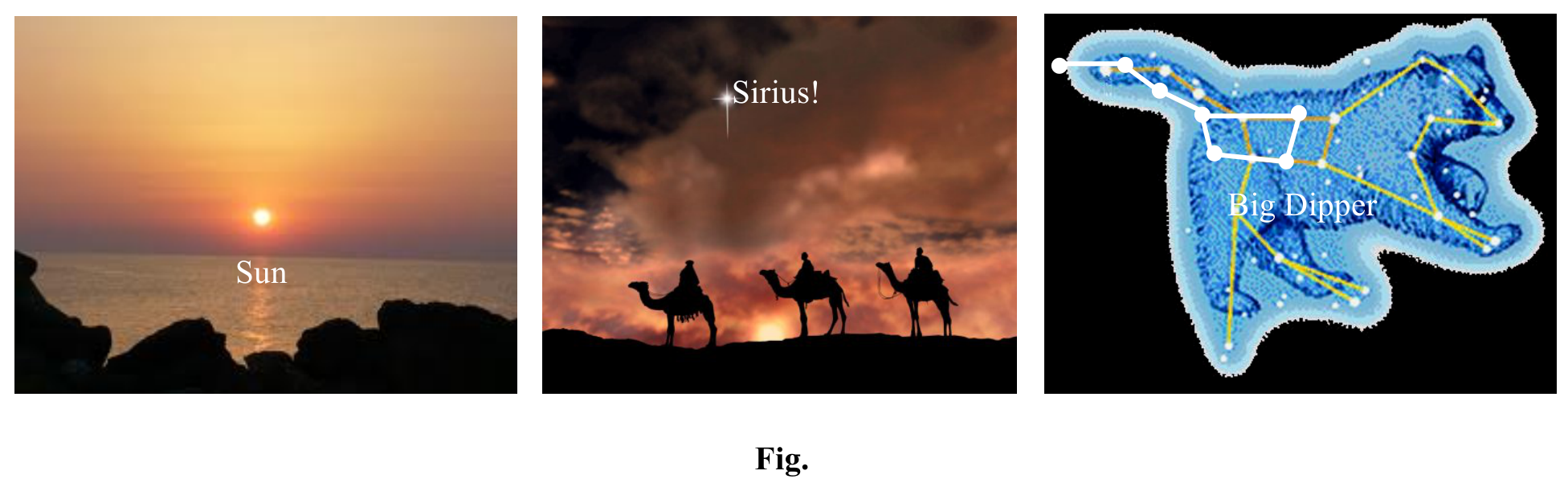
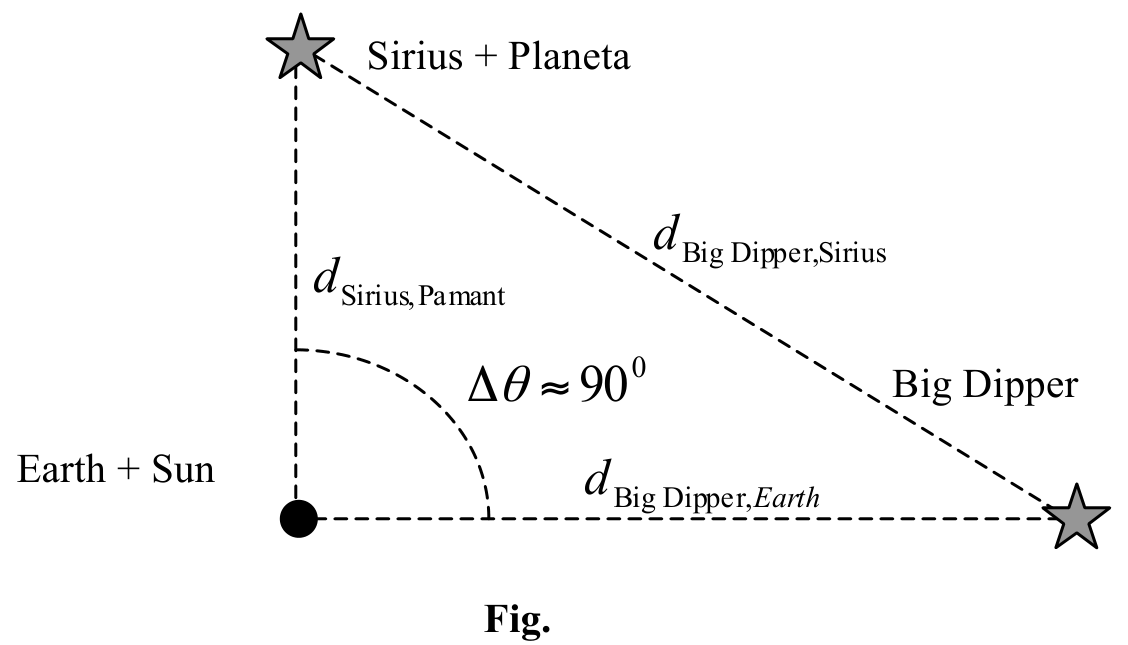
In the figure below there are represented the Sun, Sirius and the Big Dipper asterism from Ursa Major constellation.
Original illustration: Sun, Sirius and Big Dipper.
Determine:
a The magnitude of Sun as seen from the observer from the planet of Sirius mSun,Planet.
b The magnitude of Sirius star system seen by the observer on one of the planets of Sirius, mSY,Planet.
c The luminosity luminozitatea of “Big Dipper”, LBig Dipper;
d the distance between Big Dipper and Earth,
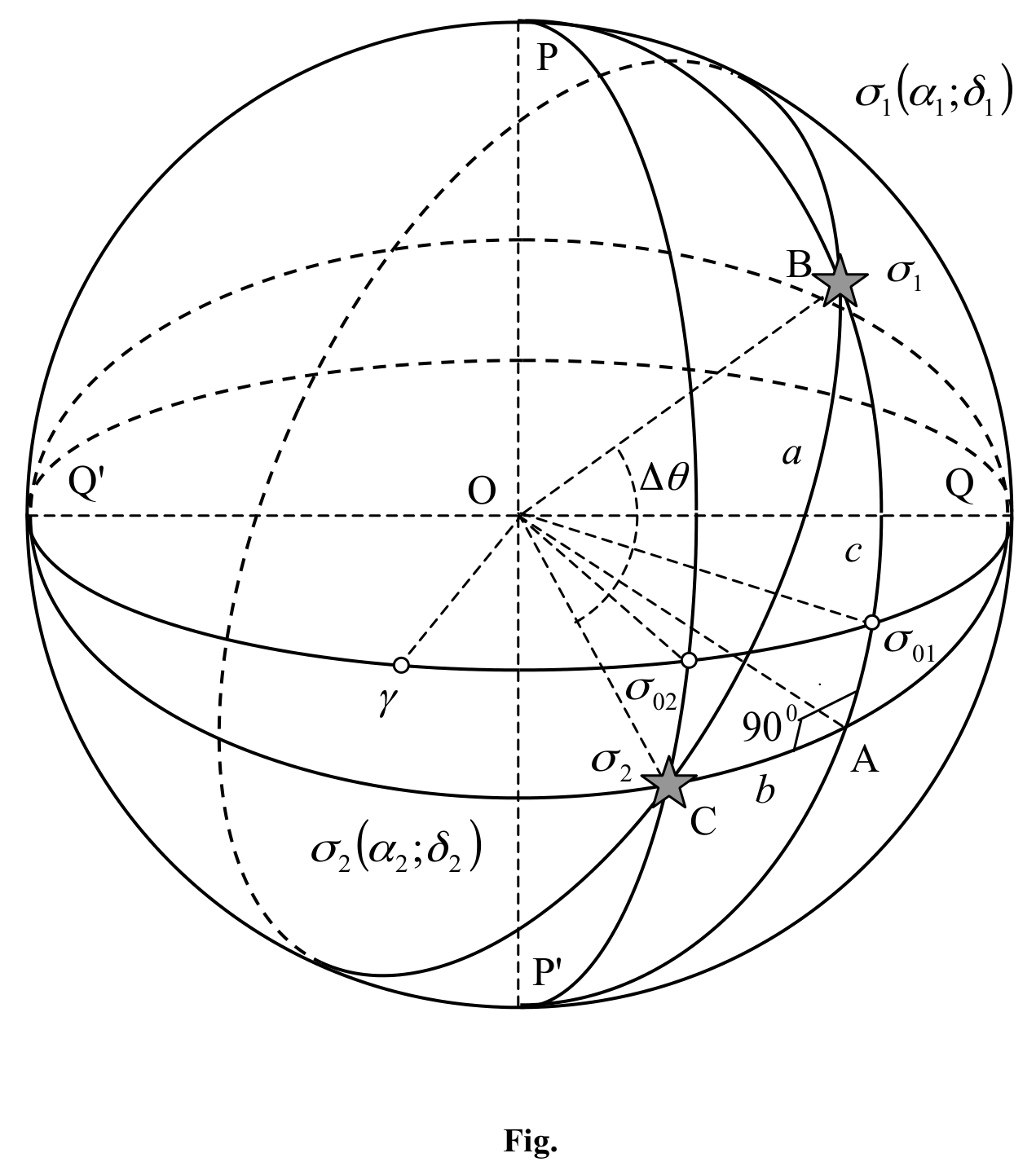
e The geocentric angular distance between Big Dipper and Sirius, Δθ;
f The distance between Big Dipper and the observer from the planet of Sirius dBig Dipper,Planet;
g The magnitude of Big Dipper as seen by the observer from the planet of Sirius mBig Dipper,Planet
Data for B
The following data are given:
dSirius,Earth=2.6pc – the Sirius–Earth distance;
mSirius,Earth=−1.46m – the apparent magnitude of Sirius measured from Earth;
LSirius=25LSun – the luminosity of Sirius;
dSun,Earth=1AU – distance Sun–Earth;
mSun,Earth=−26.78m – the apparent magnitude of Sun seen from Earth;
dSirius,Planet=10AU – the distance between Sirius and its planet where the observer is located;
mBig Dipper,Pamant≈2m – the apparent magnitude of the Big Dipper asterism for an observer from Earth.
In the table bellow there are information for the stars from Big Dipper asterism regardless to an observer on Earth.
Star number
Name of the star
Apparent magnitude
Distance (light year)
1
Dubhe
1.8
124
2
Merak
2.4
79
3
Phecda
2.4
84
4
Megrez
3.3
58
5
Alioth
1.8
81
6
Mizar
2.1
78
7
Alkaid
1.9
101
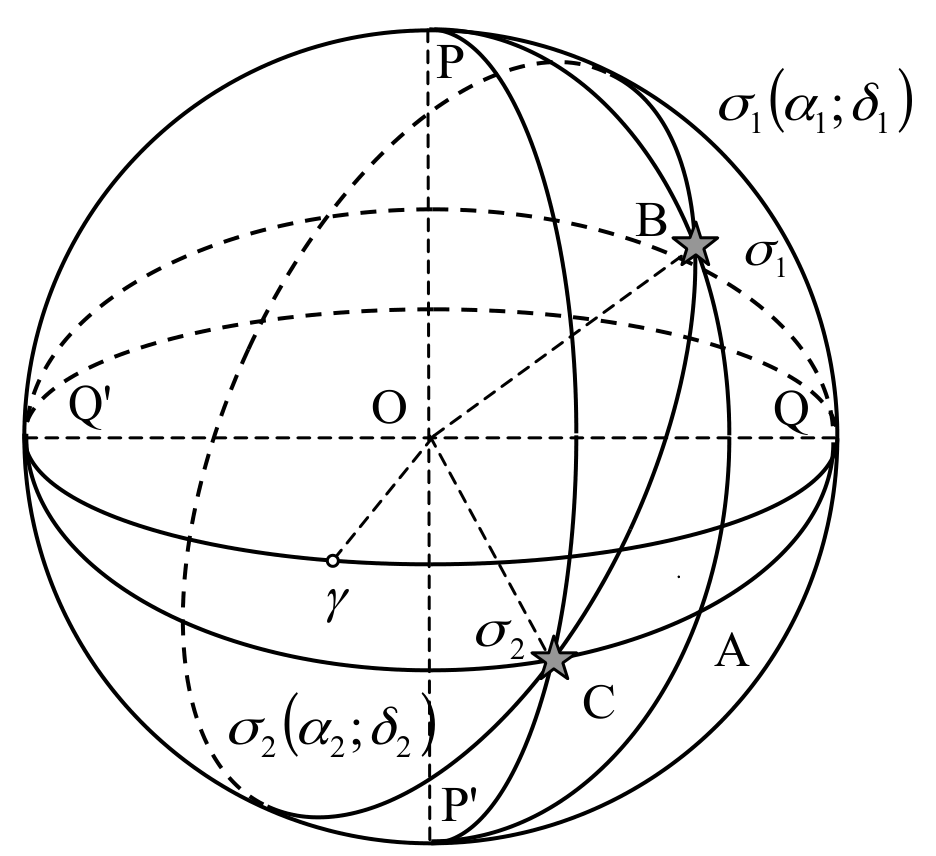
The equatorial of Big Dipper (σ1) asterism and respectively of Sirius (σ2), located on the geocentric map are:
Original geocentric celestial sphere and coordinate labels.
Решение
Official preliminary Problem 3 marking schemes: Part A 25 points and Part B 25 points. Original numerical and notational inconsistencies remain visible in the transcription.
A. Thermodynamic test
Marking scheme: a) 5 points, b) 10 points, c) 10 points.
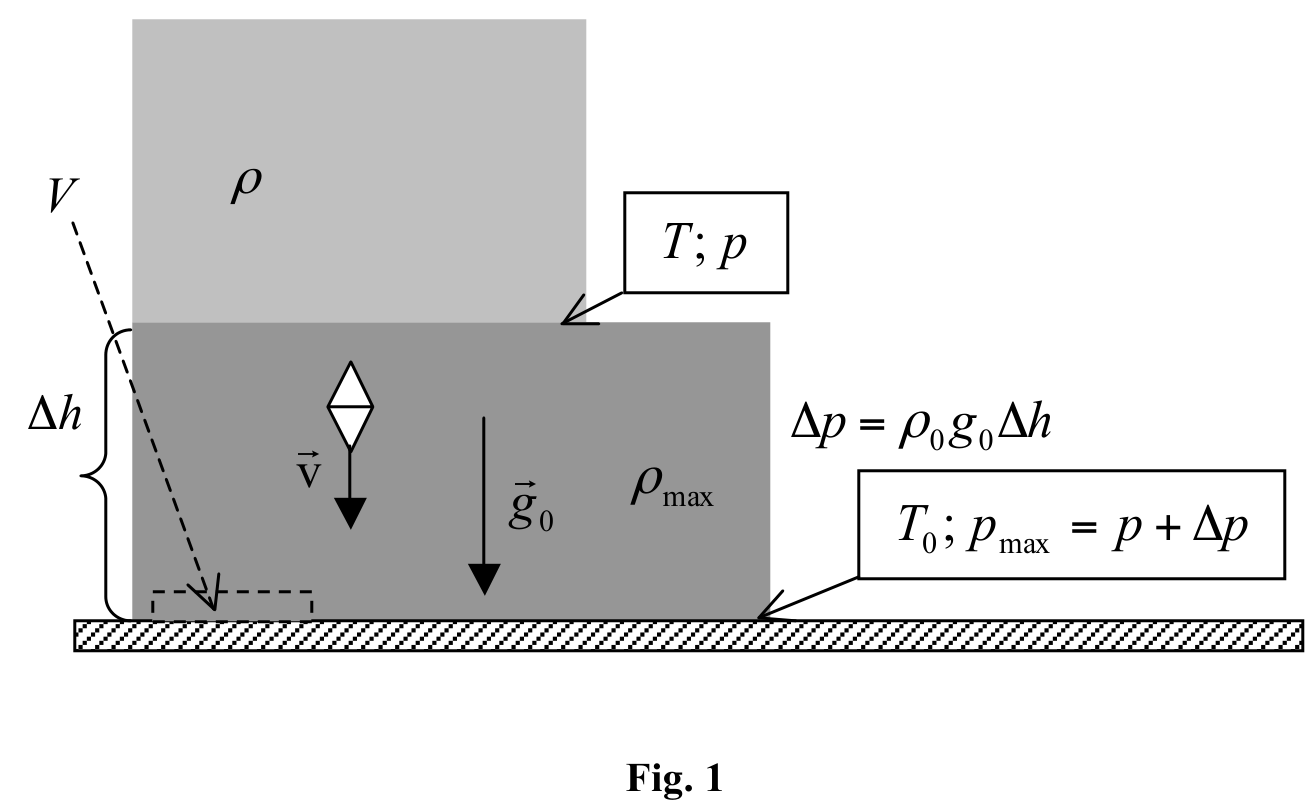
a The pressure and the density of the atmosphere increase with the decrease of the altitude. The pressure at the surface of the planet is pmax.
In figure 1 is represented a thin atmospheric layer with thickness Δh near the surface of the planet P1 where the atmosphere density can be considered ρmax. Inside this layer the pressure and the temperature are variable, reaching the values pmax and T0 near the surface.
Fig. 1. Thin atmospheric layer and pressure difference.
The following relations can be written :
pmax=p+Δp;
Δp=ρmaxg0Δh,
Δp - the variation of the pressure due to the altitude variation Δh, g0 the gravitational acceleration near the surface of planet P1;
Δh=ρmaxg0Δp.
The superior layer where the density is constant ρ is represented too. At its base the pressure and temperature have the values p and respectively T.
For a gas volume inside the near surface layer of the atmosphere,near the surface of the planet for ν mol of de gas according with Mendeleev – Klapeyron law
pmaxV=νRT0=μmRT0;
pmaxμ=VmRT0=ρmaxRT0;
ρmax=RT0pmaxμ.
Just before touching the surface of the planet P1 the radio- probe moves uniformly, so the distance Δh is spend with speed v, in time Δt :
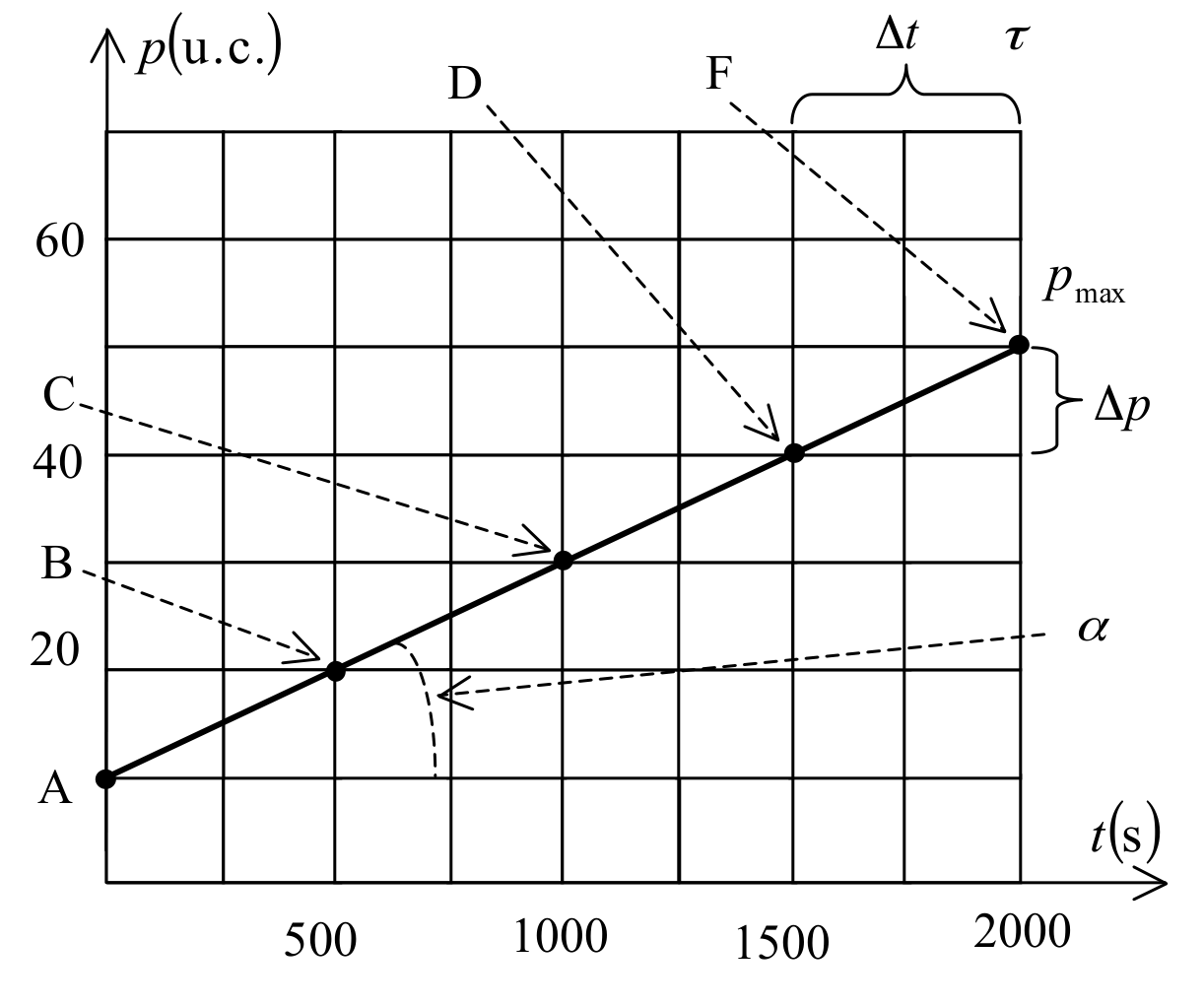
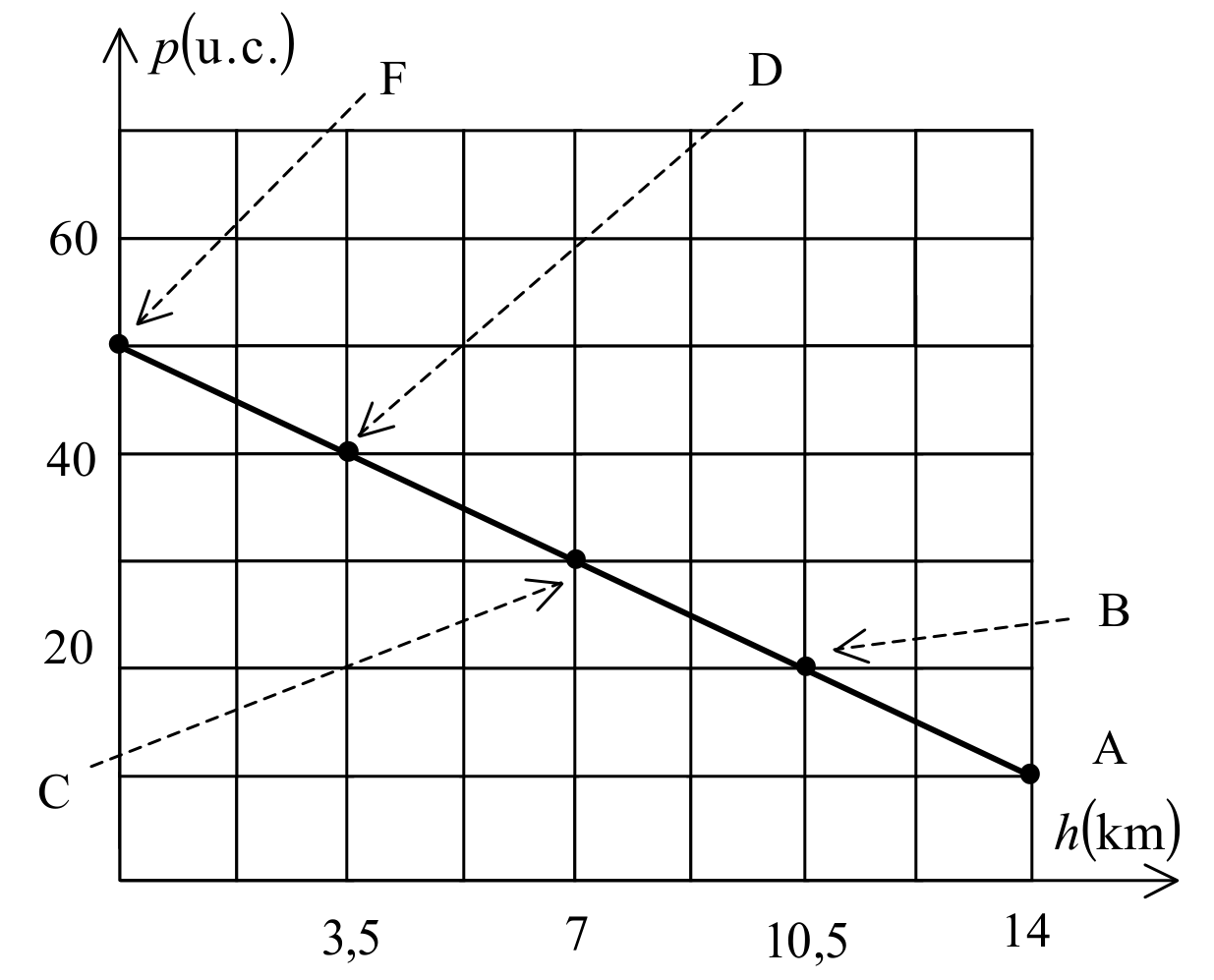
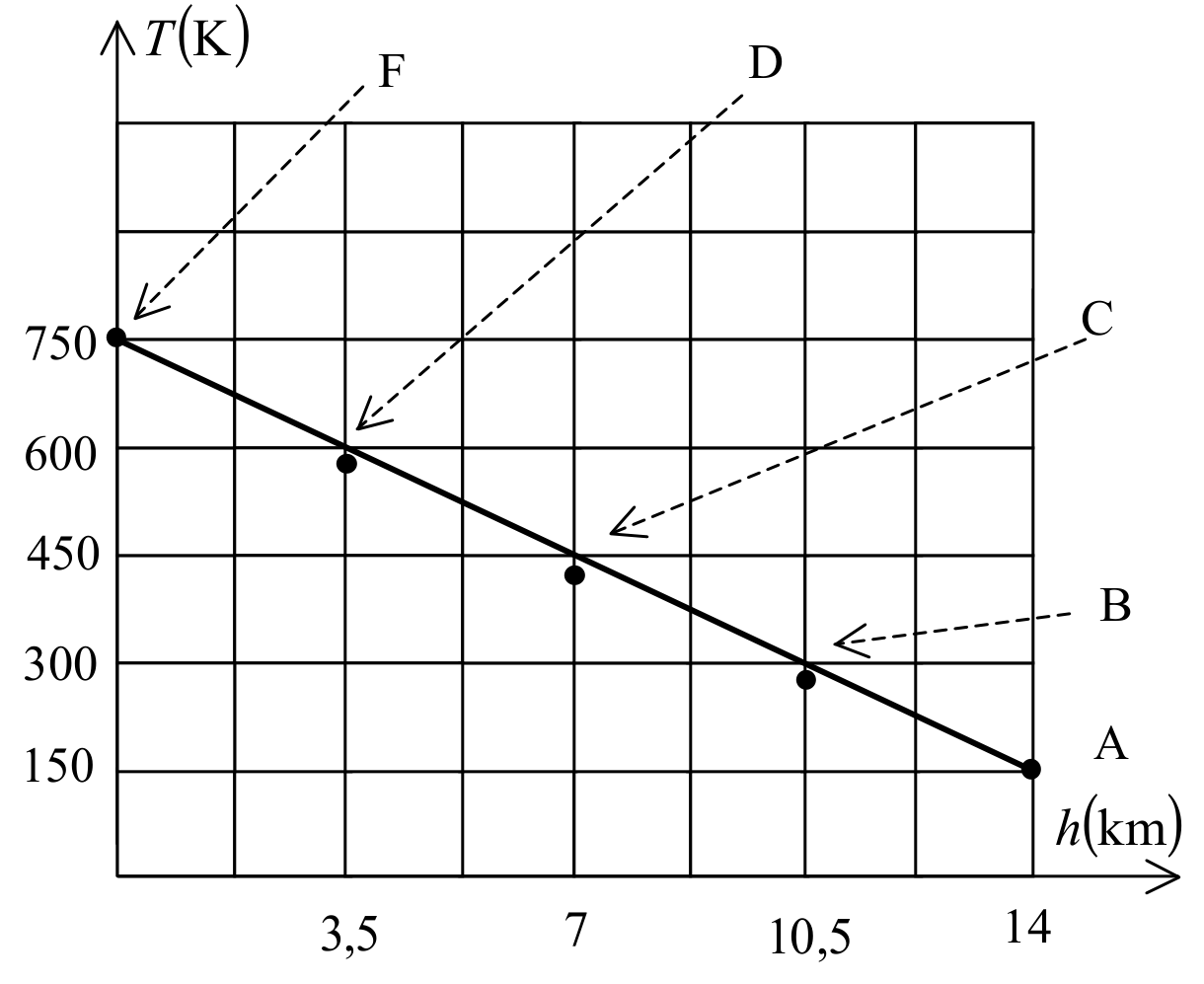
The data are in table below which allows to plot de graph p=f(h) and T=f(h) for planet P2 figure 5 and figure 6.
t
0
500 s
1000 s
1500 s
2000 s
p
10 u.c.
20 u.c.
30 u.c.
40 u.c.
50 u.c.
h
14 km
10,5 km
7 km
3,5 km
0
T
148,4 K
296,8 K
445,3 K
593,3 K
750 K
Fig. 5. Pressure versus altitude, from the official key.Fig. 6. Temperature versus altitude, from the official key.
B. Observer on an extrasolar star
Marking scheme: a) 3, b) 3, c) 4, d) 4, e) 4, f) 3, g) 4 points; total 25 points. All printed intermediate numbers and source discrepancies are retained.
a The magnitude of the SUN as seen from the observer on the Sirius planet:
Source notes: the printed luminosities and their sum, angular formula, unit mark after 55.5 in the right-ascension subtraction, declination approximation and angular result are retained. They contain inconsistencies; these are the original key's calculations, not corrected answers.